Tag Archives: books

Filling the Market Void: Why the E-Reader is not the End of the World


Some of the more literary types in my life (I am an English major so there are a quite a few of these) have been lamenting the demise of the good-old-paper-book since the very first e-readers appeared on Christmas lists. I cannot assuage the material frets of such people (What will hipsters put in their wedding photos if not piles of old books?), and it does seem sort of inevitable that paper books will go the way of vinyl. But as a movement in literature (if not material aesthetics), the e-reader does not worry me as much as it does some, who say that the Kindle and the Nook aren’t only the demise of nice-looking books but the quality of writing and fiction in general, touting the mass of self-published books and the hypothetically lower standards of publishers and editors.

There will always be a world of literature that is distinguished from books written and sold purely for entertainment, just as there will always be films made that are distinct from Hallmark TV movies, even though the same medium is being used to create the two things. This is the world that I am commenting on. The distribution of entertainment has always been fairly automatic – whatever medium is most popular will be used to make the most profit. Yaay, capitalism. There probably isn’t anything intrinsically wrong with this, but it’s important to remember that the hordes of paperbacks on the shelves in Walmart are not the front-runners of what’s being published right now – the most currently popular art will not necessarily be the most enduring.

Any media change creates a market void, and this medium is going to change, which means that there’s going to be a new horde of mediocre (and bad) material produced. I think that society tends to judge media change as culture-killing (or satanic or elitist or antielitist or condemning adjective of the day) (this generally only applies to media changes brought on by those in a younger age cohort than the complainer) and point to the “clear evidence” of the new medium’s depravity: the slew of obviously artistically empty new entertainment. But the fact is that artistically empty (unedifying, depraved, what have you) entertainment is like a cultural given – it has and will always exist. But I think that [maybe not all but at least some] humans are never going to fail to be surprisingly and inspiringly creative.

Barnes and Noble Partners with Wayfair.com, World Becomes a Sadder Place

Barnes and Noble: now your source for superfluously shiny things

Barnes and Noble will now be selling, among other things, popcorn makers, vacuum cleaners, and dehumidifiers via their website. The former sanctuary of all things book-related has prostituted itself out, it seems, to Wayfair, an online retailer. I may represent a non-objective opinion while relaying this information.

Wayfair is one of those frightening oh-my-gosh-we-sell-fricking-everything (like seven different types of bread boxes everything) websites where everything is in Helvetica (I watched that movie and am now a temporary font snob1) but all of the products elicit the same creepy feeling one gets from the idea of ordering cookies from magazines or packages of prepared meals from dieting programs. The kind of website that offers an ice bucket shaped like a crown for $517.49 and a Wonderbread plastic sandwich box for $3.99. That has 101 search results for the words “tissue box covers”.

So I weep for you, Barnes and Noble. I know that you were doing that thing where you tout overpriced polka-dotted notebooks under “Designed Exclusively for Barnes and Noble by [vaguely exotic name],” and I know that you were doing that thing where you partnered with Godiva, but at least the stationary was book-related and the chocolate was delicious. But furniture? Infomercial cookware? Who is going to buy their thermostat from Barnes and Noble, I ask you?2

I’m sure that there’s a grand marketing scheme going on here, and that by all calculations this will probably be a profitable move for Barnes and Noble, or the deal they struck with Wayfair was a steal enough for them to cut their losses if it doesn’t work. But the idea of like the internet-aged Wells Fargo catalogue just doesn’t make sense. Amazon and Walmart did not spend the majority of their retailing lifespans dedicated to a single item like you have, Barnes and Noble. Do not think that you can become them. You can’t. Borders is even gone, and you were doing way better than them anyways, on the internet front – you started earlier than they did and handled it a lot more classily (til now, that is). You kind of have the Nook thing going on, and if you get your act together on that front instead of diversifying your attention away, you could actually continue to matter in that market. Don’t let Amazon get you down!

Remember when you used to at least pretend like you were a friendly bookstore instead of a gigantic, impersonal corporation? You’re definitely failing at that with this move. I will just be interested to see what making yourself an unspecified and abstract retailer does to your customer loyalty.

1 I’m not even sure if the website’s font actually IS Helvetica, but it’s something trying to look Swedish, I can tell you that much

2 Weird upper-middle class people with too much mascara and blonde hair, that’s who, I’m pretty sure.

The People’s Library of Occupy Wall Street

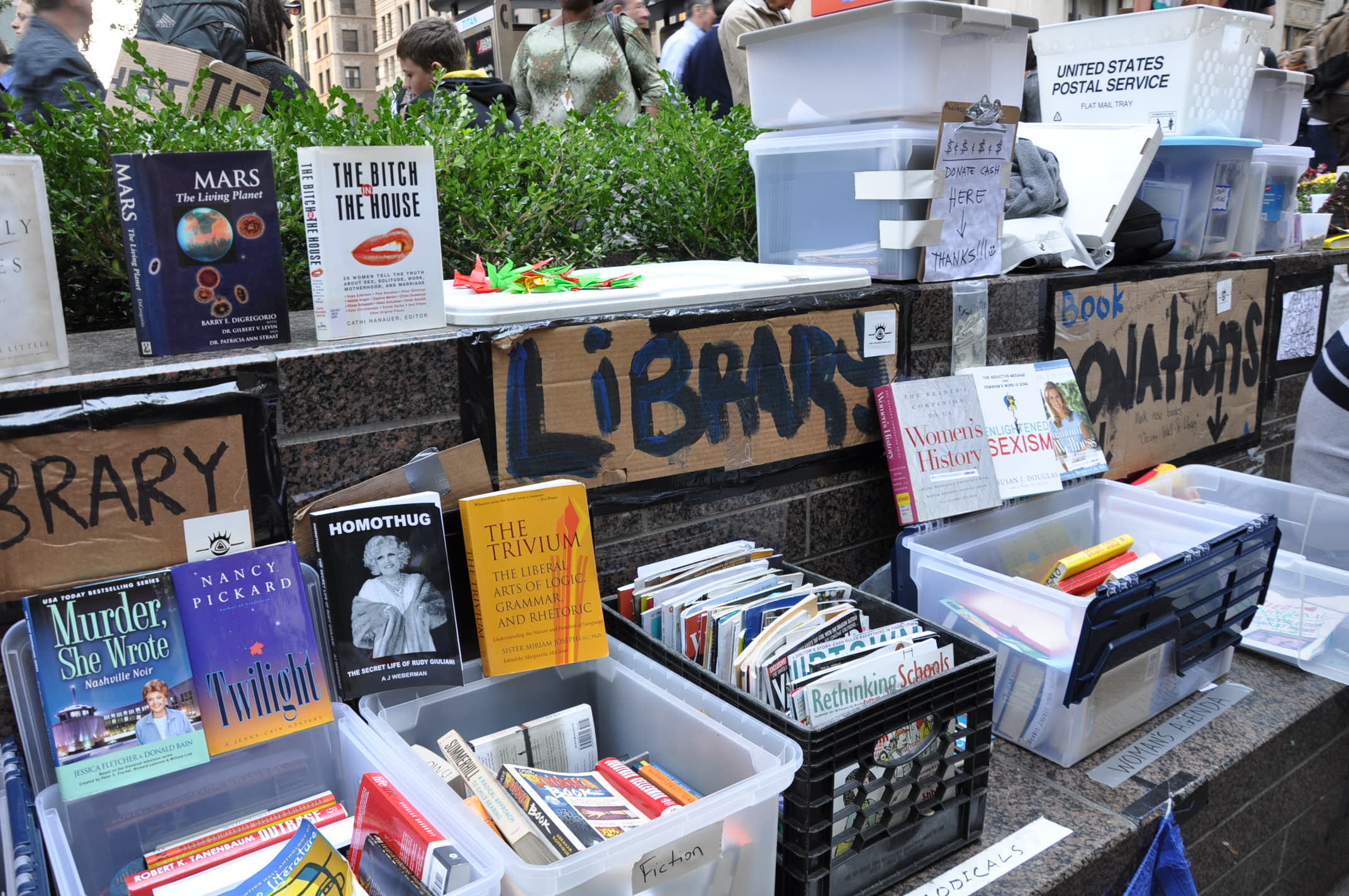
It’s day 24 of Occupy Wall Street 1 and the thousands of protesters there have been organizing themselves into pseudo governments and various working groups. 2 The place is turning into a petri-dish kind of accelerated model of semi-anarchic social planning. The coolest aspect of the new microsociety, however long it’s going to last, is the The People’s Library of #OccupyWallStreet.

source: http://www.flickr.com/photos/listentomyvoice/6215907949/in/pool-1820877@N22
The OWSL was started by an NYU library studies student setting out a pile of books – other protesters started adding books, found protection for the books from the weather, and (now) have made a catalogue of the books and are collecting donations. On the library’s blog, OWSL announced that a criminal justice attorney for a New York nonprofit offered her legal services to the library as it deals with the semi-sketch logistics of being an uncovered library located in a public park. The library has about 15 volunteers (described as “a mix of librarians and library enthusiasts”) and a barcode scanner.

According to their catalogue, the library has about 400 books, with about 50 donations per day coming for the last few days. OWSL’s catalogue includes kind of what is to be expected in the library of a strange semianarchy made up of people with too much time, from Reading Lolita in Tehran to The Shock Doctrine: The Rise of Disaster Capitalism. Volunteers say that they’re having constant requests for copies of A People’s History of the United States by Howard Zinn. There are a few less expected titles in the catalogue, though, too, like Quiverfull: Inside the Christian Patriarchy Movement3 and Cloudy with a chance of meatballs.

OWSL volunteers say that they do not discriminate when it comes to which books they put out – by nature of those donating, they have mostly liberal political and philosophical theory. But, one of the volunteers said, “if someone came with a truckload of Rush Limbaugh’s books, we’d put them out. We’re not opposed to having a dissenting voice.”4

One volunteer was asked to describe the library’s purpose: “People want to know, ‘What’s your agenda?’” he said. “Well, the status quo doesn’t have an agenda. Everyone here, in the aggregate, are people who feel disenfranchised and powerless. It’s perfectly legitimate to be frustrated. I don’t have a solution. I’m not an anarchist. I’m here because I love books.”

I'm not an anarchist. I'm here because I love books.

This attitude is what gives a sense of legitimacy to OWSL: its dedication to the availability of information in general, not just the forward movement of the protesters’ varying agendas. It’s admittedly heartening to see that one of the first things that develops in a group of people staying still for a while is a library. The agendas and decisions of the protest aside, let’s hope that the spirit of the indiscriminate availability of information and discourse remains in at least this aspect of the movement.

1 If you’re not terribly aware of what’s going on in NYC, and are interested in politics or social media or culture or anthropology or basically anything, read up on the Wiki page – for more laughs, read the .
2 For example: Sanitation, Food and Kitchen, Arts & Culture, Public Relations, Direct Action, Media Spokesperson Relations, Internet, Information, and “Peacemakers” [Security]. source: http://www.examiner.com/populist-in-long-island/night-and-day-life-at-occupy-wall-street
3 For substantial feelings of anger, horror, and loss of hope, Google the Quiverfull movement.
4 source:
http://newsfeed.time.com/2011/10/10/occupy-wall-street-their-own-mini-government-complete-with-library/#ixzz1aOZwBPAe