Category Archives: politics

Social Service and the 2012 Election

I was sitting at a meeting reviewing cases of indicted abusers – I intern at a social services office near my college, in the second poorest county in New York – and one case involved a man who had served a few months’ probation for abuse and then, upon release, committed a horridly violent act against the same victim. “We failed this kid,” an officer at the meeting said of the victim.

I like working in social services because it simultaneously disenchants and inspires me in regards to the mechanisms of helping people. I work in an office that gives legal and practical assistance to domestic violence victims, houses a women’s shelter, and runs a food pantry.

Many of our clients tell us that they don’t know what they would do without us, that we were their last chance, etc. After these cases, there is a sense that our tax dollars are being put to good use, as it were – that the social service is doing what a social service is supposed to do. But some clients aren’t as easily rewarding. Some are demanding and abrasive; their accounts of incidences don’t match police reports and they tell scattered and narcissistic stories, the verity of which crumble when anyone asks them to repeat a statement. We get people in our office who are clearly victims, but we also get the conniving, the liars, and people who file abuse complaints just to be vindictive. Our services are alternately treasured and taken advantage of.

Whatever the makeup of social service is, it is definitely not black and white; working with the logistics of public service enforces the fact that there are no clear cut cases, and that every policy is going to, at some point, meet an exception of the rule. Sometimes these exceptions are people; sometimes they are failed by the system. Sometimes (oftentimes) people seek to suck as many resources out of the public sphere as they are legally allotted. A general sense of entitlement pervades the population, which often means that public resources are given out at a competitive, first-come-first-serve basis.

But does the fact that the system is occasionally cheated discount the help it provides others? This is a question that must be asked in regards to every public service.

Charity is not so simple as shelling out money to the poor – though money helps, the uncomfortable truth is that anyone (of any class) who receives money will often not use it to their long term benefit or to that of society. The other danger of charity is the possibility of using monetary donation to excuse ourselves from any personal discomfort or investment. If we consider money the thing that solves the problem (and, believe me, it does help), we can ignore the ugly logistics of how and when and why to distribute it.

This is why any candidate who proposes “simple” tax plans (Herman Cainn, Rick Perry) ends up looking kind of foolish. Perry recently called Social Security a “Ponzi scheme” and called for the privatization of the whole thing. While basically everyone says that Social Security is pretty screwed up, much of Perry’s criticism of SS seems to be driven by a fad-like propensity for drastic calls for smaller Federal government, and the implications of such a trend on social services is worrisome.

Ron Paul, on the other hand, does have the advantage of actually sticking to his guns on the issues, it seems – but I can’t believe that his defense of less government in regard to social issues – that “increasing federal funding leaves fewer resources available for the voluntary provision of social services” – is practical at all. Calls for smaller federal government often cite the support of the power of state governments instead, but the basic philosophy seems like it would call for less state governments as well as federal.

Policy change is what is really effective. The problem is that there is no one policy change that will fix everything; social programs need to be constantly restructured to adapt to a changing society. This makes policy changes less flashy and more complicated than large donations or huge influxes of funding, and so they receive less public and political attention than they should. The logistics of helping people can be terribly complicated, and a perfect policy will never be implemented, but public assistance is still a noble, if not a glamorous, necessity for society.
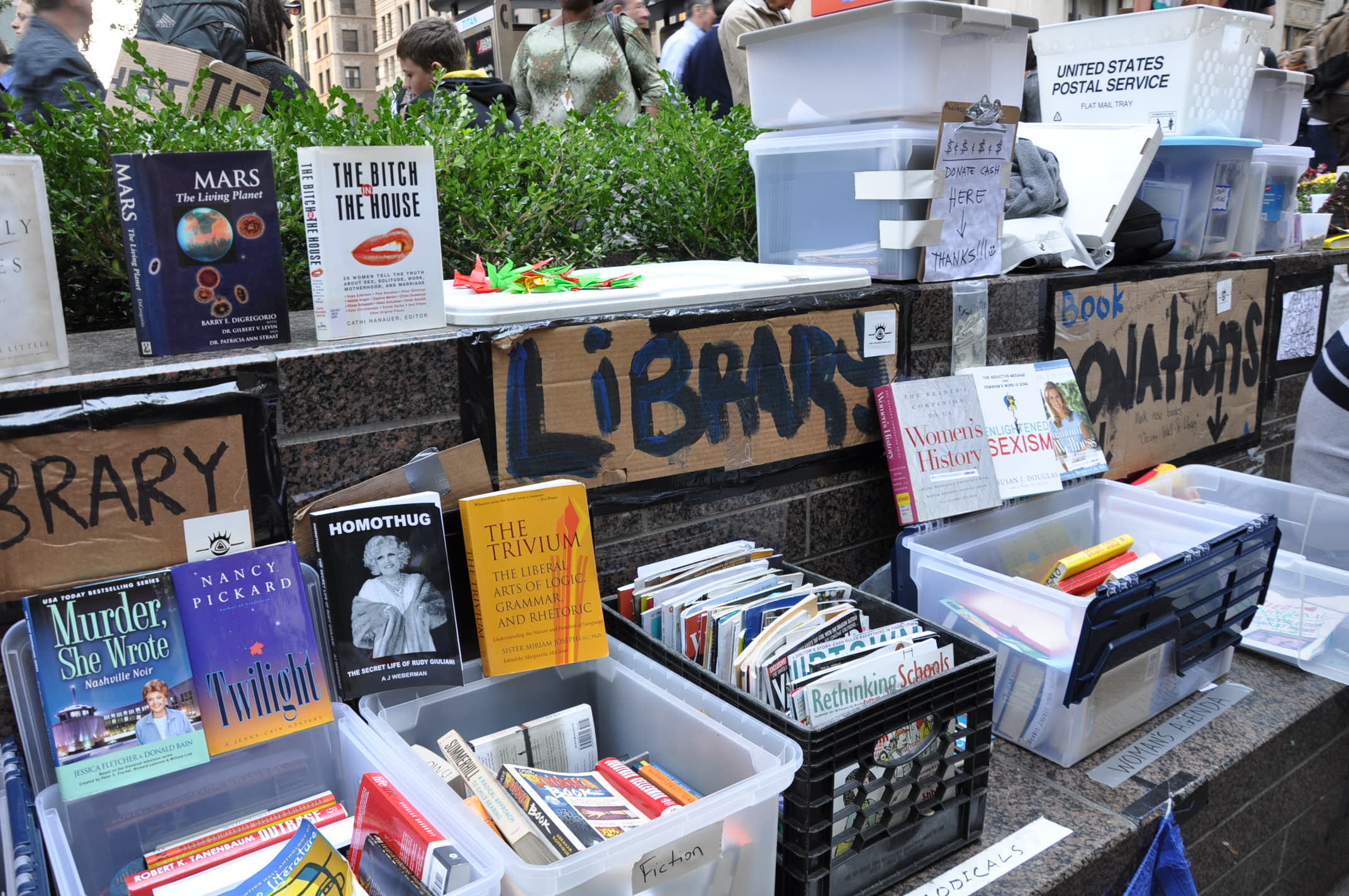
The People’s Library of Occupy Wall Street

It’s day 24 of Occupy Wall Street 1 and the thousands of protesters there have been organizing themselves into pseudo governments and various working groups. 2 The place is turning into a petri-dish kind of accelerated model of semi-anarchic social planning. The coolest aspect of the new microsociety, however long it’s going to last, is the The People’s Library of #OccupyWallStreet.

source: http://www.flickr.com/photos/listentomyvoice/6215907949/in/pool-1820877@N22
The OWSL was started by an NYU library studies student setting out a pile of books – other protesters started adding books, found protection for the books from the weather, and (now) have made a catalogue of the books and are collecting donations. On the library’s blog, OWSL announced that a criminal justice attorney for a New York nonprofit offered her legal services to the library as it deals with the semi-sketch logistics of being an uncovered library located in a public park. The library has about 15 volunteers (described as “a mix of librarians and library enthusiasts”) and a barcode scanner.

According to their catalogue, the library has about 400 books, with about 50 donations per day coming for the last few days. OWSL’s catalogue includes kind of what is to be expected in the library of a strange semianarchy made up of people with too much time, from Reading Lolita in Tehran to The Shock Doctrine: The Rise of Disaster Capitalism. Volunteers say that they’re having constant requests for copies of A People’s History of the United States by Howard Zinn. There are a few less expected titles in the catalogue, though, too, like Quiverfull: Inside the Christian Patriarchy Movement3 and Cloudy with a chance of meatballs.

OWSL volunteers say that they do not discriminate when it comes to which books they put out – by nature of those donating, they have mostly liberal political and philosophical theory. But, one of the volunteers said, “if someone came with a truckload of Rush Limbaugh’s books, we’d put them out. We’re not opposed to having a dissenting voice.”4

One volunteer was asked to describe the library’s purpose: “People want to know, ‘What’s your agenda?’” he said. “Well, the status quo doesn’t have an agenda. Everyone here, in the aggregate, are people who feel disenfranchised and powerless. It’s perfectly legitimate to be frustrated. I don’t have a solution. I’m not an anarchist. I’m here because I love books.”

I'm not an anarchist. I'm here because I love books.

This attitude is what gives a sense of legitimacy to OWSL: its dedication to the availability of information in general, not just the forward movement of the protesters’ varying agendas. It’s admittedly heartening to see that one of the first things that develops in a group of people staying still for a while is a library. The agendas and decisions of the protest aside, let’s hope that the spirit of the indiscriminate availability of information and discourse remains in at least this aspect of the movement.

1 If you’re not terribly aware of what’s going on in NYC, and are interested in politics or social media or culture or anthropology or basically anything, read up on the Wiki page – for more laughs, read the .
2 For example: Sanitation, Food and Kitchen, Arts & Culture, Public Relations, Direct Action, Media Spokesperson Relations, Internet, Information, and “Peacemakers” [Security]. source: http://www.examiner.com/populist-in-long-island/night-and-day-life-at-occupy-wall-street
3 For substantial feelings of anger, horror, and loss of hope, Google the Quiverfull movement.
4 source:
http://newsfeed.time.com/2011/10/10/occupy-wall-street-their-own-mini-government-complete-with-library/#ixzz1aOZwBPAe

#OccupyWallStreet: Protesting with Hashtags

So there’s about a thousand people protesting on Wall Street (ish) right now and I don’t really know exactly for what. The movement is #OccupyWallStreet and it started on September 17 and consists of about 1,000 (mostly) student-aged people (My official estimate of the demographic: I’m picturing literary references and lots of beards) just kind of hanging around the Wall Street area. Sometimes there are marches. People are sleeping in the park. People online are ordering pizzas to be delivered to the protesters. One girl took off her shirt.

You might want to know what people are actually protesting – that’s where things get more vague. Some advertisements speak of the need for One Demand, but nobody has decided what that demand is or should be or could be. Interviews with the protesters range from the idiotic to the informed, revealing mostly a mixture of the two (along the “I don’t know who my house representative is but I can tell you the percentage of the population that holds 50% of the wealth” line). The attitudes seem to be predominately socialist, or at least anti-capitalist, with lots of complaints alluding to the Bush tax cuts, the 2008 bank bailouts (if you don’t really know what those are about either, a good explanation by my friend Chris here.), and a lot of derogatory use of the word “corporations”.

An #OccupyWallStreet protester with an Anonymous mask and a hijab.

The whole situation is a strange crossover between internet networking and the real world – the Twitter support and piles of enthusiastic comments and exclamation all over the web have only translated to about 1,000 protesters at any time, and not even in the street the protest was planned for (the NYPD blocked off the key sections of Wall Street before any protesters got there). Online, however, the results are impressive (it’s kind of like looking at the Ron Paul campaign) – Anonymous, the 4chan-based hacker group with frightening amounts of power, is credited for much of the protest’s popularity.

It’s fascinating and kind of beautiful to watch – this is the first generation that grew up with the internet, and you can tell. Twitter-based protests are just called “protests” now. We are the generation that will use hashtags in our protest signs. It’s like old protests, but improved: we still have unconstructive platitudes, but at least some of them are ironic, dangit.

The coming-of-age of the first generation raised on the internet looks like this.

The use of the word “Occupy” in the title seems inaccurate, as if the protesters knew what they would do if they actually got control of the place. I’m imagining collages made with cut-up quarterly reports.

The thing is that Wall Street is now just as nonphysical as the organization of the protests – there’s not really much actual money to burn, anymore, and there aren’t safes full of the hoarded wealth of the rich. Significant money never really physically goes to Wall Street, or really anywhere – money is numbers in a computer and property value and stock value; it’s kind of hard to figure out where it actually exists.

The physicality of the protest is less impressive than its internet following and even seems a little incongruous – it’s like the event is being swallowed by its own abstractness; an internet-developed protest trying to cross the line of physical reality and occur in front of a physically symbolic place just doesn’t work out in the digital age.

Ai Weiwei and the inevitable human rights movement in China

Ai Weiwei: sunflower seed enthusiast, among other things

So Ai Weiwei has been in the news recently because he spoke for the first time about the details of his 3 month detention. “Who the heck is Ai Weiwei?”, you ask? LET ME TELL YOU.

Arrest
Some background: Ai is sort of a politically active artist (or artistic political activist) who’s famous for speaking against the People’s Republic of China, specifically its inhibition of free speech and cover-ups of police brutality and general nastiness towards anyone who complains about anything the government’s doing. The People’s Republic of China demolished Ai’s studio earlier this year and arrested him on April 3rd (just as he was getting ready to fly to Hong Kong) for the kind of horrifyingly vague reason given that he had “other business” to attend to. One of Ai’s anonymous associates was quoted by the New York Times as saying: “[Ai] told me that when he was taken from the airport, the police told him: ‘You always give us trouble, now it’s time for us to give you trouble.’

Later the People’s Republic of China rather unconvincingly changed the charge on Ai to tax evasion.

Artwork

Ai Weiwei, “Dropping a Han Dynasty Urn”

Most everyone else, however, figures that the reason has something more to do with his vocal political activism, both on his Twitter account and in his artwork, like the photo triptych of him breaking a Han Dynasty urn, or Grass Mud Horse Covering the Middle, which doesn’t seem terribly political until you find out that the title, in the original language, sounds something like “F*** your mother, Chinese Communist Party.”

Ai Weiwei, "Grass Mud Horse Covering the Middle", the title of which sounds like "F*** your mother, Chinese Communist Party" in Chinese

The Growing Human Rights Movement in China
Ai Weiwei is just the most media-visible figure in a large network of grass-roots human rights activists in China, one that can only continue to grow. And every effort the People’s Republic of China makes to cover up a situation or detain an inconveniently vocal activist creates a chain reaction of others publicly calling for that person’s release and bringing more, not less, attention to protestors: Zhao Lianhai, who spent time in prison after he organised a group seeking compensation for families of children who died or became ill due to tainted baby formula, was shortly detained after calling for Ai’s release; this drew more attention to Zhao and his claim that he was force-fed through the nose while on a hunger strike. Wang Lihong, an activist who draws attention to and investigates instances of suspected government injustice, was arrested in March and faces prison time for “creating a disturbance“; her case is in turn receiving public attention largely because Ai Weiwei is calling for her release.

It’s kind of nerve-wracking to watch but it seems sort of inevitable that as China becomes more prevalent in the international economy, it will become harder for the Chinese government to censor communication across the internet, and the human rights movement will become something impossible for the government stifle.

Things are going to get serious, is what I’m trying to say, and the human rights movement in China is going to be getting a lot of attention in the next decade.

Colbert Super PAC’s First Commercial

Stephen Colbert’s Super PAC released its first commercial in Iowa:

The ad encourages Iowans to write in Texas Governor Rick Perry (and to make the ad just unserious enough, Iowans are instructed to spell the name Parry, “the A is for America.” Good job, whoever had that idea.) in the Ames Straw Poll, which is a “nonbinding” political poll that has less democratic integrity than eeny meeny miney moe but is politically taken more seriously than the primary results of whatever states hold their primaries last.

Fun facts: Admission fee for the Ames Straw Poll is $30. From the Ames Straw Poll website: “Some folks say the Iowa Straw Poll is like the Iowa State Fair – but better because politics is involved.”1

1Iowans quoted here are hypothesized to have either meant “worse” instead of “better” or to not actually be human beings.

The Debt Ceiling: A Summary for People Who Don’t Know What The Debt Ceiling Is

So if you live in or have heard of the United States then you’ve probably heard lots of people talking about the whole debt ceiling deal, and if you’re the average internet peruser you probably have no idea what they’re talking about most of the time. Honestly, neither do I. So I’ve spent the last while skimming only the best Wikipedia articles, clicking on every relevant link on the New York Times website, and harrassing my one (1) political-science-inclined friend to get a very general idea of what all is going on – I call it The Grossly Simplified and Possibly Only Pseudo-Accurate Debt Ceiling for English Majors: A Love Story.source: www.sodahead.com

BackgroundDebt is accrued, kind of obviously, when the government spends more than its revenue.  In order to keep funding public programs and paying gov’t salaries, etc., Congress basically sells debt to people, and according to somewhere in the Constitution, Congress is the only thing that can borrow money on the America’s credit. So back in the day, like founding-of-the-US-through-the-early-20th-century-day, Congress had to individually approve every time it borrowed money.  During WWI, we were borrowing so much money on credit (i.e., selling debt to people and countries) that Congress decided to kind of streamline the process and just say, “eh, it’s all approved – just don’t go over . . . let’s say 11.5 billion dollars” [not adjusted for inflation].  Since then, each time the US debt was approaching the debt ceiling limit, congress would raise the limit – which has happened like 76-78 times, depending on who you ask.

And so the current debt ceiling (it’s like 14 trillion and something) was “reached” sometime in March, and the government can’t borrow any more money – so we’ve just been paying the interest on our loans. But we’re going to run out of money to pay that interest pretty soon, about August 3, is what’s been estimated, so we either have to raise the debt ceiling or default on our loans, which is basically saying “uh, hey folks, remember when we said we would pay you back? Well, we can’t. Don’t know what you wanna do about that.”

People argue about what would happen if we defaulted. Some say that the world economy would, if not completely collapse, definitely develop a very nasty limp. Others say that it wouldn’t be all that bad for reasons I don’t quite understand. Some people say that China (which owns more than half of all our foreign-held debt) will come over and shake us upside down so our lunch money falls out of our pockets. Rush Limbaugh says that Obama chose August 2nd as the deadline because it’s the day before Ramadan.

source: blog.cunysustainablecities.org

Since 1962 Congress has raised the debt ceiling 72 times

So what’s different now from all those other times that the debt ceiling was raised, as far as I can tell, is that Republicans, who hold the majority of the house of representatives, think that they can use the urgency of the situation to get the Dems and the White House to agree to a budget that they wouldn’t normally approve.  This is coupled with the fact that there is a bigger representation of the Tea Party, especially among junior representatives, than there has been before, and many of those junior representatives campaigned on promises to not raise taxes or do anything that looks or smells remotely like raising taxes ever in their lives. There are two ways to reduce deficit: reduce spending and raise taxes. The Republicans are pushing budgets that reduce spending but don’t increase taxes (or even just let the Bush tax cuts expire, or reform corporate tax laws that allow corporations to take loopholes and get out of paying taxes at all). This makes this difficult for everyone to get along.

So that’s the summary of what’s sort of going on. As the date draws nearer, things get sketchier – like, right now, it’d be impossible for anyone to write up a comprehensive budget by then. There was even talk of the Republicans just making a decision to not raise the ceiling, which the president can then veto, just so they can still say they voted against it. The closer we get to August 3, the hairier and more confusing things get. But that’s an attempt at a summary of the context of the whole issue.