Category Archives: politics

Terrible Moments in News Media (Not Limited to Rush Limbaugh)

Note: This is a version of a piece I wrote this with my brilliant friend Chris Hartline for our student newspaper, and am reprinting it here. Any goodness in it may be credited to him.

Most of the public is aware of Rush Limbaugh’s stupid and unfunny bit in which he referred to a Georgetown student as a “prostitute” and a “slut” for saying that Georgetown health insurance should cover contraception.
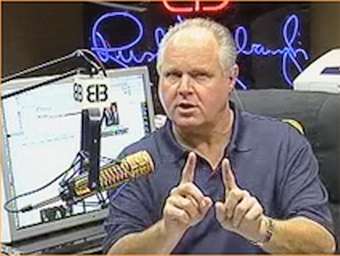
source: lifenews.com

Do not pay attention to this man. He will make you sad.
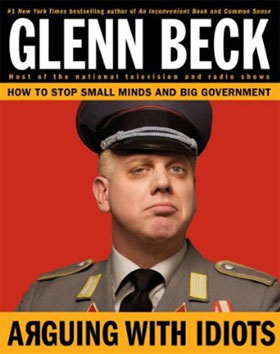
But the name-calling does not stop there: other instances of sexist slander have been just as offensive but haven’t received as much news coverage as Limbaugh’s insult. Bill Maher, a liberal comedian and amateur political commentator on HBO, referred to Sarah Palin as “a tw-t” and “a c-nt”. Chris Matthews, MSNBC host, called Hillary Clinton “witchy,” “uppity,” and claimed that she was elected to the Senate only because her “husband messed around.”

source: glennbeck.com

Looks like public discourse to me.

The state of the news media today is disheartening because the system of acidity seems to be self-perpetuating. Indeed, truculence has become a prevailing rhetorical device. Keith Olbermann had a segment on his show (and a book) called “The Worst Person in the World”. Glenn Beck wrote a book in 2009 called “Arguing with Idiots: How to Stop Small Minds and Big Government”.

Another clear manifestation of the deficit of trust of the media was a 2009 poll done by Time magazine. Walter Cronkite held the title (since 1974) of “Most Trusted Man in America”. Cronkite was the most visible figure in the media, which at the time provided objective discourse and information to the public, and he died in 2009. In the subsequent Time poll, voters said that the most trusted news anchor in America was Comedy Central host and political satirist Jon Stewart.

The fact is that the media is supposed to provide a momentary stay against political hostility, an unbiased source of objective information for the public, and that it is not doing this. Consequently, the public is losing their faith in the news media, and by extension the American political system itself.

The media has become tool used by political parties to influence the opinions of the public. A blatant example of this is the “Plan for Putting the GOP in the News” memo from the Nixon administration. The 15-page memo was anonymous, and has written comments on it by Nixon’s then-advisor and current Fox News President Roger Ailes.
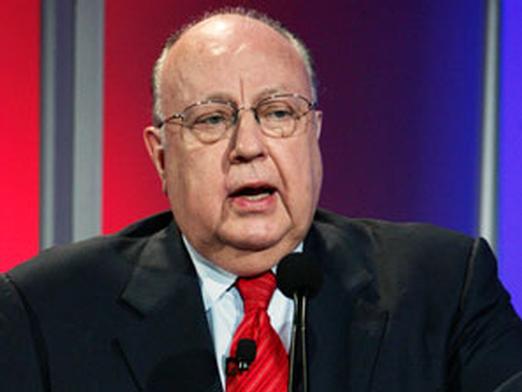
Roger Ailes!

Roger Ailes: founding CEO of Fox News and adviser to Nixon, Reagan, and Bush. Also credited for possessing the world's least attractive set of jowls.
The memo stated that television was the best medium for political persuasion because of its imminent popularity: “People are lazy. With television you just sit – watch – listen.  The thinking is done for you.” The plan was to record prepackaged interviews with Republican politicians and deliver the videotapes to local news stations. Presently, critics say that Fox News has demonstrated their role as an arm of the Republican Party.

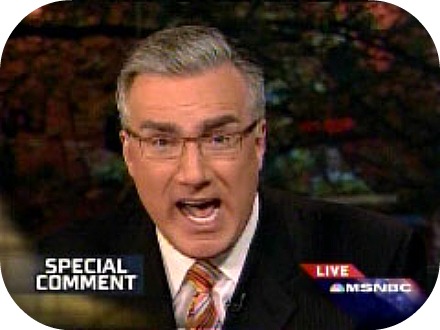
source: msnbc.com

All you need to know about Keith Olbermann is that he's not a pleasant person.

MSNBC, while on the opposite side of the political spectrum from Fox News, is similar in its audacious political stance. In a distasteful and recurring ending rant on his show, former host Keith Olbermann once shouted (his monologue was directed at then-President Bush), “This war is not about you … shut the hell up!”. Fellow host Chris Matthews also said after a 2008 Obama speech that he “felt this thrill going up my leg as Obama spoke.”

So it can be concluded that the media has become unabashedly partisan. Even the very fact that it is standard for each major newspaper to endorse a presidential candidate reflects a problem in the nature of journalism. It results in an overtly ideological news organization – the New York Times is liberal, the Wall Street Journal is conservative; the Washington Post is liberal, the Washington Times is conservative, etc.

A news staff tending to lean one way on the opinions page is typical and expected; however, the fear is that the ideological slant of the editorial pages will seep into the news coverage. The potential and underlying ‘spin’ of news stories becomes more important than the objectivity of the events being reported.

And maybe the Nixon administration’s prediction about the easy audience of television was prescient: political commentary television programs can be especially caustic and, at times, juvenile. They seem to appeal to the lowest common denominator of the public and of individuals. Keith Olbermann, Glenn Beck, Rachel Maddow, and Bill O’Reilly are all political commentators who base their rhetoric on the petty mockery of whoever disagrees with them – their arguments are negative, not positive, and clever insults take precedent over constructive criticism.
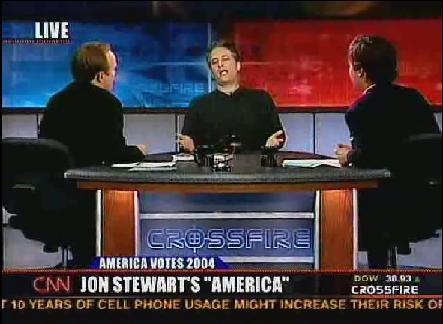
source: portland.indymedia.org

Jon Stewart pleads with the hosts of Crossfire to "stop hurting America." Crossfire was cancelled shortly after Stewart's interview.

The media itself has not only lost its ability to objectively inform the public of unbiased political events – it has become a tool for fostering and encouraging political contention. The role of the news media is not just lost – it has been perverted. As Jon Stewart said to the hosts of Crossfire, this inflammation of petty and theatrical bickering isn’t just bad journalism – it’s hurting America.

David Brooks said: “There’s a collapse in the public’s faith in American institutions. The media has done a poor job. We’ve become as insular and self-regarding as any [other institution].” It is no wonder, then, that there is a deficit of trust among the younger generations – the apparent disintegration of the integrity of our news sources is nothing less than repelling.
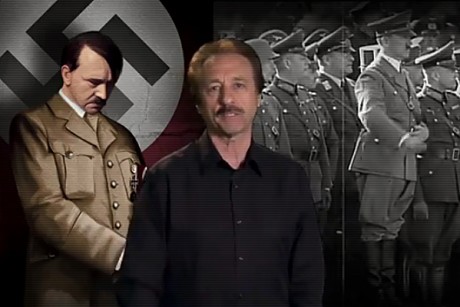

Hitler, Ray Comfort, and the Dismal State of Discussion

I did something bad for my health that I do not recommend. I watched “180”, a half-hour documentary made by Ray Comfort.

It is a bastardization of discourse from all sides. In an interview with Steve, a neo-Nazi punk type of young man, Steve says that he’s certain of his opinions about the falsehood of the Holocaust and other offensive things. To combat this, Comfort asks Steve to spell shop (Steve does) and then asks: “what do you do at a green light?” The question is a trick to get the mind to quickly respond “stop”, which is semi-associated with green lights and rhymes with “shop”, and the person answering looks silly. Sure enough, Steve responded “Stop” and looked silly. And then – well, then Comfort treated that like an actual argument for something.

The documentary was dipped in dramatic music, photos of piles of dead bodies, and use of gratuitously violent photographs. What is most interesting to me, however, is the use of what seems to be the universal argument-ender: comparisons of things to Hitler.

Hitler, the Nazis, and Lazy Discussion
Hitler and the Holocaust have become mythic elements of American culture, I think, and to the detriment of the truth of the actual historical events. I was recently visiting a small church where the members, after the service, started (sort of randomly) to wax poetic about the horrors of Hitler and the Nazis. They weren’t saying anything new – everyone was just affirming that Hitler was inhuman and the Nazis were too. It was the fervent insistence that “real humans could never do that sort of thing” that struck me – I thought of all of the other genocides and massacres of the past century alone, of the killing of civilians in wars by troops of every nationality, of atomic bombs. But even in light of all of these things, current conversation about Hitler seems to serve contrast to our new, very human, very un-barbaric society. We talk about Hitler basically like Satan – an ultimate evil; a rhetorical catch-all.

Ray Comfort and 180: Unethical Discourse

Steve, in the movie "180" by Ray Comfort

Comfort’s specific use of the Hitler argument is reductive and tired. It is, if anything, an exploration of how charged and empty rhetoric in the realm of politics is being mirrored in general culture. His interviewees are inconsistent, and seem to know very little about philosophy, theology, or basic logic. Comfort’s questions are also always precisely and pseudo-cleverly leading, and it doesn’t seem that he wants to engage with the interviewees at all: “Does this mean you’ve changed your mind about abortion?”, he asks. “Are you going to vote differently in the future?” It is not a conversation, is the point: it is a poorly executed set of rhetorical acrobatics. Is this the way to foster discourse and an informed public? Probably not. Arguments depending on rhetorical cleverness are insulting to both parties.

Comfort’s series of interviews are not only annoyingly inconsistent and poorly constructed, however: the movie is also a manipulative presentation of complex issues and events, presented crassly and with a smugly triumphant attitude. One of the less graceful moments was when Comfort asked a woman if she’d had an abortion; she said that she had. He then immediately asked: “Do you feel guilty about it?”

As the big finish, Comfort sets up a game-show setup of moral responsibility and the afterlife, and awkwards them into admissions of fright and death anxiety:

  • Comfort asks people if they have lied/stolen/been lustful: most of them say that they have.
  • Comfort then gets them to admit that this makes them liars/thieves/adulterers.
  • Comfort gets them to admit that liars/thieves/adulterers go to hell.
  • Comfort elicits from the interviewees an understandable anxiety about the prospect of hell.
  • Comfort asks them if they are going to go read their Bibles.
  • Some of them say yes.

Alesia, from Ray Comfort's movie "180"

Theologically, morally, rhetorically, and logically, this is one of the most horrible things ever. Comfort’s quick-talking way of “tricking” people into professing a fright of punishment does very little for the moral health of humanity or the search for truth within rhetoric and theology. The triumphant music and photos of bloody sheets are no help for the legitimacy of the movie.

There are also 40 thousand comments. I do not recommend those either. They are not a happy picture of humanity.

It makes sense to protest the legalization of abortion and to be horrified at the amount of deaths occurring if one believes that life begins before birth. Comfort’s smugness and “gotcha” questions, however, lack earnestness, humility. The whole thing turns a serious situation into an awkward and unproductive onslaught of unhelpful rhetorical inconsistencies, devoid of integrity and, therefore, real efficacy.

In sum, the movie is a disjointed account of unproductive discussions with unproductive people with vague and uninformed opinions. It’s a disheartening representation of the state of discourse on American sidewalks.

You Should Care About Super PACs

The new potentially-sort-of-boring-topic-about-which-we-should-educate-ourselves (this is the first election I’m paying attention to and I’m finding a lot of these things) is the issue of Super PACs and their effect on the current election.

To summarize, Political Action Committees (PACs) have been around for a while. They are organizations that raise money to use toward elections, usually television commercials — they are limited to collecting small amounts of money from individuals, political parties, and other PACs — and the stipulation was that they could only accept $5000 per person per year, which meant that (at least in theory) candidates’ support would be semi-related to the amount of supporters donating to them.

In 2010, however, it became legal for some organizations to receive unlimited donations from corporations and unions: organizations which accept these unlimited donations are called “super PACs.” They are like PACs, but much more evil. While PACs forced candidates to build a large support base to earn a substantial amount of money, a few millionaire individuals or corporations can fund a candidate’s entire ad campaign.

Super PACs are devastating to the essence of democracy: Why should congressional and presidential candidates care more about the votes of single constituents than the needs of unions and corporations when campaigns can be made or broken by union and corporate funding?

Super PACs allow campaigns to distance themselves from negative ad campaigns while reaping the benefits from commercials slandering political opponents — Mitt Romney’s PAC (the idiotically named “Restoring Our Future” — okay, one might restore hope for the future, but not the future itself) spent $3 million running negative campaigns against Newt Gingrich, effectively killing his campaign.

(evil?)Super PACs allow corporations and unions to spend huge amounts of money on elections — billions, in the 2010 midterm election — and that directly translates into influence on government decisions. If you’re imagining large men in suits grinning evilly while photographing themselves with dollar bills coming out of their ears, keep imagining it: there’s a picture of Mitt Romney that looks exactly like that.

Super PACs are a key factor in the commercialization of the political process. Since the late 90s, the money involved in elections (adjusted for inflation) has increased at an alarming rate. The amount of money that went into the 2008 election ($1 billion, 86 million) was more than twice that of the 1996 election (599 million dollars, adjusted for inflation) — Barack Obama’s 2008 campaign alone spent more than was spent in 1996 ($799 million).

Super PACs do not have to report the amount of money they receive, or how they spend it. A candidate’s super PAC can fund ridiculous amounts of illogical and negative commercials without having to pin the candidate’s name on the commercials at all. A candidate’s super PAC can also donate money to other PACs, effectively buying the good will of other politicians. Recent Supreme Court decisions deem this legal.

You should buy one of these tshirts on Colbert's website. And protect democracy.

The Colbert Report flaunted the troubling legalities of Super PACs in last Thursday’s episode, when Stephen Colbert’s Super PAC (Americans for a Better Tomorrow, Tomorrow) was transferred from Colbert to Jon Stewart as Colbert announced his fake intention to run for president. Colbert is not supposed to coordinate with the super PAC, his lawyer said on the show, but he could remain business partners with Stewart and the staff of his PAC didn’t have to change, even though they clearly knew everything about his election strategy.

Super PACs are the final step in making political campaigns entirely about money and slander. The political scene becomes a game of who-can-find-the-most-loopholes, with politicians focusing their energies on how to betray the spirit of the law without breaking the letter of it, which seems quite bad indeed.

Sweden Recognizes Kopimism as a Religion: What on Earth does ‘Religion’ Mean?

Sweden’s pretty liberal when it comes to copyright laws, as a government and as a culture – it’s the home of the thepiratebay.org and there’s a healthy anti-anti-piracy-movement movement in Sweden that’s been active since 2001. Further proof of piracy as culture in Sweden is the fact that the Swedish government just officially recognized the Church of Kopimism.

Kopimism’s central dogma centers around the idea that information is a holy thing, and copying information a sacrament. CTRL+C and CTRL+V are considered holy symbols. The English page of the church’s website says:

We challenge all copyright believers – most of which have a great deal of influence in politics, and who derive their power by limiting people’s lives and freedom.

Isak Gerson’s personal website (translated by Google) says that a Kopimist a “person who has the philosophical belief that all information should be freely distributed and unrestricted. This philosophy opposes copyrights in all forms and encourages piracy of all types of media including music, movies, TV shows, and software.”

So Gerson (who, weirdly, is also a member of the Christian Student Movement in Sweden) took this philosophy and pasted some “ritual” labels on everything and got a religion (after petitioning to the government 3 times, to his credit). The result is both a straight-faced mockery of the difficulty governments face w/r/t defining ‘religion’ (on the Kopimist website, the first line of one of the definitions of Kopimism is the defense “A religion is a belief system with rituals.”) and a strange manifestation of a strongly held belief.

Religions rooted in the internet are not a new thing. With all those people registering as “Jedi” in the 2001 census, Pastafarianism, and the prevalence of Cthulu worship, the appearance of a semi-ironic religious movement started by otherwise apathetic 20 year old males is becoming a pattern.
Maybe it’s just another irony-soaked fad, like speaking with ridiculous grammar or posting hilarious misquotes – or maybe the semi-ironic religions created will garner more earnestness and lose some irony and become, weirdly, a real way that people define their philosophies. The definition of the word “religion”, in the context of recent events and the influence of internet culture, is changing, and it’ll be interesting to see what happens to it.

GOP 2012: Why Competence and Communication are Important

NB: I’m a registered Democrat, but not a terribly leftist one. I’m a Democrat the way most college students are Democrats, I suspect – by default.


I’ve been thinking about the circus that is the Republican nomination race. You should know that I’m not a politics nut, nor do I plan on being one – but the state of my society does interest me sometimes. The GOP right now is both amusing and extremely sad. A series of caricatures who have served their time as one-month fads leaves me wondering about the state of American politics. The string of slip-up clips zooming through the internet and the idiotic things that these candidates have said might receive too much focus, according to some – but I think that the dismal communication and public speaking skills of the candidates this year is itself something to be concerned about, before even delving into their political views (too complicated for me to do any justice).

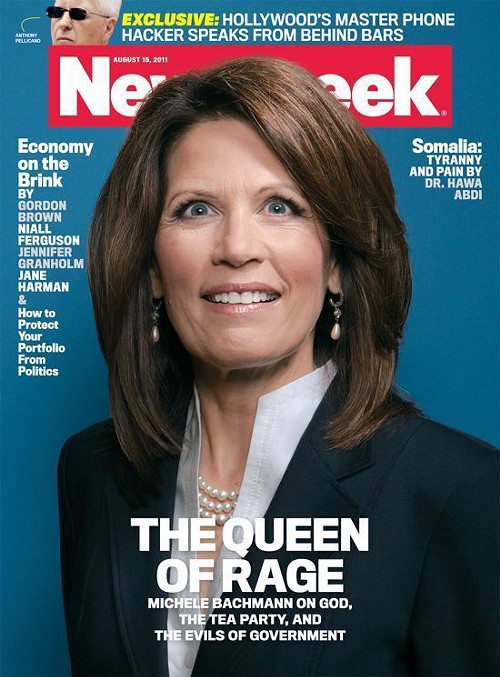
Bachman's disastrous Newsweek cover

Michele Bachmann was kind of the first fad of the GOP, and was slammed repeatedly for her bizarre and factually inaccurate comments in public – waxing poetic about New Hampshire, calling it “the state where the shot was heard round the world in Lexington and Concord,” while Lexington and Concord are actually in Massachusetts. She commented on the census, saying that “[My family] won’t be answering any information beyond [number of people in our household], because the Constitution doesn’t require any information beyond that,” which also isn’t true – the Constitution mandates citizens to fill out census forms. Or this gem about carbon dioxide: “carbon dioxide is not a harmful gas, it is a harmless gas. Carbon dioxide is natural. It is not harmful. It is part of Earth’s life cycle…And yet we’re being told that we have to reduce this natural substance and reduce the American standard of living to create an arbitrary reduction in something that is naturally occurring in the earth.” The woman is not a good speaker – she is clearly grasping for patriotic straws when she calls forth grand images of the Revolutionary War, and clearly grasping for Tea Party straws when she pigheadedly and uneducatedly dismisses the idea of global warming. This kind of saying-anything-to-please-a-crowd is not, not at all, a quality one should accept in a presidential candidate.

Rick Perry: Oops

Rick Perry was always too much like GWB to stand a chance. Not terribly substantial – seemed like the kind of guy I’d like to have a beer with but, like W, doesn’t even seem like he’d want to be the president, at the end of the day. I think the stress of even the race was too much for him.

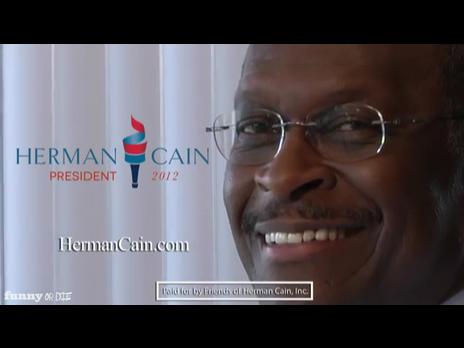
Screenshot from Cain's abysmal campaign commercial

When Herman Cain was declared frontrunner of the Republican Party, it was the last time that I was surprised/horrified at the state of the GOP candidates. Herman Cain, who attended Glenn Beck’s rally in Israel. Herman Cain, who said: “When they ask me who’s the president of Ubeki-beki-beki-beki-stan-stan, I’m going to say, ‘You know, I don’t know. Do you know?'” Herman Cain, who said: “I don’t have facts to back this up, but I happen to believe that these demonstrations are planned and orchestrated to distract from the failed policies of the Obama administration.” Herman Cain, who is a terrible, terrible candidate and appears to be willfully ignorant of foreign policy – or, at least, he imagines that that image is more desirable than utilizing his education.

So once Newt Gingrich was declared frontrunner, the GOP picking terrible candidates was sort of an expected pattern. Newt Gingrich was disgraced in the ’90s for having the worst Speakership in history – he suggested that the government shutdown was a personal attack against him, was the first Speaker of the House to receive ethical sanctions, and resigned in disgrace, commenting: “My only fear would be that if I tried to stay, it would just overshadow whoever my successor is.” I remember his name being the punch-line of jokes when I was a kid.

Also, he calls himself Newt, and he runs under “NEWT 2012”. Even without his ludicrous political career, no president should have an animal name, I’ve decided.

So why, why is the GOP choosing candidates whom I can mock by just quoting things that they actually said? Why are voters sashaying from Neo-Sarah-Palin to Neo-George-W. to Foreign-Policy-Knowledge-Have-Not to Only-Slightly-More-Desirable-As-A-President-Than-An-Actual-Newt?

An attack on the speaking skills of candidates might seem petty, but the speech- and communication- related responsibilities of the United States President are nothing to be neglected. I do suspect that the pressure on a candidate is more intense than in any other political position, and that slips in speech are widely a result of that pressure combined with the rabidness of the amusing-slip-up-snatching-and-amplifying media, but I also think that our standards for the public speaking skills of our president should be high. The pressure on candidates to not commit to anything – to sound good without making any promises – has caused the degeneration of political debates into a rhetoric-slinging festival resembling arguing grade schoolers.

These people are politicians – they have college degrees – they were popular enough to make it into the political scene and be elected to (in most cases) at least one high government office and run it with some level of competence. At least, that’s what I stubbornly assume, as I am afraid to allow myself to abandon all my hope in the political system. So let’s assume that the candidates are fairly competent and can sometimes speak without sounding like grade schoolers. Why, then, is everything about the GOP race so ridiculous?

I think that the 2012 GOP race so far demonstrates the logical extreme of a system built on fear of commitment and fear of offending even the most idiotic constituents. Noncommital and pretty-sounding political doublespeak is ridiculous in itself and always has been; in this year’s race, the insipid rhetoric has been deconstructed to reveal its logical core: nonsense. Politicians have been trained to say nothing for a long time; instead of learning what they need to know, they only need to be able to appear to know it; we are beginning to see the evidence of this more obviously. And with it, the apparent neglect of the American public to remember that the President is not only a likeable face, but the Commander in Chief of our army; not only a spearhead for conservative/liberal policy (depending on his/her affiliation, obvs.) but a position with the opportunity to encourage negotiation between the two sides of Congress and a key communicator with heads of state of other countries. And that is why the state of the GOP leanings isn’t just amusing – it’s dismal. Discouraging. One can only hope that the nominee will be someone we can take seriously.

Kim Jong-il is Dead; Nobody Knows What is Going on in North Korea (Still)

source: christanpost.com
So Kim Jung Il has died, purportedly, and I have no other choice but to write about it. Not really as a political analyst (okay not at all as a political analyst), but just as someone who kind of watches world events like sports, in a nihilistic sort of way.

Right around 10:20pm EST the Associated Press announced that North Korea said that Kim Jong-il was dead. ABC and the NYT quickly reported the story, saying that Korean Central TV reported: “Our great leader Comrade Kim Jong-il passed away at 8:30 a.m. on Dec. 17.” 8:30am in North Korea translates to 6:30 pm EST on Friday.

source: nyt.com

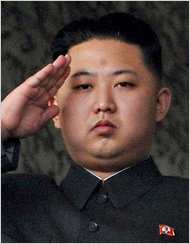
Kim Jong-un, the cheerful new dictator of North Korea

So what on Earth is going to happen to North Korea? Will the dictator’s death grip on the media continue? Kim Jong-il did some crazy things – Kijong-dong, for one, which was an entire empty city built in view of South Korea in the 50s to encourage defection. There was the claim that he was born under a double rainbow, that he scored 38 below par on his first golf game (and then promptly retired), and that he was a “worldwide fashion icon”. The idea of truth coming out of North Korea is roughly equivalent to tactful and thoughtful speech coming out of Rush Limbaugh. The whole event of Kim’s death and the transfer of power to Kim Jong-un is steeped in uncertainty. Heck, even the New York Times doesn’t know exactly how old Kim Jong-un is.

So the world is just kind of freaking out this morning. China’s pretty nervous. Everyone’s wondering what the long-oppressed people of North Korea are going to do – is the regime’s cult so ingrained in people’s heads that they will complacently move right on to Kim Jong-un as the most handsome and benevolent evil dictator ever? This event passing with no unrest in North Korea would be the most depressing thing ever.

Of course, this event causing violence between the North and South Koreas which ended up in someone (North Korea, the US…) using an atomic bomb would also be pretty depressing. The US, China, Japan, and Europe are all kind of staring at North Korea the way one would stare at a baby that just picked up a carving knife. North Korea test-fired missiles right before they announced Kim Jong-il’s death, so that’s not exciting at all. Stocks in China fell significantly. South Korea placed all of its military units on alert.

I have no parting comments. We’ll see what happens. While we wait, go to this hilarious Tumblr of Kim Jong-il looking at things for some comic relief.