Author Archives: Elisa

Christians, Sex, and Marriage, part 2(ish)

A while ago Evan wrote “Christians, Sex and Marriage”, in which he discussed the culture of sex among Christian young adults. Most of them, it was assumed, would be “saving themselves” for marriage, which is (on the surface) a fairly safe assumption, and applicable to a fair amount of Christian students. The culture of silence about sex, however, and the nervous giggles that attend any discussion of it, and the lack of admission that respected, smiling young Christian couples could possibly be doing anything but kissing chastely behind the dormitories makes me want to shout from the rooftops:

Lots of Christian students are having sex. What’s more worrisome is that lots of Christian students are professionals at alternately justifying and denying it.

Even more students are doing everything they possibly can with each other as often as possible without having the kind of sex that potentially impregnates women—and yeah, I think that the long list of not-actually-that-kind-of-sex possibilities is significantly different from the real deal. I also think that it’s sex. I’m pretty sure it would be as defined by our commandment-following-12-year-old selves, at least.

The problem with sex (for nervous promise-ringed young adults) is that it’s a good thing. The other commandments have translated pretty well into a social behavioral code, because one could argue that stealing, lying, murder, etc. are basically destructive things; sex, however, out of all of the commandments, is not.

So sex is super important, is my point, and an essentially good thing. It is one of the most creative things humans can do. It’s taught to us, however, with all the other Evangelical commandments: Don’t be drunk, Don’t do drugs, Don’t have sex. It’s treated, largely, as a thing to be avoided, feared, or even dismissed (“I Love My Future Wife, And I haven’t Even Met Her Yet” shirts, I’m looking at you). Our sex drives, in a vestigial Gnosticism in the contemporary church that saddens me, are seen as shameful things to be suppressed or ignored.

This attitude works fine until we are actually with someone. The main reason to remain celibate was often, basically, “Because the Bible says so,” an argument which weakens palpably the moment you’re alone with an attractive human being who’s attracted to you too. Most of the sex—including the sex leading up to the “real” sex, which, yes, is very different and which, yes, I’m going to continue to assert is still a big deal (commandment-breaking, I would posit, if you’re concerned about such things)—is wrapped up in substantial layers of vague guilt and shame and self-berating.

To assuage our guilt, we also end up deciding upon arbitrary Ultimate Borders of Virginity (which tend towards frequent revision), e.g., “We’re going to keep on all our clothes.” We then realize, e.g., how much one (I guess two) can actually accomplish while remaining clothed. Rinse and repeat with almost any “line” with which we decide to define Purity. I have never seen any line, like “hands above the waist,” work for a couple. Ever. And yet, sadly, it seems to be one of the main strategies of the inhabitants of steamy cars (or, for the carless: stairways, practice rooms, lean-tos, lobbies, cafeteria booths, parking lots, closets, or lawns).

So what we do is immerse ourselves in cycles of guilt and denial and more guilt. This, needless to say, isn’t super healthy. We start to talk about how it’s basically impossible to find a consistent definition of “adultery” as it’s used in the Old Testament. We find out that “fornication” often only applied to women and commandments against it are preceded by things like “don’t marry your dead husband’s brother.” We reassure ourselves that “sexual immorality” in the New Testament, when you come down to it, is pretty vague. The subject of our “Virginity Rocks” t-shirts becomes somewhat more complex than perhaps we once thought, and these newfound nuances conveniently complement our recently emerged interests.

This quick justification, while rather impressive in its ability to persuade even the previously prudest new couples (our argumentative skills and ability to think outside the box can probably be attributed to a strong liberal arts education), is seriously unhealthy. We are taught from an early age to regard sex as plainly Bad, down there with murder and lying and stealing, and so when we realize that it isn’t quite so terrible, it’s pretty easy to renege on our former simplistic convictions. This—not the sex itself, but the quick way in which we flip from “Obviously Not” to “well maybe just a little bit”—is worrisome.

Christian students are deprived of practical conversation about sex. It seems that the contemporary Christian church doesn’t really know what to do with sex besides tell young people to avoid it. Unless the goal is to leave young people confused and ridden with guilt, unless the goal is to communicate an attitude of oversimplified fear and denial when it comes to sex, and unless we prefer a confused silence to more risky and constructive dissenting discourse, the attitude with which sex is approached throughout young Christians’ lives needs to change.
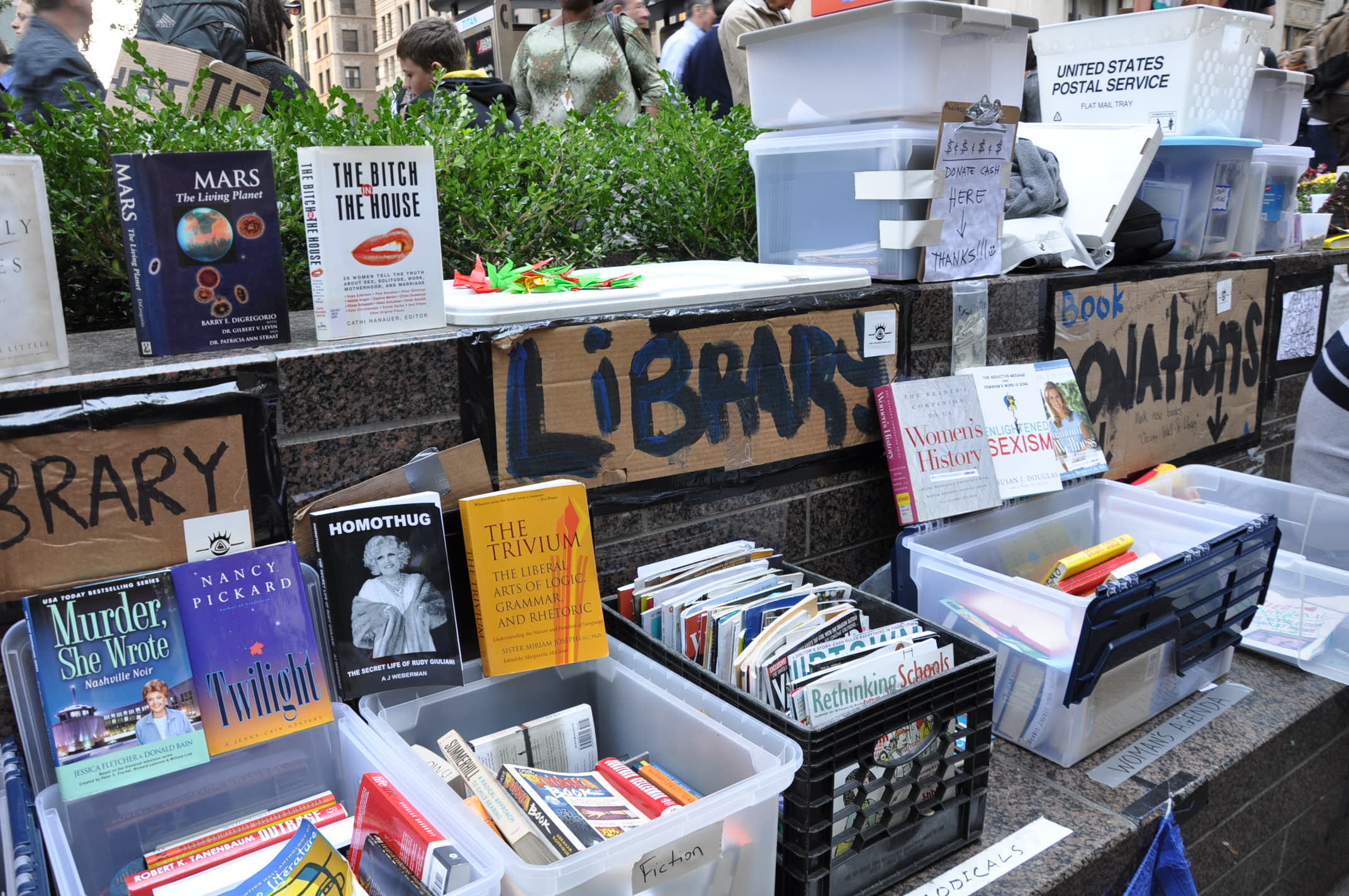
The People’s Library of Occupy Wall Street

It’s day 24 of Occupy Wall Street 1 and the thousands of protesters there have been organizing themselves into pseudo governments and various working groups. 2 The place is turning into a petri-dish kind of accelerated model of semi-anarchic social planning. The coolest aspect of the new microsociety, however long it’s going to last, is the The People’s Library of #OccupyWallStreet.

source: http://www.flickr.com/photos/listentomyvoice/6215907949/in/pool-1820877@N22
The OWSL was started by an NYU library studies student setting out a pile of books – other protesters started adding books, found protection for the books from the weather, and (now) have made a catalogue of the books and are collecting donations. On the library’s blog, OWSL announced that a criminal justice attorney for a New York nonprofit offered her legal services to the library as it deals with the semi-sketch logistics of being an uncovered library located in a public park. The library has about 15 volunteers (described as “a mix of librarians and library enthusiasts”) and a barcode scanner.

According to their catalogue, the library has about 400 books, with about 50 donations per day coming for the last few days. OWSL’s catalogue includes kind of what is to be expected in the library of a strange semianarchy made up of people with too much time, from Reading Lolita in Tehran to The Shock Doctrine: The Rise of Disaster Capitalism. Volunteers say that they’re having constant requests for copies of A People’s History of the United States by Howard Zinn. There are a few less expected titles in the catalogue, though, too, like Quiverfull: Inside the Christian Patriarchy Movement3 and Cloudy with a chance of meatballs.

OWSL volunteers say that they do not discriminate when it comes to which books they put out – by nature of those donating, they have mostly liberal political and philosophical theory. But, one of the volunteers said, “if someone came with a truckload of Rush Limbaugh’s books, we’d put them out. We’re not opposed to having a dissenting voice.”4

One volunteer was asked to describe the library’s purpose: “People want to know, ‘What’s your agenda?’” he said. “Well, the status quo doesn’t have an agenda. Everyone here, in the aggregate, are people who feel disenfranchised and powerless. It’s perfectly legitimate to be frustrated. I don’t have a solution. I’m not an anarchist. I’m here because I love books.”

I'm not an anarchist. I'm here because I love books.

This attitude is what gives a sense of legitimacy to OWSL: its dedication to the availability of information in general, not just the forward movement of the protesters’ varying agendas. It’s admittedly heartening to see that one of the first things that develops in a group of people staying still for a while is a library. The agendas and decisions of the protest aside, let’s hope that the spirit of the indiscriminate availability of information and discourse remains in at least this aspect of the movement.

1 If you’re not terribly aware of what’s going on in NYC, and are interested in politics or social media or culture or anthropology or basically anything, read up on the Wiki page – for more laughs, read the .
2 For example: Sanitation, Food and Kitchen, Arts & Culture, Public Relations, Direct Action, Media Spokesperson Relations, Internet, Information, and “Peacemakers” [Security]. source: http://www.examiner.com/populist-in-long-island/night-and-day-life-at-occupy-wall-street
3 For substantial feelings of anger, horror, and loss of hope, Google the Quiverfull movement.
4 source:
http://newsfeed.time.com/2011/10/10/occupy-wall-street-their-own-mini-government-complete-with-library/#ixzz1aOZwBPAe

Does The Onion Even Have Lines? #CongressHostage

So The Onion tweeted [#CongressHostage] about Congress holding schoolchildren hostage last Thursday. The Internet, as expected, exploded for a bit in a few places and then returned to normalcy.

A rather convincing photograph of what appears to be Speaker of the House John Boehner holding a little girl hostage

The tweets were fake live-action reports of an Onion headline that day that reported that Congress had taken hostage 12 schoolchildren and were demanding, for their release, 12 trillion dollars “in cash”. A less tasteful part of the story involved John Boehner threatening to kill “one child every hour” until the money was given, with a rather amusing photoshopped picture of Boehner holding a gun to a girl’s head.

The US Capitol police responded with a release affirming that there was no situation of any kind at the Capitol, which created a scad of angry tweets ridiculing at anyone who could “be so stupid to believe” the story – and by scad I mean like hundreds, which seems to be many more than the small amount of people who took the story to be actual news. Time asked if The Onion went to far with #CongressHostage, and lots of followers said that they did, which created another scad of angry tweets ridiculing anyone who would be offended by The Onion story and lamented over the lack of education about satire, etc. etc. Basically summarizing the whole debate, @GS_Design responded to Time’s question: “Does the Onion *have* lines?”

Some people compared the event to the War of the Worlds broadcast in 1938; @kevinhamel55 asked, “@TheOnion today, War of The Worlds in 1938; is there any difference?” (the answer is yes, yes there is, because this time nobody thought the world was actually ending and hundreds of people weren’t calling studios panicked, afraid for their lives; whether this makes the Onion more or less successful than the 1938 broadcast is another matter altogether).

Admittedly, in perhaps poor taste The Onion’s #CongressHostage thing started with this tweet: “BREAKING: Witnesses reporting screams and gunfire heard inside Capitol building.“, which wasn’t really funny or entirely unbelievable in any way. Further tweets were more appropriately hilarious: “Reports from those who know Congress say the legislative body had seemed desperate as of late“. Another tweet that isn’t really funny enough to justify its offensiveness was: “Two chaperones are also being held, one of whom is said to be pregnant “. It’s sort of amusing just because it’s so intensely typical of a hostage situation report, but it had nothing to do with the story’s strongest point, the nature of Congress in real life – as exemplified by the tweet: ‘Obama on bullhorn: “John, I know you can hear me in there. Please, you don’t need to do this.”

The article was a pretty accurate metaphor about Congress’ sense of desperation, as well as the public and presidential opinion of Congress this year, and the #CongressHostage stunt did a good job of drawing attention to it, at least. @TheOnion’s twitter account gained something like 7,000 followers, and the article received a ridiculous amount of news and blog coverage. The whole event was just another example of The Onion doing what The Onion does – drawing public attention to the nature of veracity and sensationalism in news sources, which is almost always good. The best summary of the situation in the current cultural context, in my opinion, came from @FultonMatt, who tweeted: “@TheOnion’s #CongressHostage has gone too far. Why can’t they just hack dead kid’s phones like a real news org?

#OccupyWallStreet: Protesting with Hashtags

So there’s about a thousand people protesting on Wall Street (ish) right now and I don’t really know exactly for what. The movement is #OccupyWallStreet and it started on September 17 and consists of about 1,000 (mostly) student-aged people (My official estimate of the demographic: I’m picturing literary references and lots of beards) just kind of hanging around the Wall Street area. Sometimes there are marches. People are sleeping in the park. People online are ordering pizzas to be delivered to the protesters. One girl took off her shirt.

You might want to know what people are actually protesting – that’s where things get more vague. Some advertisements speak of the need for One Demand, but nobody has decided what that demand is or should be or could be. Interviews with the protesters range from the idiotic to the informed, revealing mostly a mixture of the two (along the “I don’t know who my house representative is but I can tell you the percentage of the population that holds 50% of the wealth” line). The attitudes seem to be predominately socialist, or at least anti-capitalist, with lots of complaints alluding to the Bush tax cuts, the 2008 bank bailouts (if you don’t really know what those are about either, a good explanation by my friend Chris here.), and a lot of derogatory use of the word “corporations”.

An #OccupyWallStreet protester with an Anonymous mask and a hijab.

The whole situation is a strange crossover between internet networking and the real world – the Twitter support and piles of enthusiastic comments and exclamation all over the web have only translated to about 1,000 protesters at any time, and not even in the street the protest was planned for (the NYPD blocked off the key sections of Wall Street before any protesters got there). Online, however, the results are impressive (it’s kind of like looking at the Ron Paul campaign) – Anonymous, the 4chan-based hacker group with frightening amounts of power, is credited for much of the protest’s popularity.

It’s fascinating and kind of beautiful to watch – this is the first generation that grew up with the internet, and you can tell. Twitter-based protests are just called “protests” now. We are the generation that will use hashtags in our protest signs. It’s like old protests, but improved: we still have unconstructive platitudes, but at least some of them are ironic, dangit.

The coming-of-age of the first generation raised on the internet looks like this.

The use of the word “Occupy” in the title seems inaccurate, as if the protesters knew what they would do if they actually got control of the place. I’m imagining collages made with cut-up quarterly reports.

The thing is that Wall Street is now just as nonphysical as the organization of the protests – there’s not really much actual money to burn, anymore, and there aren’t safes full of the hoarded wealth of the rich. Significant money never really physically goes to Wall Street, or really anywhere – money is numbers in a computer and property value and stock value; it’s kind of hard to figure out where it actually exists.

The physicality of the protest is less impressive than its internet following and even seems a little incongruous – it’s like the event is being swallowed by its own abstractness; an internet-developed protest trying to cross the line of physical reality and occur in front of a physically symbolic place just doesn’t work out in the digital age.

News written by computers will make opinions matter more

For the first time, automatically generated articles are becoming practical for news sources to use – this carries interesting implications for journalism and internet writing. A variety of news sites, including The Big Ten Network, have published articles generated by a computer program written by Narrative Science, a company that uses computer algorithms to generate news articles. It saves money on writers and the public can’t really tell the difference. Here’s an excerpt from an article generated by Narrative Science [from MediaBistro]:

“Wisconsin jumped out to an early lead and never looked back in a 51-17 win over UNLV on Thursday at Camp Randall Stadium. The Badgers scored 20 points in the first quarter on a Russell Wilson touchdown pass, a Montee Ball touchdown run and a James White touchdown run. Wisconsin’s offense dominated the Rebels’ defense. The Badgers racked up 499 total yards in the game including 258 yards passing and 251 yards on the ground.”

The program, for sports articles, will even determine the MVP of the game and select a photograph to use for the article.

This is an interesting development in the “What the frick is going to happen to journalism?” question that is frequently discussed. And yeah, the fact that articles can be generated like the above, saving publishers time and money, does seem to be another pretty strong indicator of the slow and hard-to-watch decay of journalism. But I don’t think that the demand for a professional, reliable, and enjoyable source of important information is going to go away – not enough to eliminate the need for good news sources completely. I think that a story like the one above points to the fact that journalism is going to change, possibly drastically, to fill a slightly new niche in contemporary society.

One thing that might happen is the inflation of value in organic things – things clearly human, like more creative sentence structure, original metaphor, and distinct voice. I think there is a strong possibility of a reaction against cheaply written, algorithmic writing – whether computer-generated (as in the sports article quoted in the mediabistro article) or written by a sad and poorly paid writer (as in the 98% of sports articles that sound exactly like the computer generated one that are basically written by the thesaurus entries for “won” and “lost”. Not that such writing would cease to exist, but that it would fade into the background, especially amongst higher quality internet publications, the way low-quality websites do now: they contain information, but if we can tell nobody put any time into designing or laying out the website, nobody’s going to read it. I think that with the advent of more commonly computer-generated writing, readers are going to become more sensitive to what was written by a person and what is simply stark information.

As previously hard-to-get interviews and inside data (stuff stops being hard-to-get once it goes on the web) become more ubiquitous, the thing that is going to make a publication stand out in the market will be wit, voice, narrative skill, and opinion. IE, a good opinion article that you find yourself reading the whole way through will be distinctly more important to publishers and editors than an article that simply relays information that you can get from a variety of headlines.

News sources will also need to provide more background information that explains news stories. Again, the news about the latest events in Libya could be found throughout the internet, but the NYT offers topics pages on Libya (Wikipedia-esque), interactive maps of the conflicts as they unfold day-by-day, copious links to news analysis, and debates and predictions about what will happen next.

This, not cold journalism, is what is going to make or break internet news sources. Readers will be affected by how much they can interact with the information, how much they can learn in one place, and the level of trust they place in not the veracity of the information being relayed (that can be checked against any other news source instantaneously available to him/her) but the arrangement and explanation of that information.

Some Frightening Things About Popular Technology

Frederick Jameson said that “Contemporary people alternate between states of euphoria and anxiety.”

Euphoria, perhaps, because that is one natural reaction to being in the state of perpetual stimulation and entertainment and comfort (at least objectively) that we, the middle class, experience. Every minute, 48 hours of video is uploaded to YouTube. Any thought of YouTube, really, or Hulu or Grooveshark, makes one realize how kind of horrifyingly immense is the amount of entertainment available to anyone with an internet connection.

Cyborgs are probably going to start showing up soon. Hopefully Jean Luc Picard will be among them (if we can get a non-evil version).

You could do nothing but read, watch, and play on the internet for the rest of your life and there would still be more things you hadn’t seen or read. Information has always been that vast – for at least the last few centuries – but never before has it been so readily available almost all the time. With smartphones and future developments like SixthSense, access to the internet is going to start feeling like an extra limb – something without which you will feel nervous and clumsy and limited. For some people, this is already true – think about most people who’ve owned a smartphone for more than a few months, or anyone in a fantasy football league, or the fact that a SecondLife Shakespeare Company exists.

In The Shallows (read a good reflection on the book at The Millions), Nicholas Carr speculates and muses about the various psychological, social, and cultural effects of more completely immersing ourselves in an environment made entirely out of nonphysical stimulation.

As a member of the first generation to really experience internet access (if you count AOL 4.0 as internet access) for our whole lives, I look to the future of the human brain with interest and horror.