Category Archives: education

Instances of Apology to the “Younger Generation”

One thing that’s striking me lately is the attitude of the older generation – Baby Boomers and even Gen Xers – towards the plight of the current young adult population. Take David Simon’s commencement speech to Georgetown, for example.

You did the work, you got the grades. Your parents are out there with you, prouder than hell. This is your day. And theirs. And who the hell is this lumpy white guy to come here and drip doom and despair all over the lawn in front of the Healy building? For the love of God, he’s sucking the life out of the big moment.

This is part of a trend, I think – there seems to be a handful of apologies from the old to the young being passed around. I keep expecting them to pull out a phrase like “the headlines these days”:

And every day, it seems, the headlines offer fresh examples of the greed and selfishness with which my generation has laid waste to its own possibilities.

I want to issue a sincere apology from the Baby Boomer generation to the younger generations. We have failed you profoundly. With a quick look at headlines, no one can escape the conclusion that some of you were raised without an ethical foundation.
– Pamela Wright on SpinSucks

We had contempt for our parents believing that “Father Knows Best” and “Leave It to Beaver” and “Superman” — with the show’s motto of “truth, justice, and the American way” — were good things for young people to be exposed to. So we replaced these shows with MTV’s mind-numbing parade of three-second images and sex-drenched shows for teenagers. Sorry.
– Dennis Prager on creators.com

There’s a lot of mention of MTV. One guy apologizes “for using sexual attractiveness as a substitute for all other forms of acting talent,” though his was not at all the first generation to do that, and some 25-year-old reply-apologizes for the types of music that he doesn’t like (including “3-chord pop rock songs,” which largely predate 25-year-olds).

This isn’t really much – I’m just thinking about the relationship between the older generations and the younger as time moves on. Is every era like this? Will we some day lament our failings to the younger generation, or is this just the new-ish self-deprecating-self-consciousness thing playing out in old age?

I have no good thoughts. It seems a little self-serving to use an apology to the younger generation to criticize the actions of your “generation” (ie, whoever was president while you were 30). David Simon’s commencement speech is pretty transparently anti-conservative:

Even during wartime, with our armies afield, we whine about paying taxes, though our tax rates are the lowest in modern American history. Meanwhile, though less prone to overt racism, we have nonetheless abandoned the precepts of upward mobility for all Americans, conceding the very idea of public education, of equality of opportunity. And as our society further stratifies, as the rich get richer and the poor become less and less necessary to our de-industrialized economy, we wage a war against our underclass under the guise of drug prohibition, turning America into the jailingest society on the face of the earth.

Whatever the intentions are, these apologies do little more than boast of the speaker’s political regrets, and are often just a “told-you-so” directed at whatever party happened to make a bad decision last, or just a frustrated “you suck” to the corruption in the political system in general. But do these things help? No. Did David Simon’s self-referential commencement speech give energy to the generation of students listening to it? Maybe in the last two sentences – he should’ve stretched these out and made the rest of it shorter:

But tomorrow’s task is to make this moment matter to your communities, to your country, to the world. And to make sure that at the end of your run, you leave that world better than you found it.

That’s what we need. We don’t need to be apologized to – we need to be inspired. We need unselfconscious enthusiasm, not snobbish jadedness. We need someone to tell us to pick ourselves up by whatever straps there are on our footwear, if the economy is going to be rebuilt. Well, actually, I’ve heard that we need the Euro to stay constant and fiscal policy reform, but the bootstrap advice is necessary too.

And as this is a quotey post, I leave you with the immutable words of Woody Allen:

More than at any other time in history, mankind faces a crossroads. One path leads to despair and utter hopelessness. The other, to total extinction. Let us pray we have the wisdom to choose correctly.
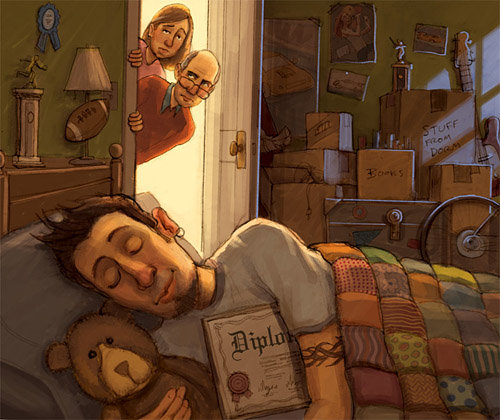
On graduating in 2012

When I was in the first grade I wanted to be an archaeologist.

I wasn’t too big on the actual dinosaurs – I couldn’t tell you whether Brachiosauruses lived in the Triassic or not – but I thought that finding things buried in sand sounded like the most fun anyone could ever have. I became addicted to those little toy blocks of hardened sand that have plastic tyrannosaurus skeletons in them. I drew pictures of myself wearing desert gear and a wide-brimmed hat. I watched Jurassic Park. I taught my 8-year-old self how to spell archaeologist.

If you asked me in the first grade, being an archaeologist was my dream. If you told me, in the first grade, that I’d be going to college for Not Archaeology, I’d be despondent.

When I was a sophomore in college, when I was choosing a track to follow for my psych major, I initially was going to go with neuroscience because it was the most impressive-sounding. I avoided declaring an English major because I was afraid of what my family would think.

We tend to think in extremes when planning or considering the future – I sure did, especially when I was a child. I thought I would marry a movie star; then I made plans to live in the woods for the rest of my life. I imagined the perfect house to be full of pianos and books, and I decided that Heaven must be a dining room with one giant bowl of macaroni and cheese in the center.

Now, my plans are less imaginative but more concrete. Instead of impressiveness, I’m looking for stability. Instead of individuality, I’m looking for ways to fit into work environments. I want my future house to have a laundry room and my conception of Heaven is considerably different from what it was when I was growing up.

And I don’t think this is a bad thing. When I was 8, my central life goal was apparently “coolness.” While coolness is, admittedly, high on my priority list, it’s tempered by “health insurance,” “family,” and “not being homeless.” Similarly, my wish to have an impressive neuroscience major has been tempered by the fact that I wouldn’t actually enjoy working in neuroscience.

I’m enjoying my new, slightly-more-relaxed mindset about my future. I’m glad that I don’t have to achieve grandiose goals to find fulfillment in my life.

But that was what I had been told. I could be the President, or a doctor, or a lawyer! I was an individual. I was special. I could do “anything” – but all the “anythings” listed were only impressive, dramatic, or glamorous anythings.

Now, though, I’m realizing that I don’t want to be an archaeologist, or the President, or an astronaut. I’d prefer a steady job over a glamorous one and a stable home over a dramatic one.

Humans are wired to be slightly delusional, but we often wouldn’t be content with the things that seem ideal to us. Being an archaeologist, while cool-sounding, requires a lot more work that I wouldn’t enjoy than my adolescent self imagined. Neuroscience sounds impressive but the pre-therapy track is way more applicable to my career plans.

I used to imagine myself being an English professor because I liked tea and I imagined it would be a career void of troubles with bureaucracy – I then realized that (a) that second point wasn’t true at all, and (b) I didn’t want to go into academia. My plans now – going to grad school in communication, finding someone who will pay me for doing something I enjoy, and maybe having a family – are more complicated than what I had planned when I was 16, but I’m also more excited about them.

We have the capacity to be discontent wherever we are. I thought that being an archaeologist – and, later, having an impressive major – would be the ideal, and would make me happy. I’m now starting to suspect that nothing’s going to make me happy – at least, not in the way I was expecting.

While there is the possibility of regretting any decision we make, we also have the ability to find contentment and joy in a wide variety of situations. Not all career choices or income levels or house photos will be impressive at class reunions, but sometimes less immediately exciting choices are the things that are actually fulfilling.

A Letter to Anyone Entering the Job Market in 2012

Cynicism about the economy, the job market, and basically anything in “the world today” is inappropriately and lazily fashionable right now, I think. Not that I’m foolish enough to say that the aforementioned institutions have nothing going wrong with them; it’s just that the default conversation seems to too often involve predictions of our gloomy, futureless futures, especially for my demographic – that is, middle class college students in the US.

Those of us who are reading this on the internet, who have enough food to eat, who have clean water to drink and somewhere warm to sleep, and who are able to rely on at least temporary financial assistance from our relatives if we really needed it – we are some of the most privileged people in the world right now, economically and situationally.

To be clear, I don’t think we’re guaranteed happiness. Life is hard. And sad. But I do think that we have been given ample resources to construct a stable and joyful existence, however, and I think that it might be healthy to occasionally reflect upon that fact with a simple and unaffected sense of baffled gratitude.

Students now are groomed not only to succeed academically but to operate professionally. We’ve been taught textbooks worth of information and, more importantly, a work ethic—the emotional benefits of which you can discount if you like but which does, it cannot be denied, set one up rather nicely for social and economic success (in the West at least). Some of us read nonfiction and enjoy it sometimes. Most of us will never be homeless. Almost all of us have some sort of skill that we cultivate for no career-oriented reason. We have learned that sometimes we are wrong, that sometimes our opinions matter and (possibly most importantly) that sometimes they don’t.

And yeah, going from college into the Real World is going to be a rather shocking change for many of us. But I think most of us will thrive on the opportunity to do work for money, after floundering in abstract work while paying lots of money to do so (yes, in the long term this makes sense, but when you are writing a paper at 3 in the morning and think to yourself that this is costing you your life’s savings, the logic of the situation is hard to articulate).

When the terror of post-graduation becomes paralyzing, I think it might be helpful to remember that we are all rather intelligent, capable, ingenuous people. We might get a job the summer after we graduate that has nothing to do with our major, but we will know to be thankful for a job, and we will be able to do it to the best of our overqualified abilities. And we might not be able to achieve whatever two-dimensional ideal of living we hold in our heads (I’m an English major, so for most of my friend group this involves “a cabin in the woods somewhere” and lots of books and wine and maybe facial hair), but I think we have the resources to find joy and a sense of potency in whatever work is at hand, whether it be academic work or scraping by for a few years at a job for which we are wholly overqualified. So I have hope that my generation can survive if given the chance.

Education Inflation and Prolonged Adolescence in Middle Class America

Education Inflation
As college attendance rises, the idea of a bachelor’s degree is starting to take the conceptual place of high school – getting a bachelor’s degree, for the middle class, is becoming the norm, such that students are going to college even if they have absolutely no idea of what they’re going to do with their education.1 Since more people are getting an undergraduate degree, the degree is becoming less impressive; more people pursue terminal degrees and that in turn becomes less of a distinction.  This results in a whole bunch of people attending school longer for degrees that carry less weight.

There’s nothing inherently wrong with the situation above – the increasing education of the population is, by itself, an appealing idea.  The problem is that as the education of the middle class stretches to include a requisite 2-4 years of undergrad and 3 to 5 years of graduate school on top of that, the students aren’t getting any younger.  So we graduate at 27, an age when our parents were married, having children, and buying houses.  To put it succinctly, ousource: http://dioclese.blogspot.comr bodies are saying “babies!”, our advisers are saying “thesis!”, and the largest purchase we’ve made so far is a minifridge.  This doesn’t seem to be bothering us too much, though; we are good at school, we figure, so we might as well remain in the bubble so our loans continue to be subsidized.  We stay in school, we stay in debt, and we stay in our parents’ houses.

The idealism eventually escapes our peer-reviewed brains when we graduate and realize that we don’t know how to buy car insurance.  But that’s really okay because we can ask our parents to do it for us.  They’re right downstairs, after all.

Overstocked and Ungrateful
One major problem is that our generation doesn’t know what to do with what we got – more so than generations before us, we are often oversupplied and oversupported.  We were told we could be anything we wanted to be and were then gingerly placed into the world, too old and too inexperienced.  We are the kids kept inside nice houses so we don’t get our clothes dirty – the kids sent on a field trip to the library with 2 days’ supply of food, a spare rain slicker and an atlas.  We are the safest generation yet.  And we are floundering because of that. Everything was set up for us to be effortlessly happy, but the essence of life is potency, not happiness.  And a 26 year old who has been in school for 21 years does not feel potent.

And then we feel unable to talk about this – what kind of idiot complains about not having enough work?  What kind of ungrateful kid says he or she doesn’t want to be pampered?  But that’s what we have to do.  Because pampering, while incredibly comfortable, is stifling.

And I don’t know what to do with this – like I said before, an increase in the college-educated population is good, and college degrees (once we actually get them) have been shown to increase salaries even in fields unrelated to one’s major.  But the inflation of the college degree has kept a whole generation of students from recognized adulthood, and the results are debilitating.

1They take Psych 101 and whatever else sounds interesting to them, and graduate with a humanities major that their adviser says will look great to graduate schools.