
Most people have heard about the accusations regarding Coca-Cola and unethical practices around the world. While the most serious allegations [union leaders killed in South America1 ] lack concrete evidence, there’s one thing we can be sure of: Dr Pepper hates women.
That may be a little harsh and something I should explain. Since a picture is worth a thousand words, here’s a series of moving pictures to back up what I’m saying:
Dr Pepper Ten, a low-calorie beverage from the Dr Pepper Snapple Group, seeks to target the market of men who aren’t comfortable with drinking diet sodas. John Sicher, editor and publisher of Beverage Digest, reports that “Regular sugared soft drinks have declined in recent years, and some consumers have taste issues with some of the diet sodas.”23
While it’s not a bad idea to have an advertising campaign directed at men, Dr Pepper has gone quite a few steps past that by explicitly excluding women. Like most ad campaigns this one features a Facebook page. A page that can only be viewed if your gender on Facebook is male.
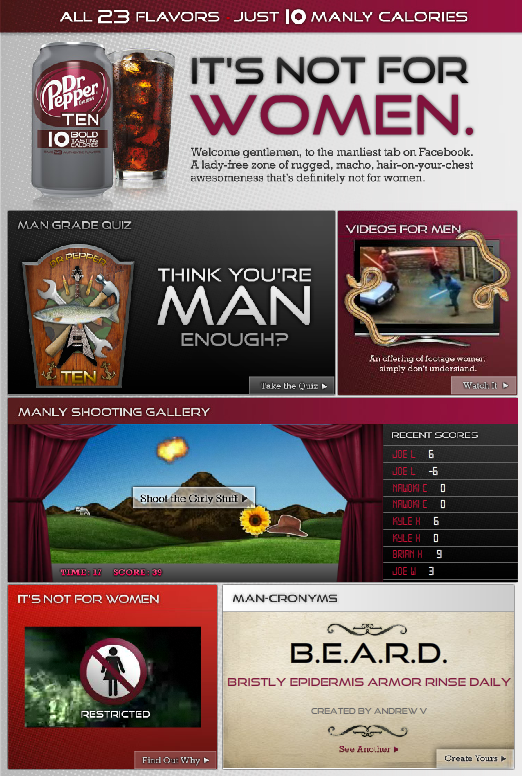
The image above is a pretty good look at that page. One of the many features is a “Manly Shooting Gallery,” as well as a corner for “Man-cronyms,” an example of which is G.O.L.F [Guys Outside Lady-Free]4
Suffice to say, people are upset. There’s been a definite backlash against the product’s ads, primarily from women. In response to these comments, Jim Trebilcock, EVP of marketing for Dr. Pepper, said that “Women get the joke.” The ads were trialed in six US markets prior to being released, and the women polled were not offended.5
The ad campaign does offend me, but not in the same way it does many out there. I’m perplexed and dismayed that this campaign was released in the first place, and that someone thought this would be a good idea. What sort of advertising seeks to cut out half of its possible market? Why was Deutsch LA, the ad agency responsible, thinking?
My guess is that this is all an effect of the oh-so-popular Old Spice ads that starred Isaiah Mustafa. The proceeding commercials with the Fabio6 and the sea captain7 follow the same formula, and similar ads can be seen coming from other companies, Dairy Queen included. Dr Pepper appears to have tried to cash in on this craze, but clearly missed the mark.
1. If that’s something you’re interested in, here’s a link: .http://killercoke.org/
2. From the Associated Press: http://hosted.ap.org/dynamic/stories/U/US_DR_PEPPER_TEN?SITE=KFDMTV&SECTION=HOME&TEMPLATE=DEFAULT
3. I would love to read Beverage Digest.
4. My hatred for this stems from the fact that it’s not even clever. It’s spelled “acronyms,” not “ancronyms.”
5. From this article: http://www.clickz.com/clickz/news/2116660/dr-pepper-draws-female-ire-facebook
6. That weird European guy: http://www.youtube.com/watch?v=ie8yn2J08Qc
7. The coins eventually drowning the couple gets me every time: http://www.youtube.com/watch?v=gzowzUsq6iY&


 Culture War Reporters