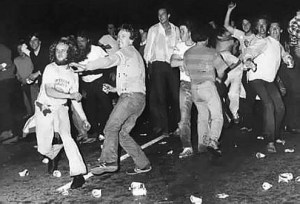
The Stonewall Inn, 1969
The passing of the monumental bill by the NY Senate last Friday (in addition to the UN commitment to protect LGBT rights) demonstrated clearly the increasing social acceptability of same sex marriage. While the movement started and is continuing with the passionate support of marginalized people, the case for same sex marriage is gaining momentum because it is becoming “cooler” to support it – being pro-gay-marriage is slowly becoming the default, and voting against it is more commonly seen as bigoted and discriminatory.
Even just a few years ago, only the more socially liberal Democrats would support same sex marriage (like in 2009, when every Republican and 8 Democratic senators voted the bill down in the New York Senate) – but this last Friday all of the Democrats in the Senate and 4 Republicans voted for gay marriage. So…what changed? 2011’s bill included that amendment that protects the right of religious institutions who refuse to marry same-sex couples, but that wasn’t the only reason – it’s the slow change of what’s socially expected.
In that strange way that things viewed as “radical notions” can eventually trickle down and become accepted common sense, supporting same sex marriage is becoming the the norm. Not long ago, anyone who campaigned for same sex marriage in the US had to explain their case persuasively and passionately to be taken seriously, but now the pressure is shifting to the other side – those who oppose gay marriage are the ones who are required to defend themselves. Being pro-gay-marriage is almost universally assumed for Democrats, and some Republicans are “coming out” as supportive of the cause too, like NY Senator Roy McDonald, who said “f*** it, I don’t care what you think. I’m trying to do the right thing.” Apologetic hand gestures and the requisite “But hear me out…” are being reassigned to the “traditional marriage” crowd – especially among academics, the upper middle class, and young adults, it would seem.
Interestingly, as views on gay marriage are shifting, the view of marriage in general is changing too. The “married scene” (or whatever you would call it) is one filled with unmarried couples who refer to their pets as children, couples who live together for decades before getting married, couples who don’t get married at all, divorce cakes, and an annoyingly-often-quoted-and-never-cited 50% divorce rate.1 The Western idea of marriage is conflicted: we still say “Til death do us part”, we still tend to teach (or at least show) the ideals of marry-young-and-live-Happily-Ever-After, but we’re getting married at an older age2 and marriages don’t tend to last “til death”. I’m not here to argue the healthiness or unhealthiness of divorce or cohabitation, – the point is that, whether good or bad, the idea of marriage is changing in the West, and we don’t seem to be sure into what. Same sex couples are fighting and protesting their way into a strange and fickle club; one that (technically and idealistically) promises lifetime commitment and doesn’t really deliver. It’ll be interesting to see what the statistics will look like for newly married same sex couples in the future.

Outside the Stonewall Inn, June 23, 2011
Support for LGBT marriage rights seems to be going the way of racial equality and women’s rights – our kids are probably going to be baffled at the idea of the Defense of Marriage Act, like we were at some women’s rights and racial discrimination issues that we take for granted. One difference, though, is that same sex couples, unlike women and racial minorities, will definitely always be a minority, unless demographics change hugely (or there are way more of us in the closet than we thought). This is another thing that’s going to make the future interesting for same-sex politics – the discrimination might just cycle around again after all of the people who witnessed the fight for marriage equality are gone, unless the idea of LGBT rights settles itself into a comfortable position as the social norm. That seems to be the case so far.3
1 the best source I could find, figure 13; the second best source I could find
2 source
3But maybe this will be a short-lived trend, considering the growing muslim population in the EU and the US; juxtapose that with the fact that the 7-9ish countries in which homosexual activity is punishable by death (Iran, Sudan, Saudi Arabia, UAE, Mauritania, Yemen, Somalia [Somaliland], Afghanistan [capital punishment until 2009, which is still often unoficially enforced], Pakistan [sometimes, where Shar’ia law applies]) are all Muslim-majority states. If demographic trends continue and Muslim-majority states continue to tend to enforce Shar’ia law, it doesn’t seem that same sex marriage will be able to remain a social norm, at least in Europe, for more than a few decades.





 Culture War Reporters