Tag Archives: sexism

Sexism, Reductionism, and Stepping on Women’s Heads

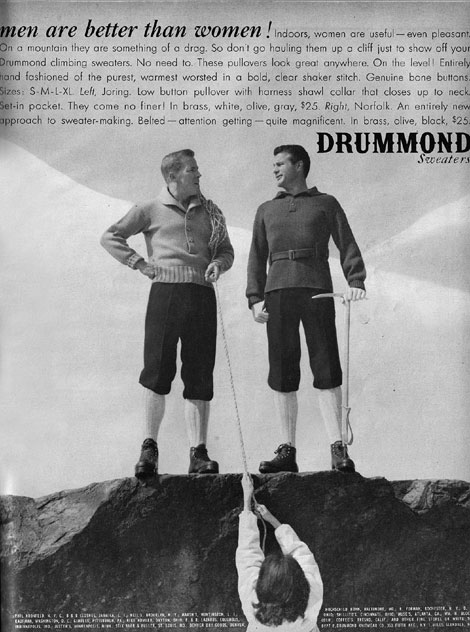
So Retronaut has a page of “Vintage Ad Sexism” – hilariously sexist ads, many of them aimed at men’s pride (“brand new man-talking, power packed patterns that tell her it’s a man’s world”) or women’s insecurities (“Would YOUR husband marry you again?”). There are some gems in there, like these:

source: retronaut.co

I'm just gonna let these speak for themselves.
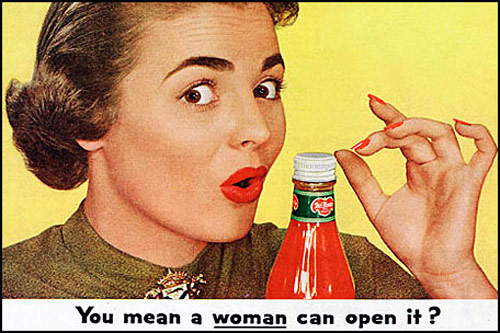
source: retronaut.co

source: retronaut.co

Read some of this one for the full effect
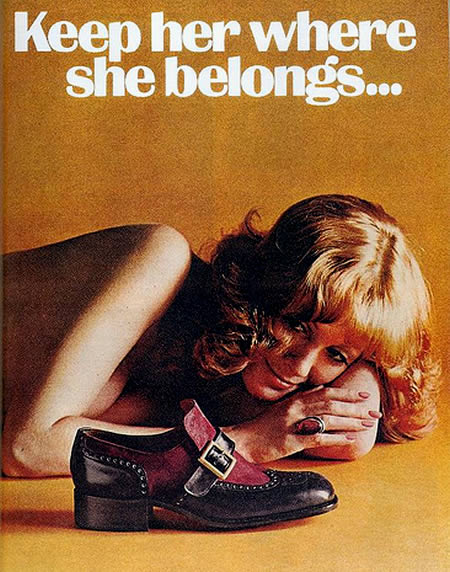
source: retronaut.co

And this one might be my favorite…source: retronaut.co

Aren’t some of them kind of frighteningly recent-looking?

So yeah, we remember sexism, 1919 and women’s suffrage and bra-burning and all that. Being shocked that women couldn’t vote, etc. But seeing advertisements make it more harrowing. Serious political oppression at least treats women with enough dignity to be oppressed – advertisements make light of women as entities. I am less concerned with the essential sexism in these than I am the reduction.

Violence and political oppression are horrid, yes, but reduction is more insidious because it tends to keep hanging around long after voting rights have been own and salaries have been evened out.

The advertisements here, of course, appear ludicrous to us. “Is a wife to blame if she doesn’t know [to use a douche]? Yes! She’s decidedly to blame.” The one with the rug with a woman’s head, the man standing with one foot on her head Captain-Morgan-style. Some of them are just ridiculous.

But it is good to remember that as insane as they may seem, these are real, and they are recent. People who saw these ads and accepted them as a relevant way to advertise a product – people who made the ads, laughed at them, nodded in agreement – still make up a large part of our society today. Even after that generation dies, the fact is that American culture (it’s what I’m talking about here; can’t speak to other places) has been steeped in the reduction of women – and this is not an influence easily shed.

Now, establishing a double standard to “make up” for lost time is not the answer. Ensuring that all males are instilled with a sense of guilt about the past will not help society. Only by awareness of our ideological roots, and the flaws and violence therein, can we stay – or at least slow – regression.

In Defense of Gender Inclusive Language

I used to not care about gender exclusive language at all. I would get a little annoyed when people pushed for gender inclusive language – switching pronouns was confusing, “he/she” was unattractive, “he or she” was cumbersome to the eye, etc. I said that I wanted an equal paycheck before I would ever care about pronouns.

Then, I was at a college art show reading an artist’s statement describing how the artist intended the viewer to experience his painting. He used only female pronouns. I read it and felt, for the first time in my life, included into the default. Included into the hypothetical viewer. When I read hypothetical male-only pronouns, I understand intellectually that the writing is referring to any hypothetical person. But when I read the artist’s statement with female pronouns, for the first time I felt like it could be talking about me.

One of my friends and I had a long discussion about this topic. He had just used the word “man” to refer to all people, and I asked him to use gender inclusive language if he was in fact including both genders in his statement – to which he responded that he never really paid attention to such admonishments of gender exclusivity (exclusiveness?) because even though he was saying the word “man”, he meant “all people”. We had a long discussion, and part of what I told him about was my own experience with how much gender exclusive language affects the experience and thought of the reader, regardless of the intent behind the exclusive words. I also mentioned that in academia, gender exclusive language is not longer considered acceptable in published works at all. Because of that point, he stated that he would try to change his language because I had made a good case about how it can offend women and make them feel excluded from things that are supposedly referring to all people.

And I told him that that wasn’t enough for me. Yes, I think it’s fine to change one’s language to gender inclusive because one earnestly wants to avoid offending people, but I didn’t call him out just because his language offended me; I called him out because he was speaking inaccurately. I think that most people will eventually change their language because gender exclusivity will continue to be considered more and more offensive, and therefore less acceptable in more and more social circles. But if that was the only reason that anyone ever changed the way they spoke, then nothing would have ever changed in the first place.

During the conversation, one of my other friends pointed out to me that women’s rights (from a USA point of view) have come a huge way in just the 90 years since the suffrage movement. Sure. I am grateful for the rights I have, especially the rights that I wouldn’t have had just a century ago. But I’m not calling you out on gender-exclusive language because I’m upset about society being unfair – I’m calling you out because you’re being inaccurate.

I’m not insisting that all of society change right now – I’m insisting that individuals that I speak to speak accurately, and refrain from saying that they “mean” men and women when they only say the word for men. Because you can’t get past that. No matter what you say the words “man” or “he” etc. mean when you say them, you cannot get past the fact that the words themselves are referring to males only. Speaking with gender inclusive language isn’t something you owe to women or hippies or those annoying there-are-no-differences-between-men-and-women-at-all people; it’s something you will want to do if you have any desire to communicate accurately.