Author Archives: Elisa

Lisbeth, the Sexualized Autist: What The Girl with the Dragon Tattoo says about American Culture

Let’s just be clear: I know that The Girl with the Dragon Tattoo is Swedish. My comment is on its popularity in American culture: its best-seller status in the NYT for 18 months, triggering a Hollywood remake of the original Swedish film. The heroine, Lisbeth, is whom I’m most interested in.

Rooney Mara in Girl with the Dragon Tattoo

Noomi Rapace as Lisbeth in the 2009 Swedish film and Rooney Mara in the 2011 American version

Lisbeth is the poster child of counter-culture: mowhawk, dyed hair, androgenous, facial piercings – what attracts people to her is that she manages to pull all of these things off (the reason being she is astoundingly beautiful) and references to her terrible experiences conveniently switch her label from “irresponsible” to “misunderstood”. Lisbeth, I think, represents two key memes in contemporary culture, the subtle prevalance of which interest me: the sexualized autist and the competent social outcast.

The Autist

Rooney Mara in Girl with the Dragon TattooLet me be clear: I’m not talking about a classified DSM-IV disorder when I talk about Lisbeth’s autistic traits – I’m just talking about the word autist as it derives from the root autos (self), which refers to a lack of empathetic sensitivity. Classic autists in fiction include: Spock, Data, Sherlock Holmes, C3PO, Sheldon from The Big Bang Theory, Monk, and (often) children. Autists serve the purpose of deconstructing society: they often involve humorous responses to or dissections of modes of relating that come natural to most humans. Here is Sheldon’s deconstruction of the social idea of dating:

I present to you the Relationship Agreement. A binding covenant that in its 31 pages enumerates, illuminates and codifies the responsibilities of Sheldon Lee Cooper (hereinafter referred to as the “Boyfriend”) and Amy Farrah Fowler (hereinafter referred to as the “Girlfriend”)

In TGWTDT, Lisbeth interacts autistically: one of the first things said about her report is that though it is thorough, it lacks her personal opinion. She, stonefacedly, refuses to acknowledge that she understands any reason why her opinion would be useful. Throughout the movie, Lisbeth is expertly and unthinkingly wholly dedicated to performing her obsessive tasks with excellence: autists almost always are (Monk, River Tam).

The Competent Social Outcast

Rooney Mara in Girl with the Dragon TattooLisbeth’s upbringing and fringe placement in society should, according to social evolution, render her unable to support herself. On the contrary, she achieves competency without the support of society, and spends much of her time defending herself from the flaws of the establishment (every scene with the social worker, his eventual blackmail). She joins Julia Roberts in Pretty Woman, the woman from The 5th Element, and Jane Eyre as the neglected gamines who nonetheless flourish and become experts at fending for themselves.

Sexualized

The essence of Lisbeth’s character is a common one that seems to be increasingly attractive to American audiences: the sexualized, independent autist. This is River Tam from Firefly, the woman from The 5th Element, and is echoed in Edward Cullen from Twilight, Dexter, and Dr. House. These characters reveal society’s increasing fetish of self-efficacy – they exude strength, independence, and provide an expression of rage at the more subtle social injustices and inhibitions of social norms. They do not respond to social patterns and expectations, like Sheldon Cooper or or C3PO, but unlike those humorous characters, the sexualized competent autist provides a violent and hypersexual (almost gnostically sexual – oftentimes, like with Julia Roberts in Pretty Woman and Lisbeth, the characters detach themselves from their sexuality and use it as a tool) successful escape. They offer a character who does not succumb to illogical non-verbal communication and oppressive social codes: they interact logically, not heatedly (Lisbeth asking Mikael for permission to kill a serial killer), and ultimately succeed, and achieve a sexualized, center-character status at that, as opposed to the comic relief status of the typical autist.

What does this say about American culture? I’d say that it indicates a reaction against the stress of social niceties. These movies could be called counter-culture, but a very thinly veiled counter-culture – no, sexualized autistic characters are not appearing in chick flicks with Owen Wilson, but The Girl with the Dragon Tattoo was by no means an obscure movie. The characters precede what I think is going to become a more prevalent theme in American culture: a fetish of successful social rejection.


Rooney Mara in Girl with the Dragon Tattoo

Why You Should Watch Philadelphia’s Mummers Parade Next Year

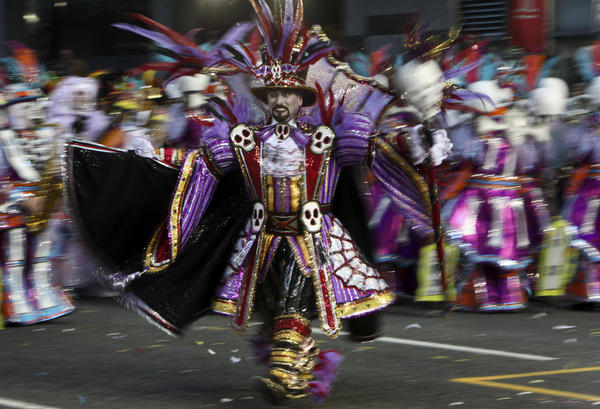
I spent all yesterday watching men in sequins dancing around on the street. I went to Pennsylvania to visit people for New Year’s, and apparently in Pennsylvania (at least around Philly) one watches the Mummers Parade on TV for all of January 1st. It was a very, very strange thing.

source: digital-photography-school.com

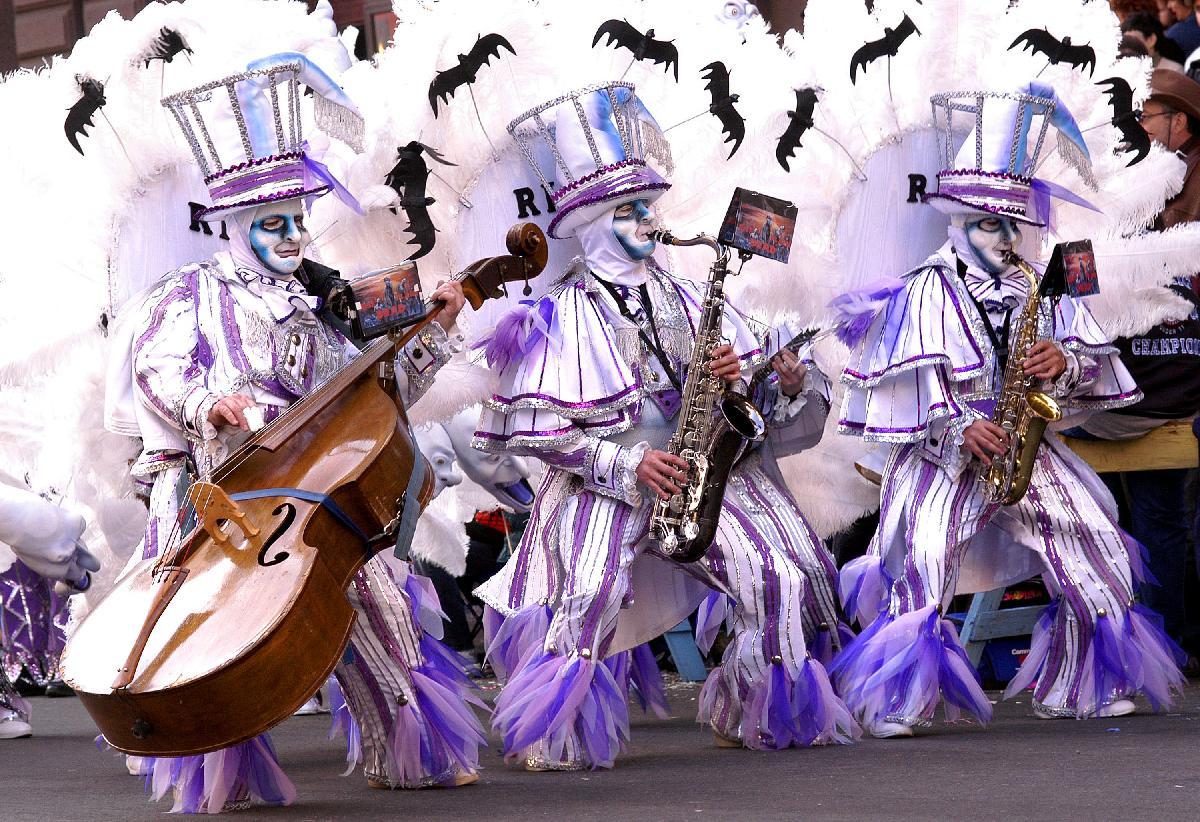
A Mummer. Banjos are sort of a thing.

It was also a beautiful thing. Well, I mean, sometimes it was a pretty hideous thing – I think the mummers get judged on the amount of different colors in their costume, and so sometimes this made the costumes wonderfully ridiculous and elaborate, but some clubs just kind of looked like someone ate a ton of Skittles and glitter and then vomited everywhere. Even the skittle vomit costumes, though, were still super impressive.

source: deseretnews.comThe longest part of the parade was for the fancy brigade: the string bands (like a marching band but with banjos and impressive people marching with string basses and far too many saxophones), who performed elaborate field-show-meets-Broadway-production in the street in the cold. This year’s shows involved dragon heads, people dressed in entire bear costumes, babies, and more feathers and sequins than I have ever seen in my life. The whole thing was reminiscent of Mardi Gras in New Orleans, except with more glitter and less inhibition.

Different sites give different accounts of the origins of the parade, but the gist of it is that the parade started with traditions from Irish, northern European, and Scandinavian immigrants living in PA. The first government-funded parade was in 1901. The tradition apparently had something to do with going door-to-door and singing on the days after feasts (notably Christmas and New Year’s Eve) and begging for leftover food. In England, this type of practice evolved into the tradition of caroling. In Philadelphia, it evolved into this: source: http://www.dweezilzappaworld.com

Mummer captains. The feather fan thing is a theme.

The Mummers Parade was definitely interesting, anthropologically. All of the captains of the fancy [“fancy” here meaning “dipped in sequins”] brigades were interviewed, and it was very strange to hear the lucid and quite normal-seeming 30somethings talk about practicing their entire year to bedeck themselves in glitter and awesomeness in front of the entire city. As a kid from a small town who has been trained (blame my dad) to view cities as community-less miasmas of disconnected worker drones, the enormous display of ritual, excess, and fellowship (albeit bizarre fellowship) was surprising and heartening. Also, as a Northerner accustomed to self-consciousness and grumpiness and cold (one of my friends from Kansas said that he assumed everyone in New York State wore only black) the extravagance complete disregard for any semblance of subtlety was refreshing. Events like the Mummers Parade reveal important things about humans in general, I think: our relative insanity and our love of the sense of community we get from practicing insanity together. So good job, Philadelphia.

GOP 2012: Why Competence and Communication are Important

NB: I’m a registered Democrat, but not a terribly leftist one. I’m a Democrat the way most college students are Democrats, I suspect – by default.


I’ve been thinking about the circus that is the Republican nomination race. You should know that I’m not a politics nut, nor do I plan on being one – but the state of my society does interest me sometimes. The GOP right now is both amusing and extremely sad. A series of caricatures who have served their time as one-month fads leaves me wondering about the state of American politics. The string of slip-up clips zooming through the internet and the idiotic things that these candidates have said might receive too much focus, according to some – but I think that the dismal communication and public speaking skills of the candidates this year is itself something to be concerned about, before even delving into their political views (too complicated for me to do any justice).

Bachman's disastrous Newsweek cover

Michele Bachmann was kind of the first fad of the GOP, and was slammed repeatedly for her bizarre and factually inaccurate comments in public – waxing poetic about New Hampshire, calling it “the state where the shot was heard round the world in Lexington and Concord,” while Lexington and Concord are actually in Massachusetts. She commented on the census, saying that “[My family] won’t be answering any information beyond [number of people in our household], because the Constitution doesn’t require any information beyond that,” which also isn’t true – the Constitution mandates citizens to fill out census forms. Or this gem about carbon dioxide: “carbon dioxide is not a harmful gas, it is a harmless gas. Carbon dioxide is natural. It is not harmful. It is part of Earth’s life cycle…And yet we’re being told that we have to reduce this natural substance and reduce the American standard of living to create an arbitrary reduction in something that is naturally occurring in the earth.” The woman is not a good speaker – she is clearly grasping for patriotic straws when she calls forth grand images of the Revolutionary War, and clearly grasping for Tea Party straws when she pigheadedly and uneducatedly dismisses the idea of global warming. This kind of saying-anything-to-please-a-crowd is not, not at all, a quality one should accept in a presidential candidate.

Rick Perry: Oops

Rick Perry was always too much like GWB to stand a chance. Not terribly substantial – seemed like the kind of guy I’d like to have a beer with but, like W, doesn’t even seem like he’d want to be the president, at the end of the day. I think the stress of even the race was too much for him.

Screenshot from Cain's abysmal campaign commercial

When Herman Cain was declared frontrunner of the Republican Party, it was the last time that I was surprised/horrified at the state of the GOP candidates. Herman Cain, who attended Glenn Beck’s rally in Israel. Herman Cain, who said: “When they ask me who’s the president of Ubeki-beki-beki-beki-stan-stan, I’m going to say, ‘You know, I don’t know. Do you know?'” Herman Cain, who said: “I don’t have facts to back this up, but I happen to believe that these demonstrations are planned and orchestrated to distract from the failed policies of the Obama administration.” Herman Cain, who is a terrible, terrible candidate and appears to be willfully ignorant of foreign policy – or, at least, he imagines that that image is more desirable than utilizing his education.

So once Newt Gingrich was declared frontrunner, the GOP picking terrible candidates was sort of an expected pattern. Newt Gingrich was disgraced in the ’90s for having the worst Speakership in history – he suggested that the government shutdown was a personal attack against him, was the first Speaker of the House to receive ethical sanctions, and resigned in disgrace, commenting: “My only fear would be that if I tried to stay, it would just overshadow whoever my successor is.” I remember his name being the punch-line of jokes when I was a kid.

Also, he calls himself Newt, and he runs under “NEWT 2012”. Even without his ludicrous political career, no president should have an animal name, I’ve decided.

So why, why is the GOP choosing candidates whom I can mock by just quoting things that they actually said? Why are voters sashaying from Neo-Sarah-Palin to Neo-George-W. to Foreign-Policy-Knowledge-Have-Not to Only-Slightly-More-Desirable-As-A-President-Than-An-Actual-Newt?

An attack on the speaking skills of candidates might seem petty, but the speech- and communication- related responsibilities of the United States President are nothing to be neglected. I do suspect that the pressure on a candidate is more intense than in any other political position, and that slips in speech are widely a result of that pressure combined with the rabidness of the amusing-slip-up-snatching-and-amplifying media, but I also think that our standards for the public speaking skills of our president should be high. The pressure on candidates to not commit to anything – to sound good without making any promises – has caused the degeneration of political debates into a rhetoric-slinging festival resembling arguing grade schoolers.

These people are politicians – they have college degrees – they were popular enough to make it into the political scene and be elected to (in most cases) at least one high government office and run it with some level of competence. At least, that’s what I stubbornly assume, as I am afraid to allow myself to abandon all my hope in the political system. So let’s assume that the candidates are fairly competent and can sometimes speak without sounding like grade schoolers. Why, then, is everything about the GOP race so ridiculous?

I think that the 2012 GOP race so far demonstrates the logical extreme of a system built on fear of commitment and fear of offending even the most idiotic constituents. Noncommital and pretty-sounding political doublespeak is ridiculous in itself and always has been; in this year’s race, the insipid rhetoric has been deconstructed to reveal its logical core: nonsense. Politicians have been trained to say nothing for a long time; instead of learning what they need to know, they only need to be able to appear to know it; we are beginning to see the evidence of this more obviously. And with it, the apparent neglect of the American public to remember that the President is not only a likeable face, but the Commander in Chief of our army; not only a spearhead for conservative/liberal policy (depending on his/her affiliation, obvs.) but a position with the opportunity to encourage negotiation between the two sides of Congress and a key communicator with heads of state of other countries. And that is why the state of the GOP leanings isn’t just amusing – it’s dismal. Discouraging. One can only hope that the nominee will be someone we can take seriously.

Kim Jong-il is Dead; Nobody Knows What is Going on in North Korea (Still)

source: christanpost.com
So Kim Jung Il has died, purportedly, and I have no other choice but to write about it. Not really as a political analyst (okay not at all as a political analyst), but just as someone who kind of watches world events like sports, in a nihilistic sort of way.

Right around 10:20pm EST the Associated Press announced that North Korea said that Kim Jong-il was dead. ABC and the NYT quickly reported the story, saying that Korean Central TV reported: “Our great leader Comrade Kim Jong-il passed away at 8:30 a.m. on Dec. 17.” 8:30am in North Korea translates to 6:30 pm EST on Friday.

source: nyt.com

Kim Jong-un, the cheerful new dictator of North Korea

So what on Earth is going to happen to North Korea? Will the dictator’s death grip on the media continue? Kim Jong-il did some crazy things – Kijong-dong, for one, which was an entire empty city built in view of South Korea in the 50s to encourage defection. There was the claim that he was born under a double rainbow, that he scored 38 below par on his first golf game (and then promptly retired), and that he was a “worldwide fashion icon”. The idea of truth coming out of North Korea is roughly equivalent to tactful and thoughtful speech coming out of Rush Limbaugh. The whole event of Kim’s death and the transfer of power to Kim Jong-un is steeped in uncertainty. Heck, even the New York Times doesn’t know exactly how old Kim Jong-un is.

So the world is just kind of freaking out this morning. China’s pretty nervous. Everyone’s wondering what the long-oppressed people of North Korea are going to do – is the regime’s cult so ingrained in people’s heads that they will complacently move right on to Kim Jong-un as the most handsome and benevolent evil dictator ever? This event passing with no unrest in North Korea would be the most depressing thing ever.

Of course, this event causing violence between the North and South Koreas which ended up in someone (North Korea, the US…) using an atomic bomb would also be pretty depressing. The US, China, Japan, and Europe are all kind of staring at North Korea the way one would stare at a baby that just picked up a carving knife. North Korea test-fired missiles right before they announced Kim Jong-il’s death, so that’s not exciting at all. Stocks in China fell significantly. South Korea placed all of its military units on alert.

I have no parting comments. We’ll see what happens. While we wait, go to this hilarious Tumblr of Kim Jong-il looking at things for some comic relief.

Let’s Quit Overthinking Philanthropy

The reason I didn’t want to talk about donating to charity, especially during the Christmas season, is because it’s so often portrayed and spoken of as a thought-free, morally spotless, warm-fuzzy inducing act. A no-brainer. Nothing to fret over. It’s also often one of those things we try to exchange for middle-class guilt; we donate $50 to charity in order to feel free to spend hundreds (thousands) on ourselves and our family and friends without qualms.

The act of donating to charity is a pit of postmodern angst: it’s cliché, it breeds self-righteousness, it can make a student go crazy with self-consciousness and infinite reevaluations of our “real motivations,” and it can instill in us (alternately) a false sense of optimism or a nihilistic feeling of despair and ultimate uselessness (when the realization of the ratio between our donations and our own frivolous personal expenses sets in). It is not, by any means, a no-brainer.

Another problem with donating is that charities are confusing and sometimes we don’t agree with how they operate. We can look up budget reports all day and still not ever really know how charities and government organizations decide which families get turkeys. Also, religious NGOs may direct finances towards pro-life or anti-gay-rights legislation; secular charitable organizations might fund birth control distribution, military support, or homosexual rights. Odds are, you’re going to disagree with some practice of whatever organization you choose.

What I’m worried about is when the confusing details and qualms prevent or inhibit action; we discuss donating to charities, argue about different ones, donate less than we could, and then feel guilty about our own prosperity – the whole process becomes so unpleasantly self-conscious that we begin to avoid it. A lot of us went through a period as children when we got excited about giving money to the poor; then we realized that the hole we’re trying to fill is bottomless. And yeah: social service is like that. It’s bottomless. Need is never ending. Because of this, if we donate to charity with the idea of fixing things permanently, or to assuage some sense of guilt, our worry and shame in this case will only compound upon themselves. And the poor can’t fill their children’s stockings with middle-class guilt.

But seriously. Yes, it feels stupid to think that your two dollars will “make a difference in someone’s life”. Yes, even the bother of donating something is enough to keep our money in our pockets. Yes, it’s a little paralyzing to think of how much we’re giving versus how much we’re keeping and receiving. But seriously. Seriously – just stop analyzing your intentions and donate something. Suck up your self-conscious selves, do some research and deposit some money into your community. Something is better than nothing, but nothing will ever be enough, so don’t feel useless for donating a small amount and don’t feel too satisfied for donating a large amount. And don’t think you have to defend your decision not to donate anything, or fear that you donated less than you think other people think you could or should have, or avoid donating because of your qualms about your possibly selfish motivations — either write a check or don’t, and stop fretting about it so much.The reason I didn’t want to talk about donating to charity, especially during the Christmas season, is because it’s so often portrayed and spoken of as a thought-free, morally spotless, warm-fuzzy inducing act. A no-brainer. Nothing to fret over. It’s also often one of those things we try to exchange for middle-class guilt; we donate $50 to charity in order to feel free to spend hundreds (thousands) on ourselves and our family and friends without qualms.

The act of donating to charity is a pit of postmodern angst: it’s cliché, it breeds self-righteousness, it can make a student go crazy with self-consciousness and infinite reevaluations of our “real motivations,” and it can instill in us (alternately) a false sense of optimism or a nihilistic feeling of despair and ultimate uselessness (when the realization of the ratio between our donations and our own frivolous personal expenses sets in). It is not, by any means, a no-brainer.

Another problem with donating is that charities are confusing and sometimes we don’t agree with how they operate. We can look up budget reports all day and still not ever really know how charities and government organizations decide which families get turkeys. Also, religious NGOs may direct finances towards pro-life or anti-gay-rights legislation; secular charitable organizations might fund birth control distribution, military support, or homosexual rights. Odds are, you’re going to disagree with some practice of whatever organization you choose.

What I’m worried about is when the confusing details and qualms prevent or inhibit action; we discuss donating to charities, argue about different ones, donate less than we could, and then feel guilty about our own prosperity – the whole process becomes so unpleasantly self-conscious that we begin to avoid it. A lot of us went through a period as children when we got excited about giving money to the poor; then we realized that the hole we’re trying to fill is bottomless. And yeah: social service is like that. It’s bottomless. Need is never ending. Because of this, if we donate to charity with the idea of fixing things permanently, or to assuage some sense of guilt, our worry and shame in this case will only compound upon themselves. And the poor can’t fill their children’s stockings with middle-class guilt.

But seriously. Yes, it feels stupid to think that your two dollars will “make a difference in someone’s life”. Yes, even the bother of donating something is enough to keep our money in our pockets. Yes, it’s a little paralyzing to think of how much we’re giving versus how much we’re keeping and receiving. But seriously. Seriously – just stop analyzing your intentions and donate something. Suck up your self-conscious selves, do some research and deposit some money into your community. Something is better than nothing, but nothing will ever be enough, so don’t feel useless for donating a small amount and don’t feel too satisfied for donating a large amount. And don’t think you have to defend your decision not to donate anything, or fear that you donated less than you think other people think you could or should have, or avoid donating because of your qualms about your possibly selfish motivations — either write a check or don’t, and stop fretting about it so much.

Les Miserables Movie 2012 (?): Mostly Exciting

LES MIS – it’s one of those things about which people who are familiar with it are very excited, and the rest of the world has no idea what it is or what is going on.

Info has been trickling into the internet for the past few months, and with any movie like this, people almost immediately get pretty rabid about the casting, so let’s muse over that for a while.

Hugh Jackman and Russel Crowe are to play Jean Valjean and Javert, respectively. This is so perfect that I have no snarky comment to make about it. I am so excited it makes me feel ill.

Geoffrey Rush will play Thenardier in the new Les Mis movie. Bizarrely, both of these pictures are of him.

Another illness-level-of-excitement-inducing thing: Geoffrey Rush will play Thenardier and will be terrifyingly perfect for the role. Rush was actually already in the crappily adapted 1998 movie(the one with Liam Neeson and Uma Thurman) as Javert, and he did a fine job (as he is a fine actor), but will be more impressive in a borderline caricature role like Thenardier, I think.

Mme. Thenardier will be played by Helena Bonham Carter. All right. Obviously. There is the risk that her in the role will be too similar to her Mrs. Lovett in Sweeney Todd.

Helena Bonham Carter: beautiful enough for Hollywood, strange-looking enough for caricatures.

It already seems like all her as Mrs. Lovett would need to become Mme. Thenardier is a little less goth and worse teeth. She will be terrifying and beautiful, to be sure, but I don’t know if that’ll be super interesting at this point, weirdly. Helena Bonham Carter in The King’s Speech interests me more than another Helena Bonham Carter with eyeshadow sinking her cheekbones.
 
Anne Hathaway will be Fantine. This will make some people mad – especially considering the unexcited response to Alice in Wonderland. Amy Adams was purportedly also considered for the role, and it’s sort of surprising that she didn’t get it – she seems to be the new Anne Hathaway-type character, with more popular movies (to the younger crowd) lately. This could be good for Hathaway. It could also be bad for the movie. Maybe that’s just because I still define Anne Hathaway by The Princess Diaries.
 
A shortlist for the role of Eponine has been released, which includes Scarlett Johansson, Taylor Swift, Evan Rachel Wood, and Lea Michele. This is mildly worrisome – some of my reasons might be petty but still, worrisome. Eponine is about 15; Scarlett Johansson is 27 – and wouldn’t easily or believably look much younger (she’s usually made to look older than she is) (look at the woman’s body, for goodness’ sake). At the thought of Taylor Swift, a blonde country singer, being cast as the neglected and not-as-pretty-as-Cosette Eponine, rabid teenage musical theater buffs will gnash their teeth. Lea Michele reportedly “knocked it out of the park” at her audition – but I can’t see how Lea Michele could escape her role as the obnoxious and talented belting alto from Glee. Eponine being such a classic role does nothing to help that – it’s a role that Rachel from Glee would play. I do prefer Lea Michele in terms of her capability for annoyingness over the other 3; Eponine’s role is supposed to be tragic and self-pitying, not demure and victimized.
 

Eddie Redmayne in The Pillars of the Earth miniseries

Eddie Redmayne (Jack in the Pillars of the Earth Series) will be Marius; he will be appropriately annoyingly earnest and attractive.


They’re actually holding an open casting call for the role of Cosette in NYC. In the context of the rest of the cast, this obviously indicates the young, ingenue quality that the casting directors are looking for – an unknown talent (a la Robin Wright in The Princess Bride) in between Russell Crowe and Geoffrey Rush. It’s a pretty common take on Cosette – it might idealize the character a little too much, but that’s a large part of the novel itself.

Theater geeks are on the prowl as information comes out. There are rumors that the movie might be released in 2013, not 2012, as filming is expected to last through the summer.

What I’m nerdily looking forward to is seeing what they’re going to do with the accents – even though the film is set in France, the theater community is kind of used to hearing everything in cockney (as they all have the original London cast CD) – will they speak with an American accent? With a French accent (like the Russians speaking English with a Russian accent in K-19)? Or will they just throw some British accents in there to make it more foreign-seeming (like in the 1998 Les Miserables, The Prince of Persia, all of the Star Wars movies, Gladiator…)? So we’ll see what choice they make with that. One just hopes the singing will be good.