Author Archives: Elisa

Slacktivism, or: Elisa feels bad about saying that philanthropy might not always be awesome

This New York Times 2010 article, which I think ends rather too optimistically, discusses two instances of the Red Cross’ use of Twitter to help raise funds from the US after a typhoon in the Philippines and the following earthquake in Haiti a few months later. After the typhoon, the Red Cross’ toll-free donation number was a trending topic on Twitter; the article says that thousands of people were posting it and asking their followers to donate – but, in spite of all of the Twitter attention, there wasn’t any noticeable change in donations. After the Haiti earthquakes, the Red Cross launched a similar Twitter campaign, but instead of having to call a number, people could just text a single word to a certain number to donate $10. The Red Cross raised 3 million dollars in 48 hours.

Beyond the moral and ethical questions about slacktivism, simple practical issues interest me: how much people’s altruism increases in relation to its ease, if distanced giving lets us avoid the overwhelming sense of incompleteness and unending need that often comes from volunteering or working for charities in RL…

And yeah, social networking has done wonders for people who otherwise wouldn’t be able to communicate or have a way to organize themselves – the election protests in Iran, for example. But I’m talking about things like the hunger site, where you go to their adful page and click a button to give “the value of 1.1 cups of food” to feed the hungry (also, now, to support education, veterans, abandoned pets, mammograms, the rainforest…), or care2.com, which has a similar “click once to give” thing as well as a “Petition Site” which literally has a “Today’s Hottest Petitions” link on their home page.

It seems like each separate out-of-borders emergency or consistently-in-need-of-funding-issue has a random YouTube video’s chance at viraldom to make it in to the public’s consciousness long enough for us to donate to it.

Yeah, every dollar that’s made via slacktivism, either the free advertiser-supported kind or the donate-easily-via-texting kind, does work. But the satisfied well-that’s-my-good-deed-for-the-week feeling that such distanced altruism gives is worrisome, because it instills a conclusive, complacent feeling that will ultimately be the death of any culture’s drive towards public service and philanthropy.

The Debt Ceiling: A Summary for People Who Don’t Know What The Debt Ceiling Is

So if you live in or have heard of the United States then you’ve probably heard lots of people talking about the whole debt ceiling deal, and if you’re the average internet peruser you probably have no idea what they’re talking about most of the time. Honestly, neither do I. So I’ve spent the last while skimming only the best Wikipedia articles, clicking on every relevant link on the New York Times website, and harrassing my one (1) political-science-inclined friend to get a very general idea of what all is going on – I call it The Grossly Simplified and Possibly Only Pseudo-Accurate Debt Ceiling for English Majors: A Love Story.source: www.sodahead.com

BackgroundDebt is accrued, kind of obviously, when the government spends more than its revenue.  In order to keep funding public programs and paying gov’t salaries, etc., Congress basically sells debt to people, and according to somewhere in the Constitution, Congress is the only thing that can borrow money on the America’s credit. So back in the day, like founding-of-the-US-through-the-early-20th-century-day, Congress had to individually approve every time it borrowed money.  During WWI, we were borrowing so much money on credit (i.e., selling debt to people and countries) that Congress decided to kind of streamline the process and just say, “eh, it’s all approved – just don’t go over . . . let’s say 11.5 billion dollars” [not adjusted for inflation].  Since then, each time the US debt was approaching the debt ceiling limit, congress would raise the limit – which has happened like 76-78 times, depending on who you ask.

And so the current debt ceiling (it’s like 14 trillion and something) was “reached” sometime in March, and the government can’t borrow any more money – so we’ve just been paying the interest on our loans. But we’re going to run out of money to pay that interest pretty soon, about August 3, is what’s been estimated, so we either have to raise the debt ceiling or default on our loans, which is basically saying “uh, hey folks, remember when we said we would pay you back? Well, we can’t. Don’t know what you wanna do about that.”

People argue about what would happen if we defaulted. Some say that the world economy would, if not completely collapse, definitely develop a very nasty limp. Others say that it wouldn’t be all that bad for reasons I don’t quite understand. Some people say that China (which owns more than half of all our foreign-held debt) will come over and shake us upside down so our lunch money falls out of our pockets. Rush Limbaugh says that Obama chose August 2nd as the deadline because it’s the day before Ramadan.

source: blog.cunysustainablecities.org

Since 1962 Congress has raised the debt ceiling 72 times

So what’s different now from all those other times that the debt ceiling was raised, as far as I can tell, is that Republicans, who hold the majority of the house of representatives, think that they can use the urgency of the situation to get the Dems and the White House to agree to a budget that they wouldn’t normally approve.  This is coupled with the fact that there is a bigger representation of the Tea Party, especially among junior representatives, than there has been before, and many of those junior representatives campaigned on promises to not raise taxes or do anything that looks or smells remotely like raising taxes ever in their lives. There are two ways to reduce deficit: reduce spending and raise taxes. The Republicans are pushing budgets that reduce spending but don’t increase taxes (or even just let the Bush tax cuts expire, or reform corporate tax laws that allow corporations to take loopholes and get out of paying taxes at all). This makes this difficult for everyone to get along.

So that’s the summary of what’s sort of going on. As the date draws nearer, things get sketchier – like, right now, it’d be impossible for anyone to write up a comprehensive budget by then. There was even talk of the Republicans just making a decision to not raise the ceiling, which the president can then veto, just so they can still say they voted against it. The closer we get to August 3, the hairier and more confusing things get. But that’s an attempt at a summary of the context of the whole issue.

Thoughts on MetaCelebrity

So Stephen Colbert recently got his Super PAC approved – which means that he can raise an unlimited amount of money, as well as advertise for his PAC on Comedy Central. The approval has brought attention to large role privately-run PACs are going to play in the next election – and brought up questions about the legitimacy of the process as a whole.

Colbert’s Super PAC allows him to raise unlimited amounts of money from whoever he wants; he has stated a goal of ‘infinity dollars’.

The Colbert Report has been doing strange things with reality for quite a while, of course – the myriad overlaps between Steve Colber[T] and his alter ego; the 2006 elephant Wikipedia thing, the selling of his wrist cast for charity, and his various in-character and semi-in-character appearances on Bill O’Reilly’s show, doubly ironic rallies, and before Congress. Stephen Colbert’s character has been breaking the boundaries of his allotted time slot since the show’s inception. People don’t even talk about Steve Colbert the comedian – he seems to be kind of a low-key guy; little is known about him that can be wholly differentiated from his pretentiously pronounced character.

Two other examples of this blurring of public and private life: Miley Cyrus/Hannah Montana (I can’t really comment too much on this, but I DO know now that there was a show and a movie and that they are the same girl but one of them is sometimes a cartoon or something), and Lady Gaga, who has said that she considers her entire life a performance.

Lady Gaga arrived at the Grammy’s in an egg. There isn’t really much more to say.

So what is this thing? Why are fictional characters bleeding into real life? Well, in the case of Colbert’s Super PAC, it’s like a pop-up book version of satire – it’s a real-life critique that plays by the rules of the society it’s critiquing, legally approved and earning real money and possibly having a real effect on the election.

And meta-awareness is the key to mainstream comedy right now: The Simpsons (with their constant in-show jokes and references to Fox), anything by Seth McFarlane, Community, Parks and Recreation, Arrested Development (Arrested Development sooo muuch), and 30 Rock, eg. It’s not enough to just be funny within the show anymore – shows need to make audiences feel like they’re in on one huge inside joke.

Characters and stories in the media have to be aware of what they are, and go outside it, for audiences to appreciate them.

Well, I mean, that’s the heart of satire, right? The acknowledgment of the form. It’s why all the songs in the Book of Mormon are so dang catchy – because the music is everything that is catchy and addictive about Broadway boiled down into one show. And so it’s like stories and characters can’t just be stories and characters anymore – they have to be aware of what they are, and go outside it, for audiences to appreciate them.

The interesting thing is that I think this indicates a certain inability to lose our self-consciousness – it’s like we can’t enjoy ourselves unless we’re letting everyone know that we know what’s going on – that we’re willingly playing along with entertainment’s game. Entertainment is becoming more and more about who is breaking the fourth wall and how well, and so we abandon the maintenance of any sense of separation – that other-worldy, play-acting quality that movies, shows, and characters used to have. Entertainment is no longer contained within the realm of fiction. I’m not sure if this is good or bad or just a natural evolution of a communication-saturated society, but there it is. We seem to have abandoned all possibility of the acceptance of myth, and now everything has to be self-aware.

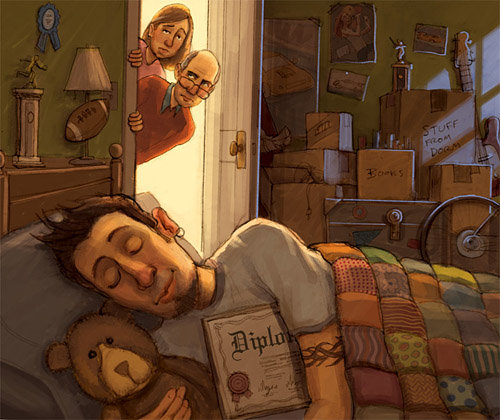
Education Inflation and Prolonged Adolescence in Middle Class America

Education Inflation
As college attendance rises, the idea of a bachelor’s degree is starting to take the conceptual place of high school – getting a bachelor’s degree, for the middle class, is becoming the norm, such that students are going to college even if they have absolutely no idea of what they’re going to do with their education.1 Since more people are getting an undergraduate degree, the degree is becoming less impressive; more people pursue terminal degrees and that in turn becomes less of a distinction.  This results in a whole bunch of people attending school longer for degrees that carry less weight.

There’s nothing inherently wrong with the situation above – the increasing education of the population is, by itself, an appealing idea.  The problem is that as the education of the middle class stretches to include a requisite 2-4 years of undergrad and 3 to 5 years of graduate school on top of that, the students aren’t getting any younger.  So we graduate at 27, an age when our parents were married, having children, and buying houses.  To put it succinctly, ousource: http://dioclese.blogspot.comr bodies are saying “babies!”, our advisers are saying “thesis!”, and the largest purchase we’ve made so far is a minifridge.  This doesn’t seem to be bothering us too much, though; we are good at school, we figure, so we might as well remain in the bubble so our loans continue to be subsidized.  We stay in school, we stay in debt, and we stay in our parents’ houses.

The idealism eventually escapes our peer-reviewed brains when we graduate and realize that we don’t know how to buy car insurance.  But that’s really okay because we can ask our parents to do it for us.  They’re right downstairs, after all.

Overstocked and Ungrateful
One major problem is that our generation doesn’t know what to do with what we got – more so than generations before us, we are often oversupplied and oversupported.  We were told we could be anything we wanted to be and were then gingerly placed into the world, too old and too inexperienced.  We are the kids kept inside nice houses so we don’t get our clothes dirty – the kids sent on a field trip to the library with 2 days’ supply of food, a spare rain slicker and an atlas.  We are the safest generation yet.  And we are floundering because of that. Everything was set up for us to be effortlessly happy, but the essence of life is potency, not happiness.  And a 26 year old who has been in school for 21 years does not feel potent.

And then we feel unable to talk about this – what kind of idiot complains about not having enough work?  What kind of ungrateful kid says he or she doesn’t want to be pampered?  But that’s what we have to do.  Because pampering, while incredibly comfortable, is stifling.

And I don’t know what to do with this – like I said before, an increase in the college-educated population is good, and college degrees (once we actually get them) have been shown to increase salaries even in fields unrelated to one’s major.  But the inflation of the college degree has kept a whole generation of students from recognized adulthood, and the results are debilitating.

1They take Psych 101 and whatever else sounds interesting to them, and graduate with a humanities major that their adviser says will look great to graduate schools.

In Defense of Gender Inclusive Language

I used to not care about gender exclusive language at all. I would get a little annoyed when people pushed for gender inclusive language – switching pronouns was confusing, “he/she” was unattractive, “he or she” was cumbersome to the eye, etc. I said that I wanted an equal paycheck before I would ever care about pronouns.

Then, I was at a college art show reading an artist’s statement describing how the artist intended the viewer to experience his painting. He used only female pronouns. I read it and felt, for the first time in my life, included into the default. Included into the hypothetical viewer. When I read hypothetical male-only pronouns, I understand intellectually that the writing is referring to any hypothetical person. But when I read the artist’s statement with female pronouns, for the first time I felt like it could be talking about me.

One of my friends and I had a long discussion about this topic. He had just used the word “man” to refer to all people, and I asked him to use gender inclusive language if he was in fact including both genders in his statement – to which he responded that he never really paid attention to such admonishments of gender exclusivity (exclusiveness?) because even though he was saying the word “man”, he meant “all people”. We had a long discussion, and part of what I told him about was my own experience with how much gender exclusive language affects the experience and thought of the reader, regardless of the intent behind the exclusive words. I also mentioned that in academia, gender exclusive language is not longer considered acceptable in published works at all. Because of that point, he stated that he would try to change his language because I had made a good case about how it can offend women and make them feel excluded from things that are supposedly referring to all people.

And I told him that that wasn’t enough for me. Yes, I think it’s fine to change one’s language to gender inclusive because one earnestly wants to avoid offending people, but I didn’t call him out just because his language offended me; I called him out because he was speaking inaccurately. I think that most people will eventually change their language because gender exclusivity will continue to be considered more and more offensive, and therefore less acceptable in more and more social circles. But if that was the only reason that anyone ever changed the way they spoke, then nothing would have ever changed in the first place.

During the conversation, one of my other friends pointed out to me that women’s rights (from a USA point of view) have come a huge way in just the 90 years since the suffrage movement. Sure. I am grateful for the rights I have, especially the rights that I wouldn’t have had just a century ago. But I’m not calling you out on gender-exclusive language because I’m upset about society being unfair – I’m calling you out because you’re being inaccurate.

I’m not insisting that all of society change right now – I’m insisting that individuals that I speak to speak accurately, and refrain from saying that they “mean” men and women when they only say the word for men. Because you can’t get past that. No matter what you say the words “man” or “he” etc. mean when you say them, you cannot get past the fact that the words themselves are referring to males only. Speaking with gender inclusive language isn’t something you owe to women or hippies or those annoying there-are-no-differences-between-men-and-women-at-all people; it’s something you will want to do if you have any desire to communicate accurately.

Same Sex Marriage in the Current Context

source: www.theamericanmagazine.com

The Stonewall Inn, 1969

The passing of the monumental bill by the NY Senate last Friday (in addition to the UN commitment to protect LGBT rights) demonstrated clearly the increasing social acceptability of same sex marriage. While the movement started and is continuing with the passionate support of marginalized people, the case for same sex marriage is gaining momentum because it is becoming “cooler” to support it – being pro-gay-marriage is slowly becoming the default, and voting against it is more commonly seen as bigoted and discriminatory.

Even just a few years ago, only the more socially liberal Democrats would support same sex marriage (like in 2009, when every Republican and 8 Democratic senators voted the bill down in the New York Senate) – but this last Friday all of the Democrats in the Senate and 4 Republicans voted for gay marriage.  So…what changed? 2011’s bill included that amendment that protects the right of religious institutions who refuse to marry same-sex couples, but that wasn’t the only reason – it’s the slow change of what’s socially expected.

In that strange way that things viewed as “radical notions” can eventually trickle down and become accepted common sense, supporting same sex marriage is becoming the the norm.  Not long ago, anyone who campaigned for same sex marriage in the US had to explain their case persuasively and passionately to be taken seriously, but now the pressure is shifting to the other side – those who oppose gay marriage are the ones who are required to defend themselves. Being pro-gay-marriage is almost universally assumed for Democrats, and some Republicans are “coming out” as supportive of the cause too, like NY Senator Roy McDonald, who said “f*** it, I don’t care what you think. I’m trying to do the right thing.” Apologetic hand gestures and the requisite “But hear me out…” are being reassigned to the “traditional marriage” crowd – especially among academics, the upper middle class, and young adults, it would seem.

Interestingly, as views on gay marriage are shifting, the view of marriage in general is changing too. The “married scene” (or whatever you would call it) is one filled with unmarried couples who refer to their pets as children, couples who live together for decades before getting married, couples who don’t get married at all, divorce cakes, and an annoyingly-often-quoted-and-never-cited 50% divorce rate.The Western idea of marriage is conflicted: we still say “Til death do us part”, we still tend to teach (or at least show) the ideals of marry-young-and-live-Happily-Ever-After, but we’re getting married at an older age2 and marriages don’t tend to last “til death”.  I’m not here to argue the healthiness or unhealthiness of divorce or cohabitation, – the point is that, whether good or bad, the idea of marriage is changing in the West, and we don’t seem to be sure into what.  Same sex couples are fighting and protesting their way into a strange and fickle club; one that (technically and idealistically) promises lifetime commitment and doesn’t really deliver.  It’ll be interesting to see what the statistics will look like for newly married same sex couples in the future.

source: www.nytime.com/slideshow/2011/06/25

Outside the Stonewall Inn, June 23, 2011

Support for LGBT marriage rights seems to be going the way of racial equality and women’s rights – our kids are probably going to be baffled at the idea of the Defense of Marriage Act, like we were at some women’s rights and racial discrimination issues that we take for granted. One difference, though, is that same sex couples, unlike women and racial minorities, will definitely always be a minority, unless demographics change hugely (or there are way more of us in the closet than we thought). This is another thing that’s going to make the future interesting for same-sex politics – the discrimination might just cycle around again after all of the people who witnessed the fight for marriage equality are gone, unless the idea of LGBT rights settles itself into a comfortable position as the social norm. That seems to be the case so far.3

1 the best source I could find, figure 13; the second best source I could find
2 source
3But maybe this will be a short-lived trend, considering the growing muslim population in the EU and the US; juxtapose that with the fact that the 7-9ish countries in which homosexual activity is punishable by death (Iran, Sudan, Saudi Arabia, UAE, Mauritania, Yemen, Somalia [Somaliland], Afghanistan [capital punishment until 2009, which is still often unoficially enforced], Pakistan [sometimes, where Shar’ia law applies]) are all Muslim-majority states. If demographic trends continue and Muslim-majority states continue to tend to enforce Shar’ia law, it doesn’t seem that same sex marriage will be able to remain a social norm, at least in Europe, for more than a few decades.