Category Archives: comics

The Representation of East Asian Characters in Two Popular Western Comic Strips

Familiar to almost anyone who grew up in America, Archie Comics has told the stories of a fairly interesting group of teenagers living in the town of Riverdale for decades. First established in 1939 these comics are still published today, 72 years of panels featuring that insipid redhead Archie Andrews and his friends [who I actually don’t mind]. The comic strip Zits, on the other hand, was first published in 1997, and has for 14 years chronicled the misadventures of much-more-modern teenager Jeremy Duncan and his own group of eclectic young people.

It’s not difficult to see how the two [a single strip and all those created by an entire company] are similar to one another. Both are about American teenagers and their day-to-day lives, albeit living in very different eras. Having originated in the late 30s Archie and his friends have moved forward generation after generation, yet stick to a much lighter tone in regards to issues that teenagers have to face. Zits, starting at the turn of the 20th century, has a more realistic view of the high school years, addressing such topics as the disconnect between teenagers and their parents, the short attention span of today’s youth, and so on.

What I would like to explore and elaborate upon is the representation of Asian characters, specifically those of East Asian descent. Both of these comics are [or, at the very least, have been] immensely popular, and as a result their content is in part representative of what the West [in this case Canada and America] is familiar and comfortable with. Continue reading
Attitudes Towards Feminism in the Past Week

Last week I edited the introduction of a 75,000 word manuscript that I had worked on in May, it being emailed to me long after the original job was complete. It was, by and large, about the feminist movement in the UK, and how it has lessened the nation as a whole. It cited the “ladettes,” which the Concise Oxford Dictionary defines as “Young women who behave in a boisterously assertive or crude manner and engage in heavy drinking sessions,” as a subject of particular disgust.

It grew more and more subjective as it went on, and denounced the “feminazis” as intensely angry women who felt little for the role of motherhood and were destroying chivalry. High subjectivity aside, on the whole he railed against these most extreme cases, acknowledging the need decades had past for gender equality in the workplace. This was by far the most reasonable standpoint I was witness to.

The day before that it was brought to my attention that Scott Adams, the creator of Dilbert, had once again written another blog post sure to start the internet buzzing. In response to the wave of news discussing men who have been cheating on their wives, tweeting pictures of their genitals, and raping, he explains that men are born “round pegs in a society full of square holes.” In other words, the society we live in today is constraining, keeping males in “a state of continuous unfulfilled urges, more commonly known as unhappiness.”

I’ve heard two of my English professors say that we always hope for our heroes to have risen above the thoughts of their time period. From the front of the classroom they often wore their disappointment clearly when this was not the case, such as Shakespeare’s portrayal of Shylock in The Merchant of Venice. Dilbert is a tremendously well-written comic strip, and in this case it’s saddening that an artist behind such a hilarious comic would also be the creator of such wildly offensive posts.

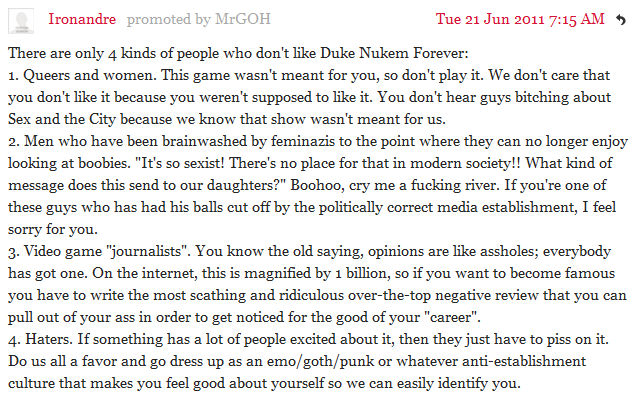
Last week, after some 15 years of development, Duke Nukem Forever was finally released. Decried by many as being overtly crude, disturbingly misogynistic, and having boring, repetitive gameplay, the comments sections of any article discussing the game became a place rife with conflict. Many staunch supporters of the game came out with some very strong opinions, the following catching my eye:

Internet Comments: A Cornucopia of Well Thought Out Opinions

This was found here, and I don’t have much else to say about it specifically. Duke Nukem Forever garnered terrible reviews, so much so that their public relations firm announced that they would be “reviewing who gets games [to review] next time and who doesn’t.” Everyone, however, is entitled to their own opinion.

In posts to come I hope to more fully explore the backlash against feminism that I believe to be an emerging trend. For every action there is an equal and opposite reaction, though in this case it appears to be a more extreme retaliation, to the point where the sensitive male is ousted as being a traitor to his gender.

This has been attitudes towards feminism in the past week.