Category Archives: video games

Why I Disagree With Dota 2

Gamers everywhere were rejoicing yesterday as Valve released the first official footage of their newest game, DotA 2, made more special by the fact that the footage was from a livestream of the first DotA 2 tournament ever.

To back up a little, DotA, or Defence of the Ancients, is a custom game mode for the Blizzard-made RTS WarCraft III. Although many mods of the game exist, there are none that can compare to the popularity that DotA has with the gaming community. Influential to the point that it has spawned its own genre of video game,and been the inspiration for the similar titles League of Legends and Heroes of Newerth, DotA has actually become a  feature at worldwide tournaments, including the Asian World Cyber Games. To say that this is just another mod is an immense understatement.

For a bit of background on Valve, they have been the brilliant minds that havebrought us titles such as Half-Life, Left 4 Dead, and Portal. For the most part these are all games that are saturated with narrative and feature inventive, innovative gameplay. Valve has long been seen as a company that deeply cares for its fans, their constant release of new content for the [now free to play] shooter Team Fortress 2 being a prime example.

On October 13th of last year, Valve announced that they were creating DotA 2. IceFrog, a modder who maintained and developed the original game was hired by the company in 2009 and has since been working on the sequel.

That last word is one of my first issues with the game. The very usage of the name “DotA” with the addition of the “2” seems to state that this is yet another sequel to another already-owned property, such as Half-Life 2. This could not be further from the truth. While IceFrog did help a great deal in furthering the game, as a mod it belongs to the community that helped create it, the hundreds of men and women who suggested heroes or contributed icons or penned lore for the heroes they loved playing as. The name, of course, was chosen simply for familiarity, which brings me to my next point.

In order to ease players into the transition from the WarCraft III mod to the new and improved DotA 2 Valve needed more than just a title. According to Game Informer:3

DotA-Allstars‘ roster of 100+ heroes is being brought over in its entirety. The single map games take place on is functionally identical to the one that you can download for free today in the Warcraft III mod. Items, skills, and upgrade paths are unchanged. Some hero skills work slightly better due to being freed from the now-ancient Warcraft III engine, but Dota 2 will be instantly familiar to any DotA player.

Along with the heroes being brought over were their models. Since the world editor in Warcraft III only allowed for so much customization, unit models from the game itself were used in DotA. Instantly recognizable after years of playing the mod, Valve chose to make their heroes look as close to their blockier counterparts as possible.

To the left is an example of the icons used for the heroes, the ones on the left from DotA and the ones on the right from DotA 2.

The first, Prophet [known as Nature’s Prophet in Dota 2], features the same beard and horns, as well as facial tattoos. What was even more disconcerting, however, was the name of the image file for the latter, “furion_lg.png.” Furion is the name of the original hero, and is actually taken from a character in WarCraft III itself.

The second is known by Dazzle in both games, and clearly depicts a troll-ish kind of creature with a skull face tattoo. The colouration is extremely similar.

The third, called Storm Spirit by both, gets only slightly more original. Instead of portraying a humanoid panda DotA 2 instead changes the character to a human, albeit wearing extremely similar garb.

Valve has always been a company that pumped out solid, original content, and watching the tournament replays of this game made me deeply upset. The Anti-Mage attacks just as he always did with long, curved blades on each hand, Leshrac gallops swiftly forward on all fours, torso rocking back rhythmically as usual.

I could point out countless similarities, especially to character design that has always been distinctly Blizzard’s, but I won’t. The fact of the matter is that the easiest way to familiarize a gamer with something new is to show them exactly what they’ve seen before. A muscular red orc with a topknot hefting an immense axe remains exactly that, even with sleeker graphics.

DotA 2 is a game that has a very large number of players waiting to get their hands on it. The genre is only growing more and more popular, and Valve has found a way to successfully cash in on that market. It’s just a shame that this was the way that they chose to do it.

1. See? There’s even a Wikipedia page on it! <http://en.wikipedia.org/wiki/Dota_genre>

2. Seriously, no strings attached. <http://www.tf2.com/freetoplay/>

3.  Source to this and much of the other facts in this post: <http://www.gameinformer.com/b/features/archive/2010/10/13/dota-2-announced-details.aspx>

Guilt in The Congo and the Koprulu Sector

Fairly spoilery.
                                                                                                                                                                      

No matter the medium, there have always been dominant themes in literature. Whether it be the theme of adulthood in About a Boy or the exploration of childhood in Calvin and Hobbes, writers have long voiced their opinions in their work, stating their viewpoints on universal experience. This can clearly be seen in the real time strategy game StarCraft II: Wings of Liberty and the novel The Poisonwood Bible. Though [literally] worlds apart in format and subject matter,  the two are bound together beneath the overarching theme of guilt.

Wings of Liberty‘s Jim Raynor is a man haunted by the ghosts of his past. The sector’s current tyrant, Emperor Mengsk, rules with an iron fist and sits proudly upon his throne due to the former-marshal’s aid in the first war. This despot betrayed Raynor’s love, Sarah Kerrigan, by ordering her to place a device on the capital planet which would lure in the voracious Zerg like moths to a flame, and then abandoning her to them. The Zerg would later transform Kerrigan into a creature known far and wide as the Queen of Blades, a malicious killing machine who would later terrorize the sector and kill Raynor’s closest Protoss ally and friend.

Four years later Raynor is taking steps to topple the government he helped establish. His band of rebels is working to right the wrong that is the Terran Dominion, but even in spite of this the loss of Kerrigan and his guilt over her abandonment remain. These feelings are exacerbated when his old friend Tychus Findlay walks back into his life. Years earlier Tychus took the blame for both of them and was incarcerated for nine years. His reappearance in Raynor’s life brings back countless memories of the good ol’ days, and Raynor is forced to constantly defend his friend against the suspicions and accusations of his crew.

As victories accumulate an opportunity arises, a chance to reclaim the Queen of Blades and restore Sarah Kerrigan to her former self arises. However, the source of the offer is Mengsk’s son, bringing him dangerously close to the man he wants dead. The gripping conclusion of the first chapter of the StarCraft II trilogy involves Raynor having to choose between two regrets, two immense sources of guilt, and his decision holds the fate of their world in its hands.

The Poisonwood Bible is the story of the Prices, a Baptist family who moves from Georgia to the unfamiliar wilds of the Congo. Narrated by the five women of the family, the tale is seen and told through the eyes of Orleanna, wife of preacher Nathan Price, and their daughters, Rachel, the eldest, Leah and Adah, the diametric twins, and Ruth May, the youngest. Originally planning on only staying for a year, their missionary tenure in the village of Kilanga is set awry by political upsets, many of which are caused by their own government.

The Prices do not adjust well to life in Africa, and the strain of life in an unfamiliar land is evident in their interactions with one another. While guilt is not present in their lives from the get-go, things take a sharp downhill turn once Nathan Price begins to force Christianity upon the villagers in a manner which borders on antagonistic. Their lives are placed in danger when political unrest begins to encroach on the borders of their existence in Kilanga and natural disasters such as a drought and the resulting famine cause many of them to wish they had never travelled to the Congo in the first place. Guilt’s immense weight finally falls, however, at the death of one of the Price daughters. None of the narrators are exempt from this event, and all are bowed beneath its burden as they move on with their lives, never quite leaving the past behind them.

The second wave of guilt is felt only by some, and it directly involves the once-hopeful nation of the Congo. America’s desire for cheap diamonds and cobalt leads to a scheme that will put the leader they want in charge of the country, a plan which will overthrow the newly-elected Patrice Lumumba, voice of the Congolese. Western guilt lies leaden on the shoulders of most (but not all) of the Price women, the actions of the Belgians in the colonial era and the actions of their own American countrymen in the post-colonial. Lives and hopes lost at the hands of their Western brethren force them to reconsider who they are as people, and to try their best to come to some sort of reconciliation.
Jim Raynor and Orleanna Price both have lines which, while appearing simple on the surface, speak volumes about who they are and what they’ve done with their lives. Facing his final decision Raynor says, “We are who we choose to be,” a line almost stupidly simple at first glance. In it, however, these seven words manage to encompass his decision to turn away from a life of crime to become a marshal, and then a rebel freedom fighter, a path Tychus looks upon scornfully. These words contain within them his choice to set aside revenge for closure, to save lives instead of sit back, and, finally, his decision to choose between what appears just and what could be redemption.

Orleanna, in the first few pages of the book, tells the reader, “One has only a life of one’s own.” This straightforward statement means more and more as the narrative progresses, yet from the beginning it reveals that she does not really feel needed or loved, and thus has only herself as company. As the novel goes on Orleanna makes her own pivotal decision, one that directly affects her remaining daughters and their lives to come. Opting to set aside her weak-willed self and to put on strength and intensity, she becomes a woman motivated by the eventual safety of what family she has left.

StarCraft II: Wings of Liberty and The Poisonwood Bible both feature protagonists who are riddled with guilt and yet seek freedom from it, who are forced to face it and move on, and who make their largest decisions in the midst of disaster, panic, and betrayal. Both have lived lives full of regrets, yet firmly choose to make one less mistake, for the sake of others and not for themselves.

Kingsolver, Barbara. The Poisonwood Bible. New York: Harper Flamingo, 1998. Print.

StarCraft II: Wings of Liberty. V 1.0.1.16195. 31 July 2010. Blizzard Entertainment. 31 July 2010.

“Rape”

Three days ago a very close friend of mine and I were watching the StarCraft II podcast The State of the Game, an episode of which was specifically discussing foul language and the professional gaming scene.1 I turned to him and casually asked him what his stance on the subject was, a question which began a debate that lasted the better part of an hour.

This post is very difficult for me to write. I face the challenge of having to fairly represent our respective opinions, and I worry I will portray our separate viewpoints with a bias of some sort. In spite of this, I will try to press on and do my best.


Our discussion was, as you may have guessed from the title of this post, on the usage of the word “rape,” specifically in the context of the gaming community. To those perhaps unfamiliar with the terminology, the second entry on Urban Dictionary reads: “To utterly defeat another person in any form of competitive activies [sic].”2  An example of it being used would be someone saying to his friends, in the aftermath of a victorious Halo match, “We just raped those guys.”

My standpoint being that the word shouldn’t be used in this manner, my first point was one that INcontroL3 (Geoff Robinson) made, that its usage is harmful to e-sports in that it lowers the community in the eyes of others. My friend’s response [hereafter referred to as T] was that the context needs to be taken into account; if the word is being used in a setting where everyone fully understands the meaning behind the word [i.e. a StarCraft II stream] then there shouldn’t be any problem.

Outside of that specific context, T pointed out that language is an ever-changing thing, a sentiment I couldn’t, and can’t, disagree with. We give words both meaning and connotation, therefore it is fully within our power to change the words if we’d like. He went so far as to say that the word “rape” has already changed, fully appropriated by the gaming community. My argument was that although this may be the case, this change certainly didn’t need to occur. I wanted to address this trend in popular culture, the inclination to forever push our boundaries [moral and otherwise], but that would have been off topic and is for another time.

Similar to that point, however, I stressed that the word was chosen for a reason. A counterpoint to what he said about “rape” losing its meaning, I brought up the fact that it has such strength about it. It’s a loaded word, and was chosen for its level of offensiveness. Just because you’re no longer stating that you are going to sexually attack another person doesn’t erase the original sentiment behind the word choice.

Lastly, and what many of you may have been thinking while reading this, is that the word “rape” has such potential to offend. Those who have been or personally know rape victims may be very hurt by hearing the word thrown around so casually. A point against hypersensitivity was then made by T: we use much more violent terms such as “kill” and “murder” in regards to video games, so why is there never any outcry made concerning those who have had friends or family murdered?

Furthermore, there is a case to be made for discernment. T placed a lot of emphasis on the ability of the average person to know what the context behind the word is. If someone involved in a contest of any kind [be it video games or basketball] uses the word “rape” and directs it at their opponent then it is immediately assumed that they don’t mean the actual definition of the word. When I once again brought up those who were offended we were brought full circle to his point about the evolution of language.

T reminded me that language is in a state of continual development, and at the very least we are in a transitional period. I argued back that if this transition is going to offend and hurt others, then it would be better if it didn’t happen.  There is also the matter of those same people being hurt and offended even after the transition has fully taken place.

After all was said and done we agreed on a few points, yet it was apparent that on others we would remain divided. According to the Online Etymology Dictionary4, the Latin word “rapere” simply mean to “seize, carry off by force, abduct”;  it wasn’t until the 15th century that the more sexual aspects of the word began to be used. It may be that a few years down the line the word “rape” is thrown around as casually as “beat.” My stance, however, was never that words can change their meaning, but that sometimes they shouldn’t have to.


1. Source: http://blip.tv/sotg/starcraft-2-state-of-the-game-ep41-5229247 [starts again {was discussed earlier} at around 1:50:50]

2. Source: http://www.urbandictionary.com/define.php?term=rape

3. If you really want to know who this guy is: http://wiki.teamliquid.net/starcraft2/INcontroL

4. Source: http://www.etymonline.com/index.php?search=rape&searchmode=none

Attitudes Towards Feminism in the Past Week

Last week I edited the introduction of a 75,000 word manuscript that I had worked on in May, it being emailed to me long after the original job was complete. It was, by and large, about the feminist movement in the UK, and how it has lessened the nation as a whole. It cited the “ladettes,” which the Concise Oxford Dictionary defines as “Young women who behave in a boisterously assertive or crude manner and engage in heavy drinking sessions,” as a subject of particular disgust.

It grew more and more subjective as it went on, and denounced the “feminazis” as intensely angry women who felt little for the role of motherhood and were destroying chivalry. High subjectivity aside, on the whole he railed against these most extreme cases, acknowledging the need decades had past for gender equality in the workplace. This was by far the most reasonable standpoint I was witness to.

The day before that it was brought to my attention that Scott Adams, the creator of Dilbert, had once again written another blog post sure to start the internet buzzing. In response to the wave of news discussing men who have been cheating on their wives, tweeting pictures of their genitals, and raping, he explains that men are born “round pegs in a society full of square holes.” In other words, the society we live in today is constraining, keeping males in “a state of continuous unfulfilled urges, more commonly known as unhappiness.”

I’ve heard two of my English professors say that we always hope for our heroes to have risen above the thoughts of their time period. From the front of the classroom they often wore their disappointment clearly when this was not the case, such as Shakespeare’s portrayal of Shylock in The Merchant of Venice. Dilbert is a tremendously well-written comic strip, and in this case it’s saddening that an artist behind such a hilarious comic would also be the creator of such wildly offensive posts.

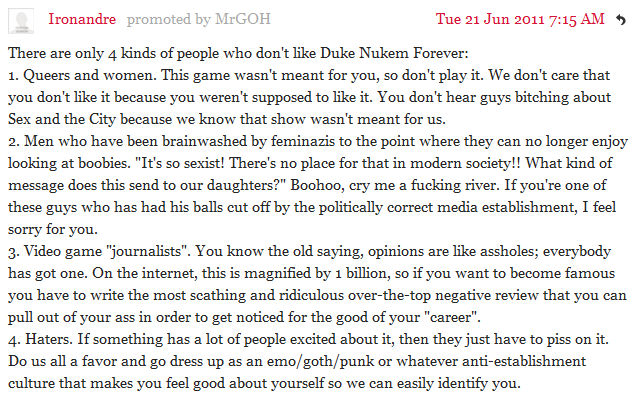
Last week, after some 15 years of development, Duke Nukem Forever was finally released. Decried by many as being overtly crude, disturbingly misogynistic, and having boring, repetitive gameplay, the comments sections of any article discussing the game became a place rife with conflict. Many staunch supporters of the game came out with some very strong opinions, the following catching my eye:

Internet Comments: A Cornucopia of Well Thought Out Opinions

This was found here, and I don’t have much else to say about it specifically. Duke Nukem Forever garnered terrible reviews, so much so that their public relations firm announced that they would be “reviewing who gets games [to review] next time and who doesn’t.” Everyone, however, is entitled to their own opinion.

In posts to come I hope to more fully explore the backlash against feminism that I believe to be an emerging trend. For every action there is an equal and opposite reaction, though in this case it appears to be a more extreme retaliation, to the point where the sensitive male is ousted as being a traitor to his gender.

This has been attitudes towards feminism in the past week.