Tag Archives: journalism

Neil Young and the Tar Sands

On January 12, 2014 Canadian singer Neil Young spoke out against the Alberta Tar Sands on his “Honour the Treaties” tour to “raise money for the legal fight against the expansion of the Athabasca oil sands in northern Alberta and other similar projects, in Toronto.” I’ve included the video for you to see for yourself below. 

Since deciding to speak out Young has been under a considerable amount of criticism. A radio station in Fort McMurray has responded with a “No Neil” day. They’ve been trying to get the #notawasteland hashtag trending on twitter and banned his music on their station. One of my favorite journalists (that’s sarcasm, FYI), Rex Murphy, insists that Young is a “man who cannot distinguish the nuclear bombing of city from a worksite [and] is plainly in need of rest and instruction.”  A spokesperson for the Canadian government responded by saying that “Even the lifestyle of a rock star relies, to some degree, on the resources developed by thousands of hard-working Canadians every day.”

I first heard about Young’s controversial statement on CBC radio as the host asked callers to respond with their opinion. The reoccurring theme coming from callers seemed to be “what does he know”. As a young person I found it especially frustrating when callers would insist that youth would now follow Young’s cause in droves, because you know us young people, we just do whatever celebrities tell us to. Continue reading

Fame Day: Us VS The US

A few weeks from now will see the 50th anniversary of the “March on Washington for Jobs and Freedom”- the “March on Washington” as it is abbreviated today. Through the sweltering heart, the Reverend Doctor Martin Luther King Jr. boomed out his famous “I Have A Dream” speech. Most everyone is familiar with the beginning, but lesser known is what King had to say later in the oration.

In a sense we have come to our nation’s capital to cash a check. When the architects of our republic wrote the magnificent words of the Constitution and the Declaration of Independence, they were signing a promissory note to which every American was to fall heir… It is obvious today that America has defaulted on this promissory note insofar as her citizens of color are concerned. Instead of honoring this sacred obligation, America has given the Negro people a bad check, a check which has come back marked “insufficient funds.”

But we refuse to believe that the bank of justice is bankrupt.

Now I have a tendency to rail on America. Having been at the pointed end of US foreign policy, I don’t believe I’m unjustified in doing so. But for everything that this nation let’s slide, for everything wrong, I can always count on some American to live out the example described by King and demand the US hold true to the noble ideals it claims it was founded upon. On this 4th of July, I’d like to showcase some of the men and women who I believe are standing up and speaking out. Continue reading

Terrible Moments in News Media (Not Limited to Rush Limbaugh)

Note: This is a version of a piece I wrote this with my brilliant friend Chris Hartline for our student newspaper, and am reprinting it here. Any goodness in it may be credited to him.

Most of the public is aware of Rush Limbaugh’s stupid and unfunny bit in which he referred to a Georgetown student as a “prostitute” and a “slut” for saying that Georgetown health insurance should cover contraception.

source: lifenews.com

Do not pay attention to this man. He will make you sad.

But the name-calling does not stop there: other instances of sexist slander have been just as offensive but haven’t received as much news coverage as Limbaugh’s insult. Bill Maher, a liberal comedian and amateur political commentator on HBO, referred to Sarah Palin as “a tw-t” and “a c-nt”. Chris Matthews, MSNBC host, called Hillary Clinton “witchy,” “uppity,” and claimed that she was elected to the Senate only because her “husband messed around.”
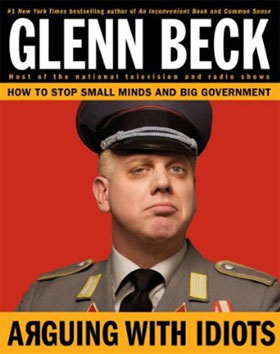
source: glennbeck.com

Looks like public discourse to me.

The state of the news media today is disheartening because the system of acidity seems to be self-perpetuating. Indeed, truculence has become a prevailing rhetorical device. Keith Olbermann had a segment on his show (and a book) called “The Worst Person in the World”. Glenn Beck wrote a book in 2009 called “Arguing with Idiots: How to Stop Small Minds and Big Government”.

Another clear manifestation of the deficit of trust of the media was a 2009 poll done by Time magazine. Walter Cronkite held the title (since 1974) of “Most Trusted Man in America”. Cronkite was the most visible figure in the media, which at the time provided objective discourse and information to the public, and he died in 2009. In the subsequent Time poll, voters said that the most trusted news anchor in America was Comedy Central host and political satirist Jon Stewart.

The fact is that the media is supposed to provide a momentary stay against political hostility, an unbiased source of objective information for the public, and that it is not doing this. Consequently, the public is losing their faith in the news media, and by extension the American political system itself.

The media has become tool used by political parties to influence the opinions of the public. A blatant example of this is the “Plan for Putting the GOP in the News” memo from the Nixon administration. The 15-page memo was anonymous, and has written comments on it by Nixon’s then-advisor and current Fox News President Roger Ailes.

Roger Ailes!

Roger Ailes: founding CEO of Fox News and adviser to Nixon, Reagan, and Bush. Also credited for possessing the world's least attractive set of jowls.

The memo stated that television was the best medium for political persuasion because of its imminent popularity: “People are lazy. With television you just sit – watch – listen.  The thinking is done for you.” The plan was to record prepackaged interviews with Republican politicians and deliver the videotapes to local news stations. Presently, critics say that Fox News has demonstrated their role as an arm of the Republican Party.

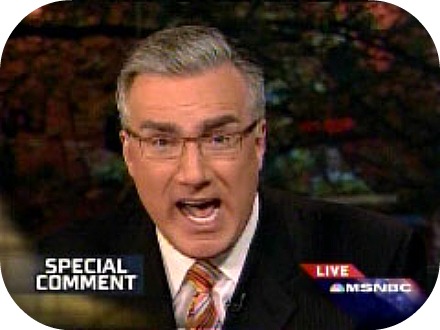
source: msnbc.com

All you need to know about Keith Olbermann is that he's not a pleasant person.

MSNBC, while on the opposite side of the political spectrum from Fox News, is similar in its audacious political stance. In a distasteful and recurring ending rant on his show, former host Keith Olbermann once shouted (his monologue was directed at then-President Bush), “This war is not about you … shut the hell up!”. Fellow host Chris Matthews also said after a 2008 Obama speech that he “felt this thrill going up my leg as Obama spoke.”

So it can be concluded that the media has become unabashedly partisan. Even the very fact that it is standard for each major newspaper to endorse a presidential candidate reflects a problem in the nature of journalism. It results in an overtly ideological news organization – the New York Times is liberal, the Wall Street Journal is conservative; the Washington Post is liberal, the Washington Times is conservative, etc.

A news staff tending to lean one way on the opinions page is typical and expected; however, the fear is that the ideological slant of the editorial pages will seep into the news coverage. The potential and underlying ‘spin’ of news stories becomes more important than the objectivity of the events being reported.

And maybe the Nixon administration’s prediction about the easy audience of television was prescient: political commentary television programs can be especially caustic and, at times, juvenile. They seem to appeal to the lowest common denominator of the public and of individuals. Keith Olbermann, Glenn Beck, Rachel Maddow, and Bill O’Reilly are all political commentators who base their rhetoric on the petty mockery of whoever disagrees with them – their arguments are negative, not positive, and clever insults take precedent over constructive criticism.
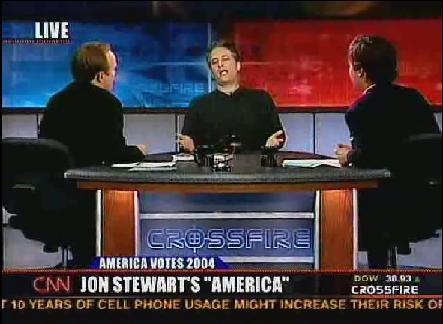
source: portland.indymedia.org

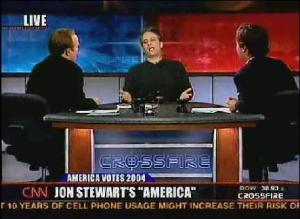
Jon Stewart pleads with the hosts of Crossfire to "stop hurting America." Crossfire was cancelled shortly after Stewart's interview.

The media itself has not only lost its ability to objectively inform the public of unbiased political events – it has become a tool for fostering and encouraging political contention. The role of the news media is not just lost – it has been perverted. As Jon Stewart said to the hosts of Crossfire, this inflammation of petty and theatrical bickering isn’t just bad journalism – it’s hurting America.

David Brooks said: “There’s a collapse in the public’s faith in American institutions. The media has done a poor job. We’ve become as insular and self-regarding as any [other institution].” It is no wonder, then, that there is a deficit of trust among the younger generations – the apparent disintegration of the integrity of our news sources is nothing less than repelling.


News written by computers will make opinions matter more

For the first time, automatically generated articles are becoming practical for news sources to use – this carries interesting implications for journalism and internet writing. A variety of news sites, including The Big Ten Network, have published articles generated by a computer program written by Narrative Science, a company that uses computer algorithms to generate news articles. It saves money on writers and the public can’t really tell the difference. Here’s an excerpt from an article generated by Narrative Science [from MediaBistro]:

“Wisconsin jumped out to an early lead and never looked back in a 51-17 win over UNLV on Thursday at Camp Randall Stadium. The Badgers scored 20 points in the first quarter on a Russell Wilson touchdown pass, a Montee Ball touchdown run and a James White touchdown run. Wisconsin’s offense dominated the Rebels’ defense. The Badgers racked up 499 total yards in the game including 258 yards passing and 251 yards on the ground.”

The program, for sports articles, will even determine the MVP of the game and select a photograph to use for the article.

This is an interesting development in the “What the frick is going to happen to journalism?” question that is frequently discussed. And yeah, the fact that articles can be generated like the above, saving publishers time and money, does seem to be another pretty strong indicator of the slow and hard-to-watch decay of journalism. But I don’t think that the demand for a professional, reliable, and enjoyable source of important information is going to go away – not enough to eliminate the need for good news sources completely. I think that a story like the one above points to the fact that journalism is going to change, possibly drastically, to fill a slightly new niche in contemporary society.

One thing that might happen is the inflation of value in organic things – things clearly human, like more creative sentence structure, original metaphor, and distinct voice. I think there is a strong possibility of a reaction against cheaply written, algorithmic writing – whether computer-generated (as in the sports article quoted in the mediabistro article) or written by a sad and poorly paid writer (as in the 98% of sports articles that sound exactly like the computer generated one that are basically written by the thesaurus entries for “won” and “lost”. Not that such writing would cease to exist, but that it would fade into the background, especially amongst higher quality internet publications, the way low-quality websites do now: they contain information, but if we can tell nobody put any time into designing or laying out the website, nobody’s going to read it. I think that with the advent of more commonly computer-generated writing, readers are going to become more sensitive to what was written by a person and what is simply stark information.

As previously hard-to-get interviews and inside data (stuff stops being hard-to-get once it goes on the web) become more ubiquitous, the thing that is going to make a publication stand out in the market will be wit, voice, narrative skill, and opinion. IE, a good opinion article that you find yourself reading the whole way through will be distinctly more important to publishers and editors than an article that simply relays information that you can get from a variety of headlines.

News sources will also need to provide more background information that explains news stories. Again, the news about the latest events in Libya could be found throughout the internet, but the NYT offers topics pages on Libya (Wikipedia-esque), interactive maps of the conflicts as they unfold day-by-day, copious links to news analysis, and debates and predictions about what will happen next.

This, not cold journalism, is what is going to make or break internet news sources. Readers will be affected by how much they can interact with the information, how much they can learn in one place, and the level of trust they place in not the veracity of the information being relayed (that can be checked against any other news source instantaneously available to him/her) but the arrangement and explanation of that information.