Tag Archives: politics

Why We Need Graphic Violence

Once upon a time, a lion was sent to the king of Sweden. After it died, its skin and bones were sent to a taxidermist so that the animal could be stuffed and preserved- the only problem was that this was the eighteenth century, and the taxidermist had never seen a lion before. His resulting work was this:

With only the most cursory knowledge of what a lion was, the work turned-out something that looks like it was pulled straight from a Looney-Tunes episode.

I’d suggest laughing at that picture for as long as you can- the rest of this post is going to be pretty unpleasant.

Most people’s Facebook news feeds are made up of snippets of conservations between friends, invitations to apps you’ll never use, the occasional rant, and baby pictures. Most people, but not so much me- only I do get to see pictures of babies, but more on that in a minute.

See, I grew up in the Middle East, specifically in Syria. For those of you who don’t keep up with the news (at all), my adopted homeland is currently in the grips of a brutal civil war. One of the ways the rebels and dissidents spread news is through social media- especially Facebook, and having “liked” such pages as “Syrian Days of Rage” and “Syrian Revolution 2011”, my news feed is mostly comprised of grainy YouTube videos of soldiers declaring their defection to the Free Syrian Army (FSA), or pictures of mass protests, or of a solitary Republic flag tied to a streetlight. Or a baby.

I warned you before that things were going to become unpleasant- again, if you’re sensitive, stop reading now.

This picture was of a baby who was killed in Gaza during the short-lived but brutal Gaza war in the early weeks of 2009. It was a bombing that killed the child. It was burned so badly the skin still on it had been turned soot-black, and was tight and shiny. You might mistake it for one of those life-sized baby dolls if two broken femurs hadn’t been sticking out where the legs should have been, or if the flesh around the left arm hadn’t melted off the bone.

It was frozen like that. Eyes closed and head rolled back so that against all reason, it looks like her or she could have been sleeping. The body’s held up by a Red Crescent paramedic, and there are no words in any language that will ever describe the look that’s on his face.

There are more of them. A young man on a hospital bed, the right side of his jaw ripped open and hanging against his neck, smiling as best as he still can and gesturing the peace sign. A man killed in a shelling bombardment, held together with white gauze and bedsheets.  A little boy, dead on the floor, drenched in blood and the right side of his body blown off.

That last one was from earlier today.

Last week, I mentioned how this generation is living in the longest war in American history, three times as long as WWII. I want to underscore this. I’m twenty one, and more than half of my existence has been during a period of uninterrupted conflict. I was eleven years old when the US went to war in Afghanistan, and today I could join up to fight in that exact same war. In a couple years, we’ll have kids going to high school who have never had a day of peace.

But this isn’t about that. I’m not here to rage against war, or take a stand for it. I’m not going to throw up my hands and declare that we’ve always been at war with Eastasia.
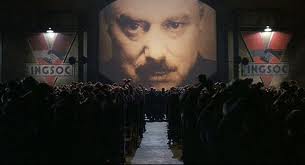
Though it wouldn’t too far from the truth…

I’m not going to talk about what war does to us so much as I’m going to discuss what we do to war.

Let’s face it, for many of us, the current wars the US (and other nations) are involved in don’t affect us much. We’re not on rations, or ducking into bomb shelters, or being told that if we don’t carpool the Axis wins.
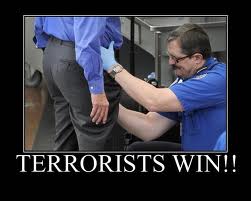
Not in so many words, anyways…

Whether a village in some valley in central Afghanistan is controlled by American or Taliban forces really doesn’t change our plans for the day. A harsh as it sounds, whether or not people are killed in Afghanistan doesn’t have much bearing on anyone but the families of the deceased, and it’s there that the problem lies.

See, we have had a problem in our society for a long time, but with the advent of the internet and similar technologies, it’s becoming worse and worse. Alienation. If you’ve heard it, it was probably in relation to Karl Marx, talking about the separation of workers from the ability to control their lives.
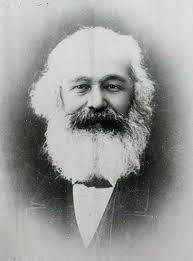
Because we’re dealing with some rough stuff, here’s a picture of Marx smiling…

In a more general sense, it’s simply it’s the separation of things that should naturally go together. Profit shouldn’t be separated from work, and work shouldn’t be separated from profit. Merit shouldn’t be separated from recognition, and recognition shouldn’t be separated from merit. Above all else, actions shouldn’t be separated from consequences- only that’s exactly what we have today.

Most of us are more than willing to wolf down a juicy hamburger, but how many of us would be willing to watch the cow be killed, let alone kill it ourselves? How many of us who wear shirts and shoes made in sweatshops would be willing to stand in the sweatshop hurling profanities and threats at the twelve year-olds hunched over the machinery? How many of us enjoy the advances of the civil rights movement would, back in the 60s and 70s, face off police dogs, hoses, and fire-bombs?

See, we’re a nation that enjoys the hard work of other people. We’re a nation that doesn’t like getting its hands dirty. We’re a nation that has no problem sending kids off to fight, kill, and die on some windswept ridge in Afghanistan because we don’t have anything to do with them afterwards. War is cheap for us. The men and women of our armed forces are expendable to us. Again, I’m not trying to condemn or vindicate the wars we’re in, but what I am saying is that we can’t make reasonable decisions about war until we’re actually confronted with the ugly, bloody, gritty consequences of it. We need pictures of the dead. We need them shoved in our faces on a daily basis. We shouldn’t be able to turn on the news without seeing rubble, the smoke, the wounded, or the dying in graphic detail. For all the outcry against violence in our media, the truth of the matter isn’t that the problem is with violence, but with violence that has been tailored to give us satisfaction and strip away all meaning to it. War, for good or ill, is all for nothing unless we actually understand it. Can we honestly say that we’re acting in the same way now we would be if we actually had to witness the consequences of our actions?

Until then, we’re just the same Swedish taxidermist, making ridiculous travesties out of things we don’t understand. We need graphic violence.

Fluffy Democracy and the 2012 Election

I’m not a political analyst. But I am concerned – as a student and as a person – by the unquestioned, inherent value in the word and idea of “Democracy.”

I understand the need for a fanatic search for government other than despotism, especially in the past, and especially in the very early history of the United States. Democracy was the ideological banner under which the United States stayed United, after all. And the deification of the ideal upon which the government was sort of constructed seemed to be a pretty good plan – it tried something new, at least; it’s not common birthplace or allegiance to an individual or even language or religion via which Americans traditionally identify themselves, but work ethic and political representation.

And that’s a good and noble thing. But “Democracy” as we use it now is lacking in substance, and only vaguely reminiscent of the word’s original purpose and ideals. It’s a fluff word – a word that’s lost its weight, meaning, and context. Something we can tack onto any object to make it instantly American and socially approved.

And the need for quick and easy social approval is, I think, rooted in the decomposition of political efficiency in the form of the partisan two-party system. The two-party system, whether it is the best model of an election-based political system or not, focuses all public attention and energy on competition for competition’s sake. The goal of traditional political debates has been skewed from clarification of one’s views to beating one’s opponent.

Bill Keller, New York Times columnist and previous executive editor, suggests that the rabid opposition effect is increasing over time. We are in “The Age of Shouting,” politically and culturally, Keller says – where politicians study talking points more than policy and semantic slip-ups receive more attention than real inconsistency. He suggests that the current political scene will be slow to make any real progress towards culling the approach of economic entropy if it continues to value short-term popularity over long-term benefit. Attempting to cling to empty ideals has caused politicians’ relationship with the public to become an empty thing in itself; all intentionality is replaced with the rabid defense of platitudes to which we glue our identities, and any sense of common benefit is drowned out by the cry to defeat any opposition.

Jon Stewart, host of “The Daily Show” , was a guest on “Crossfire” – a CNN show that featured commentators sitting at dramatically angled tables and asking political figures loud questions – in 2005. He called out the show for being culturally destructive and deceivingly theatrical: “What you do is not honest. What you do is partisan hackery.” Stewart said to the hosts, “You have a responsibility to the public discourse.”

The comedian’s call towards participation in productive public discourse is impressively insightful. Democracy is a good and beneficial thing, especially for everyone who is not a) a despot or b) stronger than everyone else. But it does not magically self-perpetuate – because it is literally constructed of the public, it requires the constant activity and engagement of the public. Socially responsible and informed discourse is needed, and we’re not going to get it by finding cheap ways to win arguments. It’s going to take work and a widespread social movement towards real discourse to keep “Democracy” in the American lexicon as anything more than a buzzword.

You Should Care About Super PACs

The new potentially-sort-of-boring-topic-about-which-we-should-educate-ourselves (this is the first election I’m paying attention to and I’m finding a lot of these things) is the issue of Super PACs and their effect on the current election.

To summarize, Political Action Committees (PACs) have been around for a while. They are organizations that raise money to use toward elections, usually television commercials — they are limited to collecting small amounts of money from individuals, political parties, and other PACs — and the stipulation was that they could only accept $5000 per person per year, which meant that (at least in theory) candidates’ support would be semi-related to the amount of supporters donating to them.

In 2010, however, it became legal for some organizations to receive unlimited donations from corporations and unions: organizations which accept these unlimited donations are called “super PACs.” They are like PACs, but much more evil. While PACs forced candidates to build a large support base to earn a substantial amount of money, a few millionaire individuals or corporations can fund a candidate’s entire ad campaign.

Super PACs are devastating to the essence of democracy: Why should congressional and presidential candidates care more about the votes of single constituents than the needs of unions and corporations when campaigns can be made or broken by union and corporate funding?

Super PACs allow campaigns to distance themselves from negative ad campaigns while reaping the benefits from commercials slandering political opponents — Mitt Romney’s PAC (the idiotically named “Restoring Our Future” — okay, one might restore hope for the future, but not the future itself) spent $3 million running negative campaigns against Newt Gingrich, effectively killing his campaign.

(evil?)Super PACs allow corporations and unions to spend huge amounts of money on elections — billions, in the 2010 midterm election — and that directly translates into influence on government decisions. If you’re imagining large men in suits grinning evilly while photographing themselves with dollar bills coming out of their ears, keep imagining it: there’s a picture of Mitt Romney that looks exactly like that.
Super PACs are a key factor in the commercialization of the political process. Since the late 90s, the money involved in elections (adjusted for inflation) has increased at an alarming rate. The amount of money that went into the 2008 election ($1 billion, 86 million) was more than twice that of the 1996 election (599 million dollars, adjusted for inflation) — Barack Obama’s 2008 campaign alone spent more than was spent in 1996 ($799 million).

Super PACs do not have to report the amount of money they receive, or how they spend it. A candidate’s super PAC can fund ridiculous amounts of illogical and negative commercials without having to pin the candidate’s name on the commercials at all. A candidate’s super PAC can also donate money to other PACs, effectively buying the good will of other politicians. Recent Supreme Court decisions deem this legal.

You should buy one of these tshirts on Colbert's website. And protect democracy.

The Colbert Report flaunted the troubling legalities of Super PACs in last Thursday’s episode, when Stephen Colbert’s Super PAC (Americans for a Better Tomorrow, Tomorrow) was transferred from Colbert to Jon Stewart as Colbert announced his fake intention to run for president. Colbert is not supposed to coordinate with the super PAC, his lawyer said on the show, but he could remain business partners with Stewart and the staff of his PAC didn’t have to change, even though they clearly knew everything about his election strategy.

Super PACs are the final step in making political campaigns entirely about money and slander. The political scene becomes a game of who-can-find-the-most-loopholes, with politicians focusing their energies on how to betray the spirit of the law without breaking the letter of it, which seems quite bad indeed.

GOP 2012: Why Competence and Communication are Important

NB: I’m a registered Democrat, but not a terribly leftist one. I’m a Democrat the way most college students are Democrats, I suspect – by default.


I’ve been thinking about the circus that is the Republican nomination race. You should know that I’m not a politics nut, nor do I plan on being one – but the state of my society does interest me sometimes. The GOP right now is both amusing and extremely sad. A series of caricatures who have served their time as one-month fads leaves me wondering about the state of American politics. The string of slip-up clips zooming through the internet and the idiotic things that these candidates have said might receive too much focus, according to some – but I think that the dismal communication and public speaking skills of the candidates this year is itself something to be concerned about, before even delving into their political views (too complicated for me to do any justice).

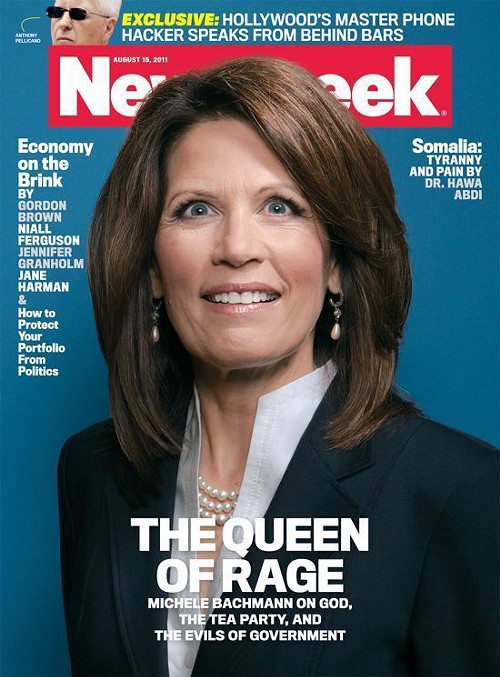
Bachman's disastrous Newsweek cover

Michele Bachmann was kind of the first fad of the GOP, and was slammed repeatedly for her bizarre and factually inaccurate comments in public – waxing poetic about New Hampshire, calling it “the state where the shot was heard round the world in Lexington and Concord,” while Lexington and Concord are actually in Massachusetts. She commented on the census, saying that “[My family] won’t be answering any information beyond [number of people in our household], because the Constitution doesn’t require any information beyond that,” which also isn’t true – the Constitution mandates citizens to fill out census forms. Or this gem about carbon dioxide: “carbon dioxide is not a harmful gas, it is a harmless gas. Carbon dioxide is natural. It is not harmful. It is part of Earth’s life cycle…And yet we’re being told that we have to reduce this natural substance and reduce the American standard of living to create an arbitrary reduction in something that is naturally occurring in the earth.” The woman is not a good speaker – she is clearly grasping for patriotic straws when she calls forth grand images of the Revolutionary War, and clearly grasping for Tea Party straws when she pigheadedly and uneducatedly dismisses the idea of global warming. This kind of saying-anything-to-please-a-crowd is not, not at all, a quality one should accept in a presidential candidate.

Rick Perry: Oops

Rick Perry was always too much like GWB to stand a chance. Not terribly substantial – seemed like the kind of guy I’d like to have a beer with but, like W, doesn’t even seem like he’d want to be the president, at the end of the day. I think the stress of even the race was too much for him.

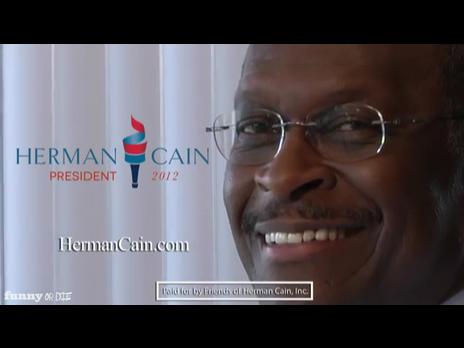
Screenshot from Cain's abysmal campaign commercial

When Herman Cain was declared frontrunner of the Republican Party, it was the last time that I was surprised/horrified at the state of the GOP candidates. Herman Cain, who attended Glenn Beck’s rally in Israel. Herman Cain, who said: “When they ask me who’s the president of Ubeki-beki-beki-beki-stan-stan, I’m going to say, ‘You know, I don’t know. Do you know?'” Herman Cain, who said: “I don’t have facts to back this up, but I happen to believe that these demonstrations are planned and orchestrated to distract from the failed policies of the Obama administration.” Herman Cain, who is a terrible, terrible candidate and appears to be willfully ignorant of foreign policy – or, at least, he imagines that that image is more desirable than utilizing his education.

So once Newt Gingrich was declared frontrunner, the GOP picking terrible candidates was sort of an expected pattern. Newt Gingrich was disgraced in the ’90s for having the worst Speakership in history – he suggested that the government shutdown was a personal attack against him, was the first Speaker of the House to receive ethical sanctions, and resigned in disgrace, commenting: “My only fear would be that if I tried to stay, it would just overshadow whoever my successor is.” I remember his name being the punch-line of jokes when I was a kid.

Also, he calls himself Newt, and he runs under “NEWT 2012”. Even without his ludicrous political career, no president should have an animal name, I’ve decided.

So why, why is the GOP choosing candidates whom I can mock by just quoting things that they actually said? Why are voters sashaying from Neo-Sarah-Palin to Neo-George-W. to Foreign-Policy-Knowledge-Have-Not to Only-Slightly-More-Desirable-As-A-President-Than-An-Actual-Newt?

An attack on the speaking skills of candidates might seem petty, but the speech- and communication- related responsibilities of the United States President are nothing to be neglected. I do suspect that the pressure on a candidate is more intense than in any other political position, and that slips in speech are widely a result of that pressure combined with the rabidness of the amusing-slip-up-snatching-and-amplifying media, but I also think that our standards for the public speaking skills of our president should be high. The pressure on candidates to not commit to anything – to sound good without making any promises – has caused the degeneration of political debates into a rhetoric-slinging festival resembling arguing grade schoolers.

These people are politicians – they have college degrees – they were popular enough to make it into the political scene and be elected to (in most cases) at least one high government office and run it with some level of competence. At least, that’s what I stubbornly assume, as I am afraid to allow myself to abandon all my hope in the political system. So let’s assume that the candidates are fairly competent and can sometimes speak without sounding like grade schoolers. Why, then, is everything about the GOP race so ridiculous?

I think that the 2012 GOP race so far demonstrates the logical extreme of a system built on fear of commitment and fear of offending even the most idiotic constituents. Noncommital and pretty-sounding political doublespeak is ridiculous in itself and always has been; in this year’s race, the insipid rhetoric has been deconstructed to reveal its logical core: nonsense. Politicians have been trained to say nothing for a long time; instead of learning what they need to know, they only need to be able to appear to know it; we are beginning to see the evidence of this more obviously. And with it, the apparent neglect of the American public to remember that the President is not only a likeable face, but the Commander in Chief of our army; not only a spearhead for conservative/liberal policy (depending on his/her affiliation, obvs.) but a position with the opportunity to encourage negotiation between the two sides of Congress and a key communicator with heads of state of other countries. And that is why the state of the GOP leanings isn’t just amusing – it’s dismal. Discouraging. One can only hope that the nominee will be someone we can take seriously.

Kim Jong-il is Dead; Nobody Knows What is Going on in North Korea (Still)

source: christanpost.com
So Kim Jung Il has died, purportedly, and I have no other choice but to write about it. Not really as a political analyst (okay not at all as a political analyst), but just as someone who kind of watches world events like sports, in a nihilistic sort of way.

Right around 10:20pm EST the Associated Press announced that North Korea said that Kim Jong-il was dead. ABC and the NYT quickly reported the story, saying that Korean Central TV reported: “Our great leader Comrade Kim Jong-il passed away at 8:30 a.m. on Dec. 17.” 8:30am in North Korea translates to 6:30 pm EST on Friday.

source: nyt.com

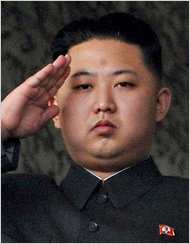
Kim Jong-un, the cheerful new dictator of North Korea

So what on Earth is going to happen to North Korea? Will the dictator’s death grip on the media continue? Kim Jong-il did some crazy things – Kijong-dong, for one, which was an entire empty city built in view of South Korea in the 50s to encourage defection. There was the claim that he was born under a double rainbow, that he scored 38 below par on his first golf game (and then promptly retired), and that he was a “worldwide fashion icon”. The idea of truth coming out of North Korea is roughly equivalent to tactful and thoughtful speech coming out of Rush Limbaugh. The whole event of Kim’s death and the transfer of power to Kim Jong-un is steeped in uncertainty. Heck, even the New York Times doesn’t know exactly how old Kim Jong-un is.

So the world is just kind of freaking out this morning. China’s pretty nervous. Everyone’s wondering what the long-oppressed people of North Korea are going to do – is the regime’s cult so ingrained in people’s heads that they will complacently move right on to Kim Jong-un as the most handsome and benevolent evil dictator ever? This event passing with no unrest in North Korea would be the most depressing thing ever.

Of course, this event causing violence between the North and South Koreas which ended up in someone (North Korea, the US…) using an atomic bomb would also be pretty depressing. The US, China, Japan, and Europe are all kind of staring at North Korea the way one would stare at a baby that just picked up a carving knife. North Korea test-fired missiles right before they announced Kim Jong-il’s death, so that’s not exciting at all. Stocks in China fell significantly. South Korea placed all of its military units on alert.

I have no parting comments. We’ll see what happens. While we wait, go to this hilarious Tumblr of Kim Jong-il looking at things for some comic relief.

#OccupyWallStreet: Protesting with Hashtags

So there’s about a thousand people protesting on Wall Street (ish) right now and I don’t really know exactly for what. The movement is #OccupyWallStreet and it started on September 17 and consists of about 1,000 (mostly) student-aged people (My official estimate of the demographic: I’m picturing literary references and lots of beards) just kind of hanging around the Wall Street area. Sometimes there are marches. People are sleeping in the park. People online are ordering pizzas to be delivered to the protesters. One girl took off her shirt.

You might want to know what people are actually protesting – that’s where things get more vague. Some advertisements speak of the need for One Demand, but nobody has decided what that demand is or should be or could be. Interviews with the protesters range from the idiotic to the informed, revealing mostly a mixture of the two (along the “I don’t know who my house representative is but I can tell you the percentage of the population that holds 50% of the wealth” line). The attitudes seem to be predominately socialist, or at least anti-capitalist, with lots of complaints alluding to the Bush tax cuts, the 2008 bank bailouts (if you don’t really know what those are about either, a good explanation by my friend Chris here.), and a lot of derogatory use of the word “corporations”.

An #OccupyWallStreet protester with an Anonymous mask and a hijab.

The whole situation is a strange crossover between internet networking and the real world – the Twitter support and piles of enthusiastic comments and exclamation all over the web have only translated to about 1,000 protesters at any time, and not even in the street the protest was planned for (the NYPD blocked off the key sections of Wall Street before any protesters got there). Online, however, the results are impressive (it’s kind of like looking at the Ron Paul campaign) – Anonymous, the 4chan-based hacker group with frightening amounts of power, is credited for much of the protest’s popularity.

It’s fascinating and kind of beautiful to watch – this is the first generation that grew up with the internet, and you can tell. Twitter-based protests are just called “protests” now. We are the generation that will use hashtags in our protest signs. It’s like old protests, but improved: we still have unconstructive platitudes, but at least some of them are ironic, dangit.

The coming-of-age of the first generation raised on the internet looks like this.

The use of the word “Occupy” in the title seems inaccurate, as if the protesters knew what they would do if they actually got control of the place. I’m imagining collages made with cut-up quarterly reports.

The thing is that Wall Street is now just as nonphysical as the organization of the protests – there’s not really much actual money to burn, anymore, and there aren’t safes full of the hoarded wealth of the rich. Significant money never really physically goes to Wall Street, or really anywhere – money is numbers in a computer and property value and stock value; it’s kind of hard to figure out where it actually exists.

The physicality of the protest is less impressive than its internet following and even seems a little incongruous – it’s like the event is being swallowed by its own abstractness; an internet-developed protest trying to cross the line of physical reality and occur in front of a physically symbolic place just doesn’t work out in the digital age.