Tag Archives: secularism

The Rise (or Return?) of the Post-Secularist

Last week, my news feed blew up with a surprising announcement: the “Post-Seculars” have arrived.

Before I get into what exactly that’s supposed to mean, let’s deal with the source of this news.  This new classification of human being comes to us from an article published in the American Sociological Review, and is based on data collected from the General Social Survey (GSS), a biennial survey of American households that, among other things, asks respondents about their attitudes regarding religion and the sciences, as well as general familiarity with facts about the latter.

Now, that’s about as much background as you’ll get from your standard internet source, but fortunately for you I’m a nerd, so I read the actual paper (with skimming.  I’m not a robot).  Basically, participants in the GSS were asked a lot of questions like: “does science increase opportunities for the next generation,” “should science receive more government funding,” “is the Bible the actual word of God,” etc.  Yes, the religion portion is absurdly Judeo-Christian-biased, but they tried to cover more ground with some personal rankings of general religiosity.  In addition, the participants were asked to answer some questions to test scientific knowledge, like: “does radioactivity occur naturally?”

Our sociologist friends found that 43% of participants adhered to what they refer to in the article as the “traditional” perspective (religiously focused with little to no understanding of/appreciation for science) and 36% could be labelled as “Moderns” (the opposite of Traditionals).  The remaining 21 percent were something in between.

But not “in-between” like Richard Dawkins playing dress-up with Papal robes.
Continue reading

The Implications of Charlie Hebdo’s Mockery of Islam and Muslims’ Response

source: gatesofvienna.blogspot.com

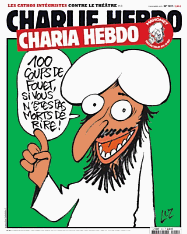
On the cover of Charlie Hebdo last week, Mohammed is saying (in English), "100 lashes if you don't die laughing!". Reproductions of images of Mohammed are considered particularly offensive in Islam.

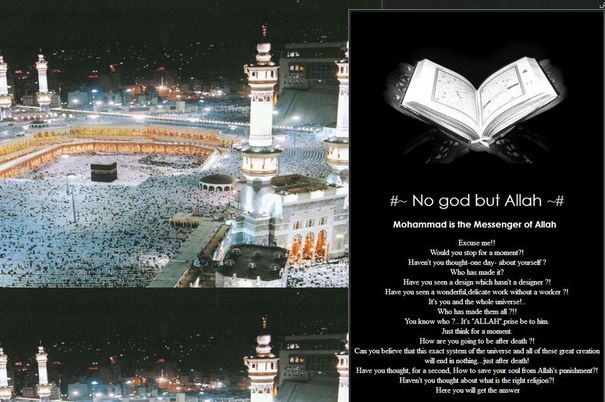
Charlie Hebdo [“Charlie Weekly”], kind of The Onion of France, published an issue last week entitled “Charia Hebdo”, which featured a cartoon of Mohammed saying (in French) “100 lashes if you don’t die laughing!”. The November 2 issue was retitled “Charia Hebdo” (referring to the holy Islamic code of laws called Sharia), and listed Mohammed as “guest editor” for the issue. In response, the publication’s website was hacked, showing a picture of Mecca and the text [in English] “No God But Allah”, followed by a series of questions arguing for theism (specifically Islam, but they were pretty generally theistic questions, like “Have you seen a wonderful delicate work without a worker?”). A 20 year old IT worker in Turkey claimed responsibility for the hacking. Shortly before the issue hit the streets, Charlie Hebdo’s offices were set on fire (via a molotov cocktail, according to telegraph.co.uk) and much of the inside of them was destroyed.

tendancecoatesy.wordpress.com

The hacked Charlie Hebdo website.

Given the recent passing of the bill that banned the wearing of niqabs and burkas under penalty of monetary fine, the demonstration of further European French/Muslim French tension is unsurprising and worrisome. The demographics of France are disputed, with reports from 2009 ranging from 4%-10% of the population being Muslim, but it is agreed upon that the Muslim population in France is increasing rapidly. Muslims have expressed feelings of ostracization by Sarkozy, especially with the recent head covering bill, and it is evident from Charlie Hebdo’s publication that at least some animosity towards Islam is common among the European French.

Charlie Hebdo’s publication was specifically blasphemous to Islam – more so than, say, Christians would probably find a picture of Jesus saying the same thing [though yes that would be rather upsetting to many people] – because of the specific Islamic mandate against the reproduction of pictures of Mohammed, and the reverence with which the prophet is held.

The French government passed a similiar and vaguer bill prohibiting ‘conspicuous religious symbols’ in 2004. This is just a small demonstration of the staunch secularism in France since 1789, when the revolution removed the huge amounts of power the Roman Catholic Church had over society. After the revolution, France has made it a pretty big deal to avoid giving a religious group such power again, and so has consistently been very intentional about the individualisation of religion and maintaining the separation between church and state.

This separation has worked fairly well for the past few centuries, as devout French Christians became fewer in number and French society as a whole valued an a-religious government, but the increasing Muslim population in France is beginning to disturb that environment. Though the population of Muslims in France is small, the presence of a solid and devout minority in such a staunchly secularist country will foster discord, the beginnings of which can be seen in recent events.