Tag Archives: YouTube

Thoughts About The Internet

So a friend of mine tweeted in the early hours of the morning, musing about the internet. The tweets are as follows [to be read from bottom to top]:
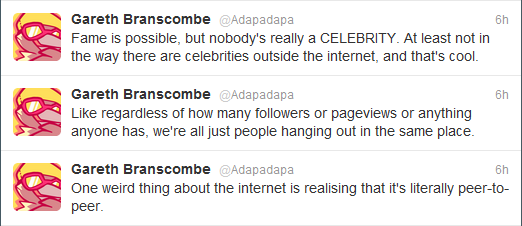
Before I can really begin addressing this, I think it’d be good for me to have a good definition of the word “celebrity.” Dictionary.com tells me that as far as people go, a celebrity is a “famous or well-known person.”

So are there capital letters CELEBRITIES, or are there just people, again, referencing the tweets, with fame? And, if they’re one and the same, do they equate with people outside the internet?

The 21st century is a place where being “outside the internet” is a basic impossibility. That being said, there is a distinction between being general fame and internet fame. Brad Pitt is a well-known movie star. wheezywaiter is a popular YouTuber with 382,628 subscribers. If both walked around the streets of any major city in America they’d be recognized, but only one would create a stampede of screaming fans leaving several dead.

On the other hand, some celebrities have supplemented their fame with their internet presence. Ashton Kutcher was the first twitter user to reach a million followers, and currently has almost ten times that. Comparing that to his work in film and television, it actually dwarfs his presence “outside the internet.”

The thing with being internet famous is how quickly it spills into the offline
world. High school pole vaulter Allison Stokke had her picture submitted to With Leather, a sports blog, where it appeared in this post [as far as I can tell, the images connected to the specific post have since been removed]. These images quickly spread around the internet, however, and Stokke became the target of a large amount of unwanted attention, a lot of it very sexual. It got to the point where her high school began receiving requests for photo shoots of the athlete. The Washington Post has more to say about it here.

To be fair, that wasn’t Stokke garnering internet fame for herself, but was instead unwittingly swept into it by a blogger named Matt Ufford. She’s not the only one who runs the very real risk of being recognized in public. Webcomic artist Jeph Jacques bumped into fans while vacationing in New Zealand, less of a surprise when you take into account the fact that his strip has thousands and thousands of viewers.

The internet is a “peer-to-peer” place where anyone can post anything and have an audience of anywhere from one to millions. I have 71 followers on twitter [with only a few spambots], meaning that anything I tweet [which I rarely do anymore] is instantaneously communicated to a several dozen people all over the world. That’s an amazing thing. Audience does matter, though.

If you have a blog, and there are millions, what are the chances that anyone is going to read it? You could tag it with words like “Dakota Fanning” and “Playboy,” and that might help, but your readers won’t be consistent and probably won’t be coming back. We may all be in the same place, but we write or draw or play instruments because we hope that others might be audience to our work, and when that audience gets large enough it will inevitably change our lives outside the internet.


Epic Meal Time: Leaving Grease Stains on Pop Culture

Last week the comics publication that I run put out an Epic Meal Time themed issue. While many here didn’t get it [need to better gauge my audience] it’s undeniable that the YouTube cooking show is nothing short of a cultural phenomenon.

It began back almost exactly a year ago, when Harley Morenstein uploaded a video of him and his friends eating a pizza they covered in fast food [it included an entire Big Mac and a Taco Bell Crunchwrap Supreme]. Ever since then Morenstein and co. have spiraled out of control, taking the internet by storm.

The following video is my personal favourite of theirs, and inarguably their most popular [at almost 11 million hits at the time of this writing]:

How big can a bunch of guys covering food in bacon get, you ask?1 Big enough to appear on The Tonight Show with Jay Leno and do a live show at the 2011 San Diego Comic Con. Type in “Epic Meal Time” followed by either “tribute” or “parody” on YouTube and prepare to be buried under an avalanche of internet video creators mimicking Morenstein’s in-your-face way of narrating the show.2

I watch these videos for more than the knowledge of how many different combinations of pork and alcohol3 there are, though. I believe this is a legitimately well-made show.

Continuity has allowed for characters like “Muscles Glasses” [Alex Perrault] to become this invincible juxtaposition of steely biceps and iron stomach. His ability to down shots of hard liquor mixed with anything from Big Mac sauce to gravy may not be inspiring, but is definitely impressive.

Tyler Lemco is without a doubt the comic relief of the show. Since the episode Maximum Mac & Cheese he’s begun devolving into a simpleton of sorts, a trend I definitely don’t have a problem with. It’s the little things, like him placing trays of bacon into the dishwasher with the phrase, “You put them in the oven, and then you’re done.” It may also have a lot to do with the fact that he appears to be the only one who has gained a significant amount of weight.

Josh Helkin has one one eyebrow perpetually raised.4 David Heuff’s always wears an exaggerated frown. Ameer Atari is, well, kind of a doofus.5 But I don’t hold that against him.

Harley Morenstein is the creator of Epic Meal Time, but since he edits the videos, conceptualizes most if not all of the episodes, and narrates using his own material he deserves a decent amount of credit.6 It may only be a three to eight minute show, but the content is still funny, the ideas fairly fresh, and the production values high.

With a little help from his friends Morenstein has created a generation of people who now believe bacon is one of the five major food groups. He’s making money off of YouTube by cooking meat with meat. He’s affecting and making culture, inspiring dozens upon dozens of young people to stuff their faces for the sheer posterity of it. Epic Meal Time has left an indelible mark on pop culture. Probably because grease stains are just so difficult to get out.

1. I did realize that this was a pun. But only after I had already written it.
2. The best ones are definitely Vegan Meal Time and the Regular Ordinary Swedish Meal Time series.
3. And there you go. I just realized what a nightmare this show must be to devout Muslims.
4. He also looks high. A lot of the time.
5. That is a sweet name, though. Seriously.
6. Not to mention the beard. It pretty much has a life of its own at this point.

Some Frightening Things About Popular Technology

Frederick Jameson said that “Contemporary people alternate between states of euphoria and anxiety.”

Euphoria, perhaps, because that is one natural reaction to being in the state of perpetual stimulation and entertainment and comfort (at least objectively) that we, the middle class, experience. Every minute, 48 hours of video is uploaded to YouTube. Any thought of YouTube, really, or Hulu or Grooveshark, makes one realize how kind of horrifyingly immense is the amount of entertainment available to anyone with an internet connection.

Cyborgs are probably going to start showing up soon. Hopefully Jean Luc Picard will be among them (if we can get a non-evil version).

You could do nothing but read, watch, and play on the internet for the rest of your life and there would still be more things you hadn’t seen or read. Information has always been that vast – for at least the last few centuries – but never before has it been so readily available almost all the time. With smartphones and future developments like SixthSense, access to the internet is going to start feeling like an extra limb – something without which you will feel nervous and clumsy and limited. For some people, this is already true – think about most people who’ve owned a smartphone for more than a few months, or anyone in a fantasy football league, or the fact that a SecondLife Shakespeare Company exists.

In The Shallows (read a good reflection on the book at The Millions), Nicholas Carr speculates and muses about the various psychological, social, and cultural effects of more completely immersing ourselves in an environment made entirely out of nonphysical stimulation.

As a member of the first generation to really experience internet access (if you count AOL 4.0 as internet access) for our whole lives, I look to the future of the human brain with interest and horror.