Category Archives: America

Media in 2011

This past year I had a resolution, of sorts. It was to log, day by day, the amount of media that I experienced. For the sake of convenience, music, YouTube videos, and comic books were all exempt from being logged. TV shows, movies, and books were the main focus here.

In picking a month to show you, I chose September in that it was a month entirely spent at school, without any breaks. All media was experienced in the free time I had outside of classes and schoolwork. Breaks tend to severely skew the average amount; an example of this is my watching five seasons of 30 Rock in January during the Christmas break.

Media in September

Television

  • 8 episodes of Deadliest Warrior [40 minutes each]
  • 1 episode of Futurama [20 minutes]
  • 1 episode of The IT Crowd [20 minutes]
  • 5 episodes of Cromartie High School [10 minutes each]
  • 2 episodes of Regular Show [10 minutes each]
  • 2 episode of Adventure Time [10 minutes each]
  • 7 episodes of Breaking Bad [45 minutes each]
  • 4 episodes of How I Met Your Mother [20 minutes each]
  • 1 episode of The Office [20 minutes]
  • 1 episode of Community [20 minutes]
  • 2 episodes of The Big Bang Theory [20 minutes each]
  • 2 episodes of New Girl [20 minutes each]

Film

  • Scott Pilgrim vs. The World [112 minutes]
  • Helvetica [80 minutes]
  • Paul [104 minutes]
  • Batman & Robin [125 minutes]
  • Hot Rod [88 minutes]
  • Ironclad [121 minutes]
  • Terminator Salvation [115 minutes]

Books

  • Part of The Odyssey
  • Most of The Aeneid
Totaled, that’s (if Google didn’t fail me on the math part), 965 minutes of television, 745 minutes of television, and about 3 or four hours of reading. After some fancy addition, that’s 28.5 hours spent watching in the month of September. A month I also partially picked because it had significantly less than others.
As an English/Writing Major, this is very unsettling to think about. Over a day of September was spent staring at a screen [not including YouTube or daily browsing], and even though comics were omitted my reading total still pales greatly in comparison. I justify my excessive viewing in a way, citing the study of plots and character progression in both television and film as a way of improving myself as a writer. Apart from this blog, however, I did little to no personal writing whatsoever in that time period.

The average American [which I am not, being neither] watches more than 151 hours of TV a month. With that in mind, I feel strangely validated. We don’t have a television in our house, and instead hook our laptops up to a monitor in the living room. This means that there is no casual turning on of the TV, no languid channel surfing. Apparently this has contributed greatly to my watching 80% less than most people.

I began this blog post with the intent to depict exactly how much media I consume in a given month, and hold that up as a shocking example of a 21-year old’s usage of his time. Contrary to that, I’ve discovered that I’m not doing too badly compared to America. At 28.5 hours per month, I’m actually doing really great.

Does this mean that I should continue to do what I’ve been doing? My answer is no. As I’ve mentioned, September was actually a low month in regards to media viewed. The month after I watched easily twice as many shows. The fact that this still ranks me as watching 40% as much as most has inspired me not to watch the same amount, but less. I’m doing better than average, but better doesn’t equal good. As someone who says he cares for literature, I need to at least pretend that that’s true in my actions. And that’s as good a resolution as any.

Why You Should Watch Philadelphia’s Mummers Parade Next Year

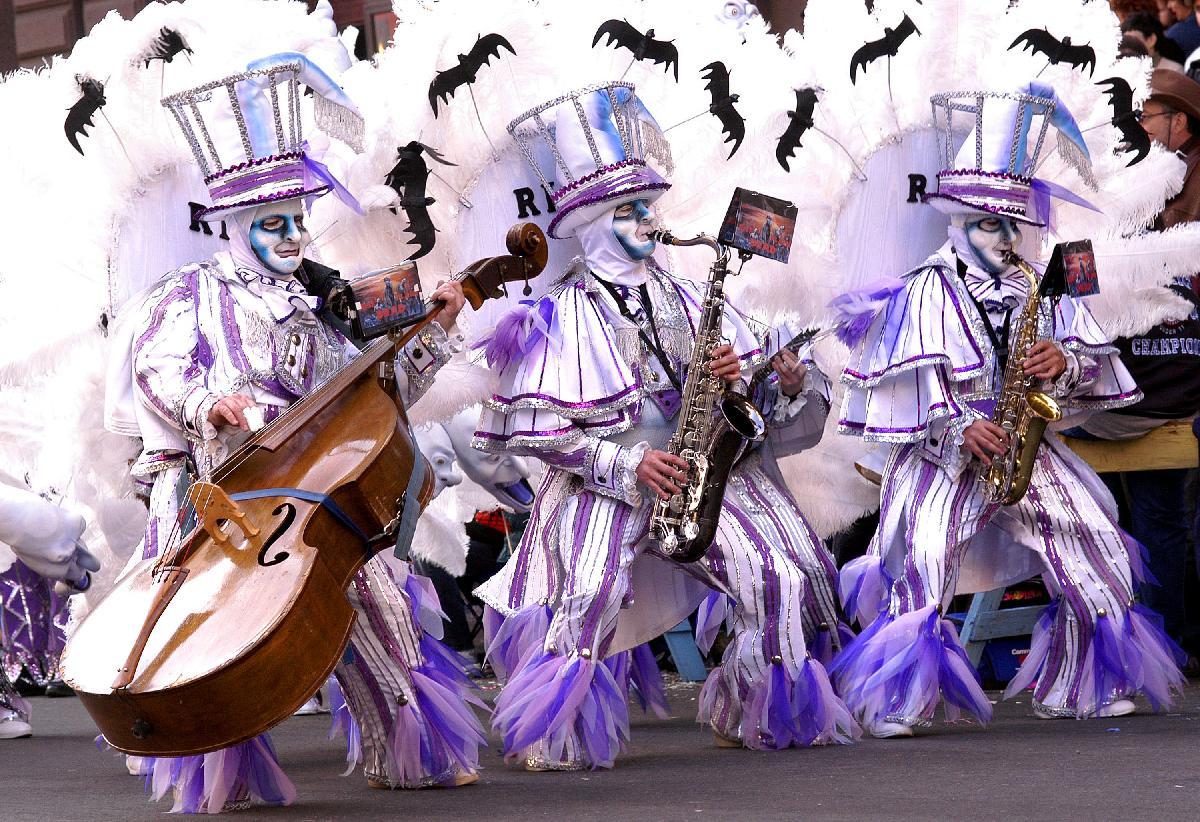
I spent all yesterday watching men in sequins dancing around on the street. I went to Pennsylvania to visit people for New Year’s, and apparently in Pennsylvania (at least around Philly) one watches the Mummers Parade on TV for all of January 1st. It was a very, very strange thing.

source: digital-photography-school.com

A Mummer. Banjos are sort of a thing.

It was also a beautiful thing. Well, I mean, sometimes it was a pretty hideous thing – I think the mummers get judged on the amount of different colors in their costume, and so sometimes this made the costumes wonderfully ridiculous and elaborate, but some clubs just kind of looked like someone ate a ton of Skittles and glitter and then vomited everywhere. Even the skittle vomit costumes, though, were still super impressive.

source: deseretnews.comThe longest part of the parade was for the fancy brigade: the string bands (like a marching band but with banjos and impressive people marching with string basses and far too many saxophones), who performed elaborate field-show-meets-Broadway-production in the street in the cold. This year’s shows involved dragon heads, people dressed in entire bear costumes, babies, and more feathers and sequins than I have ever seen in my life. The whole thing was reminiscent of Mardi Gras in New Orleans, except with more glitter and less inhibition.

Different sites give different accounts of the origins of the parade, but the gist of it is that the parade started with traditions from Irish, northern European, and Scandinavian immigrants living in PA. The first government-funded parade was in 1901. The tradition apparently had something to do with going door-to-door and singing on the days after feasts (notably Christmas and New Year’s Eve) and begging for leftover food. In England, this type of practice evolved into the tradition of caroling. In Philadelphia, it evolved into this: source: http://www.dweezilzappaworld.com

Mummer captains. The feather fan thing is a theme.

The Mummers Parade was definitely interesting, anthropologically. All of the captains of the fancy [“fancy” here meaning “dipped in sequins”] brigades were interviewed, and it was very strange to hear the lucid and quite normal-seeming 30somethings talk about practicing their entire year to bedeck themselves in glitter and awesomeness in front of the entire city. As a kid from a small town who has been trained (blame my dad) to view cities as community-less miasmas of disconnected worker drones, the enormous display of ritual, excess, and fellowship (albeit bizarre fellowship) was surprising and heartening. Also, as a Northerner accustomed to self-consciousness and grumpiness and cold (one of my friends from Kansas said that he assumed everyone in New York State wore only black) the extravagance complete disregard for any semblance of subtlety was refreshing. Events like the Mummers Parade reveal important things about humans in general, I think: our relative insanity and our love of the sense of community we get from practicing insanity together. So good job, Philadelphia.

GOP 2012: Why Competence and Communication are Important

NB: I’m a registered Democrat, but not a terribly leftist one. I’m a Democrat the way most college students are Democrats, I suspect – by default.


I’ve been thinking about the circus that is the Republican nomination race. You should know that I’m not a politics nut, nor do I plan on being one – but the state of my society does interest me sometimes. The GOP right now is both amusing and extremely sad. A series of caricatures who have served their time as one-month fads leaves me wondering about the state of American politics. The string of slip-up clips zooming through the internet and the idiotic things that these candidates have said might receive too much focus, according to some – but I think that the dismal communication and public speaking skills of the candidates this year is itself something to be concerned about, before even delving into their political views (too complicated for me to do any justice).

Bachman's disastrous Newsweek cover

Michele Bachmann was kind of the first fad of the GOP, and was slammed repeatedly for her bizarre and factually inaccurate comments in public – waxing poetic about New Hampshire, calling it “the state where the shot was heard round the world in Lexington and Concord,” while Lexington and Concord are actually in Massachusetts. She commented on the census, saying that “[My family] won’t be answering any information beyond [number of people in our household], because the Constitution doesn’t require any information beyond that,” which also isn’t true – the Constitution mandates citizens to fill out census forms. Or this gem about carbon dioxide: “carbon dioxide is not a harmful gas, it is a harmless gas. Carbon dioxide is natural. It is not harmful. It is part of Earth’s life cycle…And yet we’re being told that we have to reduce this natural substance and reduce the American standard of living to create an arbitrary reduction in something that is naturally occurring in the earth.” The woman is not a good speaker – she is clearly grasping for patriotic straws when she calls forth grand images of the Revolutionary War, and clearly grasping for Tea Party straws when she pigheadedly and uneducatedly dismisses the idea of global warming. This kind of saying-anything-to-please-a-crowd is not, not at all, a quality one should accept in a presidential candidate.

Rick Perry: Oops

Rick Perry was always too much like GWB to stand a chance. Not terribly substantial – seemed like the kind of guy I’d like to have a beer with but, like W, doesn’t even seem like he’d want to be the president, at the end of the day. I think the stress of even the race was too much for him.

Screenshot from Cain's abysmal campaign commercial

When Herman Cain was declared frontrunner of the Republican Party, it was the last time that I was surprised/horrified at the state of the GOP candidates. Herman Cain, who attended Glenn Beck’s rally in Israel. Herman Cain, who said: “When they ask me who’s the president of Ubeki-beki-beki-beki-stan-stan, I’m going to say, ‘You know, I don’t know. Do you know?'” Herman Cain, who said: “I don’t have facts to back this up, but I happen to believe that these demonstrations are planned and orchestrated to distract from the failed policies of the Obama administration.” Herman Cain, who is a terrible, terrible candidate and appears to be willfully ignorant of foreign policy – or, at least, he imagines that that image is more desirable than utilizing his education.

So once Newt Gingrich was declared frontrunner, the GOP picking terrible candidates was sort of an expected pattern. Newt Gingrich was disgraced in the ’90s for having the worst Speakership in history – he suggested that the government shutdown was a personal attack against him, was the first Speaker of the House to receive ethical sanctions, and resigned in disgrace, commenting: “My only fear would be that if I tried to stay, it would just overshadow whoever my successor is.” I remember his name being the punch-line of jokes when I was a kid.

Also, he calls himself Newt, and he runs under “NEWT 2012”. Even without his ludicrous political career, no president should have an animal name, I’ve decided.

So why, why is the GOP choosing candidates whom I can mock by just quoting things that they actually said? Why are voters sashaying from Neo-Sarah-Palin to Neo-George-W. to Foreign-Policy-Knowledge-Have-Not to Only-Slightly-More-Desirable-As-A-President-Than-An-Actual-Newt?

An attack on the speaking skills of candidates might seem petty, but the speech- and communication- related responsibilities of the United States President are nothing to be neglected. I do suspect that the pressure on a candidate is more intense than in any other political position, and that slips in speech are widely a result of that pressure combined with the rabidness of the amusing-slip-up-snatching-and-amplifying media, but I also think that our standards for the public speaking skills of our president should be high. The pressure on candidates to not commit to anything – to sound good without making any promises – has caused the degeneration of political debates into a rhetoric-slinging festival resembling arguing grade schoolers.

These people are politicians – they have college degrees – they were popular enough to make it into the political scene and be elected to (in most cases) at least one high government office and run it with some level of competence. At least, that’s what I stubbornly assume, as I am afraid to allow myself to abandon all my hope in the political system. So let’s assume that the candidates are fairly competent and can sometimes speak without sounding like grade schoolers. Why, then, is everything about the GOP race so ridiculous?

I think that the 2012 GOP race so far demonstrates the logical extreme of a system built on fear of commitment and fear of offending even the most idiotic constituents. Noncommital and pretty-sounding political doublespeak is ridiculous in itself and always has been; in this year’s race, the insipid rhetoric has been deconstructed to reveal its logical core: nonsense. Politicians have been trained to say nothing for a long time; instead of learning what they need to know, they only need to be able to appear to know it; we are beginning to see the evidence of this more obviously. And with it, the apparent neglect of the American public to remember that the President is not only a likeable face, but the Commander in Chief of our army; not only a spearhead for conservative/liberal policy (depending on his/her affiliation, obvs.) but a position with the opportunity to encourage negotiation between the two sides of Congress and a key communicator with heads of state of other countries. And that is why the state of the GOP leanings isn’t just amusing – it’s dismal. Discouraging. One can only hope that the nominee will be someone we can take seriously.


Social Service and the 2012 Election

I was sitting at a meeting reviewing cases of indicted abusers – I intern at a social services office near my college, in the second poorest county in New York – and one case involved a man who had served a few months’ probation for abuse and then, upon release, committed a horridly violent act against the same victim. “We failed this kid,” an officer at the meeting said of the victim.

I like working in social services because it simultaneously disenchants and inspires me in regards to the mechanisms of helping people. I work in an office that gives legal and practical assistance to domestic violence victims, houses a women’s shelter, and runs a food pantry.

Many of our clients tell us that they don’t know what they would do without us, that we were their last chance, etc. After these cases, there is a sense that our tax dollars are being put to good use, as it were – that the social service is doing what a social service is supposed to do. But some clients aren’t as easily rewarding. Some are demanding and abrasive; their accounts of incidences don’t match police reports and they tell scattered and narcissistic stories, the verity of which crumble when anyone asks them to repeat a statement. We get people in our office who are clearly victims, but we also get the conniving, the liars, and people who file abuse complaints just to be vindictive. Our services are alternately treasured and taken advantage of.

Whatever the makeup of social service is, it is definitely not black and white; working with the logistics of public service enforces the fact that there are no clear cut cases, and that every policy is going to, at some point, meet an exception of the rule. Sometimes these exceptions are people; sometimes they are failed by the system. Sometimes (oftentimes) people seek to suck as many resources out of the public sphere as they are legally allotted. A general sense of entitlement pervades the population, which often means that public resources are given out at a competitive, first-come-first-serve basis.

But does the fact that the system is occasionally cheated discount the help it provides others? This is a question that must be asked in regards to every public service.

Charity is not so simple as shelling out money to the poor – though money helps, the uncomfortable truth is that anyone (of any class) who receives money will often not use it to their long term benefit or to that of society. The other danger of charity is the possibility of using monetary donation to excuse ourselves from any personal discomfort or investment. If we consider money the thing that solves the problem (and, believe me, it does help), we can ignore the ugly logistics of how and when and why to distribute it.

This is why any candidate who proposes “simple” tax plans (Herman Cainn, Rick Perry) ends up looking kind of foolish. Perry recently called Social Security a “Ponzi scheme” and called for the privatization of the whole thing. While basically everyone says that Social Security is pretty screwed up, much of Perry’s criticism of SS seems to be driven by a fad-like propensity for drastic calls for smaller Federal government, and the implications of such a trend on social services is worrisome.

Ron Paul, on the other hand, does have the advantage of actually sticking to his guns on the issues, it seems – but I can’t believe that his defense of less government in regard to social issues – that “increasing federal funding leaves fewer resources available for the voluntary provision of social services” – is practical at all. Calls for smaller federal government often cite the support of the power of state governments instead, but the basic philosophy seems like it would call for less state governments as well as federal.

Policy change is what is really effective. The problem is that there is no one policy change that will fix everything; social programs need to be constantly restructured to adapt to a changing society. This makes policy changes less flashy and more complicated than large donations or huge influxes of funding, and so they receive less public and political attention than they should. The logistics of helping people can be terribly complicated, and a perfect policy will never be implemented, but public assistance is still a noble, if not a glamorous, necessity for society.

9/11: Ten Years Later

I understand that there are people out there who believe that it’s
irreverent and disrespectful to refer to what happened to the World Trade Centre with an abbreviation, but the news has deemed it an acceptable term, so I have no qualms in doing so.

To further preface this post, I am a Canadian. More than that, I spent roughly half my life in Asia, so I don’t have the deep emotional connections to the event that many of you probably do. I watched the replays of the towers fall while in the Philippines, an ocean away.

I was deeply saddened and shocked by what occurred, but didn’t think much about it again until about two years ago, when I heard about what was being done with the remains of the towers. Right now there is a battleship named The USS New York, a Navy assault ship built with steel from the World Trade Centre. As a symbol it certainly holds a different viewpoint when it comes to beating swords into ploughshares.

Much more recently I stumbled upon the infographic on the right. It goes into detail about the new World Trade Centre, and the awe-inspiring ideas behind it.

The new building will be 1,776 feet, the tallest in the US. While the exact height is representative of the years of the country’s independence, I think it represents more than that. The USS New York is the remnants of a tragedy forged into a weapon. The new World Trade Centre may only be 49 feet taller than the former, but the fact that it stands that much taller communicates America’s fearlessness and audacity; if you knock it down we will rebuild it bigger.

There’s quite a bit of news all over the place about memorial services, and servicemen and servicewomen not being able to attend due to “important” people being there, but that’s for other, more well-researched articles. The point I’m trying to make is that ten years ago catastrophe occurred, and since then a nation has been trying to get back on its feet. The whole world is paying close attention to see how exactly America will choose move forward.

Being Erica Soon to Be American

The American entertainment industry has long been dominated by remakes, a fact that’s easily backed up by a quick glance at the last year in film.¹ What’s less well-known to most people, however, are the amount of television shows on the air that have their origins elsewhere. The UK, in particular, is responsible for American Idol, Sanford and Son, American Gladiators, Being Human, and Whose Line is it Anyway?, to name a few. And let’s not forget about The Office.

It makes total sense that the game shows were taken and adapted for an American format²; if people are going to watch other people make money, they’d prefer it if it was at least the same currency. The other shows, however, were adapted because of cultural differences. As far as Being Human goes, the characters remain a vampire, werewolf, and ghost, yet attempt to live normal lives in an American setting. Cultural differences also encompass humour, and it should be clear to most people that what makes the British laugh won’t necessarily do the same for Americans.

On December 16, 2010, ABC announced that they were planning on rebooting the Canadian series Being Erica3. First airing at the beginning of 2009, Being Erica is a show that follows the life of Erica Strange, a thirty-something year old woman whose life is turned around when she begins an unorthodox form of therapy. Her sessions essentially consist of her being sent back in time to relive past regrets, a smooth blend of science fiction and comedy-drama that seems almost believable at times. Continue reading