Category Archives: bizarreness

Sexism, Reductionism, and Stepping on Women’s Heads

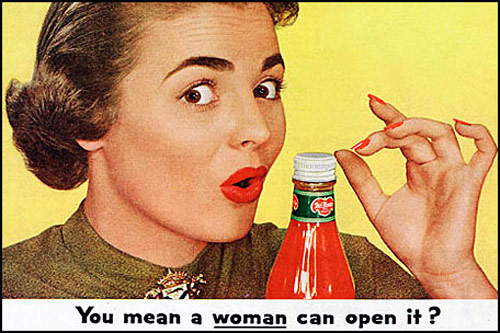
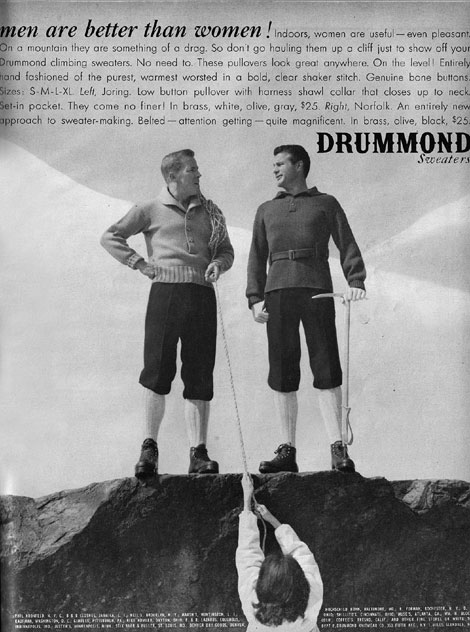
So Retronaut has a page of “Vintage Ad Sexism” – hilariously sexist ads, many of them aimed at men’s pride (“brand new man-talking, power packed patterns that tell her it’s a man’s world”) or women’s insecurities (“Would YOUR husband marry you again?”). There are some gems in there, like these:

source: retronaut.co

I'm just gonna let these speak for themselves.

source: retronaut.co

source: retronaut.co

Read some of this one for the full effect

source: retronaut.co

And this one might be my favorite…source: retronaut.co

Aren’t some of them kind of frighteningly recent-looking?

So yeah, we remember sexism, 1919 and women’s suffrage and bra-burning and all that. Being shocked that women couldn’t vote, etc. But seeing advertisements make it more harrowing. Serious political oppression at least treats women with enough dignity to be oppressed – advertisements make light of women as entities. I am less concerned with the essential sexism in these than I am the reduction.

Violence and political oppression are horrid, yes, but reduction is more insidious because it tends to keep hanging around long after voting rights have been own and salaries have been evened out.

The advertisements here, of course, appear ludicrous to us. “Is a wife to blame if she doesn’t know [to use a douche]? Yes! She’s decidedly to blame.” The one with the rug with a woman’s head, the man standing with one foot on her head Captain-Morgan-style. Some of them are just ridiculous.

But it is good to remember that as insane as they may seem, these are real, and they are recent. People who saw these ads and accepted them as a relevant way to advertise a product – people who made the ads, laughed at them, nodded in agreement – still make up a large part of our society today. Even after that generation dies, the fact is that American culture (it’s what I’m talking about here; can’t speak to other places) has been steeped in the reduction of women – and this is not an influence easily shed.

Now, establishing a double standard to “make up” for lost time is not the answer. Ensuring that all males are instilled with a sense of guilt about the past will not help society. Only by awareness of our ideological roots, and the flaws and violence therein, can we stay – or at least slow – regression.

Hitler, Ray Comfort, and the Dismal State of Discussion

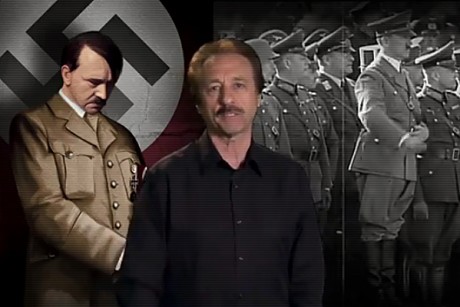
I did something bad for my health that I do not recommend. I watched “180”, a half-hour documentary made by Ray Comfort.

It is a bastardization of discourse from all sides. In an interview with Steve, a neo-Nazi punk type of young man, Steve says that he’s certain of his opinions about the falsehood of the Holocaust and other offensive things. To combat this, Comfort asks Steve to spell shop (Steve does) and then asks: “what do you do at a green light?” The question is a trick to get the mind to quickly respond “stop”, which is semi-associated with green lights and rhymes with “shop”, and the person answering looks silly. Sure enough, Steve responded “Stop” and looked silly. And then – well, then Comfort treated that like an actual argument for something.

The documentary was dipped in dramatic music, photos of piles of dead bodies, and use of gratuitously violent photographs. What is most interesting to me, however, is the use of what seems to be the universal argument-ender: comparisons of things to Hitler.

Hitler, the Nazis, and Lazy Discussion
Hitler and the Holocaust have become mythic elements of American culture, I think, and to the detriment of the truth of the actual historical events. I was recently visiting a small church where the members, after the service, started (sort of randomly) to wax poetic about the horrors of Hitler and the Nazis. They weren’t saying anything new – everyone was just affirming that Hitler was inhuman and the Nazis were too. It was the fervent insistence that “real humans could never do that sort of thing” that struck me – I thought of all of the other genocides and massacres of the past century alone, of the killing of civilians in wars by troops of every nationality, of atomic bombs. But even in light of all of these things, current conversation about Hitler seems to serve contrast to our new, very human, very un-barbaric society. We talk about Hitler basically like Satan – an ultimate evil; a rhetorical catch-all.

Ray Comfort and 180: Unethical Discourse

Steve, in the movie "180" by Ray Comfort

Comfort’s specific use of the Hitler argument is reductive and tired. It is, if anything, an exploration of how charged and empty rhetoric in the realm of politics is being mirrored in general culture. His interviewees are inconsistent, and seem to know very little about philosophy, theology, or basic logic. Comfort’s questions are also always precisely and pseudo-cleverly leading, and it doesn’t seem that he wants to engage with the interviewees at all: “Does this mean you’ve changed your mind about abortion?”, he asks. “Are you going to vote differently in the future?” It is not a conversation, is the point: it is a poorly executed set of rhetorical acrobatics. Is this the way to foster discourse and an informed public? Probably not. Arguments depending on rhetorical cleverness are insulting to both parties.

Comfort’s series of interviews are not only annoyingly inconsistent and poorly constructed, however: the movie is also a manipulative presentation of complex issues and events, presented crassly and with a smugly triumphant attitude. One of the less graceful moments was when Comfort asked a woman if she’d had an abortion; she said that she had. He then immediately asked: “Do you feel guilty about it?”

As the big finish, Comfort sets up a game-show setup of moral responsibility and the afterlife, and awkwards them into admissions of fright and death anxiety:

  • Comfort asks people if they have lied/stolen/been lustful: most of them say that they have.
  • Comfort then gets them to admit that this makes them liars/thieves/adulterers.
  • Comfort gets them to admit that liars/thieves/adulterers go to hell.
  • Comfort elicits from the interviewees an understandable anxiety about the prospect of hell.
  • Comfort asks them if they are going to go read their Bibles.
  • Some of them say yes.

Alesia, from Ray Comfort's movie "180"

Theologically, morally, rhetorically, and logically, this is one of the most horrible things ever. Comfort’s quick-talking way of “tricking” people into professing a fright of punishment does very little for the moral health of humanity or the search for truth within rhetoric and theology. The triumphant music and photos of bloody sheets are no help for the legitimacy of the movie.

There are also 40 thousand comments. I do not recommend those either. They are not a happy picture of humanity.

It makes sense to protest the legalization of abortion and to be horrified at the amount of deaths occurring if one believes that life begins before birth. Comfort’s smugness and “gotcha” questions, however, lack earnestness, humility. The whole thing turns a serious situation into an awkward and unproductive onslaught of unhelpful rhetorical inconsistencies, devoid of integrity and, therefore, real efficacy.

In sum, the movie is a disjointed account of unproductive discussions with unproductive people with vague and uninformed opinions. It’s a disheartening representation of the state of discourse on American sidewalks.


Facebook Censorship: A Sign of the Times?

source: serc.net The internet was recently given a leak of Facebook’s censorship standards. Amine Derkaoui, a previous “employee” of Facebook (employee is in quotes here because he was paid $1 an hour plus commission, which is, in a word, horrid) was so disgruntled that he gave Gawker the handbook used by Derkaoui and other assumedly disgruntled workers to know which photographs and comments to censor on Facebook, which ones to send upwards for decision by an administrator, and which ones were ok. Gawker published the one-page “cheat sheet” summarizing the standards on their website.

source: gawker.com

A summary of Facebook's censorship standards, leaked to Gawker

This gives an interesting perspective of what is considered “acceptable” and tasteful by popular consensus. Ear wax is censored, snot is not? (I guess if it was, millions of baby pictures would have to be deleted). For example, the “cheat sheet” says that “Digital/cartoon nudity” should be censored, but “Art nudity ok”, excluding all digitally created images from “art”, which is sort of a surprisingly passe way for Facebook to define things.

Something interesting about the released standard is the fact that it is clearly representing three categories of social unacceptability. The first, the depiction, commitment, planning, or lauding of criminal activity, is expected in a list like this – sexual assault, organized crime, nudity, and hard drugs are pretty normal in a “delete this” list for any censorship website.

The second category is more nuanced – I can only describe this second category as anything which debases humanity. This includes more obvious things like human organs, mutilation, violent speech, or anything encouraging or lauding mutilation or defacement of the human body (and, in some cases, animals). This also applies to willing defacement: threats of suicide, self-harm, and anything promoting eating disorders – this is interesting in light of the fact that pro-ana groups are still on Facebook. Maybe closed groups are immune to censorship – or the people getting paid next to nothing in other countries just haven’t caught them yet.

Another example of the censorship of non-illegal debasement of humanity: the prohibition of any photoshopped pictures of humans, “whether negative, positive, or neutral.” This is interesting; perhaps it is simply the case that it’s too hard to gauge the positive or negative spin of a photoshopped picture, but I think this rule isn’t just about bullying – it’s about the fact that Facebook doesn’t want to turn into Reddit (if they don’t, then they should stop trying to be Tumblr and take away the “follow” option). Their prohibition of any “versus” photo – any image grafting two photographs of people side by side in comparison – would be for the similar reason of “trying to keep Facebook untacky”. This rule is especially ironic considering Mark Zuckerberg’s famous-now-that-we’ve-all-seen-The-Social-Network first project facemash.com. Prohibitions of holocaust denial fall under the goal of no human debasement – but they apply to the third category as well.

The third and final category I’ll call “Nobody Get Mad At Us Please.” The most interesting rule in this one is the censorship of any maps of a part of Turkey (Kurdistan) and the prohibition of language or images against Mustafa Kemal Ataturk, as those laws seem suspiciously anti-free-speech-ish, and Turkey is a part of the UN.

The internet as it is currently developing has been compared to the semimythical Wild West of early American history – looking back in 50 years on this time, we’ll probably be astonished at how unregulated everything was. Governments just don’t have a good enough grasp on this new platform for data and information to be able to figure out how to effectively and efficiently (and ethically) regulate it – yet. This conversation applies to file sharing and copyright infringement as well, but Facebook’s censorship guidelines illuminate a more necessarily practical standard – things made up by businesses and not government are almost always more necessarily practical, if perhaps less ethically consistent.

Naked Boys Singing: For Your Enjoyment

After a 13-year run, Naked Boys Singing left its off-Broadway stage, leaving the rest of us to switch to plan B for our bachelorette parties1.

It’s really quite incredible, though – the show ran for 13 years, which is the second longest off-Broadway show ever (the first is the Fantasticks), has had over 3,000 performances and, not surprisingly, hosted over 2,000 bachelorette parties. It’s also been translated into 5 different languages.

The show is a gem of off-Broadway qualified ridiculousness. One of the writers has an Emmy, they had the choreographer from The Producers, 2 of the cast members were porn stars, and one of the cast members only has one testicle (and used a prosthetic). The show is a musical revue, and opens with a song called “Gratuitious Nudity” and goes on to serenade the audience with (for example) a number about being gay in a men’s locker room, and something called “Muscle Addiction”. From reviews, towels and jock straps are sometimes involved, but the majority of the show is performed nude.

The show was more than a little unconventional: after opening and advertising predominately to the young gay population in NYC, the producers quickly realised that they needed a broader viewer base – 13 years later, the show was marketed to “people from all walks of life,” including “men, women, senior citizens, mothers, fathers, Rabbis, [and] strippers” and was a popular bachelorette party destination. The theatre was also once booked by a gay nudist colony, the members of which brought gallon plastic baggies (for their clothes) and towels (for the seats). In 2005, a Milwaukee production of the show was closed down by police, and shows in Atlanta, San Juan, and Provincetown (Mass.) were shut down by the city governments as well. After the Milwaukee production was shut down, the Milwaukee Gay Arts Center won a censorship lawsuit against the city of Milwaukee for $20,000.

If you feel like you’ve missed out, the show is still playing London.

1And unconventional bachelor parties.

Sweden Recognizes Kopimism as a Religion: What on Earth does ‘Religion’ Mean?

Sweden’s pretty liberal when it comes to copyright laws, as a government and as a culture – it’s the home of the thepiratebay.org and there’s a healthy anti-anti-piracy-movement movement in Sweden that’s been active since 2001. Further proof of piracy as culture in Sweden is the fact that the Swedish government just officially recognized the Church of Kopimism.

Kopimism’s central dogma centers around the idea that information is a holy thing, and copying information a sacrament. CTRL+C and CTRL+V are considered holy symbols. The English page of the church’s website says:

We challenge all copyright believers – most of which have a great deal of influence in politics, and who derive their power by limiting people’s lives and freedom.

Isak Gerson’s personal website (translated by Google) says that a Kopimist a “person who has the philosophical belief that all information should be freely distributed and unrestricted. This philosophy opposes copyrights in all forms and encourages piracy of all types of media including music, movies, TV shows, and software.”

So Gerson (who, weirdly, is also a member of the Christian Student Movement in Sweden) took this philosophy and pasted some “ritual” labels on everything and got a religion (after petitioning to the government 3 times, to his credit). The result is both a straight-faced mockery of the difficulty governments face w/r/t defining ‘religion’ (on the Kopimist website, the first line of one of the definitions of Kopimism is the defense “A religion is a belief system with rituals.”) and a strange manifestation of a strongly held belief.

Religions rooted in the internet are not a new thing. With all those people registering as “Jedi” in the 2001 census, Pastafarianism, and the prevalence of Cthulu worship, the appearance of a semi-ironic religious movement started by otherwise apathetic 20 year old males is becoming a pattern.

Maybe it’s just another irony-soaked fad, like speaking with ridiculous grammar or posting hilarious misquotes – or maybe the semi-ironic religions created will garner more earnestness and lose some irony and become, weirdly, a real way that people define their philosophies. The definition of the word “religion”, in the context of recent events and the influence of internet culture, is changing, and it’ll be interesting to see what happens to it.

World War Z and other Incidences of the Undead

I read World War Z by Max Brooks over break – I tend to stay away from zombie media,1 but the book was interesting enough to win over my zombie-avoiding tendencies and now I can’t stop noticing the huge and recent (I’d say – recent as in like, the last decade) zombie focus almost everywhere in culture.

Did everyone else but me know about this? Did you know how many zombie poetry websites there are? You can even buy a zombie-themed magnetic poetry set. You know, so you can compose some verses about decaying flesh-eating people on the fridge while waiting for your ramen to heat up.

This guy published his work online in 2005 – excerpt:

Making
love with
zombies can
never be
without consequence.

There’s Aim for the Head, an anthology of 50 poets.

There’s Z-Composition, which is a recent start-up with sections slated for poetry, recipes, and flash fiction, and grand ideas of “a bi-monthly literary e-zine with a yearly print anthology slated to launch in 2012”.

The Zombie Nation (the tagline of which is “Begin the Zombpocalypse”) also has zombie poetry posts.

The Zombie Hunter: A Survivalist’s Journal [“A family man’s guide to surviving the zombie apocalypse”] isn’t poetry but is impressive: it’s been going pretty steadily since 2010, complete with pictures, coconuts, and a thorough knowledge of firearms.

Why are zombies so freaking popular? (or: Elisa thinks too much)
The prevalence of a smaller genre like poetry dedicated to the zombie wave is just a piece of the fascinating trend. The prevailing attraction of zombie/zombie-fighting culture, I think, is the focus on vivacity and resourcefulness amidst the breakdown of society. You have to rob the grocery store to eat and you have to destroy the staircase of a building to secure it from zombies, but the stealing and destruction are by themselves also pretty exciting. And in this generation, one of the first to grow up in such a (generally) stable and structured society, craves some sense of rule-breaking and the ability to use their imagined Crusoe/Macguyver-esque survival skills.

Zombies are also about death, but not because they’re dead. Zombies as a villain are extremely basic (I’m talking about slow-moving zombies, here, generally): in World War Z Brooks pointed out that you have no hope of discouraging zombies; there is no leader to go after and you cannot, like humans, make them uncomfortable or fearful. We fear zombies not because they’ll go after us quickly and suprisingly, but because they’re slow and, as much as we ignore or outrun them, we know that they’re still coming. A scenario in which we lose to zombies wouldn’t be large and violent and exciting – it would be, simply, slow and inevitable.

Our fear of zombies precisely mimics our fear of death, which I think is a sort of manifestation of a denial of death in contemporary culture for the past century.