I spent all yesterday watching men in sequins dancing around on the street. I went to Pennsylvania to visit people for New Year’s, and apparently in Pennsylvania (at least around Philly) one watches the Mummers Parade on TV for all of January 1st. It was a very, very strange thing.
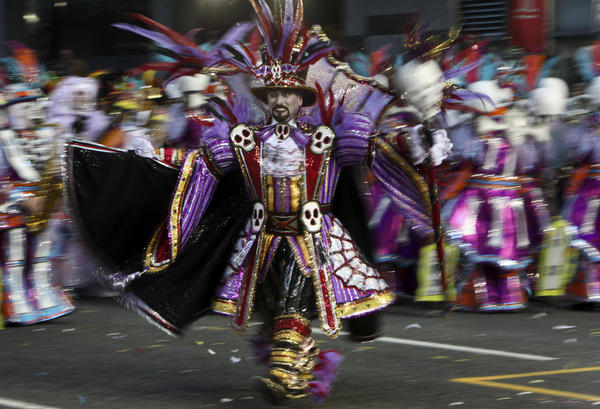
A Mummer. Banjos are sort of a thing.
It was also a beautiful thing. Well, I mean, sometimes it was a pretty hideous thing – I think the mummers get judged on the amount of different colors in their costume, and so sometimes this made the costumes wonderfully ridiculous and elaborate, but some clubs just kind of looked like someone ate a ton of Skittles and glitter and then vomited everywhere. Even the skittle vomit costumes, though, were still super impressive.
The longest part of the parade was for the fancy brigade: the string bands (like a marching band but with banjos and impressive people marching with string basses and far too many saxophones), who performed elaborate field-show-meets-Broadway-production in the street in the cold. This year’s shows involved dragon heads, people dressed in entire bear costumes, babies, and more feathers and sequins than I have ever seen in my life. The whole thing was reminiscent of Mardi Gras in New Orleans, except with more glitter and less inhibition.
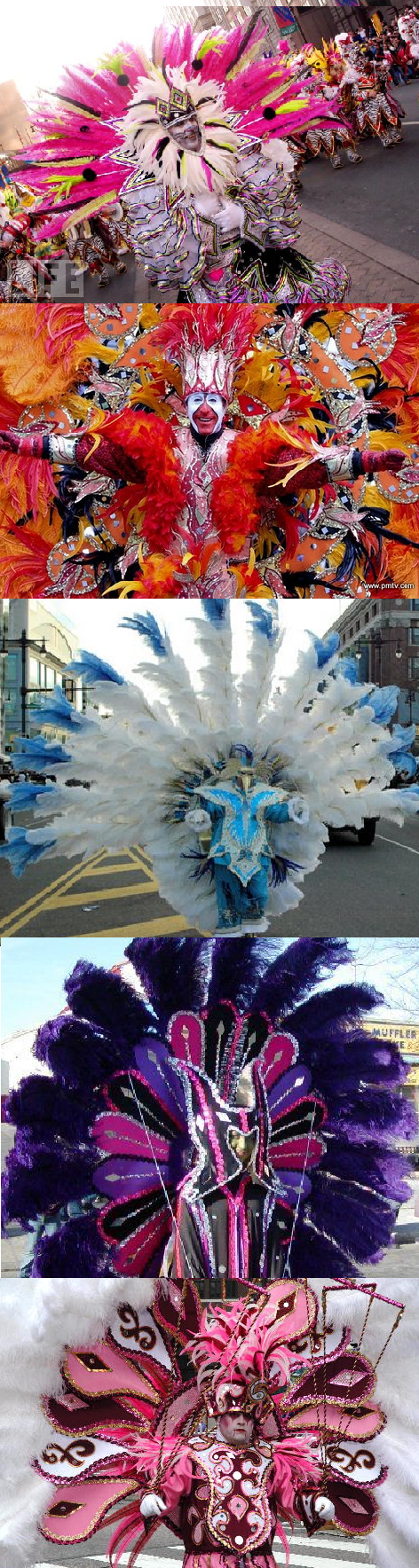
Different sites give different accounts of the origins of the parade, but the gist of it is that the parade started with traditions from Irish, northern European, and Scandinavian immigrants living in PA. The first government-funded parade was in 1901. The tradition apparently had something to do with going door-to-door and singing on the days after feasts (notably Christmas and New Year’s Eve) and begging for leftover food. In England, this type of practice evolved into the tradition of caroling. In Philadelphia, it evolved into this:
Mummer captains. The feather fan thing is a theme.
The Mummers Parade was definitely interesting, anthropologically. All of the captains of the fancy [“fancy” here meaning “dipped in sequins”] brigades were interviewed, and it was very strange to hear the lucid and quite normal-seeming 30somethings talk about practicing their entire year to bedeck themselves in glitter and awesomeness in front of the entire city. As a kid from a small town who has been trained (blame my dad) to view cities as community-less miasmas of disconnected worker drones, the enormous display of ritual, excess, and fellowship (albeit bizarre fellowship) was surprising and heartening. Also, as a Northerner accustomed to self-consciousness and grumpiness and cold (one of my friends from Kansas said that he assumed everyone in New York State wore only black) the extravagance complete disregard for any semblance of subtlety was refreshing. Events like the Mummers Parade reveal important things about humans in general, I think: our relative insanity and our love of the sense of community we get from practicing insanity together. So good job, Philadelphia.
It’s been a recent development, but I’m beginning to love TLC. No, I don’t mean the band, though their song Waterfalls will always have a special place in my heart, I mean the TV network. The best comparison I can make to watching the channel is driving past a car crash; it’s horrible, but you can’t bring yourself to look away.
It’s not all tragic scenes of humanity, though. The faux fallout bunkers that the people on Extreme Couponing are building are fascinating, as well as the fact that I have watched people buy $400 worth of stuff for under 50 cents. In a similar vein, Extreme Cheapskates teaches a wide variety of ways to save money, such as cutting an “empty” tube of toothpaste in half to get at a week’s supply.
Then, on the other hand, we have the same show featuring Roy Haynes, a man willing to ask for other people’s leftovers while eating dinner with his wife on their 25th anniversary. We also have Toddlers & Tiaras, where the world of child beauty pageants makes images like this feel like a breath of fresh air.
Premiering at the beginning of this month, The Virgin Diaries is a program that will be easier for me to show, then write an introduction for.
I must confess, I have not seen the show. This extended clip was being thrown around on Facebook on December first, and I later read about it again on one of my favourite blogs. What little I have to say about it has been garnered from clips and reviews I found online.
To follow up that last confession with another, I am also still a virgin. A 21-year-old college senior et cetera, and without any apparent physical deformities or social disabilities that come to mind. I had briefly mentioned this before, and I can summarize my reason for not having premarital sex again now as being primarily based on my faith and my knowledge of relational intimacy.
My question for the show is this: What does TLC, a program I learned today stands for The Learning Channel, want us to think about this? We’re meant to root for the savers on Extreme Couponing, evidenced by the show’s eager chronicle of how much they can accomplish given a deadline. My Strange Addiction is there to evoke an awkward catharsis, a purging of emotions as we see how far others have fallen as well as a strange sense of justification in whatever odd practices we may engage in.
What I take from the teaser above is, at least in that couple’s particular case, that the light the show is shining on adult virgins is much closer to What Not to Wear then it is to The Little Couple. Program-title-specific jargon aside, everything about the clip speaks poorly about members of this particular life style. Not only does the husband seem completely oblivious to why his wife “want to kiss so much,” her description of their wedding night is painful to behold. Couple with that the fact that a good portion takes place in a playground, furthering their descent into the immature. The kiss, of course, rises above all else as the preview’s crowning glory.
Shelby Fero, of aforementioned favourite blog fame, recounted hours of her life that were taken up by television, Brussels sprouts, and veggie bacon. In closing, she described what she thought of the first episode of The Virgin Diaries.
A way more interesting show would be to watch these people go through therapy and work through their issues. Instead we just laugh at the guy who can barely smooch his wife and ignore how depressing it is when he asks her “Why do you want to kiss so much?”
Oprah had an episode of her show this past season dealing with a few women in their late 20s who were virgins. With all of them, there was some kind of anxiety/intimacy issue. I can’t help but think if TLC is really interested in being the learning channel, a better idea might be to follow these people around for several episodes, employ a therapist and help them get over some of their hang-ups so they can have fulfilling adult relationships — and yes, those include sex.
The fact that TLC now has a show that is all about adult virgins is only mildly comforting to me. On one hand, there’s now an example on television of people like me, something that others can mentally turn to when they find out where I stand. On the other hand, there’s now an example on television of people like me, something that others can mentally turn to when they find out where I stand.
This blog is called “Culture War Reporters,” and by and large I think that my co-writer and I manage to cover topics that are about the culture we presently live in, whether it be about why we give or why we put up with watching Family Guy. Today I’m writing about an aspect of North American culture that clashes with a particular European tradition.
Last night a friend and I were talking about the social work program he’s currently taking, particularly about his fellow students and how seriously they take their course of study. The same friend I debated the usage of the word “rape” with, he stressed the importance of finding humour in everything. He recounted, with distaste, being snapped at for telling a racist joke.
Oversensitivity runs rife in North America, for better or for worse. It’s the reason lines like this one in Modern Family exist, and why we find them so funny and relatable. Political correctness and striving to not offend are held in high regard, and when comparing it to the opposite end of the spectrum, utter ignorance and obnoxiousness, it appears to be the reasonable choice. Continue reading →
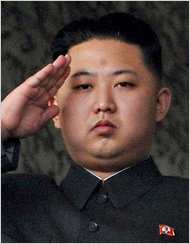
So Kim Jung Il has died, purportedly, and I have no other choice but to write about it. Not really as a political analyst (okay not at all as a political analyst), but just as someone who kind of watches world events like sports, in a nihilistic sort of way.
Right around 10:20pm EST the Associated Press announced that North Korea said that Kim Jong-il was dead. ABC and the NYT quickly reported the story, saying that Korean Central TV reported: “Our great leader Comrade Kim Jong-il passed away at 8:30 a.m. on Dec. 17.” 8:30am in North Korea translates to 6:30 pm EST on Friday.
Kim Jong-un, the cheerful new dictator of North Korea
So what on Earth is going to happen to North Korea? Will the dictator’s death grip on the media continue? Kim Jong-il did some crazy things – Kijong-dong, for one, which was an entire empty city built in view of South Korea in the 50s to encourage defection. There was the claim that he was born under a double rainbow, that he scored 38 below par on his first golf game (and then promptly retired), and that he was a “worldwide fashion icon”. The idea of truth coming out of North Korea is roughly equivalent to tactful and thoughtful speech coming out of Rush Limbaugh. The whole event of Kim’s death and the transfer of power to Kim Jong-un is steeped in uncertainty. Heck, even the New York Times doesn’t know exactly how old Kim Jong-un is.
So the world is just kind of freaking out this morning. China’s pretty nervous. Everyone’s wondering what the long-oppressed people of North Korea are going to do – is the regime’s cult so ingrained in people’s heads that they will complacently move right on to Kim Jong-un as the most handsome and benevolent evil dictator ever? This event passing with no unrest in North Korea would be the most depressing thing ever.
Of course, this event causing violence between the North and South Koreas which ended up in someone (North Korea, the US…) using an atomic bomb would also be pretty depressing. The US, China, Japan, and Europe are all kind of staring at North Korea the way one would stare at a baby that just picked up a carving knife. North Korea test-fired missiles right before they announced Kim Jong-il’s death, so that’s not exciting at all. Stocks in China fell significantly. South Korea placed all of its military units on alert.
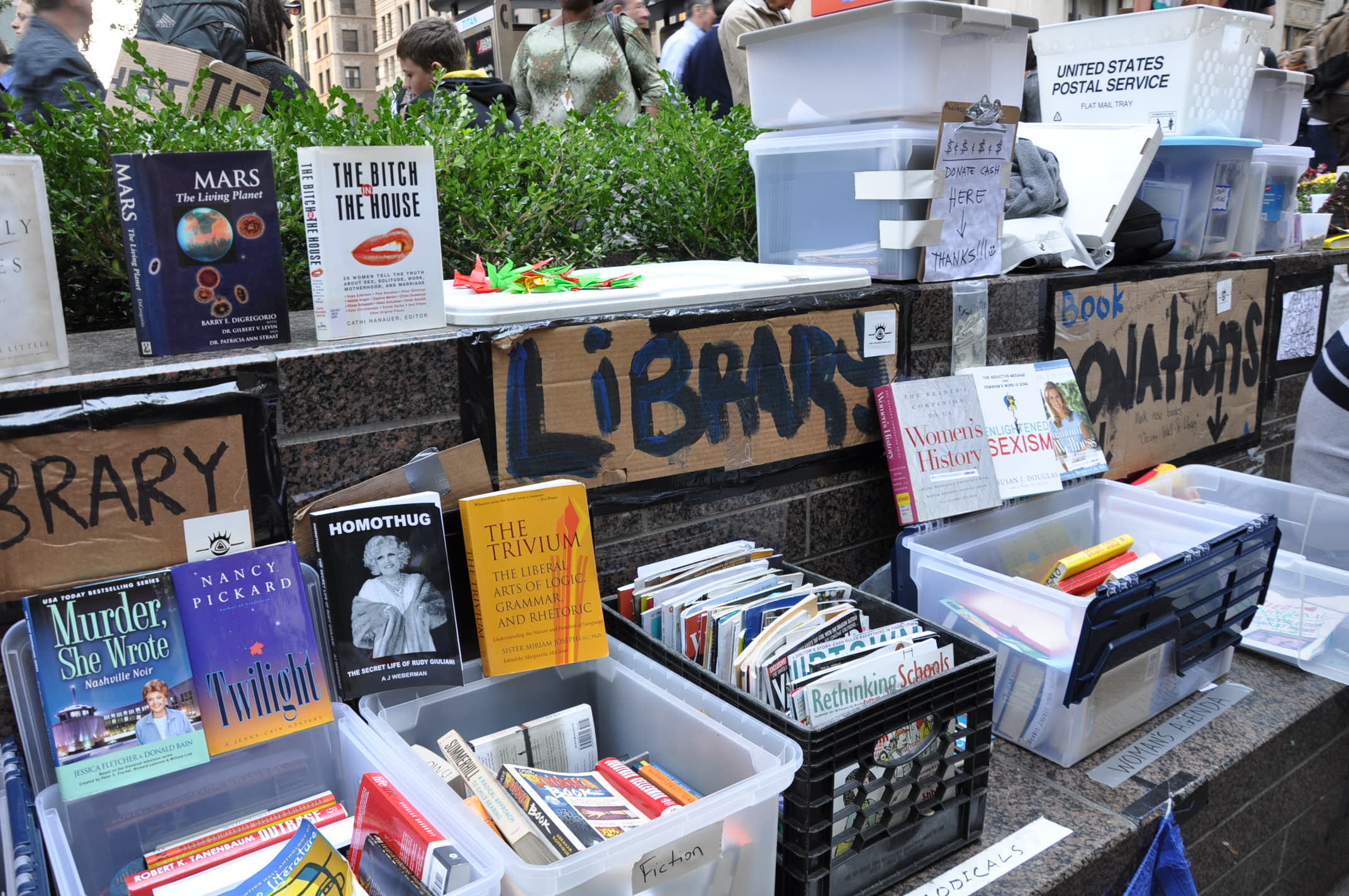
It’s day 24 of Occupy Wall Street1 and the thousands of protesters there have been organizing themselves into pseudo governments and various working groups. 2 The place is turning into a petri-dish kind of accelerated model of semi-anarchic social planning. The coolest aspect of the new microsociety, however long it’s going to last, is the The People’s Library of #OccupyWallStreet.
The OWSL was started by an NYU library studies student setting out a pile of books – other protesters started adding books, found protection for the books from the weather, and (now) have made a catalogue of the books and are collecting donations. On the library’s blog, OWSL announced that a criminal justice attorney for a New York nonprofit offered her legal services to the library as it deals with the semi-sketch logistics of being an uncovered library located in a public park. The library has about 15 volunteers (described as “a mix of librarians and library enthusiasts”) and a barcode scanner.
According to their catalogue, the library has about 400 books, with about 50 donations per day coming for the last few days. OWSL’s catalogue includes kind of what is to be expected in the library of a strange semianarchy made up of people with too much time, from Reading Lolita in Tehran to The Shock Doctrine: The Rise of Disaster Capitalism. Volunteers say that they’re having constant requests for copies of A People’s History of the United States by Howard Zinn. There are a few less expected titles in the catalogue, though, too, like Quiverfull: Inside the Christian Patriarchy Movement3 and Cloudy with a chance of meatballs.
OWSL volunteers say that they do not discriminate when it comes to which books they put out – by nature of those donating, they have mostly liberal political and philosophical theory. But, one of the volunteers said, “if someone came with a truckload of Rush Limbaugh’s books, we’d put them out. We’re not opposed to having a dissenting voice.”4
One volunteer was asked to describe the library’s purpose: “People want to know, ‘What’s your agenda?’” he said. “Well, the status quo doesn’t have an agenda. Everyone here, in the aggregate, are people who feel disenfranchised and powerless. It’s perfectly legitimate to be frustrated. I don’t have a solution. I’m not an anarchist. I’m here because I love books.”
I'm not an anarchist. I'm here because I love books.
This attitude is what gives a sense of legitimacy to OWSL: its dedication to the availability of information in general, not just the forward movement of the protesters’ varying agendas. It’s admittedly heartening to see that one of the first things that develops in a group of people staying still for a while is a library. The agendas and decisions of the protest aside, let’s hope that the spirit of the indiscriminate availability of information and discourse remains in at least this aspect of the movement.
Frederick Jameson said that “Contemporary people alternate between states of euphoria and anxiety.”
Euphoria, perhaps, because that is one natural reaction to being in the state of perpetual stimulation and entertainment and comfort (at least objectively) that we, the middle class, experience. Every minute, 48 hours of video is uploaded to YouTube. Any thought of YouTube, really, or Hulu or Grooveshark, makes one realize how kind of horrifyingly immense is the amount of entertainment available to anyone with an internet connection.
Cyborgs are probably going to start showing up soon. Hopefully Jean Luc Picard will be among them (if we can get a non-evil version).
You could do nothing but read, watch, and play on the internet for the rest of your life and there would still be more things you hadn’t seen or read. Information has always been that vast – for at least the last few centuries – but never before has it been so readily available almost all the time. With smartphones and future developments like SixthSense, access to the internet is going to start feeling like an extra limb – something without which you will feel nervous and clumsy and limited. For some people, this is already true – think about most people who’ve owned a smartphone for more than a few months, or anyone in a fantasy football league, or the fact that a SecondLife Shakespeare Company exists.
In The Shallows (read a good reflection on the book at The Millions), Nicholas Carr speculates and muses about the various psychological, social, and cultural effects of more completely immersing ourselves in an environment made entirely out of nonphysical stimulation.
As a member of the first generation to really experience internet access (if you count AOL 4.0 as internet access) for our whole lives, I look to the future of the human brain with interest and horror.


 The longest part of the parade was for the fancy brigade: the string bands (like a marching band but with banjos and impressive people marching with string basses and far too many saxophones), who performed elaborate field-show-meets-Broadway-production in the street in the cold. This year’s shows involved dragon heads, people dressed in entire bear costumes, babies, and more feathers and sequins than I have ever seen in my life. The whole thing was reminiscent of Mardi Gras in New Orleans, except with more glitter and less inhibition.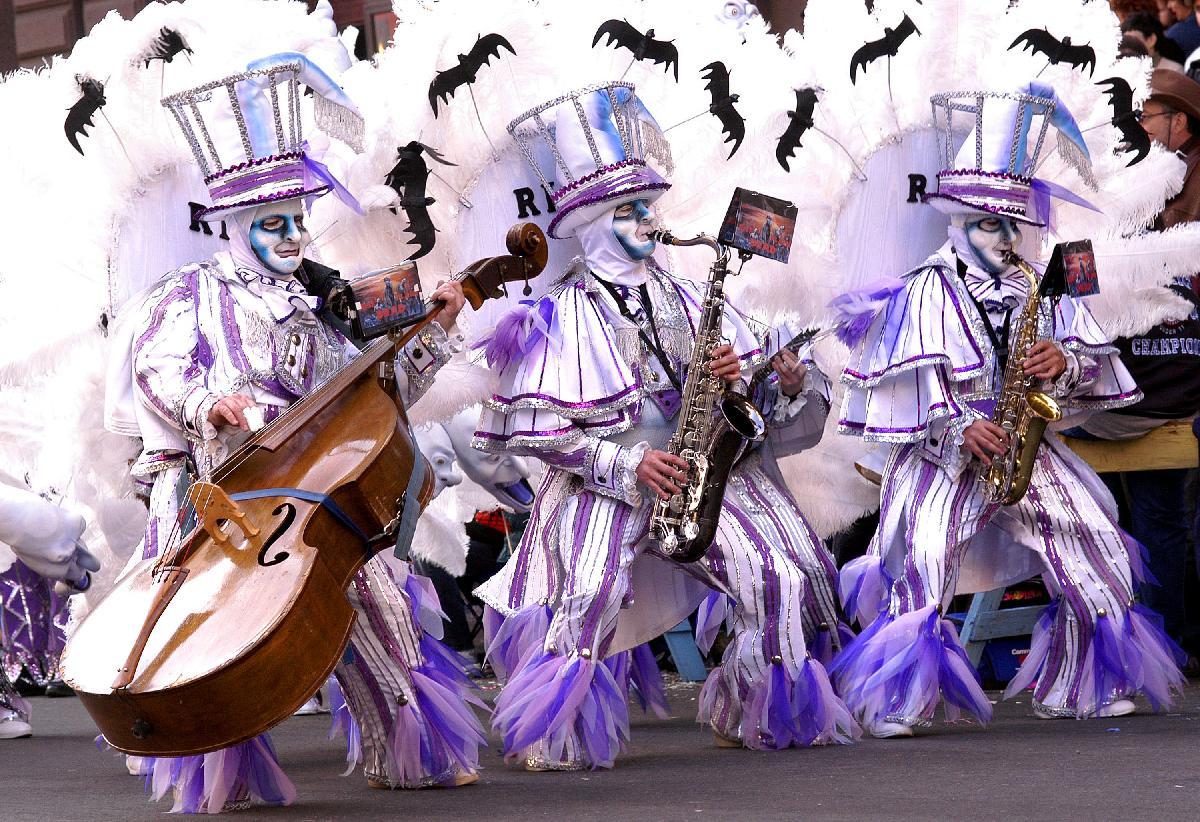



 Culture War Reporters