Media in 2011

This past year I had a resolution, of sorts. It was to log, day by day, the amount of media that I experienced. For the sake of convenience, music, YouTube videos, and comic books were all exempt from being logged. TV shows, movies, and books were the main focus here.

In picking a month to show you, I chose September in that it was a month entirely spent at school, without any breaks. All media was experienced in the free time I had outside of classes and schoolwork. Breaks tend to severely skew the average amount; an example of this is my watching five seasons of 30 Rock in January during the Christmas break.

Media in September

Television

  • 8 episodes of Deadliest Warrior [40 minutes each]
  • 1 episode of Futurama [20 minutes]
  • 1 episode of The IT Crowd [20 minutes]
  • 5 episodes of Cromartie High School [10 minutes each]
  • 2 episodes of Regular Show [10 minutes each]
  • 2 episode of Adventure Time [10 minutes each]
  • 7 episodes of Breaking Bad [45 minutes each]
  • 4 episodes of How I Met Your Mother [20 minutes each]
  • 1 episode of The Office [20 minutes]
  • 1 episode of Community [20 minutes]
  • 2 episodes of The Big Bang Theory [20 minutes each]
  • 2 episodes of New Girl [20 minutes each]

Film

  • Scott Pilgrim vs. The World [112 minutes]
  • Helvetica [80 minutes]
  • Paul [104 minutes]
  • Batman & Robin [125 minutes]
  • Hot Rod [88 minutes]
  • Ironclad [121 minutes]
  • Terminator Salvation [115 minutes]

Books

  • Part of The Odyssey
  • Most of The Aeneid
Totaled, that’s (if Google didn’t fail me on the math part), 965 minutes of television, 745 minutes of television, and about 3 or four hours of reading. After some fancy addition, that’s 28.5 hours spent watching in the month of September. A month I also partially picked because it had significantly less than others.
As an English/Writing Major, this is very unsettling to think about. Over a day of September was spent staring at a screen [not including YouTube or daily browsing], and even though comics were omitted my reading total still pales greatly in comparison. I justify my excessive viewing in a way, citing the study of plots and character progression in both television and film as a way of improving myself as a writer. Apart from this blog, however, I did little to no personal writing whatsoever in that time period.

The average American [which I am not, being neither] watches more than 151 hours of TV a month. With that in mind, I feel strangely validated. We don’t have a television in our house, and instead hook our laptops up to a monitor in the living room. This means that there is no casual turning on of the TV, no languid channel surfing. Apparently this has contributed greatly to my watching 80% less than most people.

I began this blog post with the intent to depict exactly how much media I consume in a given month, and hold that up as a shocking example of a 21-year old’s usage of his time. Contrary to that, I’ve discovered that I’m not doing too badly compared to America. At 28.5 hours per month, I’m actually doing really great.

Does this mean that I should continue to do what I’ve been doing? My answer is no. As I’ve mentioned, September was actually a low month in regards to media viewed. The month after I watched easily twice as many shows. The fact that this still ranks me as watching 40% as much as most has inspired me not to watch the same amount, but less. I’m doing better than average, but better doesn’t equal good. As someone who says he cares for literature, I need to at least pretend that that’s true in my actions. And that’s as good a resolution as any.

Why You Should Watch Philadelphia’s Mummers Parade Next Year

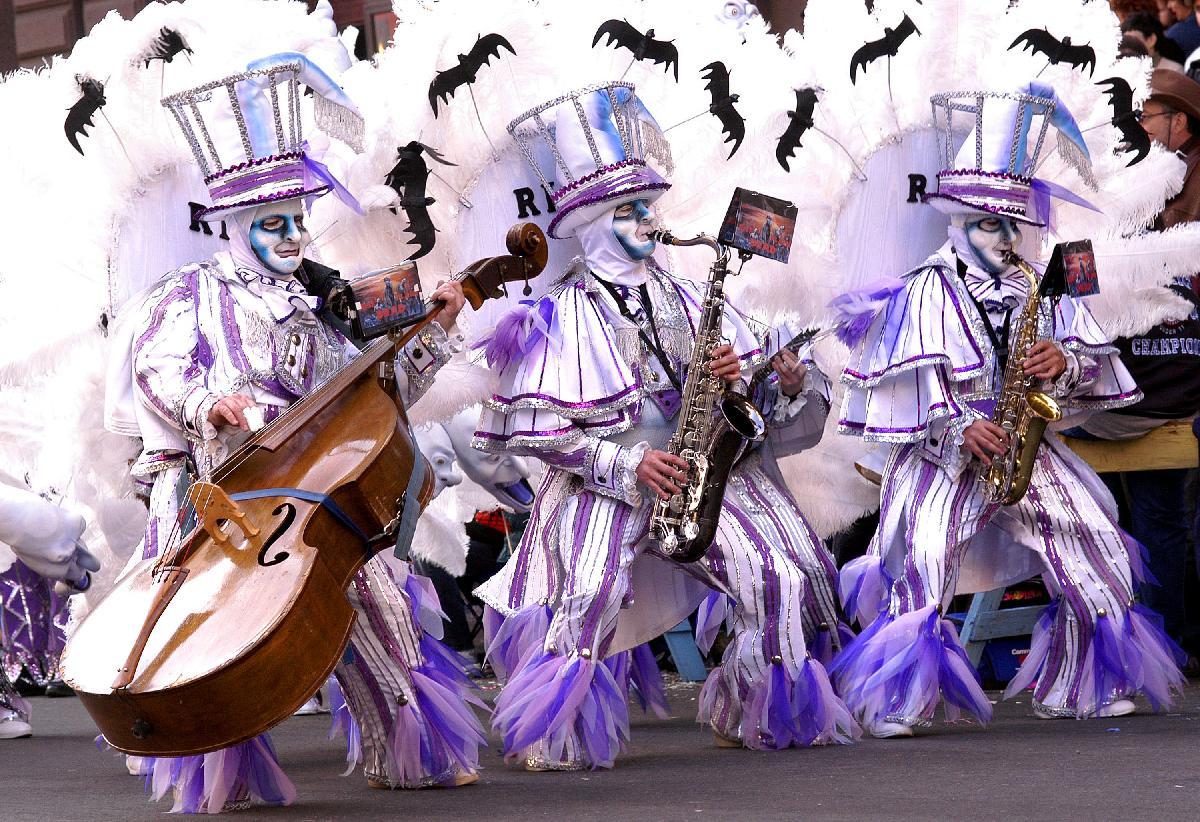
I spent all yesterday watching men in sequins dancing around on the street. I went to Pennsylvania to visit people for New Year’s, and apparently in Pennsylvania (at least around Philly) one watches the Mummers Parade on TV for all of January 1st. It was a very, very strange thing.

source: digital-photography-school.com

A Mummer. Banjos are sort of a thing.

It was also a beautiful thing. Well, I mean, sometimes it was a pretty hideous thing – I think the mummers get judged on the amount of different colors in their costume, and so sometimes this made the costumes wonderfully ridiculous and elaborate, but some clubs just kind of looked like someone ate a ton of Skittles and glitter and then vomited everywhere. Even the skittle vomit costumes, though, were still super impressive.

source: deseretnews.comThe longest part of the parade was for the fancy brigade: the string bands (like a marching band but with banjos and impressive people marching with string basses and far too many saxophones), who performed elaborate field-show-meets-Broadway-production in the street in the cold. This year’s shows involved dragon heads, people dressed in entire bear costumes, babies, and more feathers and sequins than I have ever seen in my life. The whole thing was reminiscent of Mardi Gras in New Orleans, except with more glitter and less inhibition.

Different sites give different accounts of the origins of the parade, but the gist of it is that the parade started with traditions from Irish, northern European, and Scandinavian immigrants living in PA. The first government-funded parade was in 1901. The tradition apparently had something to do with going door-to-door and singing on the days after feasts (notably Christmas and New Year’s Eve) and begging for leftover food. In England, this type of practice evolved into the tradition of caroling. In Philadelphia, it evolved into this: source: http://www.dweezilzappaworld.com

Mummer captains. The feather fan thing is a theme.

The Mummers Parade was definitely interesting, anthropologically. All of the captains of the fancy [“fancy” here meaning “dipped in sequins”] brigades were interviewed, and it was very strange to hear the lucid and quite normal-seeming 30somethings talk about practicing their entire year to bedeck themselves in glitter and awesomeness in front of the entire city. As a kid from a small town who has been trained (blame my dad) to view cities as community-less miasmas of disconnected worker drones, the enormous display of ritual, excess, and fellowship (albeit bizarre fellowship) was surprising and heartening. Also, as a Northerner accustomed to self-consciousness and grumpiness and cold (one of my friends from Kansas said that he assumed everyone in New York State wore only black) the extravagance complete disregard for any semblance of subtlety was refreshing. Events like the Mummers Parade reveal important things about humans in general, I think: our relative insanity and our love of the sense of community we get from practicing insanity together. So good job, Philadelphia.

Virgin Comments on TLC Depiction

It’s been a recent development, but I’m beginning to love TLC. No, I don’t mean the band, though their song Waterfalls will always have a special place in my heart, I mean the TV network. The best comparison I can make to watching the channel is driving past a car crash; it’s horrible, but you can’t bring yourself to look away.

It’s not all tragic scenes of humanity, though. The faux fallout bunkers that the people on Extreme Couponing are building are fascinating, as well as the fact that I have watched people buy $400 worth of stuff for under 50 cents. In a similar vein, Extreme Cheapskates teaches a wide variety of ways to save money, such as cutting an “empty” tube of toothpaste in half to get at a week’s supply.

Then, on the other hand, we have the same show featuring Roy Haynes, a man willing to ask for other people’s leftovers while eating dinner with his wife on their 25th anniversary. We also have  Toddlers & Tiaras, where the world of child beauty pageants makes images like this feel like a breath of fresh air.

Premiering at the beginning of this month, The Virgin Diaries is a program that will be easier for me to show, then write an introduction for.


I must confess, I have not seen the show. This extended clip was being thrown around on Facebook on December first, and I later read about it again on one of my favourite blogs. What little I have to say about it has been garnered from clips and reviews I found online.

To follow up that last confession with another, I am also still a virgin. A 21-year-old college senior et cetera, and without any apparent physical deformities or social disabilities that come to mind. I had briefly mentioned this before, and I can summarize my reason for not having premarital sex again now as being primarily based on my faith and my knowledge of relational intimacy.

My question for the show is this: What does TLC, a program I learned today stands for The Learning Channel, want us to think about this? We’re meant to root for the savers on Extreme Couponing, evidenced by the show’s eager chronicle of how much they can accomplish given a deadline. My Strange Addiction is there to evoke an awkward catharsis, a purging of emotions as we see how far others have fallen as well as a strange sense of justification in whatever odd practices we may engage in.

What I take from the teaser above is, at least in that couple’s particular case, that  the light the show is shining on adult virgins is much closer to What Not to Wear then it is to The Little Couple. Program-title-specific jargon aside, everything about the clip speaks poorly about members of this particular life style. Not only does the husband seem completely oblivious to why his wife “want to kiss so much,” her description of their wedding night is painful to behold. Couple with that the fact that a good portion takes place in a playground, furthering their descent into the immature. The kiss, of course, rises above all else as the preview’s crowning glory.

Shelby Fero, of aforementioned favourite blog fame, recounted hours of her life that were taken up by television, Brussels sprouts, and veggie bacon. In closing, she described what she thought of the first episode of The Virgin Diaries.

A way more interesting show would be to watch these people go through therapy and work through their issues. Instead we just laugh at the guy who can barely smooch his wife and ignore how depressing it is when he asks her “Why do you want to kiss so much?”

Entertainment Weekly said the exact same thing in their review of the program’s premiere, the penultimate paragraph of the article ‘Virgin Diaries’ react: Most uncomfortable TV hour ever? going as follows:

Oprah had an episode of her show this past season dealing with a few women in their late 20s who were virgins. With all of them, there was some kind of anxiety/intimacy issue. I can’t help but think if TLC is really interested in being the learning channel, a better idea might be to follow these people around for several episodes, employ a therapist and help them get over some of their hang-ups so they can have fulfilling adult relationships — and yes, those include sex.

The fact that TLC now has a show that is all about adult virgins is only mildly comforting to me. On one hand, there’s now an example on television of people like me, something that others can mentally turn to when they find out where I stand. On the other hand, there’s now an example on television of people like me, something that others can mentally turn to when they find out where I stand.

GOP 2012: Why Competence and Communication are Important

NB: I’m a registered Democrat, but not a terribly leftist one. I’m a Democrat the way most college students are Democrats, I suspect – by default.


I’ve been thinking about the circus that is the Republican nomination race. You should know that I’m not a politics nut, nor do I plan on being one – but the state of my society does interest me sometimes. The GOP right now is both amusing and extremely sad. A series of caricatures who have served their time as one-month fads leaves me wondering about the state of American politics. The string of slip-up clips zooming through the internet and the idiotic things that these candidates have said might receive too much focus, according to some – but I think that the dismal communication and public speaking skills of the candidates this year is itself something to be concerned about, before even delving into their political views (too complicated for me to do any justice).
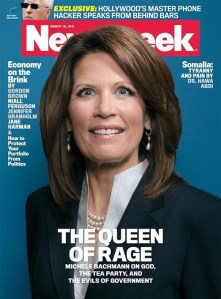
Bachman's disastrous Newsweek cover

Michele Bachmann was kind of the first fad of the GOP, and was slammed repeatedly for her bizarre and factually inaccurate comments in public – waxing poetic about New Hampshire, calling it “the state where the shot was heard round the world in Lexington and Concord,” while Lexington and Concord are actually in Massachusetts. She commented on the census, saying that “[My family] won’t be answering any information beyond [number of people in our household], because the Constitution doesn’t require any information beyond that,” which also isn’t true – the Constitution mandates citizens to fill out census forms. Or this gem about carbon dioxide: “carbon dioxide is not a harmful gas, it is a harmless gas. Carbon dioxide is natural. It is not harmful. It is part of Earth’s life cycle…And yet we’re being told that we have to reduce this natural substance and reduce the American standard of living to create an arbitrary reduction in something that is naturally occurring in the earth.” The woman is not a good speaker – she is clearly grasping for patriotic straws when she calls forth grand images of the Revolutionary War, and clearly grasping for Tea Party straws when she pigheadedly and uneducatedly dismisses the idea of global warming. This kind of saying-anything-to-please-a-crowd is not, not at all, a quality one should accept in a presidential candidate.

Rick Perry: Oops

Rick Perry was always too much like GWB to stand a chance. Not terribly substantial – seemed like the kind of guy I’d like to have a beer with but, like W, doesn’t even seem like he’d want to be the president, at the end of the day. I think the stress of even the race was too much for him.

Screenshot from Cain's abysmal campaign commercial

When Herman Cain was declared frontrunner of the Republican Party, it was the last time that I was surprised/horrified at the state of the GOP candidates. Herman Cain, who attended Glenn Beck’s rally in Israel. Herman Cain, who said: “When they ask me who’s the president of Ubeki-beki-beki-beki-stan-stan, I’m going to say, ‘You know, I don’t know. Do you know?'” Herman Cain, who said: “I don’t have facts to back this up, but I happen to believe that these demonstrations are planned and orchestrated to distract from the failed policies of the Obama administration.” Herman Cain, who is a terrible, terrible candidate and appears to be willfully ignorant of foreign policy – or, at least, he imagines that that image is more desirable than utilizing his education.

So once Newt Gingrich was declared frontrunner, the GOP picking terrible candidates was sort of an expected pattern. Newt Gingrich was disgraced in the ’90s for having the worst Speakership in history – he suggested that the government shutdown was a personal attack against him, was the first Speaker of the House to receive ethical sanctions, and resigned in disgrace, commenting: “My only fear would be that if I tried to stay, it would just overshadow whoever my successor is.” I remember his name being the punch-line of jokes when I was a kid.

Also, he calls himself Newt, and he runs under “NEWT 2012”. Even without his ludicrous political career, no president should have an animal name, I’ve decided.

So why, why is the GOP choosing candidates whom I can mock by just quoting things that they actually said? Why are voters sashaying from Neo-Sarah-Palin to Neo-George-W. to Foreign-Policy-Knowledge-Have-Not to Only-Slightly-More-Desirable-As-A-President-Than-An-Actual-Newt?

An attack on the speaking skills of candidates might seem petty, but the speech- and communication- related responsibilities of the United States President are nothing to be neglected. I do suspect that the pressure on a candidate is more intense than in any other political position, and that slips in speech are widely a result of that pressure combined with the rabidness of the amusing-slip-up-snatching-and-amplifying media, but I also think that our standards for the public speaking skills of our president should be high. The pressure on candidates to not commit to anything – to sound good without making any promises – has caused the degeneration of political debates into a rhetoric-slinging festival resembling arguing grade schoolers.

These people are politicians – they have college degrees – they were popular enough to make it into the political scene and be elected to (in most cases) at least one high government office and run it with some level of competence. At least, that’s what I stubbornly assume, as I am afraid to allow myself to abandon all my hope in the political system. So let’s assume that the candidates are fairly competent and can sometimes speak without sounding like grade schoolers. Why, then, is everything about the GOP race so ridiculous?

I think that the 2012 GOP race so far demonstrates the logical extreme of a system built on fear of commitment and fear of offending even the most idiotic constituents. Noncommital and pretty-sounding political doublespeak is ridiculous in itself and always has been; in this year’s race, the insipid rhetoric has been deconstructed to reveal its logical core: nonsense. Politicians have been trained to say nothing for a long time; instead of learning what they need to know, they only need to be able to appear to know it; we are beginning to see the evidence of this more obviously. And with it, the apparent neglect of the American public to remember that the President is not only a likeable face, but the Commander in Chief of our army; not only a spearhead for conservative/liberal policy (depending on his/her affiliation, obvs.) but a position with the opportunity to encourage negotiation between the two sides of Congress and a key communicator with heads of state of other countries. And that is why the state of the GOP leanings isn’t just amusing – it’s dismal. Discouraging. One can only hope that the nominee will be someone we can take seriously.


A Sinterklaas Celebration and Sensitivity

This blog is called “Culture War Reporters,” and by and large I think that my co-writer and I manage to cover topics that are about the culture we presently live in, whether it be about why we give or why we put up with watching Family Guy. Today I’m writing about an aspect of North American culture that clashes with a particular European tradition.

Last night a friend and I were talking about the social work program he’s currently taking, particularly about his fellow students and how seriously they take their course of study. The same friend I debated the usage of the word “rape” with, he stressed the importance of finding humour in everything. He recounted, with distaste, being snapped at for telling a racist joke.

Oversensitivity  runs rife in North America, for better or for worse. It’s the reason lines like this one in Modern Family exist, and why we find them so funny and relatable.  Political correctness and striving to not offend are held in high regard, and when comparing it to the opposite end of the spectrum, utter ignorance and obnoxiousness, it appears to be the reasonable choice. Continue reading

Kim Jong-il is Dead; Nobody Knows What is Going on in North Korea (Still)

source: christanpost.com
So Kim Jung Il has died, purportedly, and I have no other choice but to write about it. Not really as a political analyst (okay not at all as a political analyst), but just as someone who kind of watches world events like sports, in a nihilistic sort of way.

Right around 10:20pm EST the Associated Press announced that North Korea said that Kim Jong-il was dead. ABC and the NYT quickly reported the story, saying that Korean Central TV reported: “Our great leader Comrade Kim Jong-il passed away at 8:30 a.m. on Dec. 17.” 8:30am in North Korea translates to 6:30 pm EST on Friday.

source: nyt.com

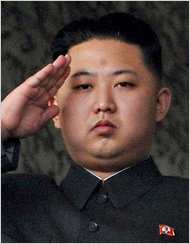
Kim Jong-un, the cheerful new dictator of North Korea

So what on Earth is going to happen to North Korea? Will the dictator’s death grip on the media continue? Kim Jong-il did some crazy things – Kijong-dong, for one, which was an entire empty city built in view of South Korea in the 50s to encourage defection. There was the claim that he was born under a double rainbow, that he scored 38 below par on his first golf game (and then promptly retired), and that he was a “worldwide fashion icon”. The idea of truth coming out of North Korea is roughly equivalent to tactful and thoughtful speech coming out of Rush Limbaugh. The whole event of Kim’s death and the transfer of power to Kim Jong-un is steeped in uncertainty. Heck, even the New York Times doesn’t know exactly how old Kim Jong-un is.

So the world is just kind of freaking out this morning. China’s pretty nervous. Everyone’s wondering what the long-oppressed people of North Korea are going to do – is the regime’s cult so ingrained in people’s heads that they will complacently move right on to Kim Jong-un as the most handsome and benevolent evil dictator ever? This event passing with no unrest in North Korea would be the most depressing thing ever.

Of course, this event causing violence between the North and South Koreas which ended up in someone (North Korea, the US…) using an atomic bomb would also be pretty depressing. The US, China, Japan, and Europe are all kind of staring at North Korea the way one would stare at a baby that just picked up a carving knife. North Korea test-fired missiles right before they announced Kim Jong-il’s death, so that’s not exciting at all. Stocks in China fell significantly. South Korea placed all of its military units on alert.

I have no parting comments. We’ll see what happens. While we wait, go to this hilarious Tumblr of Kim Jong-il looking at things for some comic relief.