Education Inflation and Prolonged Adolescence in Middle Class America

Education Inflation
As college attendance rises, the idea of a bachelor’s degree is starting to take the conceptual place of high school – getting a bachelor’s degree, for the middle class, is becoming the norm, such that students are going to college even if they have absolutely no idea of what they’re going to do with their education.1 Since more people are getting an undergraduate degree, the degree is becoming less impressive; more people pursue terminal degrees and that in turn becomes less of a distinction.  This results in a whole bunch of people attending school longer for degrees that carry less weight.

There’s nothing inherently wrong with the situation above – the increasing education of the population is, by itself, an appealing idea.  The problem is that as the education of the middle class stretches to include a requisite 2-4 years of undergrad and 3 to 5 years of graduate school on top of that, the students aren’t getting any younger.  So we graduate at 27, an age when our parents were married, having children, and buying houses.  To put it succinctly, ousource: http://dioclese.blogspot.comr bodies are saying “babies!”, our advisers are saying “thesis!”, and the largest purchase we’ve made so far is a minifridge.  This doesn’t seem to be bothering us too much, though; we are good at school, we figure, so we might as well remain in the bubble so our loans continue to be subsidized.  We stay in school, we stay in debt, and we stay in our parents’ houses.
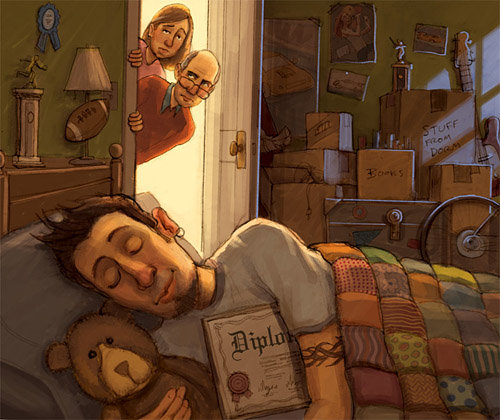
The idealism eventually escapes our peer-reviewed brains when we graduate and realize that we don’t know how to buy car insurance.  But that’s really okay because we can ask our parents to do it for us.  They’re right downstairs, after all.

Overstocked and Ungrateful
One major problem is that our generation doesn’t know what to do with what we got – more so than generations before us, we are often oversupplied and oversupported.  We were told we could be anything we wanted to be and were then gingerly placed into the world, too old and too inexperienced.  We are the kids kept inside nice houses so we don’t get our clothes dirty – the kids sent on a field trip to the library with 2 days’ supply of food, a spare rain slicker and an atlas.  We are the safest generation yet.  And we are floundering because of that. Everything was set up for us to be effortlessly happy, but the essence of life is potency, not happiness.  And a 26 year old who has been in school for 21 years does not feel potent.

And then we feel unable to talk about this – what kind of idiot complains about not having enough work?  What kind of ungrateful kid says he or she doesn’t want to be pampered?  But that’s what we have to do.  Because pampering, while incredibly comfortable, is stifling.

And I don’t know what to do with this – like I said before, an increase in the college-educated population is good, and college degrees (once we actually get them) have been shown to increase salaries even in fields unrelated to one’s major.  But the inflation of the college degree has kept a whole generation of students from recognized adulthood, and the results are debilitating.

1They take Psych 101 and whatever else sounds interesting to them, and graduate with a humanities major that their adviser says will look great to graduate schools.
The Autobots Wage Their Battle To…

There will be spoilers. Please be wary.
                                                                                                                                                                      

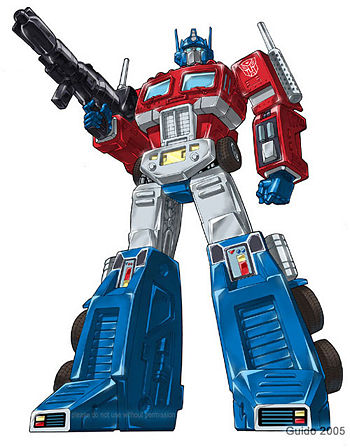
Cartoons from the 80s permeated much of my childhood, largely because a lotSource: http://tfwiki.net/wiki/Optimus_Prime_(G1) of older shows were aired in the Philippines, like the Captain America segment of The Marvel Super Heroes.1 Most people who grew up in the 90s have been exposed to Transformers, however, and know exactly what I’m writing about when I say that at one point Megatron didn’t transform into a tank or a jet, but a gun.2

Beginning in 2007, director Michael Bay began creating films based on the franchise, the content of said films fitting more in line with current cultural norms. In other words, the level of violence was ramped up to much higher levels.3 I never saw a transformer go down when watching the cartoon, but in the first two films we are witness to Optimus Prime, the leader of the Autobots: ramming his Energon Sword through Devastator’s head/neck region4, cutting off Starscream’s arm and clubbing him in the face with it5, and ultimately killing Grindor by pulling his head apart with hooks6.

As the antagonists in these films, the deaths of the Decepticons are seen as victories and not tragedies. Their design, especially when it comes to their sharp teeth and red eyes, helps to depict them as more beast-like than human. The Autobots being seen as people, however, is a point that’s pushed pretty hard in Transformers: Dark of the Moon, the third and final instalment in the series. Wheeljack, the elderly inventor of the Autobots, is captured by the Decepticons and, as he begs for mercy, brutally shot twice. Ironhide is betrayed by Sentinel Prime and shot in the back, and as he asks why the Prime “dismisses” him and deals a finishing blow. Sam [Shia LaBeouf] and Bumblebee have a relationship going back to the first film, and whenever the Chevrolet Camaro-transforming robot is endangered the audience feels as Sam does, taking emotional cues from his panicked yells.

Since the first film we’ve seen Optimus Prime lay down the law and watched him and the Autobots wage their righteous war against the Decepticons. In spite of them clearly being in the right [no one wants humans to become slaves to the Decepticons] some of the actions that they perform in the third film seem . . . excessive. One battle is concluded by Ironhide pulling a spear out of his shoulder and impaling it into Crankcase’s (a Decepticon) face, slamming him into a car, and then kicking the wreckage into an auto shop.7 More disturbing by far, though, is what happens when a Decepticon aircraft is brought down. As the pilot struggles to get out he is surrounded by Autobots and dismembered. His head, arms, and legs are all yanked from his body, with his torso being further pulled apart by one of the Wreckers. Optimus Prime ends the carnage (and the film) by finishing off Sentinel Prime in a fashion eerily similar to how Wheeljack and Ironhide were, by executing him with Megatron’s fusion shotgun as he begs for mercy.

As exhaustive as this post seems to be, there are many instances of robot carnage which I have neglected to include. I suppose that the ones mentioned could show us that extreme violence can be justified when it is the forces of good against the forces of evil (and when they are robots). What it doesn’t explain is how, exactly, to understand this. If the Autobots are to be seen as people then why aren’t the Decepticons? Their fight is a civil war, and with this in mind would we be so cavalier to promote the murder of brother by brother? Are there any real-life parallels that these levels of brutality can be placed on?

The well-known Transformers theme song has the line “The Transformers! More than meets the eye!” The lesser known lyrics immediately proceeding that are: “Autobots wage their battle to destroy the evil forces of the Decepticons!” Knowing this, I suppose we always knew as children that Optimus and his forces were destined to more than defeat Megatron and his cohorts. A dozen or more years later, what I don’t think we could have known is how brutally this would happen.


1. First syndicated on US television in 1966: [http://en.wikipedia.org/wiki/The_Marvel_Super_Heroes]

2. Specifically a Walther P-38, a World War II era handgun. Source: [http://en.wikipedia.org/wiki/Megatron_(Transformers)#Dreamwave_Productions]

3. Levels that  can only really be described as Bay-esque. [citation needed]

4. For your viewing pleasure: [http://tfwiki.net/w2/images2/thumb/5/52/Movie_Bonecrusher_dies.jpg/800px-Movie_Bonecrusher_dies.jpg]

5. Source: [http://www.youtube.com/watch?v=-T-ehTYfE-0#t=00m38s]

6. Source: [http://www.youtube.com/watch?v=-T-ehTYfE-0#t=00m46s]

7. Which then promptly explodes. Courtesy of Michael Bay.

In Defense of Gender Inclusive Language

I used to not care about gender exclusive language at all. I would get a little annoyed when people pushed for gender inclusive language – switching pronouns was confusing, “he/she” was unattractive, “he or she” was cumbersome to the eye, etc. I said that I wanted an equal paycheck before I would ever care about pronouns.

Then, I was at a college art show reading an artist’s statement describing how the artist intended the viewer to experience his painting. He used only female pronouns. I read it and felt, for the first time in my life, included into the default. Included into the hypothetical viewer. When I read hypothetical male-only pronouns, I understand intellectually that the writing is referring to any hypothetical person. But when I read the artist’s statement with female pronouns, for the first time I felt like it could be talking about me.

One of my friends and I had a long discussion about this topic. He had just used the word “man” to refer to all people, and I asked him to use gender inclusive language if he was in fact including both genders in his statement – to which he responded that he never really paid attention to such admonishments of gender exclusivity (exclusiveness?) because even though he was saying the word “man”, he meant “all people”. We had a long discussion, and part of what I told him about was my own experience with how much gender exclusive language affects the experience and thought of the reader, regardless of the intent behind the exclusive words. I also mentioned that in academia, gender exclusive language is not longer considered acceptable in published works at all. Because of that point, he stated that he would try to change his language because I had made a good case about how it can offend women and make them feel excluded from things that are supposedly referring to all people.

And I told him that that wasn’t enough for me. Yes, I think it’s fine to change one’s language to gender inclusive because one earnestly wants to avoid offending people, but I didn’t call him out just because his language offended me; I called him out because he was speaking inaccurately. I think that most people will eventually change their language because gender exclusivity will continue to be considered more and more offensive, and therefore less acceptable in more and more social circles. But if that was the only reason that anyone ever changed the way they spoke, then nothing would have ever changed in the first place.

During the conversation, one of my other friends pointed out to me that women’s rights (from a USA point of view) have come a huge way in just the 90 years since the suffrage movement. Sure. I am grateful for the rights I have, especially the rights that I wouldn’t have had just a century ago. But I’m not calling you out on gender-exclusive language because I’m upset about society being unfair – I’m calling you out because you’re being inaccurate.

I’m not insisting that all of society change right now – I’m insisting that individuals that I speak to speak accurately, and refrain from saying that they “mean” men and women when they only say the word for men. Because you can’t get past that. No matter what you say the words “man” or “he” etc. mean when you say them, you cannot get past the fact that the words themselves are referring to males only. Speaking with gender inclusive language isn’t something you owe to women or hippies or those annoying there-are-no-differences-between-men-and-women-at-all people; it’s something you will want to do if you have any desire to communicate accurately.

“Rape”

Three days ago a very close friend of mine and I were watching the StarCraft II podcast The State of the Game, an episode of which was specifically discussing foul language and the professional gaming scene.1 I turned to him and casually asked him what his stance on the subject was, a question which began a debate that lasted the better part of an hour.

This post is very difficult for me to write. I face the challenge of having to fairly represent our respective opinions, and I worry I will portray our separate viewpoints with a bias of some sort. In spite of this, I will try to press on and do my best.


Our discussion was, as you may have guessed from the title of this post, on the usage of the word “rape,” specifically in the context of the gaming community. To those perhaps unfamiliar with the terminology, the second entry on Urban Dictionary reads: “To utterly defeat another person in any form of competitive activies [sic].”2  An example of it being used would be someone saying to his friends, in the aftermath of a victorious Halo match, “We just raped those guys.”

My standpoint being that the word shouldn’t be used in this manner, my first point was one that INcontroL3 (Geoff Robinson) made, that its usage is harmful to e-sports in that it lowers the community in the eyes of others. My friend’s response [hereafter referred to as T] was that the context needs to be taken into account; if the word is being used in a setting where everyone fully understands the meaning behind the word [i.e. a StarCraft II stream] then there shouldn’t be any problem.

Outside of that specific context, T pointed out that language is an ever-changing thing, a sentiment I couldn’t, and can’t, disagree with. We give words both meaning and connotation, therefore it is fully within our power to change the words if we’d like. He went so far as to say that the word “rape” has already changed, fully appropriated by the gaming community. My argument was that although this may be the case, this change certainly didn’t need to occur. I wanted to address this trend in popular culture, the inclination to forever push our boundaries [moral and otherwise], but that would have been off topic and is for another time.

Similar to that point, however, I stressed that the word was chosen for a reason. A counterpoint to what he said about “rape” losing its meaning, I brought up the fact that it has such strength about it. It’s a loaded word, and was chosen for its level of offensiveness. Just because you’re no longer stating that you are going to sexually attack another person doesn’t erase the original sentiment behind the word choice.

Lastly, and what many of you may have been thinking while reading this, is that the word “rape” has such potential to offend. Those who have been or personally know rape victims may be very hurt by hearing the word thrown around so casually. A point against hypersensitivity was then made by T: we use much more violent terms such as “kill” and “murder” in regards to video games, so why is there never any outcry made concerning those who have had friends or family murdered?

Furthermore, there is a case to be made for discernment. T placed a lot of emphasis on the ability of the average person to know what the context behind the word is. If someone involved in a contest of any kind [be it video games or basketball] uses the word “rape” and directs it at their opponent then it is immediately assumed that they don’t mean the actual definition of the word. When I once again brought up those who were offended we were brought full circle to his point about the evolution of language.

T reminded me that language is in a state of continual development, and at the very least we are in a transitional period. I argued back that if this transition is going to offend and hurt others, then it would be better if it didn’t happen.  There is also the matter of those same people being hurt and offended even after the transition has fully taken place.

After all was said and done we agreed on a few points, yet it was apparent that on others we would remain divided. According to the Online Etymology Dictionary4, the Latin word “rapere” simply mean to “seize, carry off by force, abduct”;  it wasn’t until the 15th century that the more sexual aspects of the word began to be used. It may be that a few years down the line the word “rape” is thrown around as casually as “beat.” My stance, however, was never that words can change their meaning, but that sometimes they shouldn’t have to.


1. Source: http://blip.tv/sotg/starcraft-2-state-of-the-game-ep41-5229247 [starts again {was discussed earlier} at around 1:50:50]

2. Source: http://www.urbandictionary.com/define.php?term=rape

3. If you really want to know who this guy is: http://wiki.teamliquid.net/starcraft2/INcontroL

4. Source: http://www.etymonline.com/index.php?search=rape&searchmode=none

Same Sex Marriage in the Current Context

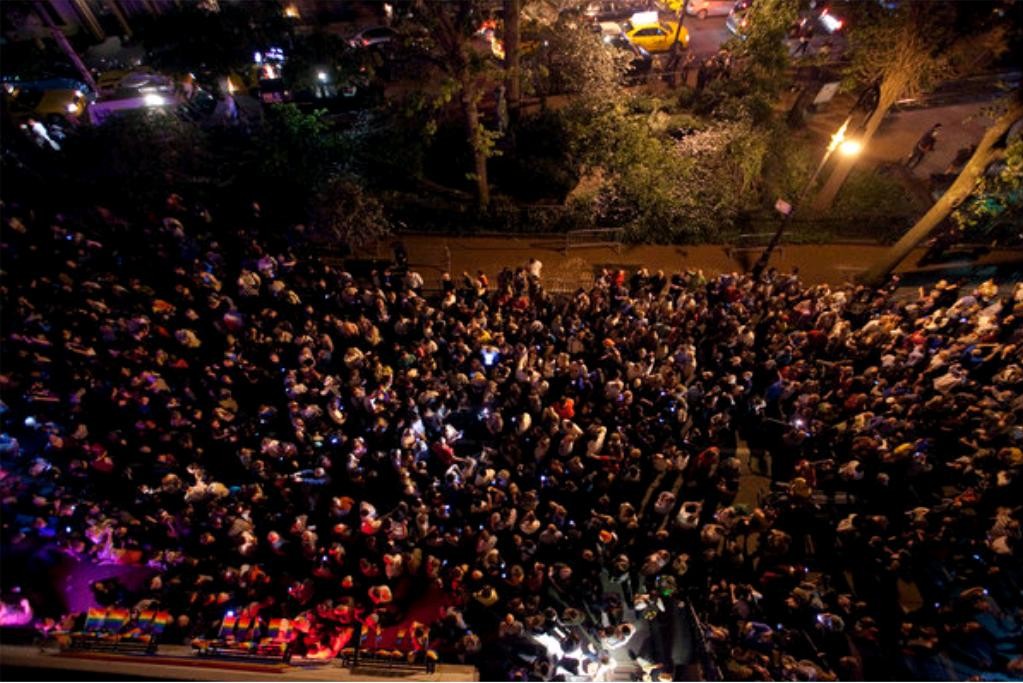
source: www.theamericanmagazine.com

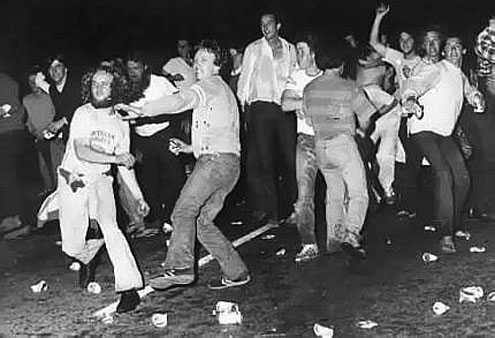
The Stonewall Inn, 1969

The passing of the monumental bill by the NY Senate last Friday (in addition to the UN commitment to protect LGBT rights) demonstrated clearly the increasing social acceptability of same sex marriage. While the movement started and is continuing with the passionate support of marginalized people, the case for same sex marriage is gaining momentum because it is becoming “cooler” to support it – being pro-gay-marriage is slowly becoming the default, and voting against it is more commonly seen as bigoted and discriminatory.

Even just a few years ago, only the more socially liberal Democrats would support same sex marriage (like in 2009, when every Republican and 8 Democratic senators voted the bill down in the New York Senate) – but this last Friday all of the Democrats in the Senate and 4 Republicans voted for gay marriage.  So…what changed? 2011’s bill included that amendment that protects the right of religious institutions who refuse to marry same-sex couples, but that wasn’t the only reason – it’s the slow change of what’s socially expected.

In that strange way that things viewed as “radical notions” can eventually trickle down and become accepted common sense, supporting same sex marriage is becoming the the norm.  Not long ago, anyone who campaigned for same sex marriage in the US had to explain their case persuasively and passionately to be taken seriously, but now the pressure is shifting to the other side – those who oppose gay marriage are the ones who are required to defend themselves. Being pro-gay-marriage is almost universally assumed for Democrats, and some Republicans are “coming out” as supportive of the cause too, like NY Senator Roy McDonald, who said “f*** it, I don’t care what you think. I’m trying to do the right thing.” Apologetic hand gestures and the requisite “But hear me out…” are being reassigned to the “traditional marriage” crowd – especially among academics, the upper middle class, and young adults, it would seem.

Interestingly, as views on gay marriage are shifting, the view of marriage in general is changing too. The “married scene” (or whatever you would call it) is one filled with unmarried couples who refer to their pets as children, couples who live together for decades before getting married, couples who don’t get married at all, divorce cakes, and an annoyingly-often-quoted-and-never-cited 50% divorce rate.The Western idea of marriage is conflicted: we still say “Til death do us part”, we still tend to teach (or at least show) the ideals of marry-young-and-live-Happily-Ever-After, but we’re getting married at an older age2 and marriages don’t tend to last “til death”.  I’m not here to argue the healthiness or unhealthiness of divorce or cohabitation, – the point is that, whether good or bad, the idea of marriage is changing in the West, and we don’t seem to be sure into what.  Same sex couples are fighting and protesting their way into a strange and fickle club; one that (technically and idealistically) promises lifetime commitment and doesn’t really deliver.  It’ll be interesting to see what the statistics will look like for newly married same sex couples in the future.

source: www.nytime.com/slideshow/2011/06/25

Outside the Stonewall Inn, June 23, 2011

Support for LGBT marriage rights seems to be going the way of racial equality and women’s rights – our kids are probably going to be baffled at the idea of the Defense of Marriage Act, like we were at some women’s rights and racial discrimination issues that we take for granted. One difference, though, is that same sex couples, unlike women and racial minorities, will definitely always be a minority, unless demographics change hugely (or there are way more of us in the closet than we thought). This is another thing that’s going to make the future interesting for same-sex politics – the discrimination might just cycle around again after all of the people who witnessed the fight for marriage equality are gone, unless the idea of LGBT rights settles itself into a comfortable position as the social norm. That seems to be the case so far.3

1 the best source I could find, figure 13; the second best source I could find
2 source
3But maybe this will be a short-lived trend, considering the growing muslim population in the EU and the US; juxtapose that with the fact that the 7-9ish countries in which homosexual activity is punishable by death (Iran, Sudan, Saudi Arabia, UAE, Mauritania, Yemen, Somalia [Somaliland], Afghanistan [capital punishment until 2009, which is still often unoficially enforced], Pakistan [sometimes, where Shar’ia law applies]) are all Muslim-majority states. If demographic trends continue and Muslim-majority states continue to tend to enforce Shar’ia law, it doesn’t seem that same sex marriage will be able to remain a social norm, at least in Europe, for more than a few decades.

Attitudes Towards Feminism in the Past Week

Last week I edited the introduction of a 75,000 word manuscript that I had worked on in May, it being emailed to me long after the original job was complete. It was, by and large, about the feminist movement in the UK, and how it has lessened the nation as a whole. It cited the “ladettes,” which the Concise Oxford Dictionary defines as “Young women who behave in a boisterously assertive or crude manner and engage in heavy drinking sessions,” as a subject of particular disgust.

It grew more and more subjective as it went on, and denounced the “feminazis” as intensely angry women who felt little for the role of motherhood and were destroying chivalry. High subjectivity aside, on the whole he railed against these most extreme cases, acknowledging the need decades had past for gender equality in the workplace. This was by far the most reasonable standpoint I was witness to.

The day before that it was brought to my attention that Scott Adams, the creator of Dilbert, had once again written another blog post sure to start the internet buzzing. In response to the wave of news discussing men who have been cheating on their wives, tweeting pictures of their genitals, and raping, he explains that men are born “round pegs in a society full of square holes.” In other words, the society we live in today is constraining, keeping males in “a state of continuous unfulfilled urges, more commonly known as unhappiness.”

I’ve heard two of my English professors say that we always hope for our heroes to have risen above the thoughts of their time period. From the front of the classroom they often wore their disappointment clearly when this was not the case, such as Shakespeare’s portrayal of Shylock in The Merchant of Venice. Dilbert is a tremendously well-written comic strip, and in this case it’s saddening that an artist behind such a hilarious comic would also be the creator of such wildly offensive posts.

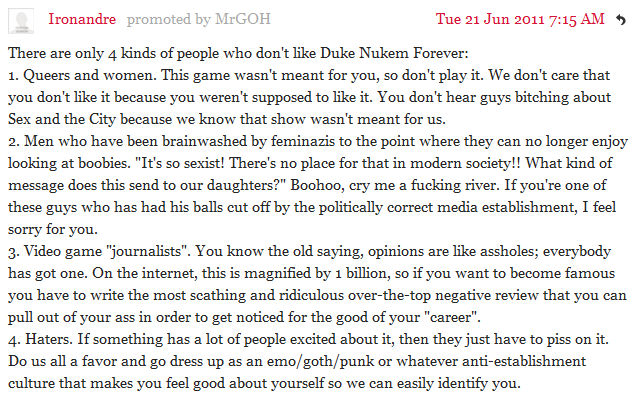
Last week, after some 15 years of development, Duke Nukem Forever was finally released. Decried by many as being overtly crude, disturbingly misogynistic, and having boring, repetitive gameplay, the comments sections of any article discussing the game became a place rife with conflict. Many staunch supporters of the game came out with some very strong opinions, the following catching my eye:

Internet Comments: A Cornucopia of Well Thought Out Opinions

This was found here, and I don’t have much else to say about it specifically. Duke Nukem Forever garnered terrible reviews, so much so that their public relations firm announced that they would be “reviewing who gets games [to review] next time and who doesn’t.” Everyone, however, is entitled to their own opinion.

In posts to come I hope to more fully explore the backlash against feminism that I believe to be an emerging trend. For every action there is an equal and opposite reaction, though in this case it appears to be a more extreme retaliation, to the point where the sensitive male is ousted as being a traitor to his gender.

This has been attitudes towards feminism in the past week.