Tag Archives: comics

Attitudes Towards Feminism in the Past Week 2

My first post ever on this blog was the first “Attitudes Towards Feminism in the Past Week.” It’s been quite a few months since then, but I guess it’s just that time again. To be more accurate, though, these are observations I’ve made in the past two to three weeks.

Most everyone knows about DC’s “New 52.” Well, people who know comics know about it. To summarize it quickly, the people at DC comics have decided to relaunch [reboot] 52 new titles this year. Most have since come out.

Since I am wont to read a comic book every now and then, I perused a few of the bigger titles. I specifically went out of my way to read Catwoman and Red Hood and the Outlaws, two releases that  appeared to have been garnering more than their fair share of attention. They weren’t.

Comics Alliance and io9 put it into much better words than I do, and I strongly, strongly suggest you read at least one of their articles. If I were to personally point out the problems with both comics, they would go as follows:

In Catwoman her first on-panel appearance involves her changing into her suit; red lingerie and butt/boob-shots abound. The issue ends [SPOILER] with her and Batman having sex. It ends with a whole page of them just- going at it.
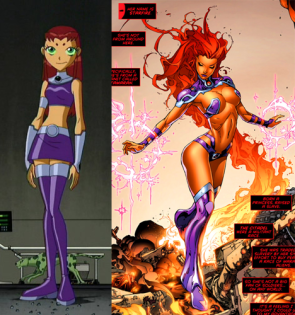
Red Hood and the Outlaws is a comic which features Starfire, a character who also showed up in the immensely popular cartoon Teen Titans. My problem here isn’t so much with her costume design [on the right]; it’s what you expect from most female heroes nowadays. My problem is that she spends most of her time out of that costume and in a barely-there bikini. She also wants to basically have sex with everyone.

DC’s responded to fans’ reactions about Starfire on Twitter. Essentially, we’re not supposed to be letting our kids read these comics.

This past Sunday I watched Ironclad, a period piece which features Paul Giamatti as an irate Prince John trying to take over in spite of the Magna Carta he just signed. Baron William de Albany, played by Brian Cox1, must defend a castle alongside templar Thomas Marshal [James Purefoy]. Kate Mara plays Lady Isabel, who occupies the keep they guard.

Lady Isabel serves two purposes.

1) To be a strong female character in a heavily male-dominated film/era.

2) To incessantly try to seduce Marshal, haranguing him about how his vows keep him from love and that he should listen to his emotions.

I hated Lady Isabel.

Mara’s character strives to be both fierce and independent [she hits a man in the face with a mace]2, yet her single goal seems to be trying to get into a templar’s pants [tights?]. As a role model she teaches that the ultimate victory is not over the iron grip of royalty, but instead the taking of a holy warrior’s virginity.

In two comic issues and one film [all released in 2011] we’re given a picture of what strong female characters should be. Attractive, certainly, but also sexually aggressive. Sexual freedom and independence seems to be what helps define a woman as strong and in control. This has caused me to come to the conclusion that the last thing I want my daughter becoming is a “strong female character.”

This has been  attitudes towards feminism in the past week. Two.

1. Who I must point out was also Colonel William Stryker in X2. It’s the only thing I can think when I see him.

2. Though when you take into account the fact that one man is cleaved in twain and another is beat in the face with a disembodied arm, it’s not that big an accomplishment.

Everyone’s Talking About Miles Morales

It doesn’t matter if comics are something you keep up with or not, you’ve probably heard the news: Spider-Man is black. Yes, you’re reading it here for possibly the third or fourth time, but it’s true. Our resident wall-crawler is now a person of colour, and people are not happy.

In case you haven’t heard anything at all about this change, allow me to restate what’s been said a thousand times already. In the Ultimate Marvel universe Peter Parker has died, and replacing him is a half black, half Latino teenager by the name of Miles Morales.

Ever since this news was announced by USA Today five days ago the internet has erupted in outrage. Many see Marvel’s decision as the purest example of forced diversity, that in the politically correct culture we live in this is just one more addition to a long line of changes made to make us more accepting.

What’s really riling people up, though, is the media. Erik Hayden’s article for The Atlantic Wire entitled “The Backlash to the Backlash of a Multiracial Spider-Man” informs us that the way the news is being portrayed is strongly affecting how we react, whether it be Glen Beck tying this change to something Michelle Obama said or Scott Mendelson of the Huffington Post pointing out that “[. . .] Parker Had To Die To Make It Happen.” As media consumers people are taking on opinions and making them their own.

The most upsetting article so far was one I found on The Daily Mail website entitled “Marvel Comics reveals the new Spider Man is black – and he could be gay in the future.” My problem with the article was not that they misspelled his name and omitted the dash, it was the gross assumption implied by the title, and the fact that said title would both pull in and incite readers.

The title is based on a quote [found in the article] by Sara Pichelli, an artist who created the new Spider-Man’s look. It goes as follows: “Maybe sooner or later a black or gay – or both – hero will be considered something absolutely normal.” Nowhere does she mention that Miles Morales might be gay. Nowhere in that statement does she even hint at it. All Pichelli did was muse that perhaps one day our comic book heroes will have a little more diversity.

My ire at faulty journalism aside, allow me to lay down a few facts that may be able to extinguish any flames of frustration over this change in character. Miles Morales is the new Spider-Man in the Ultimate universe. Peter Parker died in the Ultimate universe. It’s not regular Marvel continuity and as far as anyone is concerned in the regular comics Pete’s still donning those red and blue webbed tights and trash-talking the petty thugs of New York City.

If you can’t cope with the very fact that Marvel had the audacity to kill Peter Parker in the first place check out the Wikipedia page on Ultimatum. People die in the Ultimate universe all the time, and it’s almost always permanent. If key members of the X-Men can bite the bullet then really anyone’s fair game.

On the off chance that you’re still upset tune in to MGK [Mightygodking] and what he has to say about the topic. He’s got a point.

The Representation of East Asian Characters in Two Popular Western Comic Strips

Familiar to almost anyone who grew up in America, Archie Comics has told the stories of a fairly interesting group of teenagers living in the town of Riverdale for decades. First established in 1939 these comics are still published today, 72 years of panels featuring that insipid redhead Archie Andrews and his friends [who I actually don’t mind]. The comic strip Zits, on the other hand, was first published in 1997, and has for 14 years chronicled the misadventures of much-more-modern teenager Jeremy Duncan and his own group of eclectic young people.

It’s not difficult to see how the two [a single strip and all those created by an entire company] are similar to one another. Both are about American teenagers and their day-to-day lives, albeit living in very different eras. Having originated in the late 30s Archie and his friends have moved forward generation after generation, yet stick to a much lighter tone in regards to issues that teenagers have to face. Zits, starting at the turn of the 20th century, has a more realistic view of the high school years, addressing such topics as the disconnect between teenagers and their parents, the short attention span of today’s youth, and so on.

What I would like to explore and elaborate upon is the representation of Asian characters, specifically those of East Asian descent. Both of these comics are [or, at the very least, have been] immensely popular, and as a result their content is in part representative of what the West [in this case Canada and America] is familiar and comfortable with. Continue reading