Author Archives: Elisa

David Foster Wallace, Virginia Woolf, and Author Necromancy

Sorry this is late, ye millions of people. I am [still!] traveling through places barren of the internet, but I’m returning to the land of milk and honey soon (or whatever) and will have wireless all the time again.

source: electricliterature.com

I came across this blog on The Outlet that “revisits letters from prominent writers and other artists to revive the dying art of letter writing.” They posted a postcard from David Foster Wallace to Don Delillo (a famous person I haven’t read who seems to have won many awards for books called White Noise and Underworld and Mao II, among others).

First, the phrase “revive the dying art of letter writing” caught my attention. References to “reviving the dying art of [blank]” always have about them a sort of nobility – like when someone tells you that they work for the Peace Corps or rescue puppies for a living. But how does a note from a brilliant man help revive the dying art of letter-writing? The text is a clever note – another person defending the “art of letter[-]writing” might not even recognize it as anything more than an e-mail text.

And then I want to know why we publish and discuss the letters of famous people. David Foster Wallace was particularly brilliant, it’s true, but the post-mortem ransacking of his library was unsettling to hear about. Maybe a year ago I’d think differently, but now reading writers’ letters and diaries (like Virginia Woolf’s) seems me to me a rude, fetishistic, and sort of useless thing to do.

Virginia Woolf's diary, published post-mortem

And yes, the writing is going to be good – but many people can write witty and clever letters. Writers’ letters might be constructed, but they’re only constructed for one person and in that context. Books and published works are written in an entirely different context, for public consumption and enjoyment. Looking for writers’ letters seems to me the equivalent of wanting to hear Beyonce humming while she pees.

In David Foster Wallace‘s letter to DeLillo, he talks about a large palm tree, a book they exchanged, and how Wallace recently got his license in California. The writing is quite witty to read, because Wallace was good at words. But it is saying nothing and communicates nothing but what Wallace wanted to say to DeLillo on the 1st of September of some indiscriminate year. Why do we like reading this? How would this contribute to maintaining the art of letter writing?

Looking for every word on every grocery list scratched out by an author sounds painfully like something that I would have done a few years ago, which might be why I react so strongly against it now.

Knoebel (the blogger) calls the postcard “a prose index of cultural references,” which is pretty characteristic, I think, of the annoying self-effacement with which writers’ personal and accidental writings are usually treated: something must have been so special about these holy people that it is more worth our time to read their private, unrelated writings than it would be to develop our own. And that, I think, is my main problem with this practice – if we really want to appreciate prose, or to revive the art of letter writing, we should probably start working on writing some letters ourselves.

Thoughts on Racism, Cultural Evolution, and Neurology.

I am on choir tour and have limited internet. Thus, this post is a day late. Apologies to the world.

I took Harvard’s Implicit Association Test. I’m a racist.

Well, I guess more specifically, I show “a strong preference for European-American faces over African-American faces.” More more specifically, I associate negative words (like Agony, Hurt, Evil) more quickly with African-American faces and positive words (Peace, Wonderful, Laughter) with European-American faces. What’s more…most everybody does. Take it yourself.

There’s a lot of criticism of the IAT. I, personally, think it’s absolutely brilliantly designed – no, you can’t derive claims from it that aren’t there (everybody hates everybody but while people), but as someone trying to put together experiments, the design is really quite elegant. One of the more interesting things is the discussion of race discrimination and outgroup discrimination – is the association with negative words in reaction to African-American faces, or is it just due to the tendency (of babies, even) to prefer faces similar to our own and our families? Are my results indicative of deep-seated and individual subconscious racism or just an awareness of a cultural stereotype? One interesting report is that while self-described white people prefer white faces over black faces almost universally, self-descried black test-takers show about an even split between white-preference, black-preference, and neutrality. We could take this to mean that somehow black people are excluded from the universal tendency (observed in infants) to overwhelmingly prefer images of one’s ingroup, which seems unlikely and illogical to me, or we could take it to indicate (as I do, admittedly) that black Americans are affected by a widespread cultural stereotype and pattern negative associations. Also, Asian-Americans who took the test (to whom neither African-American nor European-American faces are an ingroup) showed preference for white faces.

Whatever the assessment of the test itself, it at the very least indicates the presence – somewhere – of the association of black faces with negative adjectives. Even just taking the test I could tell how difficult it was to not put the negative words on the side to which the black faces were assigned.

Last Sunday on Meet the Press, David Brooks referred to the IAT in reference to the Trayvon Martin case. As sticky as the case is, with the battle of media-bias accusations and omg-racist accusations fluttering around Facebook, I’m not going to touch it as I am not informed in the last. But the results of the IAT in reference to much of the discussion is fascinating. How are Americans – of any background – supposed to respond to our own natural ingroup-preferring tendencies? Humans are wired to prefer those who look like them and their families and, what’s more, mistrust those who are different from us. When nation-states were defined and connected by similar genetic background, this worked great. But in an experiment like the US, where we’re defined by our lack of ethnic connection, how are we supposed to counterbalance these neurological preferences?

The frontal cortex does a good job most of the time – we consciously suppress our negative reactions to different people groups. One study found that white subjects, when they looked at black faces, showed more action in their frontal cortex (the part of the brain associated with active thought and consciousness. It’s the part of the brain you’re reading this with right now, and the part of the brain with which you decide what to say and what to wear today.) than when they looked at faces similar to theirs. But then the researchers started flashing pictures of black faces too quickly for the subjects to consciously notice – but enough for their subconscious to be aware of the photo. When they were shown these pictures for only a few millionths of a second, subjects showed no frontal cortex response and a new response in the amygdala – which is the part of the brain (deeper inside, sort of in the middle, above your ears) that indicates fear, hatred, and feelings associated with negative stereotypes.

The point of this is that while a huge amount of people have an implicit association of negativity with outgroup faces, most people consciously suppress their negative stereotypes. This is a good thing, if it is depressing to know that it’s a necessary task for us. The more we are educated about our tendency to prefer familiar-looking people – and the more society becomes mixed, in terms of genetic background – the more we’ll be likely to suppress, if not conquer, the suspicion of difference which originally helped humans survive in an unkind environment.

Sexism, Reductionism, and Stepping on Women’s Heads

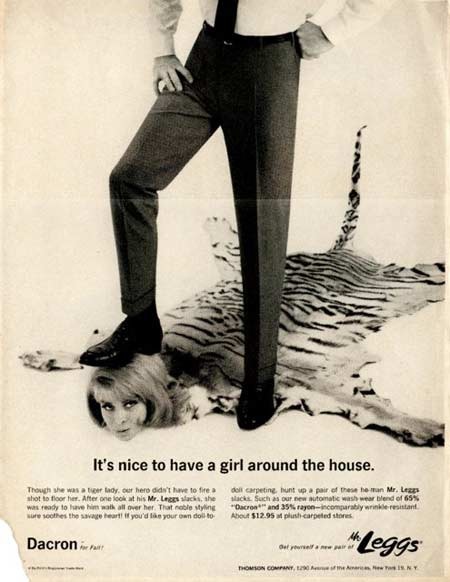
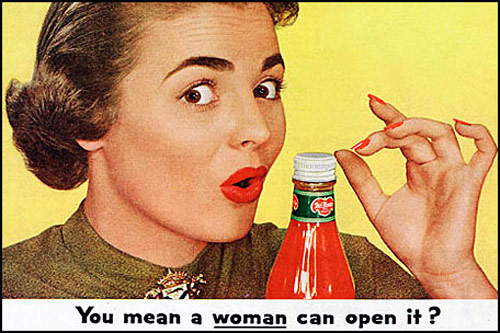
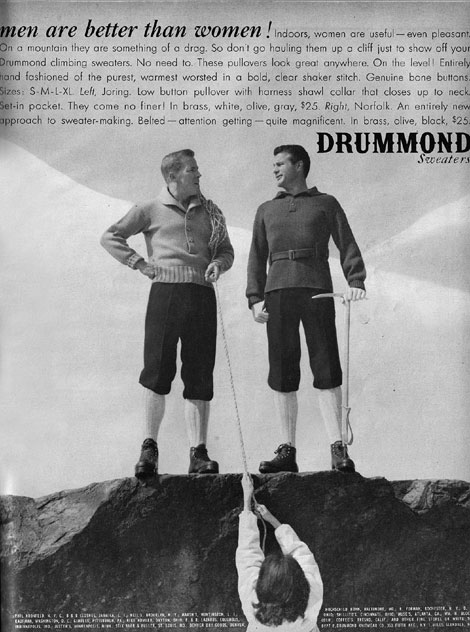
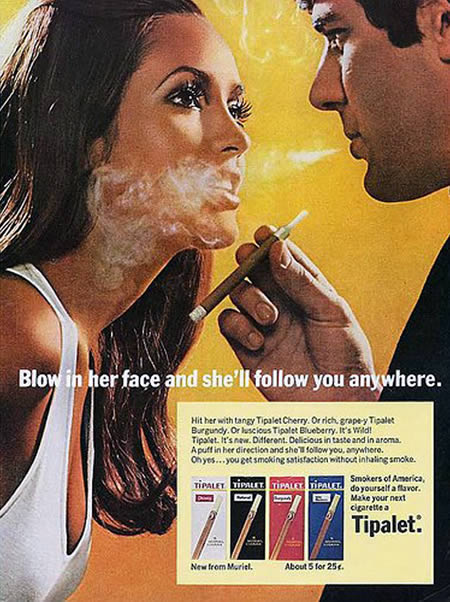
So Retronaut has a page of “Vintage Ad Sexism” – hilariously sexist ads, many of them aimed at men’s pride (“brand new man-talking, power packed patterns that tell her it’s a man’s world”) or women’s insecurities (“Would YOUR husband marry you again?”). There are some gems in there, like these:

source: retronaut.co

I'm just gonna let these speak for themselves.

source: retronaut.co

source: retronaut.co

Read some of this one for the full effect

source: retronaut.co

And this one might be my favorite…source: retronaut.co

Aren’t some of them kind of frighteningly recent-looking?

So yeah, we remember sexism, 1919 and women’s suffrage and bra-burning and all that. Being shocked that women couldn’t vote, etc. But seeing advertisements make it more harrowing. Serious political oppression at least treats women with enough dignity to be oppressed – advertisements make light of women as entities. I am less concerned with the essential sexism in these than I am the reduction.

Violence and political oppression are horrid, yes, but reduction is more insidious because it tends to keep hanging around long after voting rights have been own and salaries have been evened out.

The advertisements here, of course, appear ludicrous to us. “Is a wife to blame if she doesn’t know [to use a douche]? Yes! She’s decidedly to blame.” The one with the rug with a woman’s head, the man standing with one foot on her head Captain-Morgan-style. Some of them are just ridiculous.

But it is good to remember that as insane as they may seem, these are real, and they are recent. People who saw these ads and accepted them as a relevant way to advertise a product – people who made the ads, laughed at them, nodded in agreement – still make up a large part of our society today. Even after that generation dies, the fact is that American culture (it’s what I’m talking about here; can’t speak to other places) has been steeped in the reduction of women – and this is not an influence easily shed.

Now, establishing a double standard to “make up” for lost time is not the answer. Ensuring that all males are instilled with a sense of guilt about the past will not help society. Only by awareness of our ideological roots, and the flaws and violence therein, can we stay – or at least slow – regression.

Terrible Moments in News Media (Not Limited to Rush Limbaugh)

Note: This is a version of a piece I wrote this with my brilliant friend Chris Hartline for our student newspaper, and am reprinting it here. Any goodness in it may be credited to him.

Most of the public is aware of Rush Limbaugh’s stupid and unfunny bit in which he referred to a Georgetown student as a “prostitute” and a “slut” for saying that Georgetown health insurance should cover contraception.

source: lifenews.com

Do not pay attention to this man. He will make you sad.

But the name-calling does not stop there: other instances of sexist slander have been just as offensive but haven’t received as much news coverage as Limbaugh’s insult. Bill Maher, a liberal comedian and amateur political commentator on HBO, referred to Sarah Palin as “a tw-t” and “a c-nt”. Chris Matthews, MSNBC host, called Hillary Clinton “witchy,” “uppity,” and claimed that she was elected to the Senate only because her “husband messed around.”
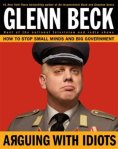
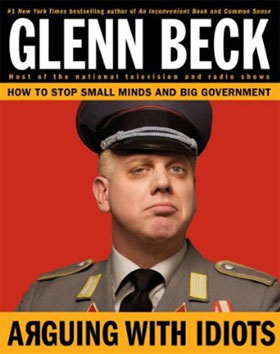
source: glennbeck.com

Looks like public discourse to me.

The state of the news media today is disheartening because the system of acidity seems to be self-perpetuating. Indeed, truculence has become a prevailing rhetorical device. Keith Olbermann had a segment on his show (and a book) called “The Worst Person in the World”. Glenn Beck wrote a book in 2009 called “Arguing with Idiots: How to Stop Small Minds and Big Government”.

Another clear manifestation of the deficit of trust of the media was a 2009 poll done by Time magazine. Walter Cronkite held the title (since 1974) of “Most Trusted Man in America”. Cronkite was the most visible figure in the media, which at the time provided objective discourse and information to the public, and he died in 2009. In the subsequent Time poll, voters said that the most trusted news anchor in America was Comedy Central host and political satirist Jon Stewart.

The fact is that the media is supposed to provide a momentary stay against political hostility, an unbiased source of objective information for the public, and that it is not doing this. Consequently, the public is losing their faith in the news media, and by extension the American political system itself.

The media has become tool used by political parties to influence the opinions of the public. A blatant example of this is the “Plan for Putting the GOP in the News” memo from the Nixon administration. The 15-page memo was anonymous, and has written comments on it by Nixon’s then-advisor and current Fox News President Roger Ailes.

Roger Ailes!

Roger Ailes: founding CEO of Fox News and adviser to Nixon, Reagan, and Bush. Also credited for possessing the world's least attractive set of jowls.

The memo stated that television was the best medium for political persuasion because of its imminent popularity: “People are lazy. With television you just sit – watch – listen.  The thinking is done for you.” The plan was to record prepackaged interviews with Republican politicians and deliver the videotapes to local news stations. Presently, critics say that Fox News has demonstrated their role as an arm of the Republican Party.

source: msnbc.com

All you need to know about Keith Olbermann is that he's not a pleasant person.

MSNBC, while on the opposite side of the political spectrum from Fox News, is similar in its audacious political stance. In a distasteful and recurring ending rant on his show, former host Keith Olbermann once shouted (his monologue was directed at then-President Bush), “This war is not about you … shut the hell up!”. Fellow host Chris Matthews also said after a 2008 Obama speech that he “felt this thrill going up my leg as Obama spoke.”

So it can be concluded that the media has become unabashedly partisan. Even the very fact that it is standard for each major newspaper to endorse a presidential candidate reflects a problem in the nature of journalism. It results in an overtly ideological news organization – the New York Times is liberal, the Wall Street Journal is conservative; the Washington Post is liberal, the Washington Times is conservative, etc.

A news staff tending to lean one way on the opinions page is typical and expected; however, the fear is that the ideological slant of the editorial pages will seep into the news coverage. The potential and underlying ‘spin’ of news stories becomes more important than the objectivity of the events being reported.

And maybe the Nixon administration’s prediction about the easy audience of television was prescient: political commentary television programs can be especially caustic and, at times, juvenile. They seem to appeal to the lowest common denominator of the public and of individuals. Keith Olbermann, Glenn Beck, Rachel Maddow, and Bill O’Reilly are all political commentators who base their rhetoric on the petty mockery of whoever disagrees with them – their arguments are negative, not positive, and clever insults take precedent over constructive criticism.
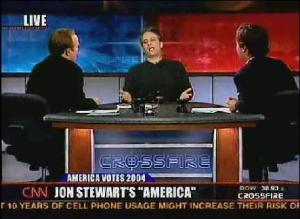
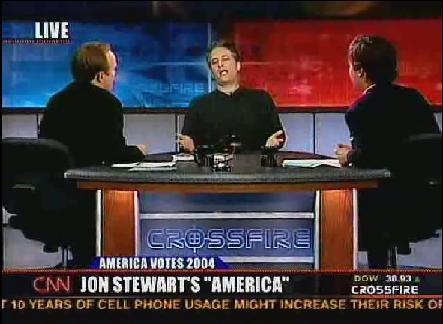
source: portland.indymedia.org

Jon Stewart pleads with the hosts of Crossfire to "stop hurting America." Crossfire was cancelled shortly after Stewart's interview.

The media itself has not only lost its ability to objectively inform the public of unbiased political events – it has become a tool for fostering and encouraging political contention. The role of the news media is not just lost – it has been perverted. As Jon Stewart said to the hosts of Crossfire, this inflammation of petty and theatrical bickering isn’t just bad journalism – it’s hurting America.

David Brooks said: “There’s a collapse in the public’s faith in American institutions. The media has done a poor job. We’ve become as insular and self-regarding as any [other institution].” It is no wonder, then, that there is a deficit of trust among the younger generations – the apparent disintegration of the integrity of our news sources is nothing less than repelling.

Hitler, Ray Comfort, and the Dismal State of Discussion

I did something bad for my health that I do not recommend. I watched “180”, a half-hour documentary made by Ray Comfort.

It is a bastardization of discourse from all sides. In an interview with Steve, a neo-Nazi punk type of young man, Steve says that he’s certain of his opinions about the falsehood of the Holocaust and other offensive things. To combat this, Comfort asks Steve to spell shop (Steve does) and then asks: “what do you do at a green light?” The question is a trick to get the mind to quickly respond “stop”, which is semi-associated with green lights and rhymes with “shop”, and the person answering looks silly. Sure enough, Steve responded “Stop” and looked silly. And then – well, then Comfort treated that like an actual argument for something.

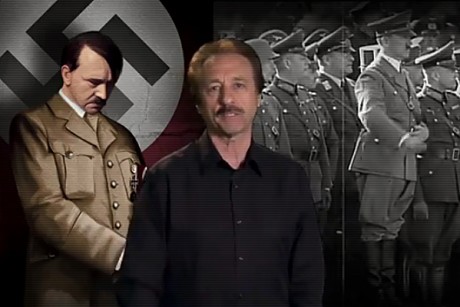
The documentary was dipped in dramatic music, photos of piles of dead bodies, and use of gratuitously violent photographs. What is most interesting to me, however, is the use of what seems to be the universal argument-ender: comparisons of things to Hitler.

Hitler, the Nazis, and Lazy Discussion
Hitler and the Holocaust have become mythic elements of American culture, I think, and to the detriment of the truth of the actual historical events. I was recently visiting a small church where the members, after the service, started (sort of randomly) to wax poetic about the horrors of Hitler and the Nazis. They weren’t saying anything new – everyone was just affirming that Hitler was inhuman and the Nazis were too. It was the fervent insistence that “real humans could never do that sort of thing” that struck me – I thought of all of the other genocides and massacres of the past century alone, of the killing of civilians in wars by troops of every nationality, of atomic bombs. But even in light of all of these things, current conversation about Hitler seems to serve contrast to our new, very human, very un-barbaric society. We talk about Hitler basically like Satan – an ultimate evil; a rhetorical catch-all.

Ray Comfort and 180: Unethical Discourse

Steve, in the movie "180" by Ray Comfort

Comfort’s specific use of the Hitler argument is reductive and tired. It is, if anything, an exploration of how charged and empty rhetoric in the realm of politics is being mirrored in general culture. His interviewees are inconsistent, and seem to know very little about philosophy, theology, or basic logic. Comfort’s questions are also always precisely and pseudo-cleverly leading, and it doesn’t seem that he wants to engage with the interviewees at all: “Does this mean you’ve changed your mind about abortion?”, he asks. “Are you going to vote differently in the future?” It is not a conversation, is the point: it is a poorly executed set of rhetorical acrobatics. Is this the way to foster discourse and an informed public? Probably not. Arguments depending on rhetorical cleverness are insulting to both parties.

Comfort’s series of interviews are not only annoyingly inconsistent and poorly constructed, however: the movie is also a manipulative presentation of complex issues and events, presented crassly and with a smugly triumphant attitude. One of the less graceful moments was when Comfort asked a woman if she’d had an abortion; she said that she had. He then immediately asked: “Do you feel guilty about it?”

As the big finish, Comfort sets up a game-show setup of moral responsibility and the afterlife, and awkwards them into admissions of fright and death anxiety:

  • Comfort asks people if they have lied/stolen/been lustful: most of them say that they have.
  • Comfort then gets them to admit that this makes them liars/thieves/adulterers.
  • Comfort gets them to admit that liars/thieves/adulterers go to hell.
  • Comfort elicits from the interviewees an understandable anxiety about the prospect of hell.
  • Comfort asks them if they are going to go read their Bibles.
  • Some of them say yes.

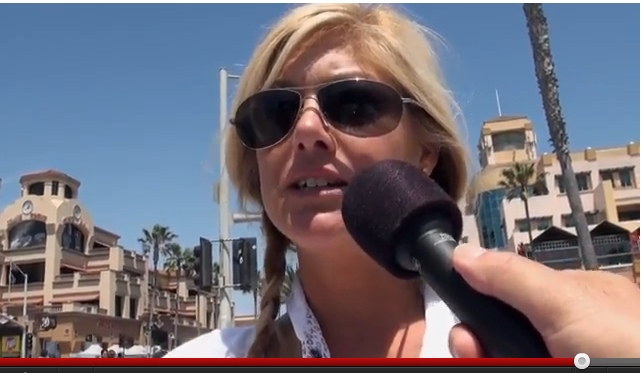
Alesia, from Ray Comfort's movie "180"

Theologically, morally, rhetorically, and logically, this is one of the most horrible things ever. Comfort’s quick-talking way of “tricking” people into professing a fright of punishment does very little for the moral health of humanity or the search for truth within rhetoric and theology. The triumphant music and photos of bloody sheets are no help for the legitimacy of the movie.

There are also 40 thousand comments. I do not recommend those either. They are not a happy picture of humanity.

It makes sense to protest the legalization of abortion and to be horrified at the amount of deaths occurring if one believes that life begins before birth. Comfort’s smugness and “gotcha” questions, however, lack earnestness, humility. The whole thing turns a serious situation into an awkward and unproductive onslaught of unhelpful rhetorical inconsistencies, devoid of integrity and, therefore, real efficacy.

In sum, the movie is a disjointed account of unproductive discussions with unproductive people with vague and uninformed opinions. It’s a disheartening representation of the state of discourse on American sidewalks.

Oscar Nominated Live Action Shorts Review (Also Austin is a Hipster City)

So I’m spending my February break in Austin, which is like a surprising hipster bastion in the middle of the yee-hawing gunslinging frying pan that is Texas. It is a strange situation.

I took a picture of this myself but it was at nightThe Alamo Drafthouse, for example, is not very much like the Alamo or a traditional drafthouse. The Alamo (at various locations; we went to South Lamar) in Austin greets you first with its selection of Princess Bride wines (“As You Wish White” and “Inconceivable Cab”), lightbulbs set in old film reels, and murals of retro movie scenes on the walls. Instead of trivia questions (“How many movies has Tom Hanks starred in that start with M?”) while you are waiting for the movie, they show old cartoons and news reals from the early 20th century; instead of a timid reminder to silence cell phones, they show a video clip of an old lady coming to beat you up if you speak or leave your cell phone on at all. On top of this, they serve pretty decent food that you can order throughout the film. Some people may call this Heaven (Who knew that Heaven would be in Texas?). The Alamo plays blockbusters, but also has events like Marlon Brando marathons and Princess Bride quote-alongs and – what I went to see last Sunday – a showing of the 5 Oscar-nominated short films.


All of the movies are 100% worth watching and you should go do it right now if you are doing nothing better (which I’m going to assume is the case). They range from a sad and stressful tale of moral ambiguity (Indian/German collaboration Raju) to a short (and brilliantly acted) depiction of an altar boy’s revenge (Pentecost).
The shortest film, Time Freak, has (arguably) the most pleasantly original plot scenario and is only 10 minutes. I recommend it (it’s on iTunes for 2 bucks and probably on the Internet somewhere illegally. But hey – support good filmmakers).

Tuba Atlantic, directed by Hallvar Witso

The most memorable part of the whole collection is in the Norwegian film Tuba Atlantic, directed by 27-year-old Hallvar Witzo. The film follows an old man, with a hatred for seagulls, who is told that he has 6 days to live. There is a sudden cut scene to Oskar (the dying guy) opening his door to a youthful, braces-bearing blonde girl, who says “Hi, I’m your local angel of death!”. If my vote were relevant, it’d be for Tuba Atlantic, I think.

Oscar winner for Best Live Action Short "The Shore", by Terry and Oorlagh George

I actually thought that the winner, The Shore, had the weakest acting of all of the films. That’s not too much of a slight, as all of the films were excellent, and the film’s ability to cram 25 years of backstory into a single, pivotal moment was impressive – but each of the other films, I thought, worked better with presenting interesting present moments and didn’t depend so much on measured history-exposition.

Go watch short films. Now.
I like short films – they seem more honest, especially plot-wise, than longer films, which sometimes just fill in an allotted time slot with pre-approved plot devices. The happy thing about short films is that their time constraints depend more on the demands of the story than anything else – the films nominated this year ranged from 10 minutes to over half an hour. Short films are worth your time; they are less likely to be contrived and the length allows them to develop honestly and cleanly, without being bogged down by the need to fill in time constraints or plot holes. So go see some, if you get the chance.