Category Archives: bizarreness

Albert Brennaman, the Patron Saint of White Dancers

I know you’ve probably seen it, but I’m starting with this: 

Arguably one of the most memorable films of 2005 [tenth highest-grossing that year], Hitch wormed its way into our hearts due to a number of reasons. First and foremost was Will Smith, but trailing surprisingly close behind was his co-star, Kevin James, and the bumbling Caucasian everyman he represented.

Now, I’m not one to perpetuate racial stereotypes; I’ve had too many people assume I like rice just by looking at me. But here’s the thing: I Love Rice. As much as many of us would hate to admit it, stereotypes typically have some kind of truth to them. The one I’m writing about today is one many of you have probably heard, and that is that:

White People Can’t Dance.

This is a truth I’ve come to more or less believe due to personal experience. The first piece of evidence being found in college dances I attended [student body 95% Caucasian]. The second was while working at a nightclub a few years ago. A group of four to five white people in their late 20s/early 30s came up to the floor I was busing, and it. . . wasn’t pretty.

Bringing this back to the beginning, what I’ve found is that a lot of the aforementioned not only love that clip from Hitch, they live it. In the most literal sense. Many know the dance by heart, and at parties moves like “the Q-tip” actually make an appearance. The character of Albert Brennaman has been lifted up to this odd place of veneration, his dancing a guide and example for others.

To put it simpler, they are proud of the way they move. There’s no shame there, and they’ve owned the fact that for the most part others don’t think they can dance. Without that social buffer of potential embarrassment, they unknowingly keep the stereotype alive. It’s a vicious cycle, and one illustrated in the equation below:

“White People Can’t Dance” —> white people dance however they want —> white people can’t dance

I’m not judging, it’s just a cultural observation. For an ethnic group to take pride in something they’re not good at is a strange thing, sort of like if Asians decided to own the stereotype that they’re bad drivers. In this case, however, no one is at risk of getting hurt. One group is content to move however they please, and the other is more than happy to sit back and watch it happen.

I leave you with an uncomfortable clip of white people dancing to “Take On Me.”

Obama: the brand

Jim Messina was an undergraduate when he managed his first campaign, and has won every race since then. He’s now manager of the Obama reelection campaign and going to great lengths to maintain his record.

source: huffingtonpostMessina has purportedly read volumes of US election history, but he spent the first months before beginning the Obama campaign in earnest meeting not with successful senators and former campaign managers, but with CEOs and senior execs of Apple, Google, facebook, Zynga, and DreamWorks. While Obama looks for support from left side of the House and Senate, Messina’s also brought Stephen Spielberg and Vera Wang into the campaign. Messina’s campaign, he says, is more based on wunderkind business strategies (Zynga and facebook, for example) than any elections from previous centuries.

The most interesting part to me of Messina’s campaign is the part focused not on intellectual persuasion, but attachment-building via branding. To contrast this with Mitt Romney’s campaign, look at the merchandise pages of each of the candidates’ websites:

Romney’s store has:
2 types of bumper stickers
a window decal
2 buttons
4 different t-shirts (2 of the with just the semi-unrecognizable logo on them)
a baseball cap
a lapel pin, and
(regrettably) a heather grey quarter-zip-up sweatshirt

All of his products are on one page, and most of them look like print-screened logos on shirts from AC Moore.

Obama’s store includes:
iPhone cases,
Earth Day packs,
“I bark for Barack” magnets,
v-neck shirts for women under 45,
calendars,
yoga pants,
a $95 Monique Pean scarf,
a Vera Wang bag, a $95 “Thakoon Panichgul“, whatever that is,
dog bandanas,
dog sweaters,
Joe Biden mugs,
Obama jerseys,
rubber bracelets,
pint glasses,
aprons,
bangles,
cufflinks,
baby bibs,
grill spatulas,
soy candles,
golf divot tools,
and a six-pack cooler.

There’s also about a billion different types of tshirts, buttons, and bumper stickers, and a “for Obama” series: women for Obama, nurses for Obama, veterans for Obama, African Americans for Obama, Latinos for Obama, Hispanics for Obama, Asian American & Pacific Islanders for Obama, and environmentalists for Obama.

Romney’s shirts say, at most, “Romney” or “Believe” – one of Obama’s shirts says “Health Reform Still a BFD.” Granted, Romney is aiming at a different demographic (LL Bean fans, eg), but Obama’s 19 pages of merchandise make Romney’s 1 page look pitiful, from a branding point of view.

The Obama campaign’s brand-focused strategy is closely integrated with its other image-focused tactics: assigning Romney the cold, out-of-touch persona, for example.
While critics of the Bain capital narrative put out by the Obama campaign said that things like negativity and party inconsistency (Bill Clinton’s subsequent praise of Romney’s management skills, eg) rendered the move moot, an article in Bloomberg said that Messina may not have been so concerned about persuasion at that point: “Messina is adamant that the Bain attack succeeded among the uncommitted voters he’s concerned with, who ignore pundits and are only now beginning to form opinions of Romney.”

For a lot of voters, Romney’s business and managing experience are just off the table. The Bain Capital anti-campaign put on by the Obama team wasn’t so much a persuasion for some voters as an excuse to keep holding their current opinion. K street and the hill will argue about the relevance and logical holes in different arguments, and about the influence of different political figures voicing their opinions, but humans decide things more based on instinct than consideration, I think.

David Plouffe, a political strategist, commented: “When people say, ‘How’s the Bain thing playing?’ it doesn’t matter what the set of Morning Joe has to say about it.”

Voters’ behavior and attitudes are hugely dependent on their initial impressions of politicians. People will take things like the Bain story how they want to, based on what they’ve already consciously or unconsciously decided. And some might criticize the Obama campaign for putting a lot of money into what seems like frivilous merchandise, but things like brand and image aren’t meant to persuade – they’re meant to create a stronger identity and community within the already-present supporters. Such branding is what made Facebook, Google, and Apple such monstrosities – and they are precisely where Messina went for advice.

Flo Rida ft. White Girls (Sort Of)

In 2009 rapper Flo Rida released his single “Right Round,” a song which heavily sampled Dead or Alive’s “You Spin Me Round (Like a Record)” in its hook. On top of shooting to number one on the charts in just three weeks, the track also featured Ke$ha on guest vocals. The following is the music video for the song:

You may notice that Ke$ha, an artist known for being Caucasian, blonde, and very into glitter does not appear in the video. Adding apparent insult to injury, she was only credited for her part outside of the US. To slightly amend the former, the artist said in an interview with Esquire Magazine that “[Flo Rida’s team] wanted me in the video, and I said, ‘Nah, I want to make my own name for myself.'”

Just today I was watching MuchMusic and saw a video for one of Flo Rida’s newer singles, “Wild Ones.” It features Australian recording artist Sia, whose presence on the track received a good amount of attention. Billboard.com described her as having a “bell-clear, campfire voice,” and noted her appearance on the Billboard Hot 100 was a deserved one. Below is the music video for that song:

The woman mouthing the lyrics to the song and accompanying Flo Rida is not Sia, but actually model Analicia Chaves. The implication in both this video and the last is that the artist whose vocals are featured are both a) present, and b) Black non-white [Chaves is Portuguese/Cape Verdean]. When “Right Round” was released everyone was asking themselves who Ke$ha was, and many assumed that she was simply the woman in the video.


I don’t believe that there’s any sort of racial conspiracy going on here, and the quirky similarity I noticed is more than likely only that. At this point neither Ke$ha nor Sia are doing badly for themselves, so it hasn’t harmed their image in the least. Still, it’s interesting to think about the fact that this has cropped up twice with the same rapper. If it happens a third time I think we’ll all know something’s up.

Miss Travel is both Lame and Prostitution

I found the worst thing.

Gary Arndt, the blogger at Everything Everywhere, posted about a new site called Miss Travel.

[youtube.com=”http://www.youtube.com/watch?feature=player_embedded&v=JLSiy4nUvnc”%5D

So, as you see, attractive women are paid by rich (mostly married, it seems) men to be “companions” during travel.

I’m tired, so I’m going to let you all think about this and come to your own snarky conclusions.

The site was founded by Brandon Wade, who founded the similarly designed and also terrible whatsyourprice.com.

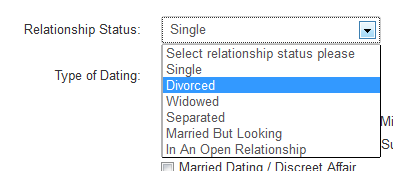
So obviously, I signed up for the site (which was free) so I could look more into it. The process itself was unsettling – I guess it’s just because I’ve never signed up for a dating site before. It was eerie when they asked my eye and hair color, but then when I saw the options for “relationship status,”

Adventures in creating a fake dating website profile

I remembered that this was a dating website. Very odd. Also, the displayed option of having an internet-sanctioned marital affair was a weird thing to see. I guess I just haven’t had many internet affairs.

So once I filled out – with not a small amount of shame – my fake account, I went and looked at some of the featured “Generous donors”. Jezebel was right – a large amount of married men, most of them (at least reportedly) millionaires (I didn’t even KNOW that there were that many millionaires in the world). Their profiles ranged from the obvious (photos in front of expensive cars – and one that was just a helicopter) to the sort of sad (a 34-year-old, “little bit on the shy side with women. but confident when working,” whose profile photo was just him in an empty white room taking a picture with his iPhone in a mirror) to the amusing (“Want to travel the world before 12/21/12 … all the girls I know have jobs and arent willing to quit there jobs”).

The relationship-seeking options on MissTravel.com

And yes, people are looking for sex. I mean, I’m not surprised – people are often looking for sex. But the sex-looking is just so official and thinly veiled. One Generous traveler, under his description of his desired “Attractive traveler”, wrote “I hope my companion is also sensual and affectionate.”.

There is also the option for Generous travelers to just gift frequent flier miles to Attractive travelers – the dubiousness of the “gift” nature of this is described tactfully: “So why would a Travel Sponsor give you miles? For many reasons. Some may want an online friend.” The lesson is: pictures of your boobs (which most of the profile pictures of Attractive travelers are anyways) will be rewarded.

One odd aside is that MissTravel.com linked the Jezebel article under their media coverage, which is called The Dating Website Where Rich People Take Pretty People on Fancy Vacations, Which Is 100% Definitely Not Prostitutey at All. I guess any publicity is good publicity and all that. But really – the article described the site as having “a F***TON of gross married dudes.”

Also, Gary Arndt was wrong about one thing: he said that “Most of the women in the system seem like very normal women.” If normal women pose in bikinis on their knees on their beds in front of cheap webcams and use profile pictures that cut off their heads so to better display their cleavage, then yes, most of the women on Miss Travel are very normal women.

So, for your weekend meditation, I ask you to consider the impressive ability of the internet to bring all of the bad ideas and unscrupulous people into one place.

Tupac and the Digitally Embalmed

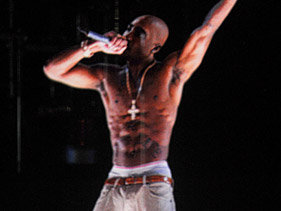
So if you haven’t heard [I hadn’t until yesterday], there was a hologram of Tupac that performed at Coachella.

ImageAnd yeah, yeah, we know it wasn’t actually a hologram now, that it was some mirror-projection-onto-glass-thing-that-the-Wall-Street-Journal-explains-better-than-I-could. And we know that there are rumors of a tour of this faux-Tupac, and people are alternately asking when Kurt Cobain will show up and decrying the monstrous zombie-raising performance.

The thing is, you could argue that the hologram/projection isn’t much different from showing videos and voice recordings of the dead. When that technology was new, I imagine people thought it pretty eerie that they could see their loved ones move and breathe and speak on a screen.

Interesting thing: They needed to project the image onto a mirror below the stage, which created a lot of light, which is why I think they made the animation look like it was lit from the bottom - it looked like the glow from the projection apparatus was part of the lighting system.

But the thing about the performance that makes it different from just a new way of looking at recordings of dead people is the new content. The animation of Tupac, at the beginning of his act, shouted “What’s the f*** up, Coachella?”. The choreography of his performance wasn’t just a recording – the people who animated him studied the way he moved, but they controlled his body and created something new. In a sense, Tupac was performing new material.

The Illusion of Interaction
And this is the real issue – not just the commemoration of the dead. We’ve been recalling the dead, through art and technology, as accurately as we can for as long as humans have been dying. But the faux-Tupac isn’t just a 21st century version of an Egyptian sarcophagus mask. What they wanted to create with the Tupac animation – which is why the fact that it was in front of a live audience was such a big deal – was the sense that Tupac was interacting with Snoop Dogg and the audience, just as a real live performer would.

This is about creating an illusion of interaction, and while a scripted interaction with an animation might be actually quite close to the way concerts can be formalized and scripted (like pro wrestling), it’s still just an illusion.

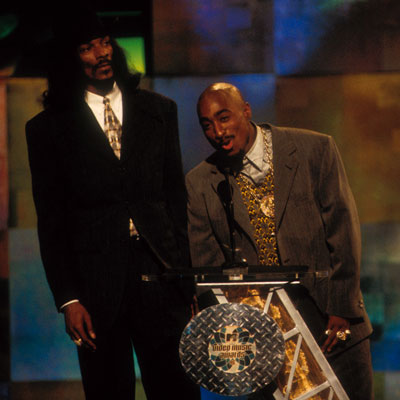
Snoop Dogg and Tupac, both about 25, in 1996

One of the weirder things though, for me,  was the age discrepancy between Snoop Dogg and Animated Tupac. Snoop Dogg is 40, and has grey hair. When Tupac died in 1996, Snoop Dogg was like 25. Tupac, who was shown as a young, shirtless 20-something, would be turning 41 this year if he were still alive, and might not look as good as his hologram did in white sweatpants.

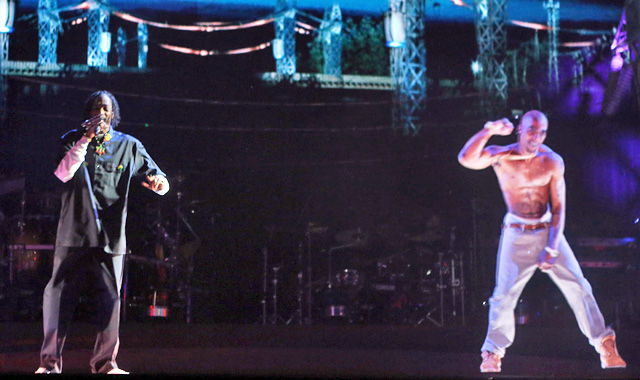
Snoop Dogg, 40, and the Tupac Illusion, still 25

The juxtaposition of digitally-embalmed washboard-ab Tupac and 40-year-old greying Snoop Dogg was probably the most eerie element of the whole performance.

If this trend continues, I think the problem is the illusion of interaction. The essence of human existence is interaction – it’s why we still feel a little weird hearing about guys dating digital AIs, and why the most popular games are the ones that allow you to play on the internet with others. Interaction with humans, illogical and annoying as we are, can’t quite be simulated. And judging from Snoop Dogg’s awkward performance with faux-Tupac, our interactions with the digitally animated dead will always fall a little short of the real thing.

David Foster Wallace, Virginia Woolf, and Author Necromancy

Sorry this is late, ye millions of people. I am [still!] traveling through places barren of the internet, but I’m returning to the land of milk and honey soon (or whatever) and will have wireless all the time again.

source: electricliterature.com

I came across this blog on The Outlet that “revisits letters from prominent writers and other artists to revive the dying art of letter writing.” They posted a postcard from David Foster Wallace to Don Delillo (a famous person I haven’t read who seems to have won many awards for books called White Noise and Underworld and Mao II, among others).

First, the phrase “revive the dying art of letter writing” caught my attention. References to “reviving the dying art of [blank]” always have about them a sort of nobility – like when someone tells you that they work for the Peace Corps or rescue puppies for a living. But how does a note from a brilliant man help revive the dying art of letter-writing? The text is a clever note – another person defending the “art of letter[-]writing” might not even recognize it as anything more than an e-mail text.

And then I want to know why we publish and discuss the letters of famous people. David Foster Wallace was particularly brilliant, it’s true, but the post-mortem ransacking of his library was unsettling to hear about. Maybe a year ago I’d think differently, but now reading writers’ letters and diaries (like Virginia Woolf’s) seems me to me a rude, fetishistic, and sort of useless thing to do.

Virginia Woolf's diary, published post-mortem

And yes, the writing is going to be good – but many people can write witty and clever letters. Writers’ letters might be constructed, but they’re only constructed for one person and in that context. Books and published works are written in an entirely different context, for public consumption and enjoyment. Looking for writers’ letters seems to me the equivalent of wanting to hear Beyonce humming while she pees.

In David Foster Wallace‘s letter to DeLillo, he talks about a large palm tree, a book they exchanged, and how Wallace recently got his license in California. The writing is quite witty to read, because Wallace was good at words. But it is saying nothing and communicates nothing but what Wallace wanted to say to DeLillo on the 1st of September of some indiscriminate year. Why do we like reading this? How would this contribute to maintaining the art of letter writing?

Looking for every word on every grocery list scratched out by an author sounds painfully like something that I would have done a few years ago, which might be why I react so strongly against it now.

Knoebel (the blogger) calls the postcard “a prose index of cultural references,” which is pretty characteristic, I think, of the annoying self-effacement with which writers’ personal and accidental writings are usually treated: something must have been so special about these holy people that it is more worth our time to read their private, unrelated writings than it would be to develop our own. And that, I think, is my main problem with this practice – if we really want to appreciate prose, or to revive the art of letter writing, we should probably start working on writing some letters ourselves.