Category Archives: internet

Thoughts About The Internet

So a friend of mine tweeted in the early hours of the morning, musing about the internet. The tweets are as follows [to be read from bottom to top]:
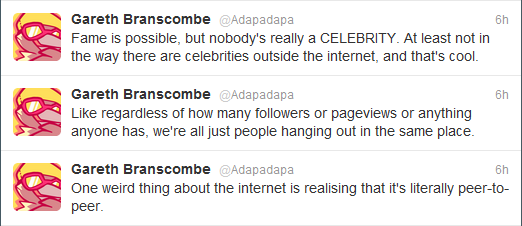
Before I can really begin addressing this, I think it’d be good for me to have a good definition of the word “celebrity.” Dictionary.com tells me that as far as people go, a celebrity is a “famous or well-known person.”

So are there capital letters CELEBRITIES, or are there just people, again, referencing the tweets, with fame? And, if they’re one and the same, do they equate with people outside the internet?

The 21st century is a place where being “outside the internet” is a basic impossibility. That being said, there is a distinction between being general fame and internet fame. Brad Pitt is a well-known movie star. wheezywaiter is a popular YouTuber with 382,628 subscribers. If both walked around the streets of any major city in America they’d be recognized, but only one would create a stampede of screaming fans leaving several dead.

On the other hand, some celebrities have supplemented their fame with their internet presence. Ashton Kutcher was the first twitter user to reach a million followers, and currently has almost ten times that. Comparing that to his work in film and television, it actually dwarfs his presence “outside the internet.”

The thing with being internet famous is how quickly it spills into the offline
world. High school pole vaulter Allison Stokke had her picture submitted to With Leather, a sports blog, where it appeared in this post [as far as I can tell, the images connected to the specific post have since been removed]. These images quickly spread around the internet, however, and Stokke became the target of a large amount of unwanted attention, a lot of it very sexual. It got to the point where her high school began receiving requests for photo shoots of the athlete. The Washington Post has more to say about it here.

To be fair, that wasn’t Stokke garnering internet fame for herself, but was instead unwittingly swept into it by a blogger named Matt Ufford. She’s not the only one who runs the very real risk of being recognized in public. Webcomic artist Jeph Jacques bumped into fans while vacationing in New Zealand, less of a surprise when you take into account the fact that his strip has thousands and thousands of viewers.

The internet is a “peer-to-peer” place where anyone can post anything and have an audience of anywhere from one to millions. I have 71 followers on twitter [with only a few spambots], meaning that anything I tweet [which I rarely do anymore] is instantaneously communicated to a several dozen people all over the world. That’s an amazing thing. Audience does matter, though.

If you have a blog, and there are millions, what are the chances that anyone is going to read it? You could tag it with words like “Dakota Fanning” and “Playboy,” and that might help, but your readers won’t be consistent and probably won’t be coming back. We may all be in the same place, but we write or draw or play instruments because we hope that others might be audience to our work, and when that audience gets large enough it will inevitably change our lives outside the internet.


Hitler, Ray Comfort, and the Dismal State of Discussion

I did something bad for my health that I do not recommend. I watched “180”, a half-hour documentary made by Ray Comfort.

It is a bastardization of discourse from all sides. In an interview with Steve, a neo-Nazi punk type of young man, Steve says that he’s certain of his opinions about the falsehood of the Holocaust and other offensive things. To combat this, Comfort asks Steve to spell shop (Steve does) and then asks: “what do you do at a green light?” The question is a trick to get the mind to quickly respond “stop”, which is semi-associated with green lights and rhymes with “shop”, and the person answering looks silly. Sure enough, Steve responded “Stop” and looked silly. And then – well, then Comfort treated that like an actual argument for something.

The documentary was dipped in dramatic music, photos of piles of dead bodies, and use of gratuitously violent photographs. What is most interesting to me, however, is the use of what seems to be the universal argument-ender: comparisons of things to Hitler.

Hitler, the Nazis, and Lazy Discussion
Hitler and the Holocaust have become mythic elements of American culture, I think, and to the detriment of the truth of the actual historical events. I was recently visiting a small church where the members, after the service, started (sort of randomly) to wax poetic about the horrors of Hitler and the Nazis. They weren’t saying anything new – everyone was just affirming that Hitler was inhuman and the Nazis were too. It was the fervent insistence that “real humans could never do that sort of thing” that struck me – I thought of all of the other genocides and massacres of the past century alone, of the killing of civilians in wars by troops of every nationality, of atomic bombs. But even in light of all of these things, current conversation about Hitler seems to serve contrast to our new, very human, very un-barbaric society. We talk about Hitler basically like Satan – an ultimate evil; a rhetorical catch-all.

Ray Comfort and 180: Unethical Discourse

Steve, in the movie "180" by Ray Comfort

Comfort’s specific use of the Hitler argument is reductive and tired. It is, if anything, an exploration of how charged and empty rhetoric in the realm of politics is being mirrored in general culture. His interviewees are inconsistent, and seem to know very little about philosophy, theology, or basic logic. Comfort’s questions are also always precisely and pseudo-cleverly leading, and it doesn’t seem that he wants to engage with the interviewees at all: “Does this mean you’ve changed your mind about abortion?”, he asks. “Are you going to vote differently in the future?” It is not a conversation, is the point: it is a poorly executed set of rhetorical acrobatics. Is this the way to foster discourse and an informed public? Probably not. Arguments depending on rhetorical cleverness are insulting to both parties.

Comfort’s series of interviews are not only annoyingly inconsistent and poorly constructed, however: the movie is also a manipulative presentation of complex issues and events, presented crassly and with a smugly triumphant attitude. One of the less graceful moments was when Comfort asked a woman if she’d had an abortion; she said that she had. He then immediately asked: “Do you feel guilty about it?”

As the big finish, Comfort sets up a game-show setup of moral responsibility and the afterlife, and awkwards them into admissions of fright and death anxiety:

  • Comfort asks people if they have lied/stolen/been lustful: most of them say that they have.
  • Comfort then gets them to admit that this makes them liars/thieves/adulterers.
  • Comfort gets them to admit that liars/thieves/adulterers go to hell.
  • Comfort elicits from the interviewees an understandable anxiety about the prospect of hell.
  • Comfort asks them if they are going to go read their Bibles.
  • Some of them say yes.

Alesia, from Ray Comfort's movie "180"

Theologically, morally, rhetorically, and logically, this is one of the most horrible things ever. Comfort’s quick-talking way of “tricking” people into professing a fright of punishment does very little for the moral health of humanity or the search for truth within rhetoric and theology. The triumphant music and photos of bloody sheets are no help for the legitimacy of the movie.

There are also 40 thousand comments. I do not recommend those either. They are not a happy picture of humanity.

It makes sense to protest the legalization of abortion and to be horrified at the amount of deaths occurring if one believes that life begins before birth. Comfort’s smugness and “gotcha” questions, however, lack earnestness, humility. The whole thing turns a serious situation into an awkward and unproductive onslaught of unhelpful rhetorical inconsistencies, devoid of integrity and, therefore, real efficacy.

In sum, the movie is a disjointed account of unproductive discussions with unproductive people with vague and uninformed opinions. It’s a disheartening representation of the state of discourse on American sidewalks.

Attitudes Towards Feminism in the Past Week 3

If you are a person who gets their video game news from the Penny Arcade Report, this won’t be new to you. If you’re a person who doesn’t read video game news much at all, this is not a post that will enhance your views of the subculture.

The article is here, and I strongly recommend you read it. I’m going to be summarizing the issue pretty succinctly, so it’s definitely worth a read.

Cross Assault, a Capcom-sponsored event is “the world’s first fighting game reality show.” It features ten contestants, with half being experts of the Street Fighter games and other half being highly proficient at Tekken. Since the show is streamed live online, there’s evidence on the web of all of the reprehensible behaviour that was featured on it.

The primary individual I’m going to be writing about is Aris Bakhtanians, the coach of the Tekken team. To sum up his stance on women and fighting games, he’s quoted as saying that sexual harassment and the fighting game community are “one and the same thing.”

The victim of the harassment in this case is Miranda “Super Yan” Pakozdi, a member of his team. She forfeited a match due to mistreatment by her coach. Below is a video of the first day of the show. Below that are quotes pulled from the clip, in case you didn’t want to hear/watch all of that.

Miranda vs. Sheri mud wrestling cage match, what do you think, Miranda? [. . .] That’s the theme, mud wrestling. And then I get the winner?

How does Miranda smell?

Miranda, I want to know your bra size.

I want to hang a Mona Lisa in the ladies room with the eyes cut out.

That’s all from the first four or so minutes of the video. I’m not certain of whether or not all of the quotes can be attributed to Bakhtanians.

The Tekken coach did email Patrick Klepek at GiantBomb.com with a full apology. To sum up where he’s coming from, he cites the origins of the fighting game scene in arcades as a large part of the subculture. People trash-talked a lot back then and he is, in part, afraid that bringing this world into the public eye will censor a lot of what created it in the first place.

This was a combination of the people taking things out of context and my own inability in the heat of the moment to defend myself and the community I have loved for over 15 years.

In other news, yesterday podcaster/writer Mur Lafferty posted on her website a response to a New York Times article from last year titled “‘Tough, Cold, Terse, Taciturn and Prone to Not Saying Goodbye When They Hang Up the Phone.’” In the article Carina Chocano derided the “strong female characters” that appear in pop culture are defined primarily by being the “strong, silent type.” She also complains that the aforementioned women also show little to no traditionally feminine traits.

Lafferty’s post, “Strong Female Characters, My Own Definition” argues that these characters do exist, and that that they’re “[women] who can take action, who [aren’t] passive.” The following quote was also the one featured on i09’s article [where I discovered the articles]. It’s a good one.

Strength is taking charge of your own destiny and not waiting on others to do so. You don’t have to swear and drink and beat people up and slay monsters. You’re allowed to cry and take care of children and cook and get your heart broken and dress up and date and get pregnant. But when decisions have to be made, a strong character makes them and doesn’t wait for someone else. When a monster is chewing on your true love, you hit it with a stick (or pick up the sword that’s RIGHT THERE.)

I also highly recommend reading both articles, as Lafferty’s fuller, more complete definition manages to soundly trump Chocano’s.

milehighTo end this all off with my favourite subject, comics, Kate Beaton, Carly Monardo, and Meredith Gran created Strong Female Characters last summer, a clear parody of how they saw women portrayed in the media. With names like Georgia O’Queefe, Queen Elizatits, and Susan B. Assthony, these are three ladies who know how to pose while showing off as much of their assets as [in]humanly possible. They featured in a decent number of strips, all hilarious, which can be read at Kate Beaton’s site here.

This has been  attitudes towards feminism in the past week. Three.

Facebook Censorship: A Sign of the Times?

source: serc.net The internet was recently given a leak of Facebook’s censorship standards. Amine Derkaoui, a previous “employee” of Facebook (employee is in quotes here because he was paid $1 an hour plus commission, which is, in a word, horrid) was so disgruntled that he gave Gawker the handbook used by Derkaoui and other assumedly disgruntled workers to know which photographs and comments to censor on Facebook, which ones to send upwards for decision by an administrator, and which ones were ok. Gawker published the one-page “cheat sheet” summarizing the standards on their website.

source: gawker.com

A summary of Facebook's censorship standards, leaked to Gawker

This gives an interesting perspective of what is considered “acceptable” and tasteful by popular consensus. Ear wax is censored, snot is not? (I guess if it was, millions of baby pictures would have to be deleted). For example, the “cheat sheet” says that “Digital/cartoon nudity” should be censored, but “Art nudity ok”, excluding all digitally created images from “art”, which is sort of a surprisingly passe way for Facebook to define things.

Something interesting about the released standard is the fact that it is clearly representing three categories of social unacceptability. The first, the depiction, commitment, planning, or lauding of criminal activity, is expected in a list like this – sexual assault, organized crime, nudity, and hard drugs are pretty normal in a “delete this” list for any censorship website.

The second category is more nuanced – I can only describe this second category as anything which debases humanity. This includes more obvious things like human organs, mutilation, violent speech, or anything encouraging or lauding mutilation or defacement of the human body (and, in some cases, animals). This also applies to willing defacement: threats of suicide, self-harm, and anything promoting eating disorders – this is interesting in light of the fact that pro-ana groups are still on Facebook. Maybe closed groups are immune to censorship – or the people getting paid next to nothing in other countries just haven’t caught them yet.

Another example of the censorship of non-illegal debasement of humanity: the prohibition of any photoshopped pictures of humans, “whether negative, positive, or neutral.” This is interesting; perhaps it is simply the case that it’s too hard to gauge the positive or negative spin of a photoshopped picture, but I think this rule isn’t just about bullying – it’s about the fact that Facebook doesn’t want to turn into Reddit (if they don’t, then they should stop trying to be Tumblr and take away the “follow” option). Their prohibition of any “versus” photo – any image grafting two photographs of people side by side in comparison – would be for the similar reason of “trying to keep Facebook untacky”. This rule is especially ironic considering Mark Zuckerberg’s famous-now-that-we’ve-all-seen-The-Social-Network first project facemash.com. Prohibitions of holocaust denial fall under the goal of no human debasement – but they apply to the third category as well.

The third and final category I’ll call “Nobody Get Mad At Us Please.” The most interesting rule in this one is the censorship of any maps of a part of Turkey (Kurdistan) and the prohibition of language or images against Mustafa Kemal Ataturk, as those laws seem suspiciously anti-free-speech-ish, and Turkey is a part of the UN.

The internet as it is currently developing has been compared to the semimythical Wild West of early American history – looking back in 50 years on this time, we’ll probably be astonished at how unregulated everything was. Governments just don’t have a good enough grasp on this new platform for data and information to be able to figure out how to effectively and efficiently (and ethically) regulate it – yet. This conversation applies to file sharing and copyright infringement as well, but Facebook’s censorship guidelines illuminate a more necessarily practical standard – things made up by businesses and not government are almost always more necessarily practical, if perhaps less ethically consistent.

Sweden Recognizes Kopimism as a Religion: What on Earth does ‘Religion’ Mean?

Sweden’s pretty liberal when it comes to copyright laws, as a government and as a culture – it’s the home of the thepiratebay.org and there’s a healthy anti-anti-piracy-movement movement in Sweden that’s been active since 2001. Further proof of piracy as culture in Sweden is the fact that the Swedish government just officially recognized the Church of Kopimism.

Kopimism’s central dogma centers around the idea that information is a holy thing, and copying information a sacrament. CTRL+C and CTRL+V are considered holy symbols. The English page of the church’s website says:

We challenge all copyright believers – most of which have a great deal of influence in politics, and who derive their power by limiting people’s lives and freedom.

Isak Gerson’s personal website (translated by Google) says that a Kopimist a “person who has the philosophical belief that all information should be freely distributed and unrestricted. This philosophy opposes copyrights in all forms and encourages piracy of all types of media including music, movies, TV shows, and software.”

So Gerson (who, weirdly, is also a member of the Christian Student Movement in Sweden) took this philosophy and pasted some “ritual” labels on everything and got a religion (after petitioning to the government 3 times, to his credit). The result is both a straight-faced mockery of the difficulty governments face w/r/t defining ‘religion’ (on the Kopimist website, the first line of one of the definitions of Kopimism is the defense “A religion is a belief system with rituals.”) and a strange manifestation of a strongly held belief.

Religions rooted in the internet are not a new thing. With all those people registering as “Jedi” in the 2001 census, Pastafarianism, and the prevalence of Cthulu worship, the appearance of a semi-ironic religious movement started by otherwise apathetic 20 year old males is becoming a pattern.

Maybe it’s just another irony-soaked fad, like speaking with ridiculous grammar or posting hilarious misquotes – or maybe the semi-ironic religions created will garner more earnestness and lose some irony and become, weirdly, a real way that people define their philosophies. The definition of the word “religion”, in the context of recent events and the influence of internet culture, is changing, and it’ll be interesting to see what happens to it.

Here Be Unwise Internet Purchases

Sometime last week I was on the lookout for books on webcomics, searching for covers to inspire a Graphic Design project. Somehow, through liberal use of the keywords “webcomic,” “history,” and “book,” I was led to a book entitled “Webcomics By Year, including: Penny Arcade (webcomic), Jerry Holkins, Mike Krahulik, Child’s Play (charity), Penny Arcade Expo, Penny Arcade Adventures: On The Rain-slick Precipice Of Darkness, Robert Khoo, Poker Night At The Inventory, User Friendly,” the cover of which you can see below.

The first thing you may notice from the cover, after the ridiculous length of the title, is that the book can’t be attributed to any specific author. Instead, the only evidence of there being an origin for the book are the words “Hephaestus Books,” centred and in small print at the bottom of the cover.

Fully intrigued at that point, I checked to see what else Barnes and Noble had to say about this publishing company, and was aghast at my findings. There were tens of thousands of books attributed to Hephaestus Books,  each featuring a title just as [if not more] lengthy and list-like as the first I found. They covered topics ranging from Judy Blume novels to the 1950s in British television. It seemed that Barnes and Noble could show me more, but not explain, and so began my investigation.

A social reading site of sorts, Goodreads ‘ page on Hephaestus Books featured a description about the “author” that goes as follows:

“Hephaestus Books represents a new publishing paradigm, allowing disparate content sources to be curated into cohesive, relevant, and informative books. To date, this content has been curated from Wikipedia articles and images under Creative Commons licensing, although as Hephaestus Books continues to increase in scope and dimension, more licensed and public domain content is being added. We believe books such as this represent a new and exciting lexicon in the sharing of human knowledge.”

In other words it publishes print-on-demand compilations of Wikipedia articles not original works. Caveat Emptor

Author Robin Hobb wrote about the series of books on her website early this month, stating that the concept of Hephaestus Books is one that “offends [her] mightily.” Science fiction writer Jerry Pournelle wrote on his own site that he was concerned in that he had “never authorized ANYONE to make a compilation of a lot of [his] books and sell them in a single volume.” His confusion is well-founded, but in reality what appears to be a single book containing multiple novels is nothing more than, as mentioned above, Wikipedia articles.

Hephaestus isn’t even the only malefactor out there. Fonte Wikipedia and Book LLC are both “publishing companies” that do the exact same thing. A blog post I found entitled Beware the Wikipedia Scrapers exposed both of those examples, and also has a helpful list on how to “avoid this junk.”

I’m not altogether surprised by this scam; it’s one I stumbled upon years ago but have only recently found again. It sadden me, however, that it’s ongoing, and that there have been people who have fallen for it, as evidenced by the used books on sale on these sites.

As writers have said before me, watch out. Caveat emptor. Let the buyer beware. Be on your guard. Please mind the gap. This is a swindle that has befallen others, and as much as a book titled “Novels By R. A. Salvatore, including: Vector Prime, The Dark Elf Trilogy, Legacy Of The Drow, The Woods Out Back, The Icewind Dale Trilogy, The Hunter’s Blades Trilogy, Paths Of Darkness, The Cleric Quintet, The Dragon’s Dagger, Dragonslayer’s Return” might catch your eye, it might be better to stop and think about what you’re doing.