Category Archives: money

Stars Earn Stripes (Is a Terrible, Awful, Idiotic Abomination)

When I was watching the bad acid trip that the Brits were passing off as the opening ceremonies of the Olympics, I saw an ad for an upcoming NBC reality show called Stars Earn Stripes.

For those of you too lazy to watch the YouTube video, Stars Earn Stripes is essentially a collection of B and C level celebrities (and Terry Crews) who are put through elements of basic military training and then tasked with carrying out “missions” (i.e. blow stuff up).

Naturally, the reaction of both myself and everyone I was watching with went a little something like this:

Ironically, this is one of the “missions”…

Despite the ad touting that “In the end, it’s all about understanding one thing… true bravery… It’s about honoring our veterans and our law enforcement officers…”.

I’m going to go out on a limb here and say that a show where a bunch of people are given a couple months of watered down military training in an environment more or less free from danger and label it as comparable to the pain, sacrifices, stress, and general hardship of the actual military is about as far as you can get from honoring them. One of the guys I saw the commercial with had been in the military himself, stationed in Afghanistan, and he asserted that the idea of the show was offensive (as did everyone else in the room). Indeed, restoring some faith in humanity, the reaction of pretty much everyone to Stars Earn Stripes has been more or less this:

Marking the first time comments on a YouTube Video have been mostly intelligent and well-reasoned…

Let’s break it down here. Stars Earn Stripes is presenting:

  1. A Sanitized View of War
  2. A Glamorized View of War
  3. An Insult to Anyone who is or ever has Been Involved in War

First, let’s address the sanitizing or “white-washing”, as some critics are calling it. Stars Earn Stripes still has ten days to air, however, I think it’s safe to say that the actual decisions and consequences on the show are nothing like what they are in reality. The ad boasts that they will use “Real Explosions” and “Live Ammo”, as if this somehow adds weight or danger to the show. You what other shows have been using live ammo and real explosions for years?

Mythbusters

Deadliest Warrior (Sorry I couldn’t find a Gif for this)

…Or pretty much any show having anything to do with guns and explosions…

See, the celebrities might be in some danger- but hardly anything that you can’t find on other shows, and nothing on the level of what combat soldiers have to deal with. On top of this, I’m guessing that the celebrities aren’t going to actually kill anyone, or have to grapple with the moral and psychological ramifications of doing so. In fact, the celebrities will never have to worry about any of the basic aspects of military service that soldiers are expected to deal with- constant danger, the possibility of being disabled (if not killed or captured or tortured) for life, the possibility of killing and innocent civilian by accident, or (for the female contestants) the rampant problem of rape. Terry Crews is a tough guy, I’m sure, but I have my doubts as to how he’d react actually witnessing someone (on any side of the conflict) killed. Let’s face the facts, Stars Earn Stripes is not going to show you bodies in all their gory reality. This isn’t war- this is Hollywood.

Second, let’s talk about the glamorization we’re sure to see hear. Of course Stars Earn Stripes will present the celebrities having little breakdowns, or getting dusty or bruised, but even John McClane got pretty trashed in Die Hard.
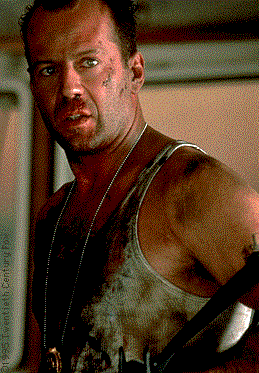
But the military isn’t just concussion grenades and contusions- there’s plenty of… well- boredom to it. I’m not saying this to put down the armed forces, I’m just trying to offer an accurate picture here. There are toilets to be scrubbed, mess halls to be cleaned, uniformed to be creased and beds to be made. There’s paperwork and basic maintenance. Are we gonna see the Stars Earn Stripes celebrities get chewed out for not having left six inches between their blankets and their sheets? I doubt it.

Thirdly, the combination of the previously mentioned points creates a completely and wholly inaccurate picture of the conditions the men and women of the military find themselves in. Stars Earn Stripes isn’t about the military, it’s about a highly fetishized aspect of war. And make no mistake- we’re not talking about just the military here- we’re talking about war. Without the past decade or so of nonstop conflict in Afghanistan, Iraq, and elsewhere, it’s highly doubtful that Stars Earn Stripes would even exist, after all, what’s the point of doing a show about the military if you can’t jam it full of explosions? An almost assured side-effect of this lousy and poorly thought-out attempt to “honor” the troops (i.e. make money off of them and their hardships) is the glorification of war. It doesn’t matter if you’re the most dogged pacifist or hard-line advocate of “just cause”- we all know that war itself is not something that should be portrayed this way. Maybe you think war is wrong, maybe you think war is right- you never think war is pretty. As William Tecumseh Sherman, perhaps the most brutal general of the Civil War, put it “There is many a boy here today who looks on war as all glory, but, boys, it is all Hell.”

The guy who burned Atlanta to the ground just by glaring at it would know….

It cheapens war. In the off chance that you want to hear my full rant about this, here’s the link. The simple version is that this drastic level of ignorance when it comes to the bloodshed- you know, the actual war is not only an insult to the military, but to any and all victims of war, and a direct attack upon the basic decency and dignity of humanity at large.

I’d say that NBC’s heart is in the right place, only I don’t think that’s true. I think this show is a calculated plan to manipulate emotions and capitalize off of human suffering. This has nothing to do with honoring anyone- this is about lining wallets.

Again, to NBC I submit this as my closing remark:

Republicans, Marriage Equality, and Inevitable Social Change

Freedom to Marry has set up the Win More States Fund with the goal of influencing legislation in Maine, Minnesota, New Hampshire, New Jersey, and Washington. Interestingly, the fund’s largest donors so far have been a group of major donors to the Republican party.

Freedom to Marry is one of the many organizations in the US that support and fight for the legalization of same-sex marriage

And this isn’t just excitement over a few novel Republicans donating insubstantial amounts; the group collectively donated $1.5 million, which is half of the fund’s stated goal. Ken Mehlman, the former chair of the RNC (Republican National Committee) (I’ve heard that they’re a big deal). The group of donors, including Mehlman, has founded a Super PAC (American Unity), which defines itself as a PAC that “supports GOP political leaders committed to advancing the rights of gay and lesbian Americans”. The PAC’s first donation was $1 million from Paul Singer, hedge fund CEO and major donor to the GOP.

This shows quite the shift, especially compared to popular (if slightly under-informed) consensus about party alignment on the gay marriage debate.
Freedom to Marry quotes Mehlman talking about his decision to donate:

“Supporting the right of adults to marry the person that they love is consistent with Republican and conservative principles. A party that ignores reality and demographic change is a party that loses a lot of elections and becomes less relevant.”

Freedom to Marry’s Win More States Fund targets Maine, Minnesota, New Hampshire, New Jersey, and Washington State

There were a lot of predictions that opposing gay marriage would just cease to be a respected opinion in the US, and it seems that that’s what’s happening now. Mehlmen’s statement is practical – he does say that the position “is consistent with Republican and conservative principles,” but this issue would not be being addressed if not for the huge social movement over the past few decades. That IS sort of how democracy is supposed to work – but I think that we will always hear more people saying things like “Those people have to change in order to survive politically” than things like “They can take the job and shove it … I’m trying to do the right thing.”

But that’s how things work, I guess. People have a tendency to distrust things that are different and strange, and so social change with respect to accepting and adapting to differences usually has more to do with social pressure (and shame) than with lots of miraculously-timed personal insights. The fact that our opinions and actions are inseparably intertwined with the popular sentiment is not news. And while political moves responding to trendy or controversial social issues might be occasionally disingenuous, there’s no arguing that they can instigate actual change.

Obama: the brand

Jim Messina was an undergraduate when he managed his first campaign, and has won every race since then. He’s now manager of the Obama reelection campaign and going to great lengths to maintain his record.

source: huffingtonpostMessina has purportedly read volumes of US election history, but he spent the first months before beginning the Obama campaign in earnest meeting not with successful senators and former campaign managers, but with CEOs and senior execs of Apple, Google, facebook, Zynga, and DreamWorks. While Obama looks for support from left side of the House and Senate, Messina’s also brought Stephen Spielberg and Vera Wang into the campaign. Messina’s campaign, he says, is more based on wunderkind business strategies (Zynga and facebook, for example) than any elections from previous centuries.

The most interesting part to me of Messina’s campaign is the part focused not on intellectual persuasion, but attachment-building via branding. To contrast this with Mitt Romney’s campaign, look at the merchandise pages of each of the candidates’ websites:

Romney’s store has:
2 types of bumper stickers
a window decal
2 buttons
4 different t-shirts (2 of the with just the semi-unrecognizable logo on them)
a baseball cap
a lapel pin, and
(regrettably) a heather grey quarter-zip-up sweatshirt

All of his products are on one page, and most of them look like print-screened logos on shirts from AC Moore.

Obama’s store includes:
iPhone cases,
Earth Day packs,
“I bark for Barack” magnets,
v-neck shirts for women under 45,
calendars,
yoga pants,
a $95 Monique Pean scarf,
a Vera Wang bag, a $95 “Thakoon Panichgul“, whatever that is,
dog bandanas,
dog sweaters,
Joe Biden mugs,
Obama jerseys,
rubber bracelets,
pint glasses,
aprons,
bangles,
cufflinks,
baby bibs,
grill spatulas,
soy candles,
golf divot tools,
and a six-pack cooler.

There’s also about a billion different types of tshirts, buttons, and bumper stickers, and a “for Obama” series: women for Obama, nurses for Obama, veterans for Obama, African Americans for Obama, Latinos for Obama, Hispanics for Obama, Asian American & Pacific Islanders for Obama, and environmentalists for Obama.

Romney’s shirts say, at most, “Romney” or “Believe” – one of Obama’s shirts says “Health Reform Still a BFD.” Granted, Romney is aiming at a different demographic (LL Bean fans, eg), but Obama’s 19 pages of merchandise make Romney’s 1 page look pitiful, from a branding point of view.

The Obama campaign’s brand-focused strategy is closely integrated with its other image-focused tactics: assigning Romney the cold, out-of-touch persona, for example.
While critics of the Bain capital narrative put out by the Obama campaign said that things like negativity and party inconsistency (Bill Clinton’s subsequent praise of Romney’s management skills, eg) rendered the move moot, an article in Bloomberg said that Messina may not have been so concerned about persuasion at that point: “Messina is adamant that the Bain attack succeeded among the uncommitted voters he’s concerned with, who ignore pundits and are only now beginning to form opinions of Romney.”

For a lot of voters, Romney’s business and managing experience are just off the table. The Bain Capital anti-campaign put on by the Obama team wasn’t so much a persuasion for some voters as an excuse to keep holding their current opinion. K street and the hill will argue about the relevance and logical holes in different arguments, and about the influence of different political figures voicing their opinions, but humans decide things more based on instinct than consideration, I think.

David Plouffe, a political strategist, commented: “When people say, ‘How’s the Bain thing playing?’ it doesn’t matter what the set of Morning Joe has to say about it.”

Voters’ behavior and attitudes are hugely dependent on their initial impressions of politicians. People will take things like the Bain story how they want to, based on what they’ve already consciously or unconsciously decided. And some might criticize the Obama campaign for putting a lot of money into what seems like frivilous merchandise, but things like brand and image aren’t meant to persuade – they’re meant to create a stronger identity and community within the already-present supporters. Such branding is what made Facebook, Google, and Apple such monstrosities – and they are precisely where Messina went for advice.

You Should Care About Super PACs

The new potentially-sort-of-boring-topic-about-which-we-should-educate-ourselves (this is the first election I’m paying attention to and I’m finding a lot of these things) is the issue of Super PACs and their effect on the current election.

To summarize, Political Action Committees (PACs) have been around for a while. They are organizations that raise money to use toward elections, usually television commercials — they are limited to collecting small amounts of money from individuals, political parties, and other PACs — and the stipulation was that they could only accept $5000 per person per year, which meant that (at least in theory) candidates’ support would be semi-related to the amount of supporters donating to them.

In 2010, however, it became legal for some organizations to receive unlimited donations from corporations and unions: organizations which accept these unlimited donations are called “super PACs.” They are like PACs, but much more evil. While PACs forced candidates to build a large support base to earn a substantial amount of money, a few millionaire individuals or corporations can fund a candidate’s entire ad campaign.

Super PACs are devastating to the essence of democracy: Why should congressional and presidential candidates care more about the votes of single constituents than the needs of unions and corporations when campaigns can be made or broken by union and corporate funding?

Super PACs allow campaigns to distance themselves from negative ad campaigns while reaping the benefits from commercials slandering political opponents — Mitt Romney’s PAC (the idiotically named “Restoring Our Future” — okay, one might restore hope for the future, but not the future itself) spent $3 million running negative campaigns against Newt Gingrich, effectively killing his campaign.

(evil?)Super PACs allow corporations and unions to spend huge amounts of money on elections — billions, in the 2010 midterm election — and that directly translates into influence on government decisions. If you’re imagining large men in suits grinning evilly while photographing themselves with dollar bills coming out of their ears, keep imagining it: there’s a picture of Mitt Romney that looks exactly like that.

Super PACs are a key factor in the commercialization of the political process. Since the late 90s, the money involved in elections (adjusted for inflation) has increased at an alarming rate. The amount of money that went into the 2008 election ($1 billion, 86 million) was more than twice that of the 1996 election (599 million dollars, adjusted for inflation) — Barack Obama’s 2008 campaign alone spent more than was spent in 1996 ($799 million).

Super PACs do not have to report the amount of money they receive, or how they spend it. A candidate’s super PAC can fund ridiculous amounts of illogical and negative commercials without having to pin the candidate’s name on the commercials at all. A candidate’s super PAC can also donate money to other PACs, effectively buying the good will of other politicians. Recent Supreme Court decisions deem this legal.

You should buy one of these tshirts on Colbert's website. And protect democracy.

The Colbert Report flaunted the troubling legalities of Super PACs in last Thursday’s episode, when Stephen Colbert’s Super PAC (Americans for a Better Tomorrow, Tomorrow) was transferred from Colbert to Jon Stewart as Colbert announced his fake intention to run for president. Colbert is not supposed to coordinate with the super PAC, his lawyer said on the show, but he could remain business partners with Stewart and the staff of his PAC didn’t have to change, even though they clearly knew everything about his election strategy.

Super PACs are the final step in making political campaigns entirely about money and slander. The political scene becomes a game of who-can-find-the-most-loopholes, with politicians focusing their energies on how to betray the spirit of the law without breaking the letter of it, which seems quite bad indeed.

Let’s Quit Overthinking Philanthropy

The reason I didn’t want to talk about donating to charity, especially during the Christmas season, is because it’s so often portrayed and spoken of as a thought-free, morally spotless, warm-fuzzy inducing act. A no-brainer. Nothing to fret over. It’s also often one of those things we try to exchange for middle-class guilt; we donate $50 to charity in order to feel free to spend hundreds (thousands) on ourselves and our family and friends without qualms.

The act of donating to charity is a pit of postmodern angst: it’s cliché, it breeds self-righteousness, it can make a student go crazy with self-consciousness and infinite reevaluations of our “real motivations,” and it can instill in us (alternately) a false sense of optimism or a nihilistic feeling of despair and ultimate uselessness (when the realization of the ratio between our donations and our own frivolous personal expenses sets in). It is not, by any means, a no-brainer.

Another problem with donating is that charities are confusing and sometimes we don’t agree with how they operate. We can look up budget reports all day and still not ever really know how charities and government organizations decide which families get turkeys. Also, religious NGOs may direct finances towards pro-life or anti-gay-rights legislation; secular charitable organizations might fund birth control distribution, military support, or homosexual rights. Odds are, you’re going to disagree with some practice of whatever organization you choose.

What I’m worried about is when the confusing details and qualms prevent or inhibit action; we discuss donating to charities, argue about different ones, donate less than we could, and then feel guilty about our own prosperity – the whole process becomes so unpleasantly self-conscious that we begin to avoid it. A lot of us went through a period as children when we got excited about giving money to the poor; then we realized that the hole we’re trying to fill is bottomless. And yeah: social service is like that. It’s bottomless. Need is never ending. Because of this, if we donate to charity with the idea of fixing things permanently, or to assuage some sense of guilt, our worry and shame in this case will only compound upon themselves. And the poor can’t fill their children’s stockings with middle-class guilt.

But seriously. Yes, it feels stupid to think that your two dollars will “make a difference in someone’s life”. Yes, even the bother of donating something is enough to keep our money in our pockets. Yes, it’s a little paralyzing to think of how much we’re giving versus how much we’re keeping and receiving. But seriously. Seriously – just stop analyzing your intentions and donate something. Suck up your self-conscious selves, do some research and deposit some money into your community. Something is better than nothing, but nothing will ever be enough, so don’t feel useless for donating a small amount and don’t feel too satisfied for donating a large amount. And don’t think you have to defend your decision not to donate anything, or fear that you donated less than you think other people think you could or should have, or avoid donating because of your qualms about your possibly selfish motivations — either write a check or don’t, and stop fretting about it so much.The reason I didn’t want to talk about donating to charity, especially during the Christmas season, is because it’s so often portrayed and spoken of as a thought-free, morally spotless, warm-fuzzy inducing act. A no-brainer. Nothing to fret over. It’s also often one of those things we try to exchange for middle-class guilt; we donate $50 to charity in order to feel free to spend hundreds (thousands) on ourselves and our family and friends without qualms.

The act of donating to charity is a pit of postmodern angst: it’s cliché, it breeds self-righteousness, it can make a student go crazy with self-consciousness and infinite reevaluations of our “real motivations,” and it can instill in us (alternately) a false sense of optimism or a nihilistic feeling of despair and ultimate uselessness (when the realization of the ratio between our donations and our own frivolous personal expenses sets in). It is not, by any means, a no-brainer.

Another problem with donating is that charities are confusing and sometimes we don’t agree with how they operate. We can look up budget reports all day and still not ever really know how charities and government organizations decide which families get turkeys. Also, religious NGOs may direct finances towards pro-life or anti-gay-rights legislation; secular charitable organizations might fund birth control distribution, military support, or homosexual rights. Odds are, you’re going to disagree with some practice of whatever organization you choose.

What I’m worried about is when the confusing details and qualms prevent or inhibit action; we discuss donating to charities, argue about different ones, donate less than we could, and then feel guilty about our own prosperity – the whole process becomes so unpleasantly self-conscious that we begin to avoid it. A lot of us went through a period as children when we got excited about giving money to the poor; then we realized that the hole we’re trying to fill is bottomless. And yeah: social service is like that. It’s bottomless. Need is never ending. Because of this, if we donate to charity with the idea of fixing things permanently, or to assuage some sense of guilt, our worry and shame in this case will only compound upon themselves. And the poor can’t fill their children’s stockings with middle-class guilt.

But seriously. Yes, it feels stupid to think that your two dollars will “make a difference in someone’s life”. Yes, even the bother of donating something is enough to keep our money in our pockets. Yes, it’s a little paralyzing to think of how much we’re giving versus how much we’re keeping and receiving. But seriously. Seriously – just stop analyzing your intentions and donate something. Suck up your self-conscious selves, do some research and deposit some money into your community. Something is better than nothing, but nothing will ever be enough, so don’t feel useless for donating a small amount and don’t feel too satisfied for donating a large amount. And don’t think you have to defend your decision not to donate anything, or fear that you donated less than you think other people think you could or should have, or avoid donating because of your qualms about your possibly selfish motivations — either write a check or don’t, and stop fretting about it so much.

A Letter to Anyone Entering the Job Market in 2012

Cynicism about the economy, the job market, and basically anything in “the world today” is inappropriately and lazily fashionable right now, I think. Not that I’m foolish enough to say that the aforementioned institutions have nothing going wrong with them; it’s just that the default conversation seems to too often involve predictions of our gloomy, futureless futures, especially for my demographic – that is, middle class college students in the US.

Those of us who are reading this on the internet, who have enough food to eat, who have clean water to drink and somewhere warm to sleep, and who are able to rely on at least temporary financial assistance from our relatives if we really needed it – we are some of the most privileged people in the world right now, economically and situationally.

To be clear, I don’t think we’re guaranteed happiness. Life is hard. And sad. But I do think that we have been given ample resources to construct a stable and joyful existence, however, and I think that it might be healthy to occasionally reflect upon that fact with a simple and unaffected sense of baffled gratitude.

Students now are groomed not only to succeed academically but to operate professionally. We’ve been taught textbooks worth of information and, more importantly, a work ethic—the emotional benefits of which you can discount if you like but which does, it cannot be denied, set one up rather nicely for social and economic success (in the West at least). Some of us read nonfiction and enjoy it sometimes. Most of us will never be homeless. Almost all of us have some sort of skill that we cultivate for no career-oriented reason. We have learned that sometimes we are wrong, that sometimes our opinions matter and (possibly most importantly) that sometimes they don’t.

And yeah, going from college into the Real World is going to be a rather shocking change for many of us. But I think most of us will thrive on the opportunity to do work for money, after floundering in abstract work while paying lots of money to do so (yes, in the long term this makes sense, but when you are writing a paper at 3 in the morning and think to yourself that this is costing you your life’s savings, the logic of the situation is hard to articulate).

When the terror of post-graduation becomes paralyzing, I think it might be helpful to remember that we are all rather intelligent, capable, ingenuous people. We might get a job the summer after we graduate that has nothing to do with our major, but we will know to be thankful for a job, and we will be able to do it to the best of our overqualified abilities. And we might not be able to achieve whatever two-dimensional ideal of living we hold in our heads (I’m an English major, so for most of my friend group this involves “a cabin in the woods somewhere” and lots of books and wine and maybe facial hair), but I think we have the resources to find joy and a sense of potency in whatever work is at hand, whether it be academic work or scraping by for a few years at a job for which we are wholly overqualified. So I have hope that my generation can survive if given the chance.