An American Invasion

Attending college in the States means that I’ve missed a lot of goings-on in Canada. Apparently Toronto Mayor Rob Ford is a terrible mayor. I did not know this. On May 1st came to another realization, but one that filled me with far more trepidation than a mayor who has given up on his diet.

Driving through an old neighbourhood, my family and I saw that Canadian superstore Zellers was having a 50-80% off liquidation sale. A well-known chain in the country, the chain is a subsidiary of the Hudson’s Bay Company (HBC). After trying on a few jeans my brother asked the woman in charge of the change room what was happening, and she told us that this branch was becoming a Target.

Fastforward to me doing research on Wikipedia, and it turns out that in January of last year the Target Corporation purchased lease agreements for 220 Zellers stores for almost 2 billion dollars. The end result was 189 stores for the company, and of these 39 were resold to Walmart Canada. I was shocked by the idea of a prominent Canadian chain being bought out by an American company, but it doesn’t stop there.

The HBC is currently owned ( as of 2008) by New York-based company NRDC Equity Partners. This is a company that has its roots in the Canadian fur trade, the foundation of this country. Grade school children all over Canada learn from a very early age in history classes that it was the fur trade that brought people to this country, and that The Bay is the oldest commercial corporation in North America and one of the oldest in the world.

What bothers me is the knowledge that this country faces a sort of invasion coming from south of the 49th parallel. It’s no mystery that American companies have more money and sway than those in Canada, but it’s terrifying that they’re establishing themselves so firmly here. Just walking around in the heart of downtown yesterday and I saw a Panera Bread, yet another company that has spread into the north within the past five years.

Canada isn’t a world power in terms of military, but our impact on popular culture has been steadily increasing. I may be blowing this whole thing out of proportion, but I just don’t see a world that takes us seriously when all of our businesses are run by America.
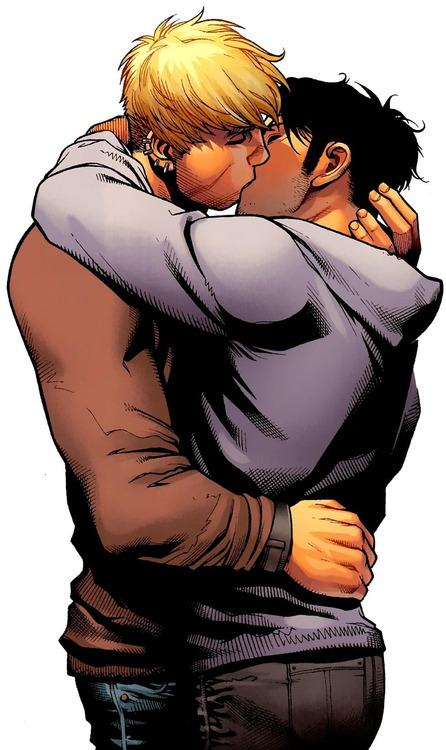
Homosexuality In Comics As Of May 20th

hulklingwiccankissIn the series following superhero team The Authority Batman/Superman analogues Midnighter and Apollo shared a kiss in 2000. A decade later Kevin Keller premiered in an issue of Veronica, the first openly gay character in Archie Comics history; he meets his future husband in a military hospital after being wounded in action. This year Young Avengers Hulking and Wiccan shared their first kiss, the result of the former proposing to the latter. Not to be outdone, fellow Marvel character Northstar will actually be beating the couple to the altar with his fiance this June.

Two days ago, May 20th, DC Senior VP Publicity Courtney Simmons announced that “One of the major iconic DC characters will reveal that he is gay in a storyline in June.”

As far as the Big Two go, Marvel’s ahead of the game. In this case, “the game” refers to “positive representations of homosexuals in comics.” Northstar announced “I am gay” in 1992, and since then has been followed by characters such as X-Man Graymalkin, Avengers Academy member Striker, and alternate-universe versions of many, many characters. In comparison, “new” Batwoman Katherine Kane is a lesbian, and is currently heading her own ongoing series, something Marvel can’t claim.

To be more specific, DC is going to reintroduce a previously existing character (previously straight) as “one of [their] most prominent gay characters.” This means that the character will not be Batman or Superman. As someone who can’t really get behind the company’s New 52 2011 relaunch I cannot speculate on what remaining characters may be coming out as gay. What I can state, however, is why other “major, iconic” characters could never be rebooted in this way.

It’s not because of fan outrage, though that’s a factor. So many of the really iconic DC characters have rich histories which involve their heterosexual love interests. It’s difficult to imagine Clark Kent without Lois Lane and her reporting on the Big Blue Boy Scout, and basically every male hero has a girlfriend who has played a significant part in their formation as a character. Batman is a character whose sexuality defines him almost not at all, though in his case his long-questioned relationship with the Boy Wonder may prove iffy.

That being said, I don’t see how major and/or iconic this gay DC character can be. To be that said character will have to have been around for a number of years. Fans are always complaining about something, but to retcon years of history will be a very messy process. I’m looking forward to finding out who it is, but am skeptical about how much clout the person will really have in the grand scheme of things.

Flo Rida ft. White Girls (Sort Of)

In 2009 rapper Flo Rida released his single “Right Round,” a song which heavily sampled Dead or Alive’s “You Spin Me Round (Like a Record)” in its hook. On top of shooting to number one on the charts in just three weeks, the track also featured Ke$ha on guest vocals. The following is the music video for the song:

You may notice that Ke$ha, an artist known for being Caucasian, blonde, and very into glitter does not appear in the video. Adding apparent insult to injury, she was only credited for her part outside of the US. To slightly amend the former, the artist said in an interview with Esquire Magazine that “[Flo Rida’s team] wanted me in the video, and I said, ‘Nah, I want to make my own name for myself.'”

Just today I was watching MuchMusic and saw a video for one of Flo Rida’s newer singles, “Wild Ones.” It features Australian recording artist Sia, whose presence on the track received a good amount of attention. Billboard.com described her as having a “bell-clear, campfire voice,” and noted her appearance on the Billboard Hot 100 was a deserved one. Below is the music video for that song:

The woman mouthing the lyrics to the song and accompanying Flo Rida is not Sia, but actually model Analicia Chaves. The implication in both this video and the last is that the artist whose vocals are featured are both a) present, and b) Black non-white [Chaves is Portuguese/Cape Verdean]. When “Right Round” was released everyone was asking themselves who Ke$ha was, and many assumed that she was simply the woman in the video.
I don’t believe that there’s any sort of racial conspiracy going on here, and the quirky similarity I noticed is more than likely only that. At this point neither Ke$ha nor Sia are doing badly for themselves, so it hasn’t harmed their image in the least. Still, it’s interesting to think about the fact that this has cropped up twice with the same rapper. If it happens a third time I think we’ll all know something’s up.

On graduating in 2012

When I was in the first grade I wanted to be an archaeologist.

I wasn’t too big on the actual dinosaurs – I couldn’t tell you whether Brachiosauruses lived in the Triassic or not – but I thought that finding things buried in sand sounded like the most fun anyone could ever have. I became addicted to those little toy blocks of hardened sand that have plastic tyrannosaurus skeletons in them. I drew pictures of myself wearing desert gear and a wide-brimmed hat. I watched Jurassic Park. I taught my 8-year-old self how to spell archaeologist.

If you asked me in the first grade, being an archaeologist was my dream. If you told me, in the first grade, that I’d be going to college for Not Archaeology, I’d be despondent.

When I was a sophomore in college, when I was choosing a track to follow for my psych major, I initially was going to go with neuroscience because it was the most impressive-sounding. I avoided declaring an English major because I was afraid of what my family would think.

We tend to think in extremes when planning or considering the future – I sure did, especially when I was a child. I thought I would marry a movie star; then I made plans to live in the woods for the rest of my life. I imagined the perfect house to be full of pianos and books, and I decided that Heaven must be a dining room with one giant bowl of macaroni and cheese in the center.

Now, my plans are less imaginative but more concrete. Instead of impressiveness, I’m looking for stability. Instead of individuality, I’m looking for ways to fit into work environments. I want my future house to have a laundry room and my conception of Heaven is considerably different from what it was when I was growing up.

And I don’t think this is a bad thing. When I was 8, my central life goal was apparently “coolness.” While coolness is, admittedly, high on my priority list, it’s tempered by “health insurance,” “family,” and “not being homeless.” Similarly, my wish to have an impressive neuroscience major has been tempered by the fact that I wouldn’t actually enjoy working in neuroscience.

I’m enjoying my new, slightly-more-relaxed mindset about my future. I’m glad that I don’t have to achieve grandiose goals to find fulfillment in my life.

But that was what I had been told. I could be the President, or a doctor, or a lawyer! I was an individual. I was special. I could do “anything” – but all the “anythings” listed were only impressive, dramatic, or glamorous anythings.

Now, though, I’m realizing that I don’t want to be an archaeologist, or the President, or an astronaut. I’d prefer a steady job over a glamorous one and a stable home over a dramatic one.

Humans are wired to be slightly delusional, but we often wouldn’t be content with the things that seem ideal to us. Being an archaeologist, while cool-sounding, requires a lot more work that I wouldn’t enjoy than my adolescent self imagined. Neuroscience sounds impressive but the pre-therapy track is way more applicable to my career plans.

I used to imagine myself being an English professor because I liked tea and I imagined it would be a career void of troubles with bureaucracy – I then realized that (a) that second point wasn’t true at all, and (b) I didn’t want to go into academia. My plans now – going to grad school in communication, finding someone who will pay me for doing something I enjoy, and maybe having a family – are more complicated than what I had planned when I was 16, but I’m also more excited about them.

We have the capacity to be discontent wherever we are. I thought that being an archaeologist – and, later, having an impressive major – would be the ideal, and would make me happy. I’m now starting to suspect that nothing’s going to make me happy – at least, not in the way I was expecting.

While there is the possibility of regretting any decision we make, we also have the ability to find contentment and joy in a wide variety of situations. Not all career choices or income levels or house photos will be impressive at class reunions, but sometimes less immediately exciting choices are the things that are actually fulfilling.

Porn Is Not Poltergeists

So last Friday I came across the following trailer for a movie called Harmless. Here it is:

In the spring semester of last year I took a writing class called Literary Nonfiction. One of the required reading pieces was Culture Making: Recovering Our Creative Calling, by Andy Crouch. The general gist of the book was that as Christians we have the ability to create our own culture. We live in the world, but we don’t need to be of it. If we can’t find anything out there that we can agree to be part of than we can make our own.

That being said, I’m not sure that I can necessarily support this film. I understand why they did it, though. I’ve seen Paranormal Activity; I understand the way fear is exacerbated by the intimacy of the  mockumentary format. I get that if you want to talk to people about your faith movies are a great way to do it, and the horror genre is an extremely popular one. The problem is that it’s ridiculous.

I won’t lie and say that pornography is all well and good. I do believe that it is degrading to women and can be extremely harmful to relationships and families. I will even go so far as to say that there is a dangerous spiritual component involved, but this is not the time or place to discuss that. I can also tell you what porn is not, though. Porn is not poltergeists.

I can’t agree with a film that could potentially be more ridiculous than the 2006 film Facing the Giants. Trailer seen here:

This was a film that just dripped with cheese.  It’s difficult for me to put into words how awful it was. The messages were certainly positive, but weren’t delivered in a way that was well-written or even believable. If Christian media wants to be taken seriously by those outside of its target audience it has to at least be a decent example of its art form.

I’m all for Christian media, or at least media with a Christian message of sorts. Ted Dekker’s novels Blink and Thr3e are well-written and actually very good. What I wish is that this would spread to the film industry, that as Christians we could do better at making and affecting culture around us, instead of creating something laughable.


Coping with Cartoon Death

Cartoons are a complicated thing. For example, children’s cartoon characters are required, in general, to always be wearing a seatbelt when in a vehicle. British TV character Peppa Pig was forced to wear one in all future episodes once parents raised concern about safety [the first few episodes would also be reanimated to reflect the change].

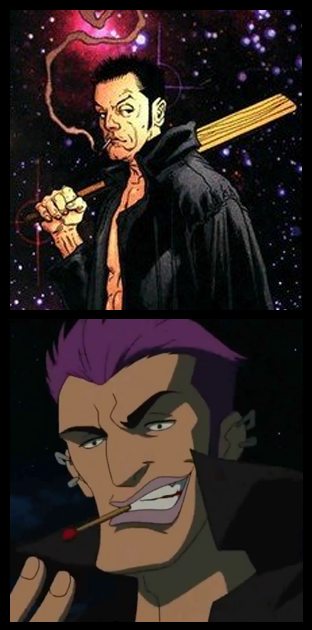
The presence of tobacco is yet another issue. In the upcoming DC animated movie “Superman vs. The Elite” British antihero Manchester Black is portrayed without his customary cigarette hanging from his lips. As you can see by the images to the right, it has been replaced by a matchstick.

What I’m slowly trying to get to is death in cartoons, and how it’s handled. The reason that this post didn’t go up yesterday was that I was powering through an entire season of “The Avengers: Earth’s Mightiest Heroes.” While I was watching the show, however, the same thought kept running through my mind: so many people just died.

Large fight scenes abound in the show as the Avengers battle to save New York City and the world, and collateral damage abounds. Skyscrapers fall and cars are thrown around, often with the implication that there are indeed people inside. A movie can be rated PG-13 for “sci-fi destruction and violence,” and I wonder how the show would stand up to the MPAA’s standards.

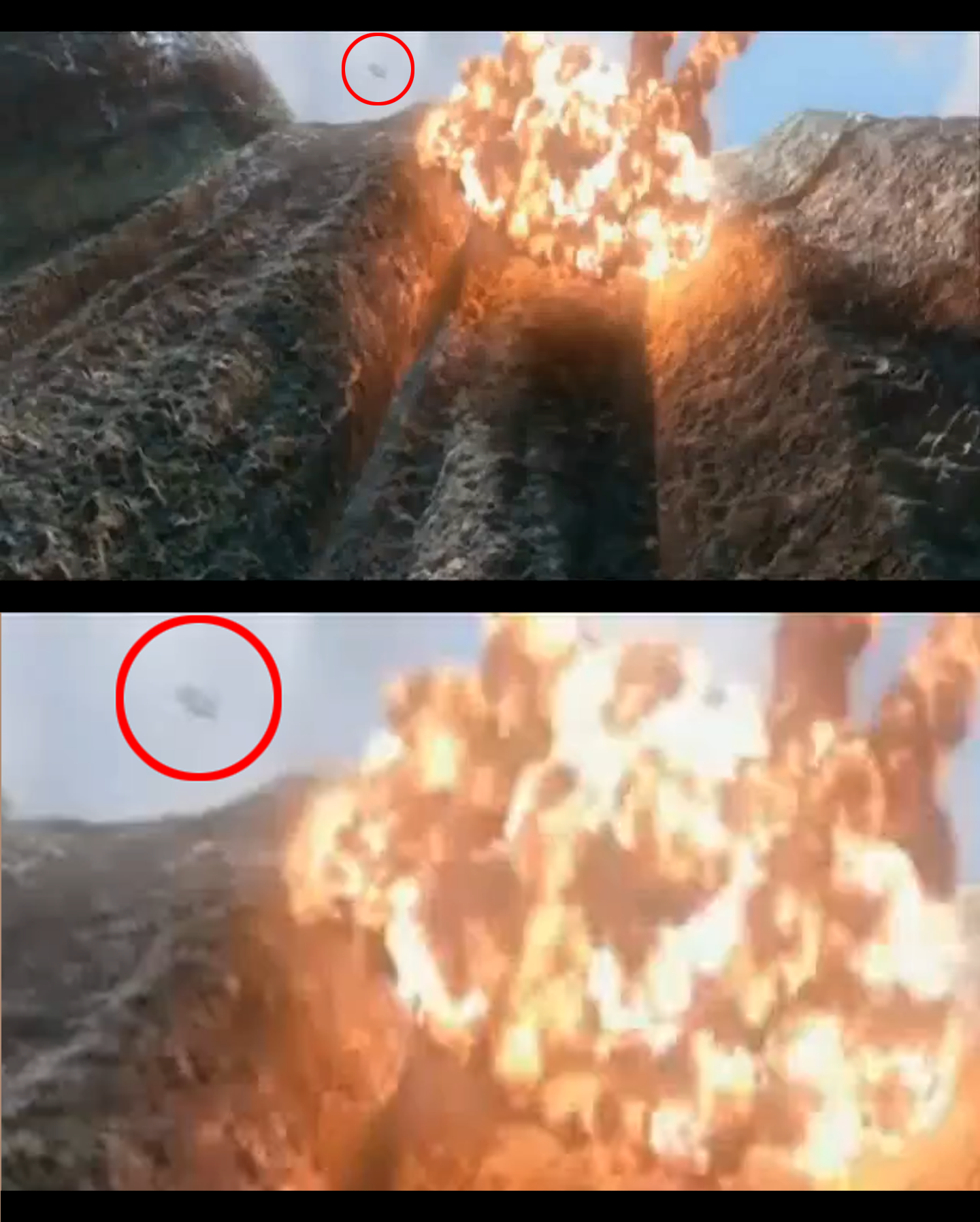
Similarly, in Pixar’s “The Incredibles” it is very strongly implied [though never outright seen/stated] that people, specifically Syndrome’s henchmen, die. There is a scene where Dash fights one of these goons and causes him to crash his vehicle into a cliffside. The result is a fiery explosion. From what I could tell the first few times I saw the movie, the man had definitely perished in the blast. Out of curiosity, however, I watched it again yesterday at half the speed.

As you can see, there is a brief second where a piece of debris can be glimpsed that could maybe be interpreted as some sort of escape pod. I sincerely doubt it, though. And this causes me to wonder how Pixar managed to get away with it, and how exactly the rules can be bent. In the scene pictured above a ten-year-old boy is the cause of a man’s death. Is that something worth considering, would children even notice or be bothered by it?

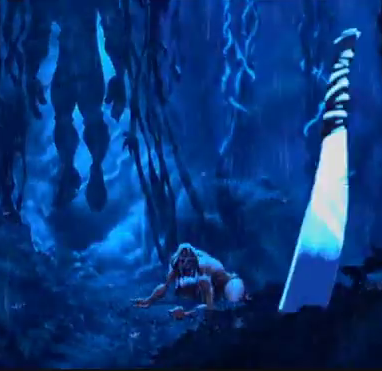
Death in cartoons has always been a very important event. Primary antagonists are normally relegated to some sort of dramatic end, and Disney movies are a fine example of this. Gaston [Beauty and the Beast] plummets to his death in a gorge, Clayton [Tarzan] ends up hanging himself from vines, and Commander Rourke [Atlantis: The Lost Empire] is turned into crystal and ends up shattering after hitting the fan of a hot air balloon. Their henchmen are, by and large, simply knocked out, oftentimes in a comical manner.

The question I’m trying to ask is whether or not we should continue to uphold the concept of death as this sacred thing in cartoons. Does a henchman’s demise deserve any kind of gravitas, or should he die in the first place? How much credit do we give children to understand what is happening when a character dies on screen? I can’t say that I have the answers, but becoming a parent will probably force me to find out.