Tag Archives: celebrity

Talking About Celebrities Talking To People

I’m going to start out with a few fun facts for readers both old and new alike.

At the time of this writing our blog has approximately 85,750 views. We have been averaging roughly 175 hits per day ever since the very talented Kat came aboard, and she’s largely the reason we’re almost at 200 on a Friday evening in spite of my not having posted yet. As is the norm, far too many of the search terms used to find this site have been people looking for porn; we began catering to fans of a particular sub-genre once Gordon wrote that one post about the hijab.

The most hits we have ever gotten was a result of massive Facebook sharing of a post I wrote about the bombing that happened in Boston. That all-time high was 562 views.

Last week Kanye West tweeted about Pacific Rim, praising it for being “easily one of [his] favorite movies of all time.” That first tweet was retweeted 8,853 times, and memorialized 5,177 times by all his twitter followers who chose to favourite it. To put that into context, Kanye West has about 9.7 million people following him on Twitter.

Kan-Jaeger West

Continue reading

Celebrity Mortality and Actual Loss

Eight days ago Michael Clarke Duncan, who you probably know better from the Green Mile but who I remember as the Kingpin in Affleck’s Daredevil, passed away having never fully recovered from a heart attack. Whenever a celebrity dies people take to the internet to mourn, and I saw the following comment on one of MGK’s very simple memorial posts:

What struck me was what exactly made this summer more heartbreaking than any other. Was it the suicide of Top Gun filmmaker Tony Scott? The passing of puppeteer Jerry Nelson? Moreover, was this summer any more “heartbreaking” than 2009, when Michael Jackson, Farrah Fawcett, Ed McMahon, and Billy Mays died? Continue reading

Thoughts About The Internet

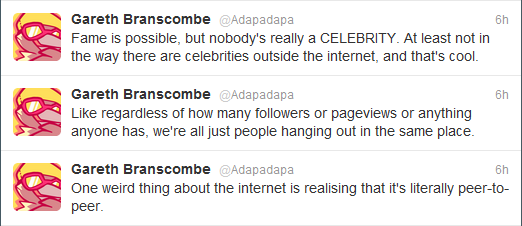
So a friend of mine tweeted in the early hours of the morning, musing about the internet. The tweets are as follows [to be read from bottom to top]:

Before I can really begin addressing this, I think it’d be good for me to have a good definition of the word “celebrity.” Dictionary.com tells me that as far as people go, a celebrity is a “famous or well-known person.”

So are there capital letters CELEBRITIES, or are there just people, again, referencing the tweets, with fame? And, if they’re one and the same, do they equate with people outside the internet?

The 21st century is a place where being “outside the internet” is a basic impossibility. That being said, there is a distinction between being general fame and internet fame. Brad Pitt is a well-known movie star. wheezywaiter is a popular YouTuber with 382,628 subscribers. If both walked around the streets of any major city in America they’d be recognized, but only one would create a stampede of screaming fans leaving several dead.

On the other hand, some celebrities have supplemented their fame with their internet presence. Ashton Kutcher was the first twitter user to reach a million followers, and currently has almost ten times that. Comparing that to his work in film and television, it actually dwarfs his presence “outside the internet.”

The thing with being internet famous is how quickly it spills into the offline
world. High school pole vaulter Allison Stokke had her picture submitted to With Leather, a sports blog, where it appeared in this post [as far as I can tell, the images connected to the specific post have since been removed]. These images quickly spread around the internet, however, and Stokke became the target of a large amount of unwanted attention, a lot of it very sexual. It got to the point where her high school began receiving requests for photo shoots of the athlete. The Washington Post has more to say about it here.

To be fair, that wasn’t Stokke garnering internet fame for herself, but was instead unwittingly swept into it by a blogger named Matt Ufford. She’s not the only one who runs the very real risk of being recognized in public. Webcomic artist Jeph Jacques bumped into fans while vacationing in New Zealand, less of a surprise when you take into account the fact that his strip has thousands and thousands of viewers.

The internet is a “peer-to-peer” place where anyone can post anything and have an audience of anywhere from one to millions. I have 71 followers on twitter [with only a few spambots], meaning that anything I tweet [which I rarely do anymore] is instantaneously communicated to a several dozen people all over the world. That’s an amazing thing. Audience does matter, though.

If you have a blog, and there are millions, what are the chances that anyone is going to read it? You could tag it with words like “Dakota Fanning” and “Playboy,” and that might help, but your readers won’t be consistent and probably won’t be coming back. We may all be in the same place, but we write or draw or play instruments because we hope that others might be audience to our work, and when that audience gets large enough it will inevitably change our lives outside the internet.

Kids Those Days

Twilight Spoilers, if that’s something you care about.
                                                                                                                                                                      

This topic was dated when I wrote about it for my other blog a year ago, August 16th. That being said, you’re going to have to think about popular trends that occurred quite a while ago, no easy task when popularity ebbs and flows as it does nowadays.

A little before my original writing on this subject, Miley Cyrus, the Jonas Brothers, and the Twilight novels were all the rage. I’m going to say right now that it was the best of times, it was the worst of times, with the hopes that what I’m about to say will back it up.

Every trend has its own share of supporters and critics. In this case, everyone everywhere (on the internet) was aghast at this cultural phenomenon that had befallen us. We (a collective we) were disgusted with this slurry that had become every teenage girl’s obsession, and we took every chance we could to denounce and deride Meyer’s novels, the Jonas’ music, and so on.

It struck me one day, however, what exactly we were doing. A lot of the issues that people were nitpicking (and deriding) were tenets that I not only agreed with, but that I lived by as well.

In Twilight Edward refuses to have premarital sex with Bella, and is adamant that if they are to go any further1  they must get married first. The Jonas Brothers wear purity rings to symbolize their commitment to, well, being pure.Lo and behold, these two items were brought under the most scrutiny and were mocked excessively.

So I questioned why, when girls finally had a half-decent role model, they were being ridiculed. Post-nowish Miley Cyrus didn’t wave the banner of blatant sexuality that former It girls Britney and Christina did,3 and that alone would have made me more comfortable letting my daughter obsess over her than many others.

From this point on in my original post I began to write about the Disney/Family Channel, but I’m not headed in that direction this time. What I want to focus on is the spirit of snarky judgementalism that seems to be permeating our culture. The constant search for what to demean and deride next, without any thought as to what good it may contain.

Yes, there are subjects which I will not defend [The Westboro Baptist Church, for example], but for the most part I’d like to call for moments of discernment whenever a target presents itself. Feel free to slam the Jonas Brothers for their musical ability, but leave their spiritual beliefs out of it.4 We should be able to consider that which we belittle and why it is we think so little of it.

To summarize what I’m trying to say, there was a point where people observed the fanatical, obsessive manner in which (pre)adolescents were throwing themselves at certain figures. In backlash against this behaviour they ridiculed their role models, yet targeted attributes which may not have been harmful for young people to mimic.

Be judgemental of those who garner the interest (and obsession) of many, but be smart (and civil) about it.

1. Than their creepy, unnatural kissing where she finds it difficult to find the air to breathe.

2.  Meaning, in this case, to save themselves sexually for their future wives. 

3. Not any more, though. You can’t release a single called “Can’t Be Tamed” and get away with it.

4. And their health issues. People made fun of Nick Jonas for being diabetic. I mean, why?

Thoughts on MetaCelebrity

So Stephen Colbert recently got his Super PAC approved – which means that he can raise an unlimited amount of money, as well as advertise for his PAC on Comedy Central. The approval has brought attention to large role privately-run PACs are going to play in the next election – and brought up questions about the legitimacy of the process as a whole.

Colbert’s Super PAC allows him to raise unlimited amounts of money from whoever he wants; he has stated a goal of ‘infinity dollars’.

The Colbert Report has been doing strange things with reality for quite a while, of course – the myriad overlaps between Steve Colber[T] and his alter ego; the 2006 elephant Wikipedia thing, the selling of his wrist cast for charity, and his various in-character and semi-in-character appearances on Bill O’Reilly’s show, doubly ironic rallies, and before Congress. Stephen Colbert’s character has been breaking the boundaries of his allotted time slot since the show’s inception. People don’t even talk about Steve Colbert the comedian – he seems to be kind of a low-key guy; little is known about him that can be wholly differentiated from his pretentiously pronounced character.

Two other examples of this blurring of public and private life: Miley Cyrus/Hannah Montana (I can’t really comment too much on this, but I DO know now that there was a show and a movie and that they are the same girl but one of them is sometimes a cartoon or something), and Lady Gaga, who has said that she considers her entire life a performance.

Lady Gaga arrived at the Grammy’s in an egg. There isn’t really much more to say.

So what is this thing? Why are fictional characters bleeding into real life? Well, in the case of Colbert’s Super PAC, it’s like a pop-up book version of satire – it’s a real-life critique that plays by the rules of the society it’s critiquing, legally approved and earning real money and possibly having a real effect on the election.

And meta-awareness is the key to mainstream comedy right now: The Simpsons (with their constant in-show jokes and references to Fox), anything by Seth McFarlane, Community, Parks and Recreation, Arrested Development (Arrested Development sooo muuch), and 30 Rock, eg. It’s not enough to just be funny within the show anymore – shows need to make audiences feel like they’re in on one huge inside joke.

Characters and stories in the media have to be aware of what they are, and go outside it, for audiences to appreciate them.

Well, I mean, that’s the heart of satire, right? The acknowledgment of the form. It’s why all the songs in the Book of Mormon are so dang catchy – because the music is everything that is catchy and addictive about Broadway boiled down into one show. And so it’s like stories and characters can’t just be stories and characters anymore – they have to be aware of what they are, and go outside it, for audiences to appreciate them.

The interesting thing is that I think this indicates a certain inability to lose our self-consciousness – it’s like we can’t enjoy ourselves unless we’re letting everyone know that we know what’s going on – that we’re willingly playing along with entertainment’s game. Entertainment is becoming more and more about who is breaking the fourth wall and how well, and so we abandon the maintenance of any sense of separation – that other-worldy, play-acting quality that movies, shows, and characters used to have. Entertainment is no longer contained within the realm of fiction. I’m not sure if this is good or bad or just a natural evolution of a communication-saturated society, but there it is. We seem to have abandoned all possibility of the acceptance of myth, and now everything has to be self-aware.