
Despite our focus on American issues, we here at Culture War Reportersrecognize that in our world of ever-shrinking borders, there’s plenty more out there than just the cloudless skies of Nevada or the homeless-packed streets of Toronto (Evan, seriously- if the healthcare system’s so good, why does Canada have so many crazy people?).
Today we turn our attention to our pasty cousins across the pond, more specifically, their TV, excuse me, “Telly” (this is why you lost your empire- well, this and genocide), and how it stacks up next to ours.
CGI and Production Values
Now I have to admit- I haven’t extensively researched British and American television financing, nor have I had a chance to compare the two, taking into consideration differences in the economy and advertising fees over the past couple decades.
What I’m saying is- I’m not an expert.

That said, I don’t need to be an architect to tell you that chances are pretty good that a lot less money was put into making a tent than a condo. British TV shows, put bluntly, just seems to be vastly less funded than their American counterparts. Just take a look at this scene from America’s Battlestar Galactica.
Pretty intense, right? If there’s any poor-quality, it’s probably from the YouTube video, rather than the actual series.
Now look at this clip from Britain’s Doctor Who.
Way worse. And oddly enough, Doctor Who has a bigger fanbase than Galactica, and despite it’s ever-increasing popularity, still has to deal with props dug out of someone’s kitchen drawers. I’m not saying Doctor Who is bad- it’s not. It’s really good- only it’s tough to really feel the full effects of a horrific reveal when the monstrous alien that’s been lurking the shadows until now makes your sock-puppets look scary by comparison. I can’t claim to know the reason for it, and I’m not putting the Brits down for it- I’m simply saying that funding- especially in CGI- appears to be a significant difference between the worlds of British and American TV.

Pretty Faces
You’ve probably heard jokes cracked about this. Not the “British are ugly” or the “British have bad teeth” jokes- the fact that the people on British television have the audacity to look like the people you’d see on the street.

That’s not to say the Brits don’t share the American weakness for fantasizing and glamorizing each and every facet of life, but it’s pretty clear that it’s nowhere near on the scale we have here in the US. Here- take a look at the leading characters of the American version of Being Human.
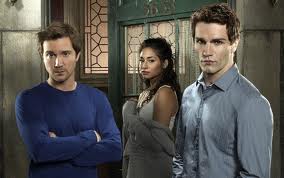
The guy on the left is decently attractive, as is the girl, and the guy on the right looks more or less like a life-sized Ken doll. Idealized people- no question about it. Now look at the same characters in the British original:
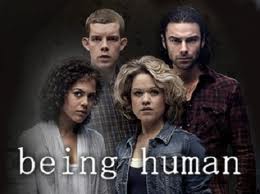
There’s not a huge difference between the girl (the blonde girl is another character- ignore her), and the dark haired guy certainly isn’t his American counterpart and stop looking at that guy’s ears! Yes, they’re huge- they’re gargantuan– and no, this isn’t just an unflattering photo- they actually are trying to escape his head in the first three seasons.
The point is, when it comes to their actors, the British are- well, appear to be- considerably less shallow. They don’t need a couple of supermodels to tell a compelling story of murder, secrecy, and perversion- and speaking of which…
Raunch Codes
Watch this clip- but before you do, get all children and Weslyans out of the room.
Pretty nasty stuff, right? Don’t say we didn’t warn you!

People complain that American media is nothing but sex and violence, but believe me- those Axe commercials are prudish compared to the Brits (and indeed- most of Europe). We may give the Brits a run for their money when it comes to blood and gore but never will we compete with them when it comes to explicitness of this degree. It’s almost to the point where it’s not even repulsive- you’re just impressed at how logic-deafeningly far they take it.

But only almost.
The Dying and the Dead
It’s been said that the difference between British comedies and American comedies is that American comedies begin with everything going wrong and end with everything being fixed, while British comedies begin with everything going right and end with everything falling apart. I wouldn’t call a story where everyone dies of scurvy at the end a comedy, but then again, I don’t whittle my life away on a miserable island full of alcoholics and skinheads.

I can say that because the only people who hate the British more than the Irish, the Kenyans, the Indians, the Chinese, the Australians, the New Zealanders, Iranians, and the Egyptians are the British themselves.

The simple fact of the matter is that there is this viciously self-deprecating mentality that pervades every element of British culture (barring fox hunts, which are just weird) that couldn’t be further removed from the general sense of optimism that you tend to find in America. Just take a look at British crime series.
Now I’ve seen quite a few, and while this certainly isn’t universally true, what I’ve typically found is that British murder mysteries focus on the whole “Whodunnit?” element, whereas American murder mysteries either have a “How’d he do it?” or a drive to keep the murderer from murdering again. Gross over-generalizations, I know, but it does seem to be true that American crime series episodes end with the detectives patting each other on the back for having done justice, while British crime series episodes end with the detective giving some despairing monologue about the tragic depravity of all mankind.
Because that’s a very depressing (and therefore, British) way to end the post- allow me offer this:
To say I’ve been ragging a bit on the British would be an understatement, and no- despite our attempts to be unbiased, we here at Culture War Reporters don’t care much for contemporary English culture. That established, there may very well be something to be said for the Brit’s here. Is it pretty? Not remotely, but for all the weirdness (from our perspective) that British TV has to offer, it can’t be denied that it’s simply more “real” than American TV. The sets aren’t shiny, the people aren’t (exclusively) gorgeous, and a stories of sin and murder actually recognize human suffering. There’s certainly a lot from British TV that merits imitation here in America.
Except for sexually explicit sausage commercials. **** that.

 In a pretty dramatic change of scene from my last field report on “Extreme Midget Wrestling”, last night I attended a production of the musical “Wicked.” Now as much as we here at the CWR try to maintain general neutrality in the culture war, the simple fact of the matter is that we do have bias, and as far as yours truly is concerned, the theater is hostile territory.


 In 2010, however, it became legal for some organizations to receive unlimited donations from corporations and unions: organizations which accept these unlimited donations are called “super PACs.” They are like PACs, but much more evil. While PACs forced candidates to build a large support base to earn a substantial amount of money, a few millionaire individuals or corporations can fund a candidate’s entire ad campaign.
  Super PACs allow corporations and unions to spend huge amounts of money on elections — billions, in the 2010 midterm election — and that directly translates into influence on government decisions. If you’re imagining large men in suits grinning evilly while photographing themselves with dollar bills coming out of their ears, keep imagining it: there’s a picture of Mitt Romney that looks exactly like that.


 Culture War Reporters