Tag Archives: representation

The Marvel Cinematic Universe Moves On [Without The Black Panther]

We all saw The Avengers; let’s not lie to ourselves here. It’s the third highest grossing film of all time, and we are the reason for that. As of earlier this month Joss Whedon was confirmed as returning to direct the sequel, with the film due to hit theatres on May 1st, 2015.

With a bit of a wait between movies, a buffer of films is currently in the works, including sequels Captain America: The Winter SoldierThor: The Dark World, and, probably the most highly anticipated, Iron Man 3. Also on the docket is the spacefaring super-group Guardians of the Galaxy.

All of this news pleases me. What’s problematic is that when researching this article I found out that the Marvel Studios have a model of “releasing just two films per year.” So let’s see what we have here:

  • Iron Man 3 – May 3rd, 2013
  • Thor: The Dark World – November 8th, 2013
  • Captain America: The Winter Soldier – April 4th, 2014
  • Guardians of the Galaxy – August 1st, 2014

With those four films taking up the next two years a horrifying fact emerges:
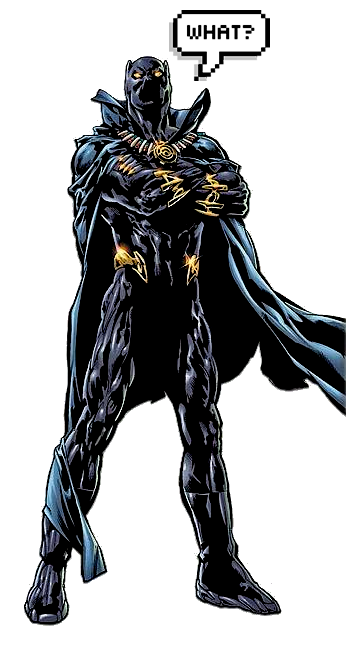
Marvel will not be making or releasing a Black Panther film before the next Avengers movie comes out.

Let me back up a little. Black Panther is, as comic book fans know, T’challa, the king of the fictional African nation of Wakanda. It is an extremely technologically advanced country, and the character himself has a PhD in physics, as well as being a master hunter, martial artist, inventor, and politician. On top of that he wears a suit made of vibranium, the same stuff Captain America’s shield is made of. He’s like if Batman were also the president and he is awesome.

Adding the Black Panther to the Avengers’ roster is not only has precedence in the comics, but it would also add the much-needed diversity that the first film was so sorely lacking. Marvel Studios co-president Louis D’Esposito discussed the possibility of a film starring the Wakandan king by admitting that:

“He has a lot of the same characteristics of a Captain America: great character, good values,”

Which is true. But he doesn’t stop there, going on to say :

“But it’s a little more difficult, maybe, creating [a world like Wakanda]. It’s always easier basing it here. For instance, ‘Iron Man 3’ is rooted right here in Los Angeles and New York. When you bring in other worlds, you’re always faced with those difficulties.”

Cue outrage from fans everywhere. The general argument against the statement above being that a sizeable portion of Thor took place in Asgard. Asgard, the mystical dwelling of the Norse gods. But playing devil’s advocate, as I try to do, perhaps Marvel execs are afraid of portraying Africa badly. Counterpoint: Wakanda is a pretty well-to-do place. Point: maybe they’re afraid of portraying the continent insincerely? Counterpoint: it’s a comic book movie. Point: but, but, but . . . Counterpoint:
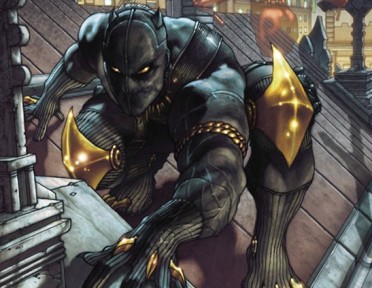
Those eyes sneer at D’Esposito’s claims.

Djimon Honsou is a number of things. An immensely talented Beninese American actor is one. The guy everyone wants to play the Black Panther is another. Honsou actually voiced the character for a short-lived TV series on BET which was essentially a motion comic.

Honsou himself has said in a 2010 interview with MovieWeb.com that:

“It is true that I have said certain things about it some time ago and that I would love to play the Black Panther. Also the opportunity came to do the voice over for the animation so I did that, maybe in the hopes that one-day they would finally get around to doing a movie. We have so many super heroes, but none that really defines the African American. I thought it could definitely happen and I have tried to push that envelope before.”

And if that wasn’t enough, Stan Lee himself is on the record as answering the question “What obscure characters would you like to see adapted into a big budget film?” in an AmA [Ask Me Anything] on reddit. His answer was this:

“Black Panther. He’s not too obscure, I hope.”

If the fans, the actor, and Stan “The Man” Lee [who also co-created the character] are all pushing for this there’s really no reason it should not or cannot happen. All that’s standing in the way are a bunch of executives too willing to take the way that’s “always easier.”

Girls: 2 Broke and One New [Pt. 3] – Race

As you may have guessed by the title, this is the third and final part of my observations about the relatively new shows 2 Broke Girls and New Girl. To read the first two posts about cast and humour click on the respective words, or just scroll down if you’re already on the front page.

RACE

For the most part, I’ve already gone into great deal about this topic and 2 Broke Girls in my post titled “Michael Patrick King, Definitely Not Being Racist.” To summarize a lot of what I’ve already written in a few words, the show is not great when it comes to boiling people of different ethnicities down to their bare bones stereotypes. Or they’re really great at it, depending on your point of view.

Per episode the show has a much greater number of new characters as its stars find themselves stumbling into such locales as a thrift store and a pharmacy in a Jewish neighbourhood. With that being said, they’re given countless opportunities to put different spins on people from different cultures and backgrounds, but fall flat again and again. I’d recommend that you turn to the post I linked to in the paragraph above to get a more in-depth look on the matter.

The show’s approach to race has made it the recipient of a lot of flak, and their most recent decision to alleviate said criticism is to bring in a “hot Asian guy.” A casting call was put out last month which sought to find an attractive male of Asian descent to act as a love interest to Beth Behr’s Caroline Channing. While this may seem to be a dictionary definition for “affirmative action,” it may be a step in the right direction.

On the other hand, we have New Girl, a show whose approach to race is summed up quite nicely in the following video clip:


Just like Morgan Freeman and his approach to Black History Month, New Girl tackles race by not making it a big deal. And it does so flawlessly in the first few episodes. The pilot has Zooey Deschanel’s Jess meet a perfectly nice Asian guy who later stands her up on their date. Yes, he’s made out to be a douchebag, and no, that’s not particularly flattering, but you know what else it’s not? A stereotype.

Similarly, in the third episode, “Wedding,” the newlyweds are an interracial couple, with an Asian groom and a Caucasian  bride. There is not a single character who makes a big deal out of it, and everyone on the show takes it as completely normal. Because it is. This is not a situation I can see the writers of 2 Broke Girls passing up for comedy, and the fact that I’m 100 percent certain of that is a sad thing.

Since it’s not plumbing the depths of New York City for people from different ethnicities and the like, New Girl has less diversity than 2 Broke Girls. That being said, its treatment of nonwhite characters is, well, nothing special, which is great. A mixed race group of students might show up, or an Asian judge [“Bells” and “Jess  & Julia” respectively], but no one makes jabs or even hints at ethnic stereotypes. The closest thing the show gets to a joke about race is Winston’s one-liner about Black Friday [I had a YouTube clip but it doesn’t work now; sory].

I’d seen that video of Morgan Freeman years ago, but it never struck me until recently how true it is. If the media simply acknowledges that we live in an incredibly diverse world and stops calling attention to details as nongermane as ethnicity, then we can live in a world where racism truly ends.

The Representation of East Asian Characters in Two Popular Western Comic Strips

Familiar to almost anyone who grew up in America, Archie Comics has told the stories of a fairly interesting group of teenagers living in the town of Riverdale for decades. First established in 1939 these comics are still published today, 72 years of panels featuring that insipid redhead Archie Andrews and his friends [who I actually don’t mind]. The comic strip Zits, on the other hand, was first published in 1997, and has for 14 years chronicled the misadventures of much-more-modern teenager Jeremy Duncan and his own group of eclectic young people.

It’s not difficult to see how the two [a single strip and all those created by an entire company] are similar to one another. Both are about American teenagers and their day-to-day lives, albeit living in very different eras. Having originated in the late 30s Archie and his friends have moved forward generation after generation, yet stick to a much lighter tone in regards to issues that teenagers have to face. Zits, starting at the turn of the 20th century, has a more realistic view of the high school years, addressing such topics as the disconnect between teenagers and their parents, the short attention span of today’s youth, and so on.

What I would like to explore and elaborate upon is the representation of Asian characters, specifically those of East Asian descent. Both of these comics are [or, at the very least, have been] immensely popular, and as a result their content is in part representative of what the West [in this case Canada and America] is familiar and comfortable with. Continue reading