Who invented Rock-and-Roll? Who should be credited as the inventor of the video game? Who’s responsible for the Zoidberg meme? Who is responsible for the way we celebrate Halloween?
Simple truth of the matter is, we can trace plenty of elements of culture to the general time period or people group where they originated, but never just who first came up with the idea of shoelaces, or “push it somewhere else Patrick.”
There’s plenty of our culture that we just accept without being able to credit the inventor, however, this Fame Day we’ll be shining the spotlight on someone we can.
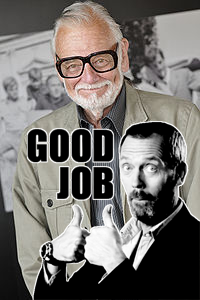
The one and only George Romero, whose influence on our culture arguable is on par with Rock-and-Roll.
Romero, for those few of you who might not recognize the name, is the creator of such films as Night of the Living Dead, Dawn of the Dead, and Day of the Dead, and according to many the father of all zombies.
Now while that affectionate title has been attached to him, the fact of the matter is, Romero did not invent the concept of the living dead. What he did do, however, was bring the concept out of obscurity, and do it so well that his work has become the basis for all subsequent zombie-horror. Zombieland, The Walking Dead, Shaun of the Dead, Resident Evil, Left for Dead, World War Z, Plants Vs. Zombies, Stephen King’s Cell, “Thriller,” I am Legend, you name it. There’s hardly an aspect of our culture that hasn’t had some zombie influence or spin-off (even before our recent craze), and there’s hardly an aspect of the zombie mythos that hasn’t been cemented and popularized by Romero. The man has simply hit it out of the park.
Now I’m not saying you have to like zombies- you don’t. I’m not saying that you have to like the films of George Romero- I don’t. But you have got to respect a man who has had such a profound influence on not only American, but world culture over the past half century (that’s right, half-century).
So, George Romero, in this last minute before midnight on Halloween 2012, we here at Culture War Reporters are tipping our hats to you.
Even if you haven’t recognized it for what it is, chances are, you’ve seen elements of it. The resurgence of beards, comments on period piece clips like “Why don’t we wear hats anymore?” or “Dang- they knew how to dress back then.” Or perhaps you’ve stumbled across The Art of Manliness or are (like me) a faithful apostle of Ron Swanson.
Now whether you’re aware of it or not, there is a growing culture based around this general perspective of “manliness” that supposedly existed from 5,000 BC to 1974 AD. The resurgence in the popularity of the beard, the wave of internet memes centered around being “classy,” our love affair with period pieces- all of this compounded has created the beginnings of a whole new subculture.
Don’t believe me? Just take a look at some of our favorite TV characters.
Don “F***-You, Liver!” Draper
Jack “Even Ayn Rand Thinks I’m Egotistical” Donaghy
Rick “Bad Decisions” Grimes
Walter “Tied with Draper for Making People Love Fedoras” White
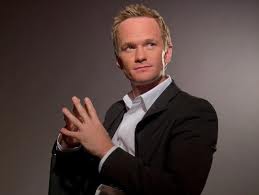
Barney “Legen- wait for it… -DARY!” Stinson
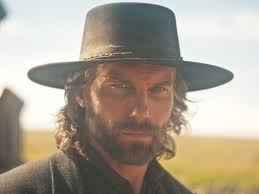
Cullen “I Will Punch You For No Particular Reason” Bohannon
Comedy, Drama, Action/Horror, Westerns- this is a pretty broad range, and we’ve got the same strong, dour antihero type in all of them. Men who remind us of our fathers and grandfathers. Tough as nails bastards who came to this country with only a dollar in their pockets- who took a break from their honest 8 to 8 jobs of hitting metal with other pieces of metal to kill Nazis and look dapper doing it.
So what’s this culture all about? As with any group, we can talk about the superfluous or cosmetic elements- in the case of the “manly” group, handshake etiquette, strait-razor whetting, and driving stick- but to really understand ’em, we’re going to need to look at the underlying values in play here.
Independence:
What do all the men shown above have in common? A degree of independence. They’re DIY guys. Men who aren’t reliant on the help or charity of others- in short, dudes who can take care of themselves in most any situation, from car repair to providing for the family to killing the undead. And on that note…
Initiative:
These are all men who don’t allow themselves to be victims. They’re proactive moment-seizing leaders who don’t wait idly by for someone to step up. Good or bad, they’re leading the way- and speaking of bad…
Stoic:
These are guys who tend to lend credence to the stereotype of the unspeaking, unfeeling male. At best, the strong, silent type- at worse, the uncommunicative lout. One way or another, they don’t let the situation get the better of them. That’d be undignified, and if there’s one thing that they’re about, it’s…
Dignity/Pride:
It’s in the way they dress, the way they speak, the way they expected to be treated. A kind of code that prohibits some things and makes others compulsory. You can’t hold your head high, then what’s the point in having one?
Moral Ambiguity:
These men are all, to varying degrees, antiheroes. Guys with their own agendas and a certain degree of moral ambiguity that keeps you on your toes. There’s a level of egotism, self-centeredness, and disregard for others that makes them pretty good at what they do, but what they do not all that good- certainly they don’t fit the traditional mold of the selfless, self-sacrificial hero.
Wealth:
And while it’s not true for all of them, money tends to be a major element of their stories. A drive to be successful, prosperous, and (again) independent. It’s the age-old dream of being your own boss.
So what does all of this boil down to?
Power.
It’s about power. These guys represent everything we, as a generation, aren’t. Independent, wealthy, self-assured, proud. Does that sound like us? Not at all. We’re the casual dressed, globally conscious masses struggling to make it by, and taking whatever miserable, degrading soulless job we can find. We’re not strong like these glamorized images of our grandparents are (having conveniently erased the racism, bigotry, and misogyny).
But we want to be.
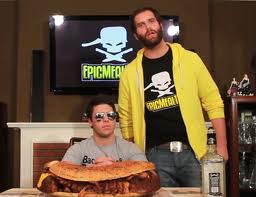
And so begins the perpetual motion machine of life-imitating-art and art-imitating-life. Epic Meal Time, Memes, Period Pieces- the list goes on.
So is this a good thing or a bad thing?
Well, there are good and bad elements to every culture (some more bad than good, and vice versa), but let’s list out the positives and negatives.
Positive:
We can stand to toughen up a bit a lot as a generation. We don’t need to be bending horseshoes with our teeth, but some basic survival skills and a thicker skin when it comes to discomfort and hardship would be nice (battery running out on your phone doesn’t count as suffering).
In these tough economic times, be able to do basic repairs to your house and car aren’t just good- they’re necessary. Same goes for any of the thrifty elements of the culture.
Even if we don’t have it quite yet, demanding a certain level of dignity in our work and our day to day lives isn’t just good for you as an individual- it improves society on the whole.
While we probably shouldn’t worship the fedora or declare the suit to be the only appropriate clothing for a man over the age of twelve, it certainly doesn’t hurt to know how to dress ourselves, or conduct ourselves well in any given situation.
Negatives:
The glorification of the past can, as I jokingly mentioned above, lead to the uglier elements of it being glossed over. We hail our grandfathers as being great men, forgetting how easy it is to make a name for yourself when none of the good or prestigious jobs can be given to equally qualified women or non-white men.
The culture really doesn’t leave a whole lot of room for women at all, other than the kitchen. This is not to say that all adherents of the culture see it this way, but when you’re trying to espouse 1950s society, that includes 50s traditional gender roles as well.
It can’t be denied that there’s a strong conservative appeal in this culture, as well as hints of Ayn Rand’s Objectivism. Glorifying wealth and success, especially when coupled with a “do whatever you need to do” mentality, can lead to the twisted perspective that poor people are poor because they are lazy.
This culture, despite the intentions of its adherents, does give a home for sexism. The uglier elements of the masculinity movement, those who view women as belonging in the home and nowhere else will doubtlessly find it a lot easier to fly under the radar in a culture that’s utterly dominated by males.
So what’s the final verdict?
“Manly” culture doesn’t appear to be either helpful or harmful- at least, not yet. The underlying issue being power, it’s going to be faced with the task of walking the thin line between empowerment and megalomania. So long as self-control is kept in mind, they oughta be fine.
It sounds almost like a cartoonish satire of the kind of people who storm into PTA meetings demanding to know why their children have been
“exposed to filth” after discovering a copy of Catcher in the Rye, Slaughterhouse Five, or Harry Potter in their kids’ assigned reading list. The kind of people who warn about the corrosive and unwholesome messages hidden in rock songs, or who sit horrified in front of the TV as some sensationalist dead-inside “journalist” warns about the latest secret teenager trend that’s sure to kill them/get them pregnant.
And as much as it sounds like something that’s ripped out of Footloose, Concerned Women for America is very real.
And that is an absolute shame.
Let’s take a look at some of the bilge that these guys are producing.
What caught my eye was a recent article of theirs on Malala Yousafzai, a heroic Pakistani girl and women’s rights and peace activist. In this post, the authors launch a vicious attack on Islam as being an inherently barbarous and misogynistic religion with a murderous agenda for any who dare oppose it. As the article states
“Malala questioned the station of women under Islam’s oppressive thumb, and the Taliban tried to put her six feet under the ground.”
This, quite simply, is a lie.
Yes the Taliban tried to kill Malala, and yes, Malala questioned the station of women-but what the authors of the article neglect to mention is that Malala Yousafzai is a Muslim herself.
Apparently it’s not enough that this fifteen year old girl (and she is fifteen, not fourteen, as the CWA article wrongly states) has to deal with the threat of violence and murder- she now has to endure her activism being hijacked by the “Concerned Women for America” bent on turning her sacrifice into a smear campaign against her own religion, which they claim is both “false” and “hate-filled.”
But why stop there?
The “Concerned Women for America” are also turning their ignorant ire against the “Slut Walks,” which for those of you who may be unaware, are parades of women wearing clothes of different degrees of modesty or exposure to make the point that it doesn’t matter how you’re dressed- one’s wardrobe is never an “invitation to rape” as some sex-offenders have tried claiming.
Being the moral, upstanding people that they are, CWA has sent up a howl of protest against these walks, declaring:
“The latest desperate bid for attention by the publicity-starved feminists is to sponsor SlutWalks — events where scantily clad women take to the streets en masse to claim their “right” to dress and behave however they want or to go anywhere at any time without the risk of being sexually assaulted or deemed streetwalkers.”
“They propose somehow to make the point that even if what they wear, their drunken state, or their presence alone in a very vulnerable place might indicate their willingness to participate in a sexual free-for-all, women should not be subject to lewd propositions or be at risk of being raped.”
Now I could leave it right there- those two statements alone are enough to demonstrate without a shred of doubt just what vile, reprehensible misogynistic scum the CWA is made of, but just to hammer in a few more nails for safe measure, here are some of there other quotes.
Here’s a lovely little comment regarding the Russian punk-rock protest group “Pussy Riot,” recently sentenced to two years in prison for singing an anti-government song in a cathedral.
Their formal statements about the incident reveal their utter lack of morality, embrace of a “blame-everyone-but-us” ideology, and disdain for capitalism and individual responsibility. Like their U.S. counterparts, they want “human rights, civil and political freedoms” for themselves but not for Christian believers or anyone else with different beliefs… Christians around the world are facing intolerance of their beliefs and sometimes violence as well. In spite of the Constitution, religious liberty is under attack in the United States, with the federal government telling religious institutions that they must violate their beliefs and support homosexual “marriage,” homosexual adoptions, contraception, and abortion or face penalties.
Really? A handful of women sing a song in a church decrying the increasingly totalitarian state, get the ridiculous sentence of two years prison for doing so (the same action in the US would merit a fine, if that) and it’s you who are the persecuted ones.
Transgender? Give me a break! First of all, there is no such thing; it is a choice of behavior. And hope as we might, our desire to behave in a certain way does not legitimize a chosen behavior. It certainly does not entitle them to circumvent the rights of society and our moral tenets in order for them to “have their way.” Natalie Johnson, the employee in question, was quoted in an ABC interview, “I refuse to comply with this policy,” and “There are no transgenders in the world. A guy can dress up as a woman all he wants. That’s still not going to make you a woman.”
An easy call? Certainly not, but this self-righteous outrage is just plain stupid. What if the person in question had been born a hermaphrodite? How would he or she be treated then? Would that kind of ambiguity have justified the guy/gal being denied service? If that’s our logic, why not deny service to people in wheelchairs for not conforming to the societal norm? That logic just doesn’t hold up.
End of the day, “Concerned Women for America” is what cancer would look like if it were an social movement. Shame on this vile organization.
Earlier today Evan sent me a link to a documentary on YouTube dealing with the subject of “hacktivists,” or more specifically, the rise of internet mischief and mayhem group “Anonymous.” For the most part, the movie was decent enough, though of course it wasn’t without its own agenda and a there are a few misconceptions resulting from that. But this post isn’t going to be a review. Rather, it’s going to launch off from an interesting phenomena I saw throughout the documentary- and that was the way people talked about Anonymous.
See, whenever people talk about the group, they usually have to veer off into a parenthetical speech where they try to explain just exactly who these guys are, and how at the same time they can be anybody, because anybody can be “Anonymous.” The end result is that they wind up sounding like a paranoid schizophrenic or conspiracy theorist, and the explanation itself doesn’t sound all that believable. After all, how can any individual or group take on the mantle and conduct whatever hacking or pranking or ranting they do against their enemies without some leadership? How do they do anything if they have no demands or agenda?
The problem here (and elsewhere, but we’ll get to that in a minute) is that a completely wrong lens is being used to look at the group. People are looking for structure or goals- the two things that usually define any collection of people, and that’s where it falls apart. Anonymous isn’t a group, it’s an idea. It’s a culture.
Now that sounds strange, but bear with me here.
What’s a conservative?
You probably have an image in your head right now. You can probably tell me what a conservative would think about a certain issue, or how he or she would act in a certain scenario, or the general value system one might have, but if I really pushed you for criteria, my guess is that you wouldn’t be able to give me one. After all- there are varying ideas of “conservatism,” and no real defined boundaries. You’ll find conservatives who state that the “religious extremists” have a skewed view of conservative values, and those same extremists offer the exact same criticism of those wimpy fiscal conservatives. Regardless of the specifics, once you stand back, both groups do fit neatly into the category of “conservative.”
Now apply the same general lens to Anonymous.
What’s “Anonymous”? It’s not a group with an ideology- it’s an ideology with a group, or rather, a whole bunch of groups. Consensus isn’t made through secretive discussion boards or by a clandestine collective of angry computer-geeks. Consensus isn’t made at all- actions simply stem from a general set of perspectives and ideas (the most major of which is freedom of speech and opposition to censorship) held by the adherents. Anonymous doesn’t exist as a coherent, structured group anymore than any culture or subculture exists as a coherent, structured group. Sure you’ve got your major players, and you’ve got various projects or movements within, but at the end of the day, there’s no list of demands, just a set of values.
The reason I bring this up is that this kind of organic organization is becoming more and more prevalent in our culture, the most notable example perhaps being the “Occupy Movement.” Critics of the movement, in its early days, continually parroted the protest of “But what do they want?“- the issue with that being that there was no, and never could be, any list of demands. Occupy wasn’t a structured or unified group- it was, like Anonymous is, a culture. A massive number of people sharing (and developing) certain common perspectives and values and then taking actions based on those views (those actions further developing those views, and so on ad infinitum). Trying to get demands out of Occupy protestors would’ve been about as fruitful as trying to get demands out of conservatives. You’re going to get conflicting specifics, even if there is a general set of guiding principles.
And of course, there are others out there. Though there’s no real term or name for it yet, there’s a rising “Manly” culture, comprised of elements of survivalists, masculinists, and guys who debate each other on-line about how to build porches and properly maintain classic muscle cars. Now I can’t claim to know the origin of this- perhaps it’s partly a reaction against our increasing dependence on technology, perhaps it stems from our powerlessness in a time of political and economic hardship- but either way, it is a growing culture based in principals of independence, self-sufficiency, self-control.
On the other side of the spectrum, there’s the general philosophies and ideas of the trans-humanists, futurists, utopians, geeks, nerds, and people who worship the ground Bill Nye and Neil DeGrasse Tyson walk on. Those who view technology as being the solution to most, if not all, human ills, and eagerly await the day when you can get a free jet-pack when you go in for your cancer vaccine.
Now why bring any of this up?
Because it’s important.
We’re currently breaking away from the liberal/conservative paradigm, and we’re going to need to understand what else is out there. This isn’t to say that we’ve only had conservative and liberal cultures- that simply isn’t true. But we can’t deny that there has been, over the past decade, developments of new value-systems which are really neither here nor there. New and alternative views for what the world ought to be, and how you ought to be in it. Over the course of the next few weeks, I’ll be focusing on dissecting these various concepts, so be sure to stop by next Monday for my examination of “Manly” culture.
Video games and video game culture gets a lot of bad press- not all of it
undeserved. However, in the midst of all the pandering, casual sexism, and juvenile sensibilities, there is a radiant beacon of hope.
Penny Arcade’s (and for a while, The Escapist’s) very own Extra Credits web show!
Even if gaming isn’t your thing, you have got to respect these guys and their weekly 11-minute clips for their neutrality and maturity alone. With the sensationalist media trying to cast even the smallest flaw of video games as the worst threat to humanity since polio, and the gaming community defending even the most idiotic element of their pastime as if it were the Dead Sea scrolls, that Extra Credits manages to remain the calm voice of reason that it is ought to be applauded.
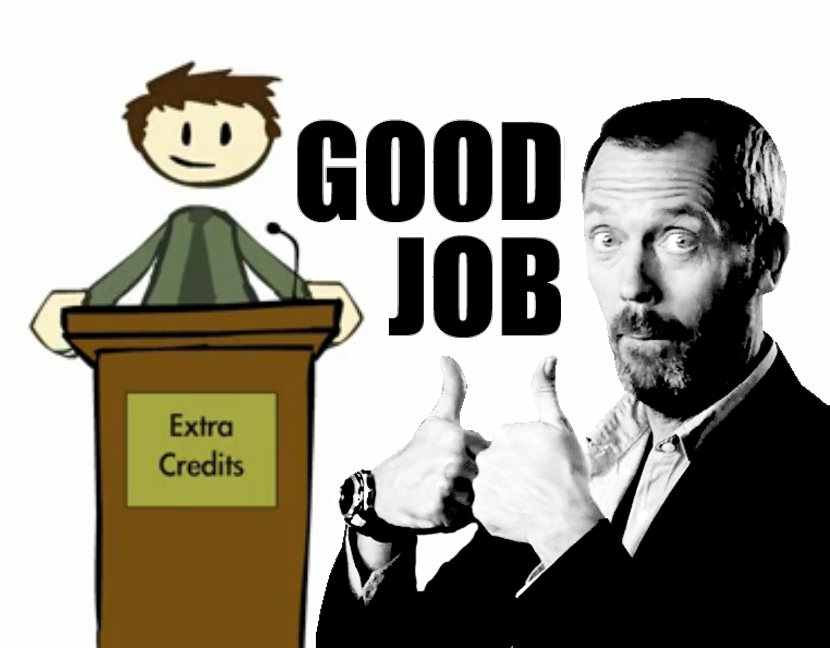
But of course, there’s more on that. These guys are the good angel on the shoulder of the gaming industry, calling for video games to be not only a source of entertainment, but also of education and even a new form of art. Whether or not you agree with that is up to you, but you’ve got to admit- it’s a bold and noble stance in a subculture that too often obsessed with doing this:
Extra Credits, here’s to you- keep doing the great work you’re doing!
P.S.: Evan, being the meany-face that he is, is forcing me to make this post longer. Set below is one of Extra Credit’s finervideos, and an easy introduction into their more jargon-heavy clips on narrative, mechanics, and other elements of video games.
EVAN: Last week Gordon and I discussed the greatest flaw of this generation, and discussed apathy, laziness, entitlement, and creative bankruptcy. Deciding that we had much more to work with, Gordon left us with this question last week, which heads this continuation of the topic:
““Do we want to be good, or do we just want to look good?”
GORDON: I’m not entirely sure I can come up with any swift dismissal of this possibility, I mean- look at the world we live in. Do we believe in being environmentally and socially conscious? Absolutely. But to what extent? I mean, we’ll chuck our soda cans in the recycling, but are we gonna picket Monsanto?
Are we really just observing these “little” things because they’re expected of us? Do we actually care one way or another?
EVAN: As far as recycling goes, we do that in Canada because it’s the law. Looking good only has so much to do with it.
If we want to go with the example of, say, giving a few dollars towards an environmental organization [or maybe because the fundraiser was cute], that works a little more maybe. It at least contrasts with picketing/protesting. I think we care, but maybe not enough? That’s if we’re quantifying “care” now by the actions that it results in.
GORDON: Is it, perhaps, that we’re cynical? Do we as a generation ultimately despair of the effectiveness of any method of change? Is the reason we’re unable to really go the distance when it comes to our causes because we think it’s all just in vain?
EVAN: Do we think it’s all futile? I mean, we’re certainly led to believe that to some extent. To focus on environmentalism, the extent of the destruction to this earth is growing ever closer to irreversible, and we’re made aware of this.
As far as documentaries and the like go, however, we are told over and over that what we do does indeed matter. Being conscious about how we spend our money and that sort of thing.
GORDON: That’s what we’re told, but then again, the creators of such documentaries are overwhelmingly members of older generations.
Look at the Occupy Movement, for example.
People were there from all demographics, but more than anyone else it was the youth- our generation. Despite massive popularity, that venture ultimately met its death under the boot heels of riot cops and a fog of pepper spray.
It’s been about a year since it all started, and the situation is the same, yet there’s really no push for any resurrection of the movement or even for any major protest at all. Have we given up? We’re all the same people- we have all the same drives and values- have we simply despaired of peaceful protest?
That aside, maybe you can explain what exactly happened as the movement petered out. It’s somewhat well-known that the weather was a large contributor to those occupying various streets and cities, but what else led to its collapse. Was it simply fatigue?
GORDON: I’d blame massive crackdowns on the part of the mayors of the occupied cities- let’s not forget that mayor Jean Quan pretty much turned Oakland into a warzone. Injured a protesting war vet so badly most folks thought he was going to become the first casualty of the movement (he pulled through, fortunately).
EVAN: This sort of all falls back to a point I made in relation to apathy our first attempt at this topic. That people care, but simply don’t feel like stepping outside their comfort zones. I realize that this may seem like a ludicrous thing to say in the face of the Occupy Movement, but I feel that the vast majority of youth, our generation, don’t want to do what it takes.
They, we, value comfort too much.
GORDON: I’m gonna have to second that theory.
I remember back when I was in college, going door-to-door trying to get students to boycott various unethical companies [Coca-Cola, Nike] doing business on campus. I was amazed at how many people would nod their heads and smile and agree with each and every word out of my mouth until I called on ’em to stop buying those companies’ products.
Guts. We got none. Difficulty with the concept of actual sacrifice, you know?
EVAN: And the refreshing taste of Coca-Cola is the very basest of comforts. If we can’t part with a caffeinated beverage we’re into, then what can we do?
I’ve joined in your personal boycott of the company, and although it can be a little difficult, it’s certainly nothing compared to being beaten by batons as I march on Parliament.
GORDON: Is that it then? Are our values just skewed ever so slightly in favor of immediate gratification? Do we prefer keeping our skulls in once piece over bread and freedom?
EVAN: History would say: yes. At least until things reach a certain point. Until we realize that being comfortable doesn’t outweigh what we put up with to get that comfort.
GORDON: So what’s the word for this?
EVAN: To put it simply would be “laziness,” and we both know it’s more than that.
GORDON: “Over-Attachment,” perhaps?
EVAN: “Comfort-Loving”?
GORDON: “Hesitation”? “Looking back towards Sodom”?
EVAN: Looking back towards Sodom assumes that they’re actually doing something.
GORDON: It’s a fear- a very specific kind of fear. The kind where you “choke” just before doing something major.
EVAN: I’m going to say there’s probably something in French or German for that, but since we’re writing this in English we’re pretty limited in our options.
GORDON: Can we make one up?
EVAN: Heh. I don’t see why not.
How about . . . “Statusquophilia.”
GORDON: “Fluxophobia”?
EVAN: Haha, I like how we went different directions with our Greek roots.
GORDON: As do I. Shall we have the readers vote?
EVAN: Sounds good to me, and we should be wrapping things up anyway. Want to summarize how we got here?
GORDON: Ultimately, o readers, it all comes down to this. The great and terrible flaw of our generation- from what we’ve discussed- is not a sin of commission. We are not entitled, we are not lazy, we are not without our values. Our fault is in what we lack the guts to be good, the balls to be bad. In short, the unwillingness to part with what we have for the chance to attain something more. We’re trapped in a dance with the devil we know.
EVAN: Vote for the terminology you like more. “Statusquophilia,” meaning a love for things as they are, or “Fluxophobia,” meaning, in this case, a fear of sacrifice.
GORDON: For next week’s topic, we’ve got: Zombies- Are We Beating a Dead Horse At This Point?
EVAN: Or what is going on with all the wars on television? I’m referring to programs like “Storage Wars” and the like. Real wars are happening, I realize this.
GORDON: And with that, people of the interwebs, we are out of time- make sure to vote for your preferred word as well as the topic for next week, and be sure to check out our new “Fame/Shame Day” feature!

 Who invented Rock-and-Roll? Who should be credited as the inventor of the video game? Who’s responsible for the Zoidberg meme? Who is responsible for the way we celebrate Halloween?