Category Archives: America

Fluffy Democracy and the 2012 Election

I’m not a political analyst. But I am concerned – as a student and as a person – by the unquestioned, inherent value in the word and idea of “Democracy.”

I understand the need for a fanatic search for government other than despotism, especially in the past, and especially in the very early history of the United States. Democracy was the ideological banner under which the United States stayed United, after all. And the deification of the ideal upon which the government was sort of constructed seemed to be a pretty good plan – it tried something new, at least; it’s not common birthplace or allegiance to an individual or even language or religion via which Americans traditionally identify themselves, but work ethic and political representation.

And that’s a good and noble thing. But “Democracy” as we use it now is lacking in substance, and only vaguely reminiscent of the word’s original purpose and ideals. It’s a fluff word – a word that’s lost its weight, meaning, and context. Something we can tack onto any object to make it instantly American and socially approved.

And the need for quick and easy social approval is, I think, rooted in the decomposition of political efficiency in the form of the partisan two-party system. The two-party system, whether it is the best model of an election-based political system or not, focuses all public attention and energy on competition for competition’s sake. The goal of traditional political debates has been skewed from clarification of one’s views to beating one’s opponent.

Bill Keller, New York Times columnist and previous executive editor, suggests that the rabid opposition effect is increasing over time. We are in “The Age of Shouting,” politically and culturally, Keller says – where politicians study talking points more than policy and semantic slip-ups receive more attention than real inconsistency. He suggests that the current political scene will be slow to make any real progress towards culling the approach of economic entropy if it continues to value short-term popularity over long-term benefit. Attempting to cling to empty ideals has caused politicians’ relationship with the public to become an empty thing in itself; all intentionality is replaced with the rabid defense of platitudes to which we glue our identities, and any sense of common benefit is drowned out by the cry to defeat any opposition.

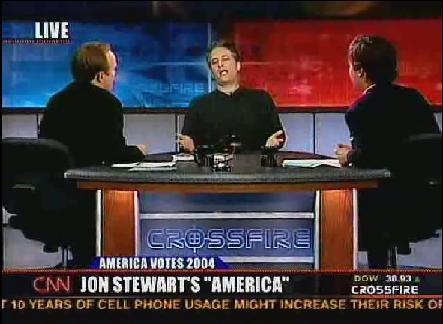
Jon Stewart, host of “The Daily Show” , was a guest on “Crossfire” – a CNN show that featured commentators sitting at dramatically angled tables and asking political figures loud questions – in 2005. He called out the show for being culturally destructive and deceivingly theatrical: “What you do is not honest. What you do is partisan hackery.” Stewart said to the hosts, “You have a responsibility to the public discourse.”

The comedian’s call towards participation in productive public discourse is impressively insightful. Democracy is a good and beneficial thing, especially for everyone who is not a) a despot or b) stronger than everyone else. But it does not magically self-perpetuate – because it is literally constructed of the public, it requires the constant activity and engagement of the public. Socially responsible and informed discourse is needed, and we’re not going to get it by finding cheap ways to win arguments. It’s going to take work and a widespread social movement towards real discourse to keep “Democracy” in the American lexicon as anything more than a buzzword.


Instances of Apology to the “Younger Generation”

One thing that’s striking me lately is the attitude of the older generation – Baby Boomers and even Gen Xers – towards the plight of the current young adult population. Take David Simon’s commencement speech to Georgetown, for example.

You did the work, you got the grades. Your parents are out there with you, prouder than hell. This is your day. And theirs. And who the hell is this lumpy white guy to come here and drip doom and despair all over the lawn in front of the Healy building? For the love of God, he’s sucking the life out of the big moment.

This is part of a trend, I think – there seems to be a handful of apologies from the old to the young being passed around. I keep expecting them to pull out a phrase like “the headlines these days”:

And every day, it seems, the headlines offer fresh examples of the greed and selfishness with which my generation has laid waste to its own possibilities.

I want to issue a sincere apology from the Baby Boomer generation to the younger generations. We have failed you profoundly. With a quick look at headlines, no one can escape the conclusion that some of you were raised without an ethical foundation.
– Pamela Wright on SpinSucks

We had contempt for our parents believing that “Father Knows Best” and “Leave It to Beaver” and “Superman” — with the show’s motto of “truth, justice, and the American way” — were good things for young people to be exposed to. So we replaced these shows with MTV’s mind-numbing parade of three-second images and sex-drenched shows for teenagers. Sorry.
– Dennis Prager on creators.com

There’s a lot of mention of MTV. One guy apologizes “for using sexual attractiveness as a substitute for all other forms of acting talent,” though his was not at all the first generation to do that, and some 25-year-old reply-apologizes for the types of music that he doesn’t like (including “3-chord pop rock songs,” which largely predate 25-year-olds).

This isn’t really much – I’m just thinking about the relationship between the older generations and the younger as time moves on. Is every era like this? Will we some day lament our failings to the younger generation, or is this just the new-ish self-deprecating-self-consciousness thing playing out in old age?

I have no good thoughts. It seems a little self-serving to use an apology to the younger generation to criticize the actions of your “generation” (ie, whoever was president while you were 30). David Simon’s commencement speech is pretty transparently anti-conservative:

Even during wartime, with our armies afield, we whine about paying taxes, though our tax rates are the lowest in modern American history. Meanwhile, though less prone to overt racism, we have nonetheless abandoned the precepts of upward mobility for all Americans, conceding the very idea of public education, of equality of opportunity. And as our society further stratifies, as the rich get richer and the poor become less and less necessary to our de-industrialized economy, we wage a war against our underclass under the guise of drug prohibition, turning America into the jailingest society on the face of the earth.

Whatever the intentions are, these apologies do little more than boast of the speaker’s political regrets, and are often just a “told-you-so” directed at whatever party happened to make a bad decision last, or just a frustrated “you suck” to the corruption in the political system in general. But do these things help? No. Did David Simon’s self-referential commencement speech give energy to the generation of students listening to it? Maybe in the last two sentences – he should’ve stretched these out and made the rest of it shorter:

But tomorrow’s task is to make this moment matter to your communities, to your country, to the world. And to make sure that at the end of your run, you leave that world better than you found it.

That’s what we need. We don’t need to be apologized to – we need to be inspired. We need unselfconscious enthusiasm, not snobbish jadedness. We need someone to tell us to pick ourselves up by whatever straps there are on our footwear, if the economy is going to be rebuilt. Well, actually, I’ve heard that we need the Euro to stay constant and fiscal policy reform, but the bootstrap advice is necessary too.

And as this is a quotey post, I leave you with the immutable words of Woody Allen:

More than at any other time in history, mankind faces a crossroads. One path leads to despair and utter hopelessness. The other, to total extinction. Let us pray we have the wisdom to choose correctly.

An American Invasion

Attending college in the States means that I’ve missed a lot of goings-on in Canada. Apparently Toronto Mayor Rob Ford is a terrible mayor. I did not know this. On May 1st came to another realization, but one that filled me with far more trepidation than a mayor who has given up on his diet.

Driving through an old neighbourhood, my family and I saw that Canadian superstore Zellers was having a 50-80% off liquidation sale. A well-known chain in the country, the chain is a subsidiary of the Hudson’s Bay Company (HBC). After trying on a few jeans my brother asked the woman in charge of the change room what was happening, and she told us that this branch was becoming a Target.

Fastforward to me doing research on Wikipedia, and it turns out that in January of last year the Target Corporation purchased lease agreements for 220 Zellers stores for almost 2 billion dollars. The end result was 189 stores for the company, and of these 39 were resold to Walmart Canada. I was shocked by the idea of a prominent Canadian chain being bought out by an American company, but it doesn’t stop there.

The HBC is currently owned ( as of 2008) by New York-based company NRDC Equity Partners. This is a company that has its roots in the Canadian fur trade, the foundation of this country. Grade school children all over Canada learn from a very early age in history classes that it was the fur trade that brought people to this country, and that The Bay is the oldest commercial corporation in North America and one of the oldest in the world.

What bothers me is the knowledge that this country faces a sort of invasion coming from south of the 49th parallel. It’s no mystery that American companies have more money and sway than those in Canada, but it’s terrifying that they’re establishing themselves so firmly here. Just walking around in the heart of downtown yesterday and I saw a Panera Bread, yet another company that has spread into the north within the past five years.

Canada isn’t a world power in terms of military, but our impact on popular culture has been steadily increasing. I may be blowing this whole thing out of proportion, but I just don’t see a world that takes us seriously when all of our businesses are run by America.

Sexism, Reductionism, and Stepping on Women’s Heads

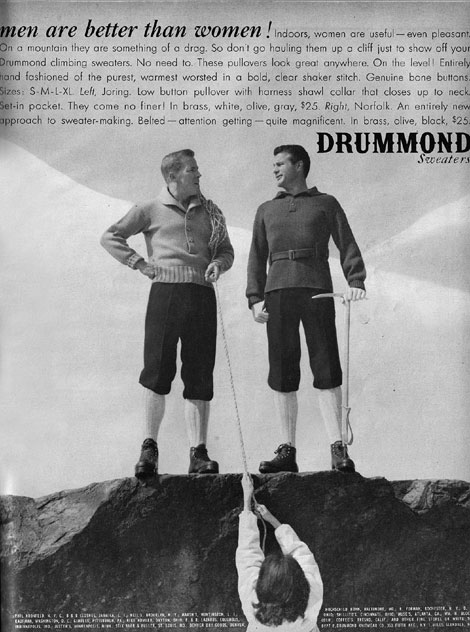
So Retronaut has a page of “Vintage Ad Sexism” – hilariously sexist ads, many of them aimed at men’s pride (“brand new man-talking, power packed patterns that tell her it’s a man’s world”) or women’s insecurities (“Would YOUR husband marry you again?”). There are some gems in there, like these:

source: retronaut.co

I'm just gonna let these speak for themselves.

source: retronaut.co

source: retronaut.co

Read some of this one for the full effect

source: retronaut.co

And this one might be my favorite…source: retronaut.co

Aren’t some of them kind of frighteningly recent-looking?

So yeah, we remember sexism, 1919 and women’s suffrage and bra-burning and all that. Being shocked that women couldn’t vote, etc. But seeing advertisements make it more harrowing. Serious political oppression at least treats women with enough dignity to be oppressed – advertisements make light of women as entities. I am less concerned with the essential sexism in these than I am the reduction.

Violence and political oppression are horrid, yes, but reduction is more insidious because it tends to keep hanging around long after voting rights have been own and salaries have been evened out.

The advertisements here, of course, appear ludicrous to us. “Is a wife to blame if she doesn’t know [to use a douche]? Yes! She’s decidedly to blame.” The one with the rug with a woman’s head, the man standing with one foot on her head Captain-Morgan-style. Some of them are just ridiculous.

But it is good to remember that as insane as they may seem, these are real, and they are recent. People who saw these ads and accepted them as a relevant way to advertise a product – people who made the ads, laughed at them, nodded in agreement – still make up a large part of our society today. Even after that generation dies, the fact is that American culture (it’s what I’m talking about here; can’t speak to other places) has been steeped in the reduction of women – and this is not an influence easily shed.

Now, establishing a double standard to “make up” for lost time is not the answer. Ensuring that all males are instilled with a sense of guilt about the past will not help society. Only by awareness of our ideological roots, and the flaws and violence therein, can we stay – or at least slow – regression.

Terrible Moments in News Media (Not Limited to Rush Limbaugh)

Note: This is a version of a piece I wrote this with my brilliant friend Chris Hartline for our student newspaper, and am reprinting it here. Any goodness in it may be credited to him.

Most of the public is aware of Rush Limbaugh’s stupid and unfunny bit in which he referred to a Georgetown student as a “prostitute” and a “slut” for saying that Georgetown health insurance should cover contraception.

source: lifenews.com

Do not pay attention to this man. He will make you sad.

But the name-calling does not stop there: other instances of sexist slander have been just as offensive but haven’t received as much news coverage as Limbaugh’s insult. Bill Maher, a liberal comedian and amateur political commentator on HBO, referred to Sarah Palin as “a tw-t” and “a c-nt”. Chris Matthews, MSNBC host, called Hillary Clinton “witchy,” “uppity,” and claimed that she was elected to the Senate only because her “husband messed around.”

source: glennbeck.com

Looks like public discourse to me.

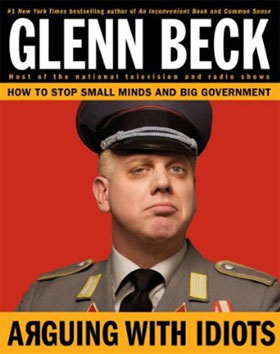
The state of the news media today is disheartening because the system of acidity seems to be self-perpetuating. Indeed, truculence has become a prevailing rhetorical device. Keith Olbermann had a segment on his show (and a book) called “The Worst Person in the World”. Glenn Beck wrote a book in 2009 called “Arguing with Idiots: How to Stop Small Minds and Big Government”.

Another clear manifestation of the deficit of trust of the media was a 2009 poll done by Time magazine. Walter Cronkite held the title (since 1974) of “Most Trusted Man in America”. Cronkite was the most visible figure in the media, which at the time provided objective discourse and information to the public, and he died in 2009. In the subsequent Time poll, voters said that the most trusted news anchor in America was Comedy Central host and political satirist Jon Stewart.

The fact is that the media is supposed to provide a momentary stay against political hostility, an unbiased source of objective information for the public, and that it is not doing this. Consequently, the public is losing their faith in the news media, and by extension the American political system itself.

The media has become tool used by political parties to influence the opinions of the public. A blatant example of this is the “Plan for Putting the GOP in the News” memo from the Nixon administration. The 15-page memo was anonymous, and has written comments on it by Nixon’s then-advisor and current Fox News President Roger Ailes.

Roger Ailes!

Roger Ailes: founding CEO of Fox News and adviser to Nixon, Reagan, and Bush. Also credited for possessing the world's least attractive set of jowls.

The memo stated that television was the best medium for political persuasion because of its imminent popularity: “People are lazy. With television you just sit – watch – listen.  The thinking is done for you.” The plan was to record prepackaged interviews with Republican politicians and deliver the videotapes to local news stations. Presently, critics say that Fox News has demonstrated their role as an arm of the Republican Party.

source: msnbc.com

All you need to know about Keith Olbermann is that he's not a pleasant person.

MSNBC, while on the opposite side of the political spectrum from Fox News, is similar in its audacious political stance. In a distasteful and recurring ending rant on his show, former host Keith Olbermann once shouted (his monologue was directed at then-President Bush), “This war is not about you … shut the hell up!”. Fellow host Chris Matthews also said after a 2008 Obama speech that he “felt this thrill going up my leg as Obama spoke.”

So it can be concluded that the media has become unabashedly partisan. Even the very fact that it is standard for each major newspaper to endorse a presidential candidate reflects a problem in the nature of journalism. It results in an overtly ideological news organization – the New York Times is liberal, the Wall Street Journal is conservative; the Washington Post is liberal, the Washington Times is conservative, etc.

A news staff tending to lean one way on the opinions page is typical and expected; however, the fear is that the ideological slant of the editorial pages will seep into the news coverage. The potential and underlying ‘spin’ of news stories becomes more important than the objectivity of the events being reported.

And maybe the Nixon administration’s prediction about the easy audience of television was prescient: political commentary television programs can be especially caustic and, at times, juvenile. They seem to appeal to the lowest common denominator of the public and of individuals. Keith Olbermann, Glenn Beck, Rachel Maddow, and Bill O’Reilly are all political commentators who base their rhetoric on the petty mockery of whoever disagrees with them – their arguments are negative, not positive, and clever insults take precedent over constructive criticism.

source: portland.indymedia.org

Jon Stewart pleads with the hosts of Crossfire to "stop hurting America." Crossfire was cancelled shortly after Stewart's interview.

The media itself has not only lost its ability to objectively inform the public of unbiased political events – it has become a tool for fostering and encouraging political contention. The role of the news media is not just lost – it has been perverted. As Jon Stewart said to the hosts of Crossfire, this inflammation of petty and theatrical bickering isn’t just bad journalism – it’s hurting America.

David Brooks said: “There’s a collapse in the public’s faith in American institutions. The media has done a poor job. We’ve become as insular and self-regarding as any [other institution].” It is no wonder, then, that there is a deficit of trust among the younger generations – the apparent disintegration of the integrity of our news sources is nothing less than repelling.

Hitler, Ray Comfort, and the Dismal State of Discussion

I did something bad for my health that I do not recommend. I watched “180”, a half-hour documentary made by Ray Comfort.

It is a bastardization of discourse from all sides. In an interview with Steve, a neo-Nazi punk type of young man, Steve says that he’s certain of his opinions about the falsehood of the Holocaust and other offensive things. To combat this, Comfort asks Steve to spell shop (Steve does) and then asks: “what do you do at a green light?” The question is a trick to get the mind to quickly respond “stop”, which is semi-associated with green lights and rhymes with “shop”, and the person answering looks silly. Sure enough, Steve responded “Stop” and looked silly. And then – well, then Comfort treated that like an actual argument for something.

The documentary was dipped in dramatic music, photos of piles of dead bodies, and use of gratuitously violent photographs. What is most interesting to me, however, is the use of what seems to be the universal argument-ender: comparisons of things to Hitler.

Hitler, the Nazis, and Lazy Discussion
Hitler and the Holocaust have become mythic elements of American culture, I think, and to the detriment of the truth of the actual historical events. I was recently visiting a small church where the members, after the service, started (sort of randomly) to wax poetic about the horrors of Hitler and the Nazis. They weren’t saying anything new – everyone was just affirming that Hitler was inhuman and the Nazis were too. It was the fervent insistence that “real humans could never do that sort of thing” that struck me – I thought of all of the other genocides and massacres of the past century alone, of the killing of civilians in wars by troops of every nationality, of atomic bombs. But even in light of all of these things, current conversation about Hitler seems to serve contrast to our new, very human, very un-barbaric society. We talk about Hitler basically like Satan – an ultimate evil; a rhetorical catch-all.

Ray Comfort and 180: Unethical Discourse

Steve, in the movie "180" by Ray Comfort

Comfort’s specific use of the Hitler argument is reductive and tired. It is, if anything, an exploration of how charged and empty rhetoric in the realm of politics is being mirrored in general culture. His interviewees are inconsistent, and seem to know very little about philosophy, theology, or basic logic. Comfort’s questions are also always precisely and pseudo-cleverly leading, and it doesn’t seem that he wants to engage with the interviewees at all: “Does this mean you’ve changed your mind about abortion?”, he asks. “Are you going to vote differently in the future?” It is not a conversation, is the point: it is a poorly executed set of rhetorical acrobatics. Is this the way to foster discourse and an informed public? Probably not. Arguments depending on rhetorical cleverness are insulting to both parties.

Comfort’s series of interviews are not only annoyingly inconsistent and poorly constructed, however: the movie is also a manipulative presentation of complex issues and events, presented crassly and with a smugly triumphant attitude. One of the less graceful moments was when Comfort asked a woman if she’d had an abortion; she said that she had. He then immediately asked: “Do you feel guilty about it?”

As the big finish, Comfort sets up a game-show setup of moral responsibility and the afterlife, and awkwards them into admissions of fright and death anxiety:

  • Comfort asks people if they have lied/stolen/been lustful: most of them say that they have.
  • Comfort then gets them to admit that this makes them liars/thieves/adulterers.
  • Comfort gets them to admit that liars/thieves/adulterers go to hell.
  • Comfort elicits from the interviewees an understandable anxiety about the prospect of hell.
  • Comfort asks them if they are going to go read their Bibles.
  • Some of them say yes.

Alesia, from Ray Comfort's movie "180"

Theologically, morally, rhetorically, and logically, this is one of the most horrible things ever. Comfort’s quick-talking way of “tricking” people into professing a fright of punishment does very little for the moral health of humanity or the search for truth within rhetoric and theology. The triumphant music and photos of bloody sheets are no help for the legitimacy of the movie.

There are also 40 thousand comments. I do not recommend those either. They are not a happy picture of humanity.

It makes sense to protest the legalization of abortion and to be horrified at the amount of deaths occurring if one believes that life begins before birth. Comfort’s smugness and “gotcha” questions, however, lack earnestness, humility. The whole thing turns a serious situation into an awkward and unproductive onslaught of unhelpful rhetorical inconsistencies, devoid of integrity and, therefore, real efficacy.

In sum, the movie is a disjointed account of unproductive discussions with unproductive people with vague and uninformed opinions. It’s a disheartening representation of the state of discourse on American sidewalks.