Category Archives: language

Evan and Gordon Talk: Nerd Culture

EVAN: To start this off by ignoring our readership and addressing you, this week’s topic is a weird sort of continuation of the various posts on culture you’ve written, such as “manly culture,” “science culture,” etc. And similar to these other groups of people, “nerd culture” is a pretty nebulous sort of thing to define.

GORDON: No argument there. After all, even the “nerds” insist on calling out “fake nerds”- especially in regards to women/girls. But what is a nerd anyways?

EVAN: See, now I’m torn, because we do need to define it, but you’ve also directly referenced an issue I wanted to discuss in depth this week.

GORDON: How about we abandon our previous track record, and just plunge recklessly ahead and hope the issue resolves itself?

EVAN: Well, let me throw this image out there:

And then hope that suffices for now.

GORDON: Works for me. So what was it that you wanted to address specifically?

EVAN: Well, just last month there was this guy, a comic artist, named Tony Harris. And he wrote this post on his Facebook page that was essentially a tirade against “faux nerd” women, and how they are whores, and so on.

To break it down further, these are women who dress up as superheroes and what have you without knowing about the actual characters themselves. He is upset because, to quote him:

BECAUSE YOU DONT KNOW SH-T ABOUT COMICS, BEYOND WHATEVER GOOGLE IMAGE SEARCH YOU DID TO GET REF ON THE MOST MAINSTREAM CHARACTER WITH THE MOST REVEALING COSTUME EVER.

Also that they attend to essentially just tease the regular con-goers and are actually not even hot, just “con-hot.” So yeah, he said a lot.

GORDON: Ah yes, I recall reading about this. And while I think we can all agree Harris went too far, is a bit hypocritical (seeing how most comic women ain’t exactly average looking), and probably getting too emotional, I can’t help but wonder if he has, somewhere in there, a point.

I mean, imagine if all of a sudden, something that you had been stigmatized for became popular, and people started trying to co-opt your identity knowing nearly nothing about it. I’d be ticked off too.

EVAN: That’s definitely something I’ve read people write about, that this used to be an exclusive club and that it took years to build up this knowledge and become, well, a nerd, and here are these noobs and they want in and it’s not that easy.

And I can see where they’re coming from as well.

But if you really love something, shouldn’t you want others to as well? The Avengers has an enormous following on tumblr these days [because of the movie], and these are people who are actually going out and starting to buy comics. They are helping sales, aiding the industry, etc.

GORDON: That’s true, and something I’ve considered, but there’s probably also an argument to be made for the other side. That something precious to you is being watered down and diluted for profit. I don’t believe that nerds (comic book nerds, anyways) can necessarily make this argument, but the line of logic is there.

Let’s try to come up with an example of this happening somewhere else, especially in regards to persecution.

EVAN: Mmk, go ahead-

GORDON: “Black culture” (or what was passed off as black culture) might be an example. Can you state that you’re not driven nuts by wealthy, comfortable suburban kids fronting like they’re from the streets of Oakland?

EVAN: Yeah, people are upset about it, sure, but there’s not this immense outcry over it. There are comic-con enthusiasts that are genuinely incensed that all of this is happening-

I doubt that an actual thug or gangbanger or whatever these rich White kids are playing at imitating is going to start freaking out that he’s getting ripped off. He’s going to laugh or shrug it off, because it hardly matters.

GORDON: I’d argue that the reason for this has more to do with the change in venue. It’s easy for the major players of the comic book industry to voice their opinions than, say, a Wu-Tang Clan fan in the late 90s. But maybe I’m wrong.

EVAN: For the most part, I see this as a mindset that is the foundation or core of hipsterism, and that we all feel to some extent, however minor. That we found something and we love it and there is a pride in joy in being one of the original fans.

And this outpouring of others somehow cheapens things. And all of a sudden we’re trying to assert how we’re better than them in some way.

“You chose to dress up as Spider-Woman? Do you even know who her alter-ego is, or what her powers are? Etc.”

GORDON: Again, do we not sympathize? Do we not feel frustrated with people who have more or less jumped on the bandwagon now that it’s all safe and socially acceptable to do so? Heck, just imagine if someone tried listing themselves as a fan of fine cooking, having only eaten sushi once- would you be ticked?

EVAN: If I equated sushi with fine cooking I guess I would, yeah. But just because we can understand someone’s anger and frustration doesn’t make it logical.

GORDON: I wouldn’t say that there’s not a logic to it. I mean, a major part of being a nerd is, and always has been, the social pariah element. All of the sudden you have these people trying to claim to be on the fringes of society? It’s condescending and insulting.

EVAN: I think that’s the issue- They’re not trying to “claim to be on the fringes of society.”

GORDON: I disagree- I feel this is a coward’s way of feigning rebelliousness and all that.

EVAN: Sometimes people who haven’t been exposed to comics for much of their lives see a movie, or read a trade, and go to a con. Maybe they wear a costume. That doesn’t mean they’re going into this thinking, in any way, that they’re suddenly a part of this group of outcasts.

Comics are popular now. I mean, more than they’ve ever been. To say “I like comics” is no longer the sort of thing that’s going to get you shunned. People are going to raise their eyebrows and wonder why you think that’s a big deal.

GORDON: Comics yes, no one is gonna argue that. The title of “nerd” however, that’s different. And after all, “nerd” is a much larger term. It applies to gamers, to film, and so on.

EVAN: So how does one become a “fake nerd”?

GORDON: Therein lies the rub- there’s always gonna be more obsessive nerds out there. People higher up and lower down the hierarchy. But for the most part, I think we can agree that a “false” nerd is one who does not meet the criteria in that diagram you posted.

The “social ineptitude”, the “obsessiveness”- if it’s not actually there (no matter how much the person or persons might insist otherwise) then that person is a “fake” nerd.

EVAN: So am I a “fake nerd”?

GORDON: Do you call yourself a nerd?

EVAN: I don’t really call myself anything. But I’d also say that many of the girls who go to cons and find themselves attacked by Harris don’t refer to themselves as anything in particular either.

GORDON: Then no, I wouldn’t define you or them as fitting this category. Like I said- Harris went overboard.

EVAN: I just don’t think social ineptitude needs to be a requirement in this. I think you could be a nerd and still have friends, and achieve some level of popularity. The diagram above really shoehorns the definition. I mean, what if I did call myself a nerd?

I’m fairly smart, about 80% of the time I’m thinking about comics, or comics-related media. At the same time, I’m a fairly social guy. What does that mean?

GORDON: You think about comics 80% of the time?

EVAN: I think about comics a lot.

GORDON: 80% of your waking thoughts is a craaaaaazy lot, though I’d say your self-identification as a nerd is flawed. Serial-killer in the making would be more accurate. But we begin to split hairs at this point.

EVAN: I guess it’s like, does Hugh Laurie have the right to play the blues?

GORDON: Hugh Laurie can do whatever the **** he wants. As does anyone. With everything he does, can he identify himself first and foremost as a blues musician? Not really. At least, that ain’t how we’re all gonna think of him, or remember him.

EVAN: Does it matter that it’s what you identify as first and foremost? I am positive that at some level, yes, he does identify as a blues musician.

GORDON: It does matter how you identify yourself first and foremost. I’ve eaten bugs on multiple occasions- I don’t declare myself “Gordon Brown: Bug Eater.” The rest of the stuff I do outweighs it by far.

EVAN: You’re missing my point. You’ve eaten bugs, so on some level you can identify as a bug-eater.

If he identifies as a blues artist less than he does as an actor, that doesn’t negate the fact that he identifies as a blues artist, and what we’re talking about is people being able to say that they can and do relate to a culture, and that doesn’t make them fake adherents of that.

GORDON: Let me offer another example: I’ve been camping, and I occasionally read survivalist pamphlets. For me to call myself a “survivalist” would nevertheless be inaccurate and misleading. That’s the crux of the matter, I believe.

A nerd is someone who is in this for the long haul- a person who enjoys The Avengers or Nolan’s Batman trilogy isn’t. At least, not necessarily.

EVAN: I’m not saying that a person who enjoyed The Avengers equates being a nerd. That’s like, half the Earth’s population, if the box office is any indicator.

I’m saying that a person who saw The Avengers, and then heads over to their local comics store to check some out, and gets really into it, has the potential to become a “comics nerd” of sorts. And people who see them and scorn them for not being there from the beginning should be ashamed of themselves.

If we’re sticking with the example of film and comics and so-on.

GORDON: And I agree- those people should not be viewed with derision. But that’s not who we’re talking about here.

We’re talking about ****ing hipsters, about people who have just enough knowledge of a culture to give themselves the veneer or adopting it. People who wear glasses as a ****ing fashion statement. You know the kind.

It’s about motives. The noob who is just now getting into the culture isn’t a “false” nerd- just a young one. The person who call himself or herself a nerd to co-opt the social stigma (now that it’s all but gone) deserves contempt.

EVAN: I honestly don’t think that what these people are trying to co-opt is the social stigma.

GORDON: My poor choice of words. I mean the false sense of rebellion. Like people who post pro-gay Facebook statements simply to draw attention and applause to themselves. Fake-rebels. Fair-weather activists.

EVAN: That’s fine, and I agree that these people are not to be applauded.

I just think that for the most part, people are realizing that there is a lot in the “nerd culture” that they find interesting and accessible, and are gravitating towards it. Not out of some misguided attempt to be on the edge of society, but because they legitimately enjoy whatever it is they’re trying to engage with.

GORDON: I agree- I simply don’t think it’s these people most old-guard nerds are angry at.

EVAN: But how can they differentiate? That’s a huge issue. It’s this reaction of the community against anyone that’s not legit, but without any way of truly being able to tell how people feel-

A person can go to comic-con in an elaborate costume simply because they enjoy the aesthetics and design of the character. They’re not required to know everything about them, and shouldn’t be hissed and booed at when they don’t.

GORDON: That in and of itself is another issue. If I showed up to the social justice convention dressed as Che Guevara  you’d best believe I’d better know a thing or two about the guy who I’m completely dressed up as- but we’re moving off track.

EVAN: But the point of social justice conventions isn’t to dress up as your favourite revolutionary- that’s entirely besides the point. I bring it up because it’s completely cogent to our topic, because it’s exactly what Tony Harris was railing against.

GORDON: Tony Harris ran his mouth and made a fool of himself, I ain’t trying to defend a word of what he said or wrote, only the general perspective he seems to be coming from.

EVAN: What I’m saying, without negating your points is this, and I’m going to try to wrap up since we’re 15 minutes past our cut-off, is this:

I’m someone says “LOL im such a nerd” and they wear glasses with big frames and have a Green Lantern patch on their backpack, yeah, I’d say that’s not okay. But a large issue is being able to, as a community, acknowledge when “outsiders” try to access what it is that we love so dearly.

We like comic books and Star Trek and Dungeons and Dragons, and if other people might as well, that’s fine. Just because others weren’t always welcoming of us in the past doesn’t mean we should do the same to others. Especially when there’s some likelihood, even a little, that they could one day be as big a fan as you [as hard as that may be to believe].

GORDON: Well put. Be sure to stop by next time for our discussion of . . .

EVAN: Of . . . uh . . . I threw out this topic last week, what’ve you got?

GORDON: Let’s address the portrayal of drugs- weed in particular- in media and popular culture.

EVAN: That’s a pretty contemporary topic too, because of the legalization in Washington and all that. Sounds good to me.

GORDON: Let it be so then. Merry Wednesday to all, and to all a good night!

“Rape”: A Continuation

The second post I ever wrote on this blog was about the word “rape,” and since then it has not ceased to be an issue. A number of events have occurred in the past couple of months, and re-reading many of them this week has reminded me what a big deal it can be.

About a month ago stand-up comedian Daniel Tosh was doing a show when an audience member commented on the bit he was doing. He had been going on about how hilarious rape jokes were [his position: always], when the woman interrupted him by yelling “Actually, rape jokes are never funny!” She reports that Tosh responded with the words: “Wouldn’t it be funny if that girl got raped by like, 5 guys right now? Like right now?”

John Seavey, one of the writers on Mightygodking, wrote a response to what happened, titled “From the “How To Be A Decent Human Being” File….” In it he decried Tosh’s response to the woman, and basically lay down that freedom of speech or not, threatening someone sexually is not something you ever do.

I talked to Gordon about this yesterday, and not to turn this into another “Evan and Gordon Talk” post, but I had to add just a little of our conclusion to this one:

[after agreeing that probably no one in the audience actually took Tosh’s words “seriously.”]

EVAN: I mean, I guess we can both be on the level that to at least one member involved, Tosh, it was not a threat.

GORDON: Agreed. You also promised to crap in my bed. [I will not deny this -E.]

EVAN: Valid, but 1/5 of all Gordons don’t have their beds crapped in.

Similar to my first post on the word, there are those out there who believe that this is all a matter of sensitivity. Comedians like Louis C.K. have defended Tosh‘s right to free speech. Others on the internet have taken more creative avenues to back up the “rape joke” that was made [warning for language and content]:


The video, for those who don’t feel like or want to watch it, is a press conference with the character “F-ck Bot 5000.” He answers that rape jokes are off limits, while jokes about “9/11,” “dead babies,” and “making fun of autistic children” are perfectly acceptable. The point being, from what I can tell, that people are being overly sensitive about a particular buzzword, but letting these other topics slide completely.

Then, of course, there’s the whole “legitimate rape” thing. On August 19th Todd Akin, Republican nominee for the state of Missouri Todd, told KTVI-TV that “First of all, from what I understand from doctors [pregnancy from rape] is really rare. If it’s a legitimate rape, the female body has ways to try to shut that whole thing down.”

Now I’m no Biology major, but I have friends who are, and none of them can back up his claims. His words have, of course, created quite the uproar on the internet. Jezebel compiled a very thorough “Official Guide to Legitimate Rape,” which compiles the ways in which the word and act have been portrayed in past years. I strongly recommend checking it out.

Finally, game designer James Desborough wrote a post this past June entitled “In Defence of Rape.” After admitting that the title is instigative at best, he, and this is a direct quote, states “Rape or attempted rape is a f-cking awesome plot element, one of many.”

Gordon and I talked about this one as well, and the issue is, at the heart of his argument, not wrong. The gist of what he’s saying is [and I quote Gordon] “Look, rape can be an effective and powerful storytelling element, so long as it isn’t trivialized.” And that’s not something I can disagree with.

What I can disagree with is his statement that “I’m not prepared to take spurious claims about ‘rape culture’ etc at face value without something substantive to back them up.” It’s one that he uses to defend his argument, lumping “rape culture” in with the “‘all men are bastards’ argument.” I don’t see what can be more substantive than the gigabytes of rape porn on the internet. I mean, it’s not like it’s hiding or anything. If some weirdo gets off on The Girl with the Dragon Tattoo then that’s one instance, but the people creating rape porn for a very large audience is not.

Rape is, as ever, a hotly debated issue. While we can always say that people are being too sensitive, the fact is that it is a very real, legitimate act that happens more than once a minute. It’s not something to be made light of, and especially not something to “jokingly threaten” someone with. It is also not something that can simply be thrown around in speech without strong knowledge of what’s being talked about.

Go Listen to “Guilty Pleasures: Art and Politics”

Two days ago Gordon and I talked about “hipster racism,” a topic he heard about via an eye-opening lecture by novelist China Miéville. The talk was titled Guilty Pleasures: Art and Politics, and discussed far more than what we were able to given our time.

A number of things: Firstly, I am not going to discuss or summarize his lecture in its entirety; it was forty-some minutes long and that would be ridiculous, just listen to it for yourself. Secondly, I am not a socialist, and much of what he was saying was through that filter. He did, after all, speak at a little something called “Socialism 2012.” I am not someone who has very strong political leanings, but I am someone who truly loves art in its many forms. The following are the three ideas he spoke about that stuck me the most.

The Artist and Their Art

Miéville, about a minute in, states that the socialist position on art and politics is this: “[socialists] do not judge art by the politics of the creator of that art.” He then quickly adds that they do so all the time anyway. I briefly wrote about this in a post about Jewish children’s author Rich Michelson. Michelson hosted a session that was largely about race and background, and how they impact audiences’ opinions of a work. Is a Jewish author allowed to write about the struggle of the civil right’s movement? And if not, then why?

The relationship between creator and his or her art is heavily debated, but its extremes are very easy to criticize. Miéville said that they’d all sat through “egregious folk music” simply because of the grounds of its sentiments expressed. Simply having a good message does not make art good. A Christian movie about the horrors of porn is not in and of itself a bad thing; having it feature ghosts [and be a clear knock-off of Paranormal Activity] is. To put it in the form of a proverb, “the road to hell is paved with good intentions.” Feel free to replace “hell” with “bad art” or “disappointed audiences.”

Guilty Pleasures

The title of his talk and what I’m the most interested in, Miéville listed different axes of socialist guilt. The third of which [17:56] he says is:

The question of quality: “I know it’s not very good but I like it anyway.” A declaration of kind of defensive guilt.

The thing is, he realizes that the statement is inherently flawed. By saying something is not very good we declare that we can make qualitative judgements about art, and this leads to questions like: “What is art? What makes it good, bad, better? What kind of social phenomenon is it?”

When it comes to television shows I have a standard rule, and that is to watch it ’till its dying days. I have watched all of The Office to date, and that is the same as 30 RockHow I Met Your Mother, and a slew of other shows. Sooner or later they begin to break down [see my first example], but I stick to them. The reason I’m bringing this up is The Big Bang Theory.

Gordon hates TBBT. He hates it because, honestly, it’s not a very good show. He often says that “nerdface” is an excellent way to describe their treatment of the characters. That being said, I have, and do [sometimes still] enjoy it. Do I feel guilty? As an English and Writing major, yes. I studied for four years to differentiate between good and bad writing. As a general media consumer and television enthusiast, yes, I still feel guilty. And, as Miéville said, I somehow defend myself by admitting to others that I realize it is not very good.

Does this justify me? I don’t think so. But beyond what it means to be good or bad, what does it mean to like?

What Does It Mean to “Like” Art?

I like the Dungeons and Dragons Monster Manual. I like the novels of Barbara Cummings [sp?]. I like Gramsci’s prison notebooks. [20:15]

None of these statements tells him anything about his relationship with each piece of art, because they’re all so distinct. What further complicates the verb is the discussion of “the art piece one enjoys disliking” [20:32]. We can like to dislike things; Justin Bieber basically encapsulates this idea by himself. While he never ends up truly defining the word, he seeks closure in the writing of another.

What follows is a piece of writing by Lady Mary Wortley Montagu, an 18th century writer, and Miéville’s response to it [34:45]:

“The pretty fellows you speak of I own entertain me sometimes, but is it impossible to be diverted with what one despises? I can laugh at a puppet show and at the same time know there is nothing in it  worthy of my attention or regard.”
This is one of the most liberating things I have ever read in terms of the cultural sphere. It is not obligatory to have footnoted opinions about everything you consume.

I read his meaning in that last paragraph as being that we need not get caught up in guilt. There should be a way of looking at what we like that doesn’t involve us castigating ourselves. I can enjoy the King Fantastic Remix of Drive It Like You Stole It without being a proponent of foul language. Likewise I can read AmazingSuperPowers, be amused, and not have to argue how high- or lowbrow its humour is. While the intent of an artist and the perceived quality of their work should be taken into account, there are times when we can simply like, or more simply enjoy, art, whatever it may be.

Fluffy Democracy and the 2012 Election

I’m not a political analyst. But I am concerned – as a student and as a person – by the unquestioned, inherent value in the word and idea of “Democracy.”

I understand the need for a fanatic search for government other than despotism, especially in the past, and especially in the very early history of the United States. Democracy was the ideological banner under which the United States stayed United, after all. And the deification of the ideal upon which the government was sort of constructed seemed to be a pretty good plan – it tried something new, at least; it’s not common birthplace or allegiance to an individual or even language or religion via which Americans traditionally identify themselves, but work ethic and political representation.

And that’s a good and noble thing. But “Democracy” as we use it now is lacking in substance, and only vaguely reminiscent of the word’s original purpose and ideals. It’s a fluff word – a word that’s lost its weight, meaning, and context. Something we can tack onto any object to make it instantly American and socially approved.

And the need for quick and easy social approval is, I think, rooted in the decomposition of political efficiency in the form of the partisan two-party system. The two-party system, whether it is the best model of an election-based political system or not, focuses all public attention and energy on competition for competition’s sake. The goal of traditional political debates has been skewed from clarification of one’s views to beating one’s opponent.

Bill Keller, New York Times columnist and previous executive editor, suggests that the rabid opposition effect is increasing over time. We are in “The Age of Shouting,” politically and culturally, Keller says – where politicians study talking points more than policy and semantic slip-ups receive more attention than real inconsistency. He suggests that the current political scene will be slow to make any real progress towards culling the approach of economic entropy if it continues to value short-term popularity over long-term benefit. Attempting to cling to empty ideals has caused politicians’ relationship with the public to become an empty thing in itself; all intentionality is replaced with the rabid defense of platitudes to which we glue our identities, and any sense of common benefit is drowned out by the cry to defeat any opposition.

Jon Stewart, host of “The Daily Show” , was a guest on “Crossfire” – a CNN show that featured commentators sitting at dramatically angled tables and asking political figures loud questions – in 2005. He called out the show for being culturally destructive and deceivingly theatrical: “What you do is not honest. What you do is partisan hackery.” Stewart said to the hosts, “You have a responsibility to the public discourse.”

The comedian’s call towards participation in productive public discourse is impressively insightful. Democracy is a good and beneficial thing, especially for everyone who is not a) a despot or b) stronger than everyone else. But it does not magically self-perpetuate – because it is literally constructed of the public, it requires the constant activity and engagement of the public. Socially responsible and informed discourse is needed, and we’re not going to get it by finding cheap ways to win arguments. It’s going to take work and a widespread social movement towards real discourse to keep “Democracy” in the American lexicon as anything more than a buzzword.

Sweden Recognizes Kopimism as a Religion: What on Earth does ‘Religion’ Mean?

Sweden’s pretty liberal when it comes to copyright laws, as a government and as a culture – it’s the home of the thepiratebay.org and there’s a healthy anti-anti-piracy-movement movement in Sweden that’s been active since 2001. Further proof of piracy as culture in Sweden is the fact that the Swedish government just officially recognized the Church of Kopimism.

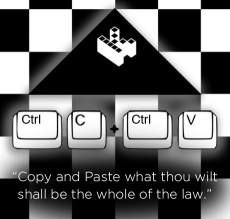
Kopimism’s central dogma centers around the idea that information is a holy thing, and copying information a sacrament. CTRL+C and CTRL+V are considered holy symbols. The English page of the church’s website says:

We challenge all copyright believers – most of which have a great deal of influence in politics, and who derive their power by limiting people’s lives and freedom.

Isak Gerson’s personal website (translated by Google) says that a Kopimist a “person who has the philosophical belief that all information should be freely distributed and unrestricted. This philosophy opposes copyrights in all forms and encourages piracy of all types of media including music, movies, TV shows, and software.”

So Gerson (who, weirdly, is also a member of the Christian Student Movement in Sweden) took this philosophy and pasted some “ritual” labels on everything and got a religion (after petitioning to the government 3 times, to his credit). The result is both a straight-faced mockery of the difficulty governments face w/r/t defining ‘religion’ (on the Kopimist website, the first line of one of the definitions of Kopimism is the defense “A religion is a belief system with rituals.”) and a strange manifestation of a strongly held belief.

Religions rooted in the internet are not a new thing. With all those people registering as “Jedi” in the 2001 census, Pastafarianism, and the prevalence of Cthulu worship, the appearance of a semi-ironic religious movement started by otherwise apathetic 20 year old males is becoming a pattern.

Maybe it’s just another irony-soaked fad, like speaking with ridiculous grammar or posting hilarious misquotes – or maybe the semi-ironic religions created will garner more earnestness and lose some irony and become, weirdly, a real way that people define their philosophies. The definition of the word “religion”, in the context of recent events and the influence of internet culture, is changing, and it’ll be interesting to see what happens to it.

In Defense of Gender Inclusive Language

I used to not care about gender exclusive language at all. I would get a little annoyed when people pushed for gender inclusive language – switching pronouns was confusing, “he/she” was unattractive, “he or she” was cumbersome to the eye, etc. I said that I wanted an equal paycheck before I would ever care about pronouns.

Then, I was at a college art show reading an artist’s statement describing how the artist intended the viewer to experience his painting. He used only female pronouns. I read it and felt, for the first time in my life, included into the default. Included into the hypothetical viewer. When I read hypothetical male-only pronouns, I understand intellectually that the writing is referring to any hypothetical person. But when I read the artist’s statement with female pronouns, for the first time I felt like it could be talking about me.

One of my friends and I had a long discussion about this topic. He had just used the word “man” to refer to all people, and I asked him to use gender inclusive language if he was in fact including both genders in his statement – to which he responded that he never really paid attention to such admonishments of gender exclusivity (exclusiveness?) because even though he was saying the word “man”, he meant “all people”. We had a long discussion, and part of what I told him about was my own experience with how much gender exclusive language affects the experience and thought of the reader, regardless of the intent behind the exclusive words. I also mentioned that in academia, gender exclusive language is not longer considered acceptable in published works at all. Because of that point, he stated that he would try to change his language because I had made a good case about how it can offend women and make them feel excluded from things that are supposedly referring to all people.

And I told him that that wasn’t enough for me. Yes, I think it’s fine to change one’s language to gender inclusive because one earnestly wants to avoid offending people, but I didn’t call him out just because his language offended me; I called him out because he was speaking inaccurately. I think that most people will eventually change their language because gender exclusivity will continue to be considered more and more offensive, and therefore less acceptable in more and more social circles. But if that was the only reason that anyone ever changed the way they spoke, then nothing would have ever changed in the first place.

During the conversation, one of my other friends pointed out to me that women’s rights (from a USA point of view) have come a huge way in just the 90 years since the suffrage movement. Sure. I am grateful for the rights I have, especially the rights that I wouldn’t have had just a century ago. But I’m not calling you out on gender-exclusive language because I’m upset about society being unfair – I’m calling you out because you’re being inaccurate.

I’m not insisting that all of society change right now – I’m insisting that individuals that I speak to speak accurately, and refrain from saying that they “mean” men and women when they only say the word for men. Because you can’t get past that. No matter what you say the words “man” or “he” etc. mean when you say them, you cannot get past the fact that the words themselves are referring to males only. Speaking with gender inclusive language isn’t something you owe to women or hippies or those annoying there-are-no-differences-between-men-and-women-at-all people; it’s something you will want to do if you have any desire to communicate accurately.