Don’t get me wrong, there’s a lot- a lot– to criticize about the millennial generation. There’s creative bankruptcy (see Evan’s post), “slacktivism” and general laziness, ever-shortening attention spans, and of course, loud, obnoxious repetitive music without any discernible beginning, end, or climax.

I cannot state enough how much I hate techno…
Now with all that stated, I do want to address some of the criticisms thrown at Generation Y by our elders and (as they see it, anyways) betters.
Late last year, I came across this article, titled “5 Ways We Ruined the Occupy Wall Street Generation“. In his defense, the author emphatically states at the beginning of the piece that “This is not a sarcastic apology, I’m not a big enough dick to write all of this as a backhanded insult about how lazy and entitled you are. Because you’re not…”. Even so, it’s tough to read the article and not feel frustrated at some of the more glaring errors, or condescended to by false conclusions drawn from them. Despite the author’s best intentions, you can’t really walk away from the piece without imagining him to look something like this:

I’ll get right into things here with his first point “#5. Making You Ashamed to Take Manual Labor Jobs“. The author opens by offering the example of a piece of dialogue that went viral about a year ago.
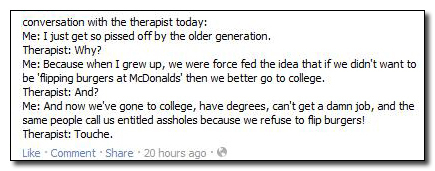
It’s a great little bit, but I still have to stop things right there. We’re not ashamed to take manual labor jobs. We never have been. In this economy more than ever, there are college graduates willing, ready, and even eager to take jobs sweeping floors, unloading crates, answering phones, or stocking shelves. We’re not ashamed of flipping burgers, we just can’t afford to flip burgers. See, we have this funky little thing called “debt”, and not just any debt, the one kind of debt we, by law, cannot have discharged. To clarify- if I went bankrupt, if fire burned down my house and destroyed each and every last earthly possession I had, the only thing I would have left would be tens of thousands of dollars of debt I still need to pay.

The appropriate reaction…
All that’s to say we can’t take jobs flipping burgers because the $7.25 an hour you get for being abused by the customers and/or inhaling carcinogenic fumes just isn’t enough us to live independently and pay off our various mountains of inescapable debt. Even if we move back in with our parents (more on that in a minute) things will still be tight- and God forbid we should even think about getting married or having kids until we’re in our mid-30’s. Which brings us to our next point- “extension of adolescence”.
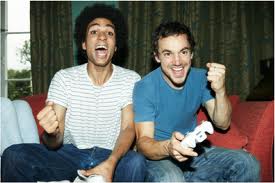 This is a psychologically documented phenomena, and something that’s rather throwing the combined worlds of sociology and psychology. Ever since the line between childhood and manhood ceased to be set at bringing down an elk and bathing in its blood, figuring out exactly when a person ceases to become a kid and becomes an adult is tough. It’s certainly not something new, but it is currently far more pronounced than with previous generations. Take that picture up there for example. Two guys, looking to be in their mid or even late twenties, playing X-Box. There’s the clincher there- the X-Box. The older generations, having had really nothing quite on the level of video games (pac-man doesn’t really count), labeled them as “kids’ stuff” from their inception, and the fact that we still play video games well into our twenties is seen as us extending our teen years, rather than shifting over to being an adult. The author of the article has this as his third point “Adding Seven More Years to Being a Teenager”.
Of course, it’s absolute nonsense once you think about it. What did our grandparents or even our parents do for fun when they were kids? They played cards, board games, hunted, fished, went to the movies, and beat up minorities.

KKK Rally, or as they called it in the 30s, “Wednesday”…
And what do our grandparents and parents do today when they want to have fun? They play cards, board games, go hunting, fishing, and go to the movies (hopefully they’ll have dropped “Harassing Pollacks” from the daily planner by this point). You never hear anyone accuse them of extending their teen years. My grandfather and his friend have been playing cribbage together for over half a century, does anyone tell them that they need to start acting like adults? Let’s face it, when it comes to what this generation does for fun, we really don’t differ from anyone in a previous generation, it’s just that what we do is so radically different, we have the appearance of being immature.
And what about responsibility? Is this generation really lazy and wussy compared to the generation who worked in the mill, took a break to fight Hitler, and went back to working in the mill and raising a family? Last time I checked, we’re in the worst depression since the 1930s (a crisis which we, incidentally, had nothing to do with but still have to pay for) and on top of this we’ve been locked in the longest war in American history- nearly twice as long as the entirety of WWII, just for some perspective. You can say a lot of things about this generation, but you can’t try to claim that we’re somehow just a bunch of young adults still trying to drag out our years as kids.

“Just look at that entitled, lazy kid. No concept of hard work or adult responsibility.”
Of course, we do tend to party, and while I could point to this being true of pretty much every young generation since a Cro-Magnon named Thruk invented partying roughly 43,000 years ago, I’m going to take a different approach.

This might come as a shock to some, but young people don’t want to spend their twenties partying because they’re afraid of turning into soulless corporate drones- it’s because we’re enjoying, often for the first time, full independence. Believe it or not, we don’t want to move back in with our parents and spend our youth still under their watchful gaze. We want our own place, our own job, our own car. We want responsibility, and as strange as it sounds, the partying is simply an extension of our attempts to explore our new found freedom.
As for us being entitled, there is something to be said for that. I recall once riding the subway with this blog’s regular contributor Evan and overhearing two youths snivel that the computer they were getting wasn’t quite as advanced as it could be. That said, there’s plenty of so-called “entitlement” that get’s unfairly pinned on us. The Occupy Movement, for example, was criticized by some as being a bunch of lazy kids that expected everything to be handed to them. I mentioned above that the current economic crises responsible for so many of our problems was- and this is key here- not started by us. What was I doing when the economy started to tank? Nothing. I was consuming the food put before me, buying as much stuff as could be expected from a teenager, and working summer jobs when I could. What did I do wrong? Why am I getting stuck with the economic crises I had nothing to do with? If you want to talk about entitlement, let’s talk about the generation who gambled with our collective futures and expects us to clean up the mess. Same goes for the wars we’re currently locked into.
As for our “armchair-activism”, again, there’s plenty wrong with this, and you could spend plenty of time going through what makes it such a pointless endeavor. Nevertheless, I can’t help but feel irked when someone from an older generation- specifically my parent’s generation (who would’ve been my age in the 80s and early 90s). Say what you will about people who mass-forward e-mails about signing petitions or demanding you like a cause on Facebook, there’s at least a level of interest. Barring the grossly simplistic anti-drug movement of the 80s, I can’t exactly recall the major moral movements of that generation. In short, the whole that this generation might be shallow isn’t without merit, but the people who point the finger ought to be awful careful that they pick the log out of their own eye first.

“What do we want?”
“Fluffy hair!”
“When do we want it?”
“After we’re done snorting crack!”
I’m going to finish up here with this last point- addressing the author of the article’s claim that the number one reason “We’ve ruined the occupy wall street generation” is that “we’ve taken away every reason to go outside”.
Am I the only one here who sees a staggering paradox? Am I the only one struggling to resolve how the “Occupy Wall Street People” need to “Get Outside More”? Last time I checked, the protestors at Occupy Wall Street were literally occupying Wall Street.
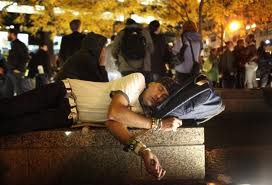
“Look at how pale you are! When’s the last time you went outside? Besides yesterday, and the day before that, and the day before that, and the day before that, and…”
Now do we get outside as much as previous generations. Not really no. But then again, I don’t really see masses of the elderly roaming the streets either. Look, the reason we don’t “go out” is because many of us (who would, by the way, love to go out) are living in cities or urbanized areas. Short of just “walking around”, any major outdoor activity costs us money, which in case you haven’t picked up on by now, isn’t something we have just lying around. Between gas, food, entry fees, and other costs, I’d have to spend nearly a monthly payment to my college debt getting forty-eight hours in the great outdoors. That’s the reason we don’t like paying for entertainment (the author’s fourth point), only it’s not because we expect our entertainment to be free (just ask anyone who’s paid upwards of 60 bucks for a new X-Box game), it’s because we’re trying to be thrifty. If we want to get our own car and our own house to avoid the sneers of our elders, we have to pinch every penny until it slaps us with a sexual harassment lawsuit- entertainment is simply a major way we can save money and not go postal.
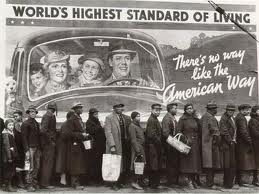
Look at those people trying to get food for free instead of paying for it! Lazy, entitled bunch of bums expecting everything to be handed to ’em, that’s what they are!
So in sum total, that’s my defense of my generation. It’s not a great generation- certainly not yet, anyways. It’s not the worst generation either, though, and before anyone- anyone– wants to label us as lazy or entitled or juvenile; please, look at us in the bigger scheme of things, and better still, look at yourselves. Would you want the standards you place on us applied to you?


 You may notice that Ke$ha, an artist known for being Caucasian, blonde, and very into glitter does not appear in the video. Adding apparent insult to injury, she was only credited for her part outside of the US. To slightly amend the former, the artist said in
  The woman mouthing the lyrics to the song and accompanying Flo Rida is not Sia, but actually model Analicia Chaves. The implication in both this video and the last is that the artist whose vocals are featured are both a) present, and b) Black non-white [Chaves is Portuguese/Cape Verdean]. When “Right Round” was released everyone was asking themselves who Ke$ha was, and many assumed that she was simply the woman in the video.



 Culture War Reporters
