Category Archives: media

The Avengers and New Footage Fatigue

Mild spoilers, if you’re not constantly watching for comic book movie news [like I do].
                                                                                                                                                                      

Don’t get me wrong, I’m still going to see The Avengers this summer. The thing is, I may as well be watching it for the second time.

Joss Whedon’s biggest directorial experience to date will hit in a little under three weeks with a running time of 155 minutes. After all of the trailers, previews, and TV spots I’ve seen I think that only leaves me about half an hour of footage to experience in the theatre for the first time.

Seriously, though, today I found out that Maria Hill and Nick Fury will have an argument of some sort. I don’t know exactly what it’s going to be about, but I know that it will happen because of an interview Cobie Smulders [playing Hill] did with David Letterman. I also know that Captain America will tell the Gamma-Powered Goliath to smash something. At some point in the film I know that Black Widow will soundly thrash a general and his cronies, because a 43-second clip was released by Marvel.

I don’t mind that Marvel has been advertising this film with everything from Dr. Pepper to Wyndham Hotels. Pixar’s Cars made something like $462 million in the box office, which isn’t bad. What’s even better, though, is the $5 billion they made in merchandise. Movie tie-ins that include toys and such are not at all what worry me. What worries me is knowing too much about the movie before I see it on the big screen.

StarCraft II: Wings of Liberty was what the summer of 2010 held for me, and while waiting for in the ’09-10 academic year I spent a great deal of my free time trying to find out more about the game. In the process I became privy to information on seven or eight missions. That’s about a third of the game. Not only that, but I also perused a site that had posted unit models, robbing myself of experiencing them in the game first-hand.

We live in a world where information is at our fingertips, and leaks and spoilers of any kind can be found within seconds. At this point in time I have no idea what the image on the right is of, only that they are part of Loki’s army and the primary antagonists in The Avengers. I don’t want to know what they are until I see the movie, and it’s getting harder and harder to when I daily visit sites such as ComicBookMovie.com, ComicsAlliance, and io9 [the latter even has a daily feature called Early Morning Spoilers].

From this point on I refuse to watch another TV spot for The Avengers. There’s only so many seconds of new footage they can cram in there before I’ve seen more of the movie than I wanted to. I’m going to see if I can hold out until May 4, and I hope that when I finally see it in theatres I’ll be able to enjoy every second of those 155 minutes like I’m watching them for the first time.

Mashin’ It Up

Outrage doesn’t even begin to describe what fans of Teenage Mutant Ninja
Turtles felt when Michael Bay, producer of the franchise’s next live-action film,  announced that the quartet would be aliens. This was coupled with the news that Leonardo, Raphael, Michaelangelo, and Donatello would not only lose their alien status, but would not be teenagers either.

Ninja Turtles aside [that’s the working film title, folks], why should this matter to non-fans? From an objective perspective, this is simply taking two modifiers, “mutant” and “ninja,” and replacing them with another, “alien.” The original thing idea was already a conglomeration of extremely dissimilar parts. The seemingly mindless melding of genres.

Take the past decade in film for example. Jon Favreau’s Cowboys and Aliens hit theatres in 2011, and Abraham Lincoln, Vampire Hunter, premiering this summer, causes us to branch out further still. The film is based on a book by Seth Grahame-Smith, the same person who authored Pride and Prejudice and Zombies. Taking zombies into account, they’ve terrorized everyone and everything from strippers to ninjas to plants to the entire Marvel universe.

So where does it stop, and should it? Grant Morrison will be writing Dinosaurs Vs. Aliens, both a graphic novel and a feature film that will pit highly evolved dinosaurs against extraterrestrial invaders. This sounds utterly ridiculous, but if anyone can do it, it’s Morrison. His miniseries We3 features three mech-clad house pets and their escape from a government facility, and he finds a way to embody these animals and their experiences with more depth than you would think possible.

So clearly this can be done well. 2009’s Sherlock Holmes mixed detective work, martial arts, and some steampunk elements. Joss Whedon’s short-lived series Firely was a space western, meaning that it melded both the futuristic and the American Western. Genre mashups can and have worked.

At this point in time I think that we’ve oversaturated media with these films, books, shows, et cetera. In light of the fact that this summer’s The Avengers is essentially a gigantic hodgepodge of genres I’m postponing my embargo on such works for the time of being. Until then, please, for the sake of good entertainment, enough with the zombies.

Missing: Non-White Actors

This past weekend I asked my friends over lunch who the new generation of actors are. Who are this decade’s Julia Roberts and Tom Hanks? Who are the actors who will be representative of these years?

We came to a few conclusions. Nostalgia is a powerful force, and that’s why our Bruce Willis is still Bruce Willis. Leonardo DiCaprio has been acting since Romeo + Juliet in the mid-90s and has continued to go strong with 2010’s Shutter Island and Inception. Newer stars such as Michael Fassbender and Sam Worthington have only really begun gaining recognition in the past five or so years. Name recognition is what matters, and they’re still earning theirs.

Having answered that question, I posed yet another one: Where are all the new non-white actors?

There are actors [using the gender-neutral version of the word] making a reputation for themselves, but they’re men and women like Emma Stone and Andrew Garfield [yes, the leads of this summer’s The Amazing Spider-Man, I think in comic book movies, okay?]. But where are their non-white counterparts? The following are short lists I’ve made categorized by ethnicity-

AFRICAN-AMERICAN/BLACK
Donald Glover tops the list. NBC’s Community has done a lot to get him out there, and he’s beginning to become a household name. Idris Elba will be in this year’s sci-fi epic Prometheus and in Guillermo del Toro giant mech vs. alien action flick Pacific Rim. Anthony Mackie took a backseat to Matt Damon and Emily Blunt in The Adjustment Bureau, but will be starring in a number of films both this year and the next.

HISPANIC
Édgar Ramirez starred in 2008’s Ché, and will be in this summer’s Wrath of the Titans as the Greek god of war Ares. Javier Bardem has been in show business for quite a while, but will be the primary antagonist [okay, villain] of the next Bond film, Skyfall. Gael García Bernal starred opposite Will Ferrel in Casa de Mi Padre, and will be appearing alongside acting greats Pacino and Daniel Day Lewis in the upcoming years.

EAST INDIAN
Similar to Donald Glover television is where Aziz Ansarfi thrives and he’s gained the most recognition for his role on Parks and Recreation.  Russell Peters was in last year’s star-studded New Year’s Eve, and primarily works as a stand-up comedian. Kal Penn [Kumar, of Harold and Kumar fame] will be in the yet to-be-announced Bhopal: Prayer for Rain.

CHINESE, KOREAN, JAPANESE
Ken Jeong has been running around screaming ever since The Hangover; he’s going to keep finding work. John Cho  will be in the Star Trek sequel reprising his role as Hikaru Sulu. Daniel Dae Kim continues to be ridiculously good-looking on CBS’ Hawaii Five-0. Really, all of these actors are Korean.

As far as Asian actors go martial-arts movies are not as popular as they once were. In fact, the two most recent listed on Wikipedia are MMA [mixed martial arts] films, starring White leads. Actors of Asian descent must find work elsewhere, and normally this means in comedy movies.

In general non-white actors find themselves relegated to supporting roles, most lacking the clout in the industry that heavyweights like Will Smith have. There’s an immense multiethnic audience out there but few studios willing to cast actors of different ethnicities in roles where names mean everything.

Actors like Morgan Freeman, Denzel Washington, Chow Yun-fat, and Jackie Chan aren’t getting any younger. These are all names that once were, and still are, recognizable by most. One day, however, they will inevitably retire, and once that happens who will be there to take their place?

Terrible Moments in News Media (Not Limited to Rush Limbaugh)

Note: This is a version of a piece I wrote this with my brilliant friend Chris Hartline for our student newspaper, and am reprinting it here. Any goodness in it may be credited to him.

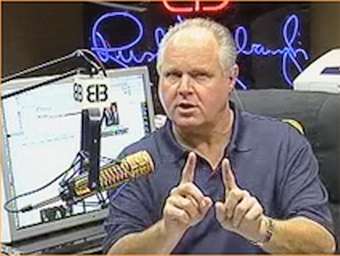
Most of the public is aware of Rush Limbaugh’s stupid and unfunny bit in which he referred to a Georgetown student as a “prostitute” and a “slut” for saying that Georgetown health insurance should cover contraception.

source: lifenews.com

Do not pay attention to this man. He will make you sad.

But the name-calling does not stop there: other instances of sexist slander have been just as offensive but haven’t received as much news coverage as Limbaugh’s insult. Bill Maher, a liberal comedian and amateur political commentator on HBO, referred to Sarah Palin as “a tw-t” and “a c-nt”. Chris Matthews, MSNBC host, called Hillary Clinton “witchy,” “uppity,” and claimed that she was elected to the Senate only because her “husband messed around.”

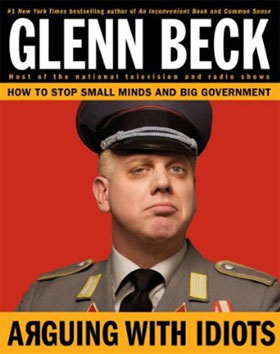
source: glennbeck.com

Looks like public discourse to me.

The state of the news media today is disheartening because the system of acidity seems to be self-perpetuating. Indeed, truculence has become a prevailing rhetorical device. Keith Olbermann had a segment on his show (and a book) called “The Worst Person in the World”. Glenn Beck wrote a book in 2009 called “Arguing with Idiots: How to Stop Small Minds and Big Government”.

Another clear manifestation of the deficit of trust of the media was a 2009 poll done by Time magazine. Walter Cronkite held the title (since 1974) of “Most Trusted Man in America”. Cronkite was the most visible figure in the media, which at the time provided objective discourse and information to the public, and he died in 2009. In the subsequent Time poll, voters said that the most trusted news anchor in America was Comedy Central host and political satirist Jon Stewart.

The fact is that the media is supposed to provide a momentary stay against political hostility, an unbiased source of objective information for the public, and that it is not doing this. Consequently, the public is losing their faith in the news media, and by extension the American political system itself.

The media has become tool used by political parties to influence the opinions of the public. A blatant example of this is the “Plan for Putting the GOP in the News” memo from the Nixon administration. The 15-page memo was anonymous, and has written comments on it by Nixon’s then-advisor and current Fox News President Roger Ailes.

Roger Ailes!

Roger Ailes: founding CEO of Fox News and adviser to Nixon, Reagan, and Bush. Also credited for possessing the world's least attractive set of jowls.

The memo stated that television was the best medium for political persuasion because of its imminent popularity: “People are lazy. With television you just sit – watch – listen.  The thinking is done for you.” The plan was to record prepackaged interviews with Republican politicians and deliver the videotapes to local news stations. Presently, critics say that Fox News has demonstrated their role as an arm of the Republican Party.

source: msnbc.com

All you need to know about Keith Olbermann is that he's not a pleasant person.

MSNBC, while on the opposite side of the political spectrum from Fox News, is similar in its audacious political stance. In a distasteful and recurring ending rant on his show, former host Keith Olbermann once shouted (his monologue was directed at then-President Bush), “This war is not about you … shut the hell up!”. Fellow host Chris Matthews also said after a 2008 Obama speech that he “felt this thrill going up my leg as Obama spoke.”

So it can be concluded that the media has become unabashedly partisan. Even the very fact that it is standard for each major newspaper to endorse a presidential candidate reflects a problem in the nature of journalism. It results in an overtly ideological news organization – the New York Times is liberal, the Wall Street Journal is conservative; the Washington Post is liberal, the Washington Times is conservative, etc.

A news staff tending to lean one way on the opinions page is typical and expected; however, the fear is that the ideological slant of the editorial pages will seep into the news coverage. The potential and underlying ‘spin’ of news stories becomes more important than the objectivity of the events being reported.

And maybe the Nixon administration’s prediction about the easy audience of television was prescient: political commentary television programs can be especially caustic and, at times, juvenile. They seem to appeal to the lowest common denominator of the public and of individuals. Keith Olbermann, Glenn Beck, Rachel Maddow, and Bill O’Reilly are all political commentators who base their rhetoric on the petty mockery of whoever disagrees with them – their arguments are negative, not positive, and clever insults take precedent over constructive criticism.

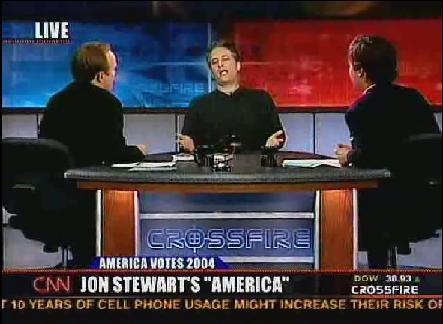
source: portland.indymedia.org

Jon Stewart pleads with the hosts of Crossfire to "stop hurting America." Crossfire was cancelled shortly after Stewart's interview.

The media itself has not only lost its ability to objectively inform the public of unbiased political events – it has become a tool for fostering and encouraging political contention. The role of the news media is not just lost – it has been perverted. As Jon Stewart said to the hosts of Crossfire, this inflammation of petty and theatrical bickering isn’t just bad journalism – it’s hurting America.

David Brooks said: “There’s a collapse in the public’s faith in American institutions. The media has done a poor job. We’ve become as insular and self-regarding as any [other institution].” It is no wonder, then, that there is a deficit of trust among the younger generations – the apparent disintegration of the integrity of our news sources is nothing less than repelling.

Thoughts About The Internet

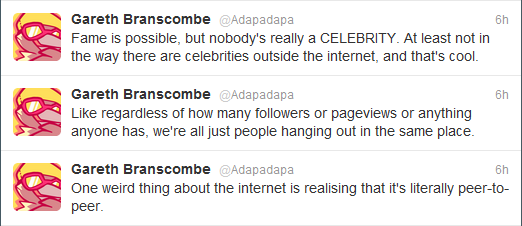
So a friend of mine tweeted in the early hours of the morning, musing about the internet. The tweets are as follows [to be read from bottom to top]:

Before I can really begin addressing this, I think it’d be good for me to have a good definition of the word “celebrity.” Dictionary.com tells me that as far as people go, a celebrity is a “famous or well-known person.”

So are there capital letters CELEBRITIES, or are there just people, again, referencing the tweets, with fame? And, if they’re one and the same, do they equate with people outside the internet?

The 21st century is a place where being “outside the internet” is a basic impossibility. That being said, there is a distinction between being general fame and internet fame. Brad Pitt is a well-known movie star. wheezywaiter is a popular YouTuber with 382,628 subscribers. If both walked around the streets of any major city in America they’d be recognized, but only one would create a stampede of screaming fans leaving several dead.

On the other hand, some celebrities have supplemented their fame with their internet presence. Ashton Kutcher was the first twitter user to reach a million followers, and currently has almost ten times that. Comparing that to his work in film and television, it actually dwarfs his presence “outside the internet.”

The thing with being internet famous is how quickly it spills into the offline
world. High school pole vaulter Allison Stokke had her picture submitted to With Leather, a sports blog, where it appeared in this post [as far as I can tell, the images connected to the specific post have since been removed]. These images quickly spread around the internet, however, and Stokke became the target of a large amount of unwanted attention, a lot of it very sexual. It got to the point where her high school began receiving requests for photo shoots of the athlete. The Washington Post has more to say about it here.

To be fair, that wasn’t Stokke garnering internet fame for herself, but was instead unwittingly swept into it by a blogger named Matt Ufford. She’s not the only one who runs the very real risk of being recognized in public. Webcomic artist Jeph Jacques bumped into fans while vacationing in New Zealand, less of a surprise when you take into account the fact that his strip has thousands and thousands of viewers.

The internet is a “peer-to-peer” place where anyone can post anything and have an audience of anywhere from one to millions. I have 71 followers on twitter [with only a few spambots], meaning that anything I tweet [which I rarely do anymore] is instantaneously communicated to a several dozen people all over the world. That’s an amazing thing. Audience does matter, though.

If you have a blog, and there are millions, what are the chances that anyone is going to read it? You could tag it with words like “Dakota Fanning” and “Playboy,” and that might help, but your readers won’t be consistent and probably won’t be coming back. We may all be in the same place, but we write or draw or play instruments because we hope that others might be audience to our work, and when that audience gets large enough it will inevitably change our lives outside the internet.

Hitler, Ray Comfort, and the Dismal State of Discussion

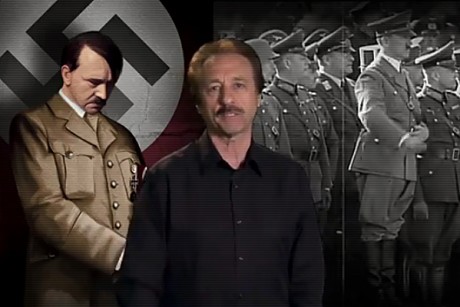
I did something bad for my health that I do not recommend. I watched “180”, a half-hour documentary made by Ray Comfort.

It is a bastardization of discourse from all sides. In an interview with Steve, a neo-Nazi punk type of young man, Steve says that he’s certain of his opinions about the falsehood of the Holocaust and other offensive things. To combat this, Comfort asks Steve to spell shop (Steve does) and then asks: “what do you do at a green light?” The question is a trick to get the mind to quickly respond “stop”, which is semi-associated with green lights and rhymes with “shop”, and the person answering looks silly. Sure enough, Steve responded “Stop” and looked silly. And then – well, then Comfort treated that like an actual argument for something.

The documentary was dipped in dramatic music, photos of piles of dead bodies, and use of gratuitously violent photographs. What is most interesting to me, however, is the use of what seems to be the universal argument-ender: comparisons of things to Hitler.

Hitler, the Nazis, and Lazy Discussion
Hitler and the Holocaust have become mythic elements of American culture, I think, and to the detriment of the truth of the actual historical events. I was recently visiting a small church where the members, after the service, started (sort of randomly) to wax poetic about the horrors of Hitler and the Nazis. They weren’t saying anything new – everyone was just affirming that Hitler was inhuman and the Nazis were too. It was the fervent insistence that “real humans could never do that sort of thing” that struck me – I thought of all of the other genocides and massacres of the past century alone, of the killing of civilians in wars by troops of every nationality, of atomic bombs. But even in light of all of these things, current conversation about Hitler seems to serve contrast to our new, very human, very un-barbaric society. We talk about Hitler basically like Satan – an ultimate evil; a rhetorical catch-all.

Ray Comfort and 180: Unethical Discourse

Steve, in the movie "180" by Ray Comfort

Comfort’s specific use of the Hitler argument is reductive and tired. It is, if anything, an exploration of how charged and empty rhetoric in the realm of politics is being mirrored in general culture. His interviewees are inconsistent, and seem to know very little about philosophy, theology, or basic logic. Comfort’s questions are also always precisely and pseudo-cleverly leading, and it doesn’t seem that he wants to engage with the interviewees at all: “Does this mean you’ve changed your mind about abortion?”, he asks. “Are you going to vote differently in the future?” It is not a conversation, is the point: it is a poorly executed set of rhetorical acrobatics. Is this the way to foster discourse and an informed public? Probably not. Arguments depending on rhetorical cleverness are insulting to both parties.

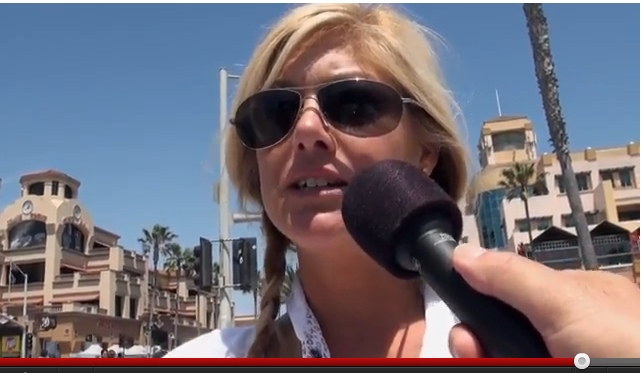
Comfort’s series of interviews are not only annoyingly inconsistent and poorly constructed, however: the movie is also a manipulative presentation of complex issues and events, presented crassly and with a smugly triumphant attitude. One of the less graceful moments was when Comfort asked a woman if she’d had an abortion; she said that she had. He then immediately asked: “Do you feel guilty about it?”

As the big finish, Comfort sets up a game-show setup of moral responsibility and the afterlife, and awkwards them into admissions of fright and death anxiety:

  • Comfort asks people if they have lied/stolen/been lustful: most of them say that they have.
  • Comfort then gets them to admit that this makes them liars/thieves/adulterers.
  • Comfort gets them to admit that liars/thieves/adulterers go to hell.
  • Comfort elicits from the interviewees an understandable anxiety about the prospect of hell.
  • Comfort asks them if they are going to go read their Bibles.
  • Some of them say yes.

Alesia, from Ray Comfort's movie "180"

Theologically, morally, rhetorically, and logically, this is one of the most horrible things ever. Comfort’s quick-talking way of “tricking” people into professing a fright of punishment does very little for the moral health of humanity or the search for truth within rhetoric and theology. The triumphant music and photos of bloody sheets are no help for the legitimacy of the movie.

There are also 40 thousand comments. I do not recommend those either. They are not a happy picture of humanity.

It makes sense to protest the legalization of abortion and to be horrified at the amount of deaths occurring if one believes that life begins before birth. Comfort’s smugness and “gotcha” questions, however, lack earnestness, humility. The whole thing turns a serious situation into an awkward and unproductive onslaught of unhelpful rhetorical inconsistencies, devoid of integrity and, therefore, real efficacy.

In sum, the movie is a disjointed account of unproductive discussions with unproductive people with vague and uninformed opinions. It’s a disheartening representation of the state of discourse on American sidewalks.