Category Archives: music

Where’s the Counter-Culture?

In my last post, I grossly oversimplified a Marxist concept called “Alienation”. Today, I’ll be grossly oversimplifying the Marxist concept of dialectics.

Don’t give me any of that “Hegel said it first!” crap.

Boiled down to its basic components, it functions more or less as Newton’s third law of motion. Every action has an equal and opposite reaction, and that applies to society as well. Every spirit of the times is accompanied by a little inverted version of itself- or at least, its key values. Now according to dialectics, the conflict between these two opposites ultimately resolves in an evolved combination of the two, but in this post, we’re only addressing the first part.

Or at least, we would be if I could figure out what today’s counterculture is…

Think about it…

Look at the 1950s. For all the white-picket fences; sagely, pipe-smoking fathers; dutiful housewives/mothers, general patriotism and decency, and terror at the prospect of infiltration by degenerate Commies, there were greasers and bikers.

Despite the 1950s conjuring up images of idealized suburbia, this decade was the one that gave birth to rock and Hells Angels. Trafficking and dumping excrement and urine on their initiates doesn’t quite mesh with the general ideals of the time.

The same can be said for the sixties, which produced the hippies and the civil rights movement in the face of an otherwise conservative culture desperately trying to maintain the status quot.

Or the 70s, whose militancy and pessimism were a rejection of the peace, love, and hope values that arose during the previous decade.

Or the wildly egotistically and self-centered 80s producing (or at least, nurturing) anti-establishment and anti-corporate punks culture.

Even the 90s saw rise to goths, opposing the (comparatively) cheery and consumerist zeitgeist of the time.

So why not our era?

The Occupy Movement? I did consider them, but they don’t really fit the profile.

Despite being viciously cracked down on by the powers-that-be, the OWS protestors never really presented anything shockingly antithetical to the values we hold today. At least, not entirely.

Violence is (almost) universally decried as a means of protest and social change by all but those doing it. While America hasn’t seen much of it, continued rioting in Europe could very well mean not so much a brief outburst of rage as a entirely new perspective on what is and isn’t acceptable in society in general.

That’s one way of calling for social change…

Hipsters? I did briefly consider the whole Indy/Hipster movement as a possible subculture, and generally despised, the hordes of lost lumberjacks wandering the streets really don’t stand for anything that mainstream society is opposed to.

You are NOT a lumberjack and this is NOT Ok…

Annoying? Absolutely. Opposed to the spirit of the time? Not really. At most the hipster culture is guilty of desperately trying to cling to childhood nostalgia in the face of creative bankruptcy (see Evan’s post) and espousing thriftiness in the middle of a major economic depression (see my old post).

Bros. Everyone hates ’em, from their obnoxious machismo to their flaming skull t-shirts and spray-on tans.

Problem with this group is that it’s not a new group- just the latest reincarnation of the same kind of people. The same basic mentality can be found clear on back in Shakespeare’sRomeo and Juliet, which essentially starts with a bunch of bros crashing a party to pick up girls.

the 1890s, when “Bros” were called “Chums”…

Ok, so what if we look at what we have in society today and just invert it? What’s the major defining element of our generation? Technology. Internet and smartphones. Social media and memes. Anonymous and scams. The opposite of all this would be the primitivist subculture, right? The people who don’t wash or shave and live in compounds in the middle of nowhere.

And while it makes sense theoretically, we’re just not seeing a vibrant primitivist counterculture or even subculture. Even when you add in the survivalist subculture (in case you don’t know, those are they guys who think the gum’mint out ta git ’em), there’s still not exactly a rising trend in people learning how to skin squirrels or live in total harmony with the earth-mother.

What about these guys?

This site (which I’ll be delving more deeply into next week) really does seem to have an actually beef with contemporary culture- specifically in regards to men. Offering instructions on how to polish your shoes, store your fedora (you’re expected to have one, and if you don’t, to go out and get one), shave (or trim your beard, if that’s your thing), throw a punch, or patch a hole in your drywall (holes may be caused by punching it). In a lot of ways, the reverence this site has for the “traditional” concept of what a man ought to be like is reflective of a more general reaction against skinny jeans and YouTube comment section debates. While the site itself has a devoted cult following (and not a ton else), I have seen this general sentiment expressed, and I’m seeing it expressed more and more. Granted, I might be too close to the issue to be seeing it clearly- I myself think guys wearing skinning jeans should be put in stocks for all the village children to throw dead animals at- but perhaps you’ve run into this too. Just last night I heard a comedian complaining that the current generation were (in short) wimps. Gone, he said, were the days when you could chuck a television set out of a hotel window after some drug-fueled rock band had just given human decency the finger via a seven minute guitar solo. Another comedian remarked that “Our fathers would never take the crap we’re taking… the founders revolted because of a 3% tax increase- we won’t even riot when we’re being forced to strip down at an airport!”.

There is doubtlessly a certain mystique and appeal to the figure of powerful, well-dressed men, sitting around roaring fires, puffing on cigars and sipping aged scotch to celebrate that they were in complete control of their lives. Plenty of guys today would give their right arms to be Don Draper.

Though ideally minus the aggressive lung cancer and liver failure…

And interestingly enough, this general “Manly” reaction against emotionalism, appearance (over functionality), pacifism/nonviolence, and interdependence has elements from each of the cultures I described above. There’s the primitive concept of being free from dependence on technology that bears a similarity to the DIY slogans espoused by the “Manly”. There’s the “if you gotta punch a guy, you gotta punch a guy” mentality that seems related to the Black Bloc protest tactics. The simplicity of the Hipsters is here, and even the general “I am Man, here me roar” vibe seems to be a more sane version of Bro machismo.

But that’s all just a theory. Might be true- might be just a passing fad, though if it is just a fad, then we’re back at square one with a rather uncomfortable question.

If there is no counter-culture- what does that say about our culture today? Have we reached a point where we’re so pluralistic and tolerant and multicultural that everything’s acceptable- or is there just nothing substantial to rebel against? If there’s no antithesis, is there even a thesis?

Flo Rida ft. White Girls (Sort Of)

In 2009 rapper Flo Rida released his single “Right Round,” a song which heavily sampled Dead or Alive’s “You Spin Me Round (Like a Record)” in its hook. On top of shooting to number one on the charts in just three weeks, the track also featured Ke$ha on guest vocals. The following is the music video for the song:

You may notice that Ke$ha, an artist known for being Caucasian, blonde, and very into glitter does not appear in the video. Adding apparent insult to injury, she was only credited for her part outside of the US. To slightly amend the former, the artist said in an interview with Esquire Magazine that “[Flo Rida’s team] wanted me in the video, and I said, ‘Nah, I want to make my own name for myself.'”

Just today I was watching MuchMusic and saw a video for one of Flo Rida’s newer singles, “Wild Ones.” It features Australian recording artist Sia, whose presence on the track received a good amount of attention. Billboard.com described her as having a “bell-clear, campfire voice,” and noted her appearance on the Billboard Hot 100 was a deserved one. Below is the music video for that song:

The woman mouthing the lyrics to the song and accompanying Flo Rida is not Sia, but actually model Analicia Chaves. The implication in both this video and the last is that the artist whose vocals are featured are both a) present, and b) Black non-white [Chaves is Portuguese/Cape Verdean]. When “Right Round” was released everyone was asking themselves who Ke$ha was, and many assumed that she was simply the woman in the video.
I don’t believe that there’s any sort of racial conspiracy going on here, and the quirky similarity I noticed is more than likely only that. At this point neither Ke$ha nor Sia are doing badly for themselves, so it hasn’t harmed their image in the least. Still, it’s interesting to think about the fact that this has cropped up twice with the same rapper. If it happens a third time I think we’ll all know something’s up.

Tupac and the Digitally Embalmed

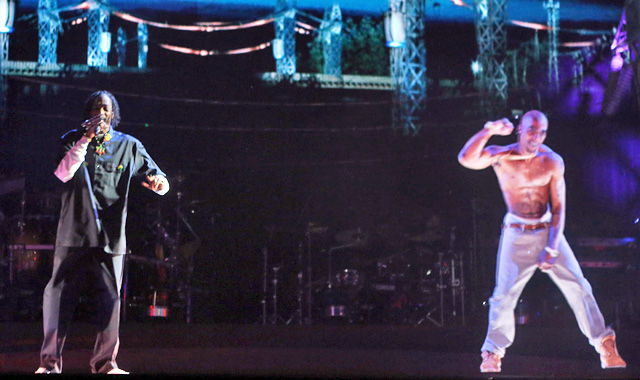
So if you haven’t heard [I hadn’t until yesterday], there was a hologram of Tupac that performed at Coachella.

ImageAnd yeah, yeah, we know it wasn’t actually a hologram now, that it was some mirror-projection-onto-glass-thing-that-the-Wall-Street-Journal-explains-better-than-I-could. And we know that there are rumors of a tour of this faux-Tupac, and people are alternately asking when Kurt Cobain will show up and decrying the monstrous zombie-raising performance.

The thing is, you could argue that the hologram/projection isn’t much different from showing videos and voice recordings of the dead. When that technology was new, I imagine people thought it pretty eerie that they could see their loved ones move and breathe and speak on a screen.

Interesting thing: They needed to project the image onto a mirror below the stage, which created a lot of light, which is why I think they made the animation look like it was lit from the bottom - it looked like the glow from the projection apparatus was part of the lighting system.

But the thing about the performance that makes it different from just a new way of looking at recordings of dead people is the new content. The animation of Tupac, at the beginning of his act, shouted “What’s the f*** up, Coachella?”. The choreography of his performance wasn’t just a recording – the people who animated him studied the way he moved, but they controlled his body and created something new. In a sense, Tupac was performing new material.

The Illusion of Interaction
And this is the real issue – not just the commemoration of the dead. We’ve been recalling the dead, through art and technology, as accurately as we can for as long as humans have been dying. But the faux-Tupac isn’t just a 21st century version of an Egyptian sarcophagus mask. What they wanted to create with the Tupac animation – which is why the fact that it was in front of a live audience was such a big deal – was the sense that Tupac was interacting with Snoop Dogg and the audience, just as a real live performer would.

This is about creating an illusion of interaction, and while a scripted interaction with an animation might be actually quite close to the way concerts can be formalized and scripted (like pro wrestling), it’s still just an illusion.

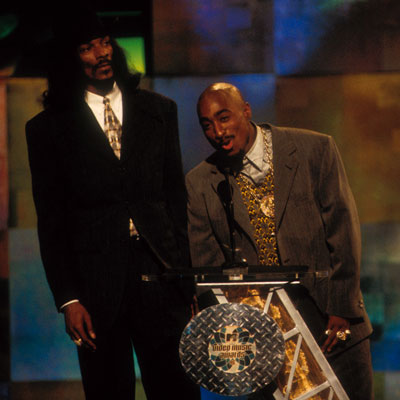
Snoop Dogg and Tupac, both about 25, in 1996

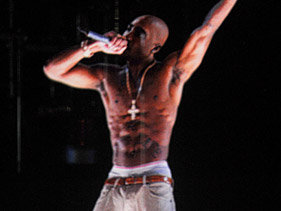
One of the weirder things though, for me,  was the age discrepancy between Snoop Dogg and Animated Tupac. Snoop Dogg is 40, and has grey hair. When Tupac died in 1996, Snoop Dogg was like 25. Tupac, who was shown as a young, shirtless 20-something, would be turning 41 this year if he were still alive, and might not look as good as his hologram did in white sweatpants.

Snoop Dogg, 40, and the Tupac Illusion, still 25

The juxtaposition of digitally-embalmed washboard-ab Tupac and 40-year-old greying Snoop Dogg was probably the most eerie element of the whole performance.

If this trend continues, I think the problem is the illusion of interaction. The essence of human existence is interaction – it’s why we still feel a little weird hearing about guys dating digital AIs, and why the most popular games are the ones that allow you to play on the internet with others. Interaction with humans, illogical and annoying as we are, can’t quite be simulated. And judging from Snoop Dogg’s awkward performance with faux-Tupac, our interactions with the digitally animated dead will always fall a little short of the real thing.

Kids Those Days

Twilight Spoilers, if that’s something you care about.
                                                                                                                                                                      

This topic was dated when I wrote about it for my other blog a year ago, August 16th. That being said, you’re going to have to think about popular trends that occurred quite a while ago, no easy task when popularity ebbs and flows as it does nowadays.

A little before my original writing on this subject, Miley Cyrus, the Jonas Brothers, and the Twilight novels were all the rage. I’m going to say right now that it was the best of times, it was the worst of times, with the hopes that what I’m about to say will back it up.

Every trend has its own share of supporters and critics. In this case, everyone everywhere (on the internet) was aghast at this cultural phenomenon that had befallen us. We (a collective we) were disgusted with this slurry that had become every teenage girl’s obsession, and we took every chance we could to denounce and deride Meyer’s novels, the Jonas’ music, and so on.

It struck me one day, however, what exactly we were doing. A lot of the issues that people were nitpicking (and deriding) were tenets that I not only agreed with, but that I lived by as well.

In Twilight Edward refuses to have premarital sex with Bella, and is adamant that if they are to go any further1  they must get married first. The Jonas Brothers wear purity rings to symbolize their commitment to, well, being pure.Lo and behold, these two items were brought under the most scrutiny and were mocked excessively.

So I questioned why, when girls finally had a half-decent role model, they were being ridiculed. Post-nowish Miley Cyrus didn’t wave the banner of blatant sexuality that former It girls Britney and Christina did,3 and that alone would have made me more comfortable letting my daughter obsess over her than many others.

From this point on in my original post I began to write about the Disney/Family Channel, but I’m not headed in that direction this time. What I want to focus on is the spirit of snarky judgementalism that seems to be permeating our culture. The constant search for what to demean and deride next, without any thought as to what good it may contain.

Yes, there are subjects which I will not defend [The Westboro Baptist Church, for example], but for the most part I’d like to call for moments of discernment whenever a target presents itself. Feel free to slam the Jonas Brothers for their musical ability, but leave their spiritual beliefs out of it.4 We should be able to consider that which we belittle and why it is we think so little of it.

To summarize what I’m trying to say, there was a point where people observed the fanatical, obsessive manner in which (pre)adolescents were throwing themselves at certain figures. In backlash against this behaviour they ridiculed their role models, yet targeted attributes which may not have been harmful for young people to mimic.

Be judgemental of those who garner the interest (and obsession) of many, but be smart (and civil) about it.

1. Than their creepy, unnatural kissing where she finds it difficult to find the air to breathe.

2.  Meaning, in this case, to save themselves sexually for their future wives. 

3. Not any more, though. You can’t release a single called “Can’t Be Tamed” and get away with it.

4. And their health issues. People made fun of Nick Jonas for being diabetic. I mean, why?

Let Them Talk: Hugh Laurie’s new blues album

Hugh Laurie puts out his first blues album tomorrow.

If you’re American (actually, if you’re anyone with a television who’s not British), you know probably Hugh Laurie as Dr. House, that snarky doctor with the good writers and a screechy female following. If you’re British, you know Hugh Laurie as that guy your parents talk about who seems to be sort of common-law married to Stephen Fry.

"The question of why a soft-handed English schoolboy should be touched by music born of slavery and oppression in another city, on another continent, in another century, is for a thousand others to answer before me: from Korner to Clapton, the Rolling Stones to the Joolsing Hollands. Let’s just say it happens."

And if you’re into New Orleans blues, you have no idea who Hugh Laurie is at all. But don’t worry! He isn’t doing a blues album because that’s the cool thing for actors to do now, and he isn’t trying to convince anyone that he was born in New Orleans. He’s doing it – well, he’s doing it for no discernible Hollywood-esque reason. He’s a musician and he love New Orleans blues, and in the context of his celebrity it doesn’t really make a lot of sense, and he knows and admits that: “Let this record show that I am a white, middle-class Englishman, openly trespassing on the music and myth of the American south.”

As someone who – well, I’m not like a jazz expert, let’s just say As a 21 year old who knows who Jelly Roll Morton is, there were two things that made me want to pay attention to this album. The first was the preface he wrote to the album, at once gushing about the greats and saying that he doesn’t want to see blues “confined to a glass cabinet, under the heading Culture: Only To Be Handled By Elderly Black Men”. The second was his recording of St. Louis Blues, which starts out with a seriously impressive (but not obnoxious) piano intro, and features Hugh Laurie singing in all his British earnestness, and it somehow works. This is not the album of a poser or a bored celebrity. Elvis Costello reportedly said, upon hearing Laurie play, “This guy is a musician before he’s anything else. He’s probably a better musician than an actor.”

Decemberists, Infinite Jest, and Michael Schur Unite (and there was much rejoicing)

The Decemberist’s latest music video (for Calamity Song, from their most recent album The King is Dead) portrayed a scene from David Foster Wallace’s mammoth novel Infinite Jest, and the probability that somewhere within 100 yards of you a humanities major is freaking out increased by about 600%.

And this is awesome not only because 1) The Decemberists are awesome and 2) Infinite Jest is awesome, both of which reasons would be plenty justification for awesomeness, but it’s awesome because Infinite Jest is so huge and complicated and a-linear and full of bizarre details that it seems only slightly short of a miracle than anyone would even be able to succesfully portray in film just one scene from the novel, and yet Michael Schur (known for writing for SNL, The Office, and Parks and Recreation) managed to have the scene play out almost exactly as I imagined it – which I understand is a hideously biased judgement but I really only have my own imagination to go by, and perhaps the fact that film adaptations of writing almost never do that for me bolster the impressiveness of my statement.

The scene fromt the book, by the way, was brilliantly and kind of impressively chosen too – it shows the students at a tennis academy playing Eschaton, which is a ludicrously complicated game involving a mentally-projected map of the world on a tennis court, socks and tshirts representing different strategic targets, tennis balls (lobbed by each country) representing nuclear bombs, and insane algorithms (that David Foster Wallace all but teaches you in the book) to determine the damage and population loss of each hit. Colin Meloy sitting in the place of Michael Pemulis, one of the main characters of the book, with his characteristic sailor’s hat, is weirdly perfect. Schur’s attention to details from the novel made the video, I think, bringing yelps of excitement from readers of the book seeing a scene from possibly the most bizarre and un-movie-able piece of fiction they’ve read portrayed (almost) perfectly on film, but also allowing people who haven’t read the book to still understand what’s going on.

So, in summary, props to The Decemberists for being awesome, postmortem props to David Foster Wallace for being brilliant, and mad props to Michael Schur for creating a visual reality out of a piece of something as abstract and wonderful as Infinite Jest.