Tag Archives: gender

Fame Day: Bleeding Cool and The Big Bang Theory

It all started with this teaser for tonight’s episode of The Big Bang Theory:

“The girls go . . . WHERE NO WOMAN HAS GONE BEFORE.”

This prompted the writing a post two days ago by Rich Johnston on his comics website Bleeding Cool, entitled “Are You A Woman, Have You Actually Been Inside A Comic Shop?” This in turn prompted another post by the name of “Disproving The Big Bang Theory” in which Johnston received feedback from numerous individuals on what they thought of this premise.

A few response tweets:

Untitled-1

Untitled-1

And one of the longer email responses, this one from Susanna Baird:

I started reading comic books about a year ago. I’m a middle-aged mom and the first few times I walked to the “New Comics” back wall at Harrison’s in Salem, MA, I felt like I was walking the halls of my junior high school with a new haircut. But after a few weeks, I realized that feeling was entirely my own.

Everyone wanted to talk comics, and no one cared that I was the only middle-aged housewife in the store. Now it’s like all the enthusiastic geekery of junior high minus the mean girls. I love it. Love comics, love Harrison’s – the staff, the clientele – and I love being in a room full of metal shelves lined with three-dollar art.

I love Harrison’s.

Finally, one last post just today revealed that even an editorial staffer at one of the Big Two [Marvel/DC] had things to say about, which I won’t quote here since I don’t want this to just be links to Bleeding Cool articles. You can read that here, though.

Is all of this attention warranted? Should The Big Bang Theory really be criticized for depicting comic book stores as havens for uncomfortably staring virgins?

The fact of the matter is this: it’s the perpetuation of a stereotype that simply isn’t true. More than that, it’s based on the sexist assumption that some forms of media [in this case, comics] are closed off to women. I know for a fact that there are members of the finer sex who appreciate a good comic book, and saying that no woman has ever stepped foot in a comic book store straight-up denies this.

As someone who loves comic books, and wishes more people did, it’s a huge
encouragement to me that so many women are speaking out on this topic. They’re asserting that they appreciate good art and storylines too, and I am immensely pleased that this is happening.

asdgasdgasgd

It’s unfortunate, as well, since The Big Bang Theory has actually been really great this season. They’ve started giving the female cast members equal screentime, and it’s refreshing and creates a lot of immensely funny situations. It’s a shame that tonight’s episode turns to relying on such tired material, but it is definitely worth giving kudos to those who are doing their best to prove its premise false.
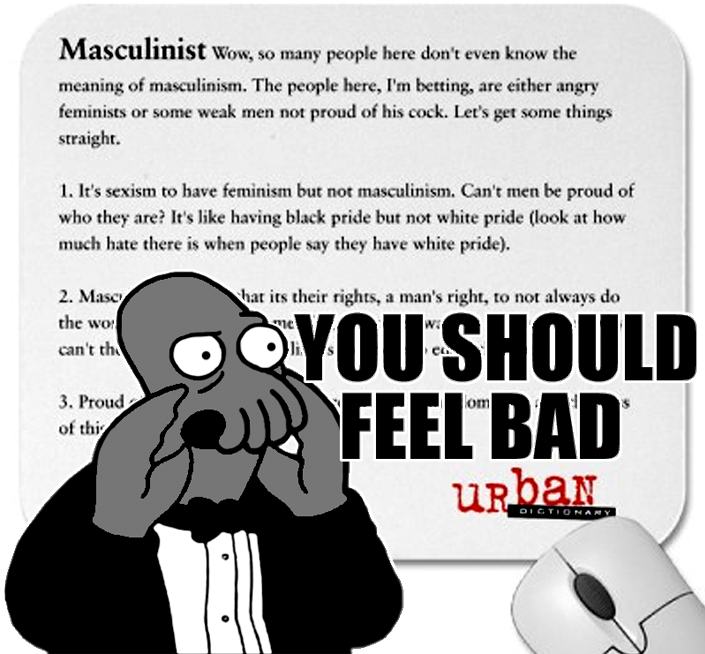
Shame Day: Masculinists

Let’s be clear right here and now- I’m not talking about “masculinism” in the original “let’s recognize gender discrimination against men too” philosophy. No, I’m talking masculinism in its modern day sense: the general idea that women have somehow hijacked everything it means to be a man, and have either watered down everything manly, or made it socially unacceptable. This is the gripes of countless dads and uncles around the country at every kid on the team getting a medal given an intellectual motor.

That’s not to say that there are certain points which these guys aren’t correct on. In custody battles, the courts are almost certainly going to side with the mother on the basis that her gender somehow makes here a superior parent. That’s stupid. If a man were to make a pass at a female co-worker, the consequences would in all likelihood be more severe than if the positions were reversed. That’s unfair. A man striking a woman gets a visceral reaction out of us, a woman striking generally does not. That’s sexist.

Now promoting gender equality is perfectly fine. After all, when a person hits a person, that’s all that really matters. Gender (or race, creed, religion, etc.) don’t make the act any better or worse. But tragically, that positive element of the movement is mired down by all the psychotic and apologetically misogynistic madness that makes up the other 50%. Stuff like:

  • Equating circumcision with genital mutilation (or even wrongly declaring that women are exempt from any such practice)
  • Declaring the existence of a “war on men”
  • Complaining of the lack of existence of any day celebrating men
  • Complaining the women are somehow exempt from heavy, dangerous, and strenuous labor (again, what planet are these people living on?)
  • And countless other bat**** crazy claims of male victimization and persecution

Again, as stated above, there is a double standard, and while any inequality in the rules is obviously unfair there’s no way on earth we can possibly imagine that these offenses against men in any way stack up to the offenses against women. Is there female domestic abuse of males? There is. Is it as much as male domestic abuse against females? Not even remotely. Does that mean that one side is more right or wrong than the other? Of course not. The same basic logic applies to pretty much each and every one of the nutty gripes the masculinist movement brings against the supposedly woman-dominated world we’re trapped in. Other claims are quite simply false. The idea that women somehow have a “glass floor” protecting them from working physical labor or living in rough, dismal conditions is simply an utter lie. Women are disproportionately the majority in sweatshops around the world. Not two hours ago, I drove past a homeless woman on the street, and I saw another one the day before (although it could’ve been a hipster, I’m not entirely sure). Again, it’s true that men are sometimes treated unfairly on the basis of their gender, or subjected to a double standard. However, the degree to which men are persecuted and the degree to which women are persecuted are leagues apart.

That’s not to say that injustice to a man is any less unjust, but rather, when you’ve got a paper cut and the person in the emergency room with you is missing an arm, you should still apply a band-aid, just maybe without griping about it.

In Defense of Gender Inclusive Language

I used to not care about gender exclusive language at all. I would get a little annoyed when people pushed for gender inclusive language – switching pronouns was confusing, “he/she” was unattractive, “he or she” was cumbersome to the eye, etc. I said that I wanted an equal paycheck before I would ever care about pronouns.

Then, I was at a college art show reading an artist’s statement describing how the artist intended the viewer to experience his painting. He used only female pronouns. I read it and felt, for the first time in my life, included into the default. Included into the hypothetical viewer. When I read hypothetical male-only pronouns, I understand intellectually that the writing is referring to any hypothetical person. But when I read the artist’s statement with female pronouns, for the first time I felt like it could be talking about me.

One of my friends and I had a long discussion about this topic. He had just used the word “man” to refer to all people, and I asked him to use gender inclusive language if he was in fact including both genders in his statement – to which he responded that he never really paid attention to such admonishments of gender exclusivity (exclusiveness?) because even though he was saying the word “man”, he meant “all people”. We had a long discussion, and part of what I told him about was my own experience with how much gender exclusive language affects the experience and thought of the reader, regardless of the intent behind the exclusive words. I also mentioned that in academia, gender exclusive language is not longer considered acceptable in published works at all. Because of that point, he stated that he would try to change his language because I had made a good case about how it can offend women and make them feel excluded from things that are supposedly referring to all people.

And I told him that that wasn’t enough for me. Yes, I think it’s fine to change one’s language to gender inclusive because one earnestly wants to avoid offending people, but I didn’t call him out just because his language offended me; I called him out because he was speaking inaccurately. I think that most people will eventually change their language because gender exclusivity will continue to be considered more and more offensive, and therefore less acceptable in more and more social circles. But if that was the only reason that anyone ever changed the way they spoke, then nothing would have ever changed in the first place.

During the conversation, one of my other friends pointed out to me that women’s rights (from a USA point of view) have come a huge way in just the 90 years since the suffrage movement. Sure. I am grateful for the rights I have, especially the rights that I wouldn’t have had just a century ago. But I’m not calling you out on gender-exclusive language because I’m upset about society being unfair – I’m calling you out because you’re being inaccurate.

I’m not insisting that all of society change right now – I’m insisting that individuals that I speak to speak accurately, and refrain from saying that they “mean” men and women when they only say the word for men. Because you can’t get past that. No matter what you say the words “man” or “he” etc. mean when you say them, you cannot get past the fact that the words themselves are referring to males only. Speaking with gender inclusive language isn’t something you owe to women or hippies or those annoying there-are-no-differences-between-men-and-women-at-all people; it’s something you will want to do if you have any desire to communicate accurately.