Tag Archives: Twitter

Re: Where I Try To Explain Red Dawn

I don’t normally get that angry about things. Disappointed, sure. Upset, often enough. But really, truly angry? That emotion is normally reserved for pure, undistilled racism.

Yesterday I wrote about the production history of Red Dawn, and mostly talked about how the plot was immensely improbable and how the film industry is all about money, et cetera. What I did not at all dwell on was the potential of the film to bring out racism in people, similar [but not at all comparable] to the abuse of Middle Eastern Americans after what happened on 9/11.

On Facebook Racebending.com directed me to Tumblr user manilaryce, who compiled a number or racist tweets by people who had just watched Red Dawn. I have embedded the image below and on the right.

The following are a few of the tweets that particularly stood out to me:

Kinda wanna kill some Asians right now and defend the homeland, thank you Red Dawn for sparking some patriotism in me

The only reason Im going to see red dawn is cause there’s sexy ass guys running around with guns killing Asians my type of movie;)!

I now hate all Chinese, Japanese, Asian, Korean people. Thanks. #reddawn #amazingmoviedoe

Red dawn was sickkk..just another reason why to hate asians.

This is like when racist Hunger Games fans tweeted about how the casting of a character as Black ruined the movie for them. The difference between that situation and this one is that I feel directly targeted.

One of the tweets, by @elysse223, reads “I usually love Asians, but in Red Dawn I found them terrifying.” After reading that I almost immediately felt worse, like both me and everyone else like me had been transformed into inhuman movie monsters.

The only consolation I can take in all this is that the film is being almost universally panned. Liam Lacey, reviewing the film for The Globe and Mail, says “Red Dawn panders to the worst kind of racist and jingoist impulses, though the movie is so preposterously insincere, it feels like those adjectives should be in air quotes.” Over at Indiewire Gabe Toro describes the film as “stitched together with scotch tape and falling apart at the seams, letting casual racism and misanthropy to spill out the sides.”

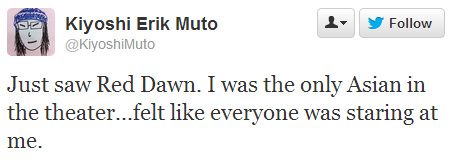
I honestly don’t have a lot to say except that I’m angry, hurt, and somewhat unsurprised that this is what audience members all over America are choosing to take away from this movie. I am Asian and I am not evil. I do not want to take over America. I do not want to ever feel like this:
Shame Day: Americans and the Environment

Today is Election Day for the United States of America, so I suppose this is just as good a time to write about this as any. While the embedded video below “stars” Mitt Romney, he is in no part the focal point of this post.


The video was brought to my attention via a tweet by Canadian webcomic artist Kate Beaton, which linked to an article titled “Watch Romney grin awkwardly as his audience shouts down climate activist.”

A breakdown of said video:

  • Mitt Romney has some things to say about ways to help those affected by Hurricane Sandy.
  • A man yells at around 00:22, and says  “What about climate? What about climate, that’s what caused this monster storm!”
  • He holds up a sign that says “End Climate Silence.”
  • This is almost instantly met with boos.
  • The boos turn into a rousing cheer of “USA! USA!”
  • At around 36 seconds in his sign is violently yanked down.
  • Seemingly unperturbed, the man tries in vain to yell above the crowd; he does not succeed.
  • 00:54 has the camera zoom in nice and close on Romney’s awkward grinning face.
  • Thirty seconds after the man’s outburst, Romney continues his speech where he left off as if nothing happened.

Even watching that video for a third and fourth time to write this I’m still both shocked and angry. This man was raising a legitimate point about  the source of the storm, and he was shouted down. What’s more, he was shouted down by dozens of people yelling the name of their country over and over and over.

Why did this happen? Sure, the guy may have been interrupting what was ultimately supposed to be a way for Gov. Romney to raise support, but is that a reason to boo him? Is it a reason to yank his sign down? You can see the man struggle to keep it up and then decide it’s not worth the trouble.

As a presidential candidate, can you stop Americans from crying “USA! USA! USA!”? Yes. You can. When what is typically a patriotic cheer is used to instead bully someone and invalidate their opinion. It is disgusting what happened, and anyone involved should feel disgraced by their behaviour.

A reply to Beaton’s tweet put it well when he said:

“Nero, what about the fire?” “USA! USA! USA!”

Oh, and here is an actual video where Romney basically says that caring about the environment is a joke:

Thoughts About The Internet

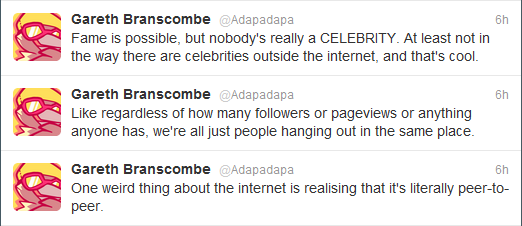
So a friend of mine tweeted in the early hours of the morning, musing about the internet. The tweets are as follows [to be read from bottom to top]:

Before I can really begin addressing this, I think it’d be good for me to have a good definition of the word “celebrity.” Dictionary.com tells me that as far as people go, a celebrity is a “famous or well-known person.”

So are there capital letters CELEBRITIES, or are there just people, again, referencing the tweets, with fame? And, if they’re one and the same, do they equate with people outside the internet?

The 21st century is a place where being “outside the internet” is a basic impossibility. That being said, there is a distinction between being general fame and internet fame. Brad Pitt is a well-known movie star. wheezywaiter is a popular YouTuber with 382,628 subscribers. If both walked around the streets of any major city in America they’d be recognized, but only one would create a stampede of screaming fans leaving several dead.

On the other hand, some celebrities have supplemented their fame with their internet presence. Ashton Kutcher was the first twitter user to reach a million followers, and currently has almost ten times that. Comparing that to his work in film and television, it actually dwarfs his presence “outside the internet.”

The thing with being internet famous is how quickly it spills into the offline
world. High school pole vaulter Allison Stokke had her picture submitted to With Leather, a sports blog, where it appeared in this post [as far as I can tell, the images connected to the specific post have since been removed]. These images quickly spread around the internet, however, and Stokke became the target of a large amount of unwanted attention, a lot of it very sexual. It got to the point where her high school began receiving requests for photo shoots of the athlete. The Washington Post has more to say about it here.

To be fair, that wasn’t Stokke garnering internet fame for herself, but was instead unwittingly swept into it by a blogger named Matt Ufford. She’s not the only one who runs the very real risk of being recognized in public. Webcomic artist Jeph Jacques bumped into fans while vacationing in New Zealand, less of a surprise when you take into account the fact that his strip has thousands and thousands of viewers.

The internet is a “peer-to-peer” place where anyone can post anything and have an audience of anywhere from one to millions. I have 71 followers on twitter [with only a few spambots], meaning that anything I tweet [which I rarely do anymore] is instantaneously communicated to a several dozen people all over the world. That’s an amazing thing. Audience does matter, though.

If you have a blog, and there are millions, what are the chances that anyone is going to read it? You could tag it with words like “Dakota Fanning” and “Playboy,” and that might help, but your readers won’t be consistent and probably won’t be coming back. We may all be in the same place, but we write or draw or play instruments because we hope that others might be audience to our work, and when that audience gets large enough it will inevitably change our lives outside the internet.

Does The Onion Even Have Lines? #CongressHostage

So The Onion tweeted [#CongressHostage] about Congress holding schoolchildren hostage last Thursday. The Internet, as expected, exploded for a bit in a few places and then returned to normalcy.

A rather convincing photograph of what appears to be Speaker of the House John Boehner holding a little girl hostage

The tweets were fake live-action reports of an Onion headline that day that reported that Congress had taken hostage 12 schoolchildren and were demanding, for their release, 12 trillion dollars “in cash”. A less tasteful part of the story involved John Boehner threatening to kill “one child every hour” until the money was given, with a rather amusing photoshopped picture of Boehner holding a gun to a girl’s head.

The US Capitol police responded with a release affirming that there was no situation of any kind at the Capitol, which created a scad of angry tweets ridiculing at anyone who could “be so stupid to believe” the story – and by scad I mean like hundreds, which seems to be many more than the small amount of people who took the story to be actual news. Time asked if The Onion went to far with #CongressHostage, and lots of followers said that they did, which created another scad of angry tweets ridiculing anyone who would be offended by The Onion story and lamented over the lack of education about satire, etc. etc. Basically summarizing the whole debate, @GS_Design responded to Time’s question: “Does the Onion *have* lines?”

Some people compared the event to the War of the Worlds broadcast in 1938; @kevinhamel55 asked, “@TheOnion today, War of The Worlds in 1938; is there any difference?” (the answer is yes, yes there is, because this time nobody thought the world was actually ending and hundreds of people weren’t calling studios panicked, afraid for their lives; whether this makes the Onion more or less successful than the 1938 broadcast is another matter altogether).

Admittedly, in perhaps poor taste The Onion’s #CongressHostage thing started with this tweet: “BREAKING: Witnesses reporting screams and gunfire heard inside Capitol building.“, which wasn’t really funny or entirely unbelievable in any way. Further tweets were more appropriately hilarious: “Reports from those who know Congress say the legislative body had seemed desperate as of late“. Another tweet that isn’t really funny enough to justify its offensiveness was: “Two chaperones are also being held, one of whom is said to be pregnant “. It’s sort of amusing just because it’s so intensely typical of a hostage situation report, but it had nothing to do with the story’s strongest point, the nature of Congress in real life – as exemplified by the tweet: ‘Obama on bullhorn: “John, I know you can hear me in there. Please, you don’t need to do this.”

The article was a pretty accurate metaphor about Congress’ sense of desperation, as well as the public and presidential opinion of Congress this year, and the #CongressHostage stunt did a good job of drawing attention to it, at least. @TheOnion’s twitter account gained something like 7,000 followers, and the article received a ridiculous amount of news and blog coverage. The whole event was just another example of The Onion doing what The Onion does – drawing public attention to the nature of veracity and sensationalism in news sources, which is almost always good. The best summary of the situation in the current cultural context, in my opinion, came from @FultonMatt, who tweeted: “@TheOnion’s #CongressHostage has gone too far. Why can’t they just hack dead kid’s phones like a real news org?

#OccupyWallStreet: Protesting with Hashtags

So there’s about a thousand people protesting on Wall Street (ish) right now and I don’t really know exactly for what. The movement is #OccupyWallStreet and it started on September 17 and consists of about 1,000 (mostly) student-aged people (My official estimate of the demographic: I’m picturing literary references and lots of beards) just kind of hanging around the Wall Street area. Sometimes there are marches. People are sleeping in the park. People online are ordering pizzas to be delivered to the protesters. One girl took off her shirt.

You might want to know what people are actually protesting – that’s where things get more vague. Some advertisements speak of the need for One Demand, but nobody has decided what that demand is or should be or could be. Interviews with the protesters range from the idiotic to the informed, revealing mostly a mixture of the two (along the “I don’t know who my house representative is but I can tell you the percentage of the population that holds 50% of the wealth” line). The attitudes seem to be predominately socialist, or at least anti-capitalist, with lots of complaints alluding to the Bush tax cuts, the 2008 bank bailouts (if you don’t really know what those are about either, a good explanation by my friend Chris here.), and a lot of derogatory use of the word “corporations”.

An #OccupyWallStreet protester with an Anonymous mask and a hijab.

The whole situation is a strange crossover between internet networking and the real world – the Twitter support and piles of enthusiastic comments and exclamation all over the web have only translated to about 1,000 protesters at any time, and not even in the street the protest was planned for (the NYPD blocked off the key sections of Wall Street before any protesters got there). Online, however, the results are impressive (it’s kind of like looking at the Ron Paul campaign) – Anonymous, the 4chan-based hacker group with frightening amounts of power, is credited for much of the protest’s popularity.

It’s fascinating and kind of beautiful to watch – this is the first generation that grew up with the internet, and you can tell. Twitter-based protests are just called “protests” now. We are the generation that will use hashtags in our protest signs. It’s like old protests, but improved: we still have unconstructive platitudes, but at least some of them are ironic, dangit.

The coming-of-age of the first generation raised on the internet looks like this.

The use of the word “Occupy” in the title seems inaccurate, as if the protesters knew what they would do if they actually got control of the place. I’m imagining collages made with cut-up quarterly reports.

The thing is that Wall Street is now just as nonphysical as the organization of the protests – there’s not really much actual money to burn, anymore, and there aren’t safes full of the hoarded wealth of the rich. Significant money never really physically goes to Wall Street, or really anywhere – money is numbers in a computer and property value and stock value; it’s kind of hard to figure out where it actually exists.

The physicality of the protest is less impressive than its internet following and even seems a little incongruous – it’s like the event is being swallowed by its own abstractness; an internet-developed protest trying to cross the line of physical reality and occur in front of a physically symbolic place just doesn’t work out in the digital age.