Tag Archives: women

Wither Feminism?

This isn’t the first time I’ve lamented about the sorry state of feminism in the culture wars, and it certainly won’t be the last- nevertheless, the time has come for me to really lay out exactly what it is that’s killing feminism.


Sure feminism was necessary at one point, but it’s just not relevant anymore
.

You never hear that stated outright, but it seems to be underlying most responses on why feminism isn’t as major an issue was it was in the 70s or the 60s or the 50s or whenever exactly it was that the last wall of patriarchy supposedly fell.
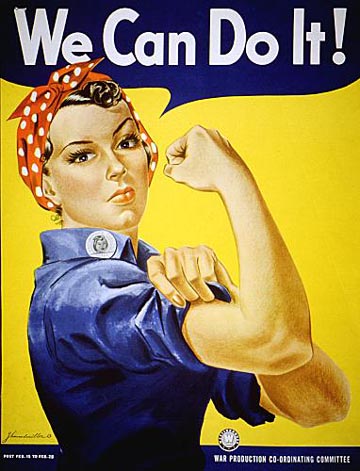
Let’s face it, women can vote, run for and hold public office, be CEOs or workers, and so on and so forth. Really, shy of being able to serve in combat (American women, anyways), one might argue that all doors are now open. This mentality even seems to be affected most contemporary feminists, who though I am sure have the very best intentions, really can’t find much to rail about themselves. I’ve been through blog post after blog post, article after article, and found that overwhelmingly the subjects being discussed are mostly rants against Todd Akin (not to say that idiot doesn’t deserve it) or retrospectives on the battles of the past. Take a look at the contents of the latest Ms. magazine:

With Wonder Woman at the helm, the issue celebrates 40 years of fearless reporting with 40 Ms. and key feminist moments that shaped our history; birthday letters from dozens of life-long readers; and essays from founding editors Gloria Steinem and Letty Pogrebin, and current Executive Editor Kathy Spillar.

In the special 40th anniversary issue, you’ll also read about:

– What’s at stake for women in the 2012 election

– The significant ballot initiatives in your state

– Record numbers of women running for office

That’s their central points for their fall issue.

Now let’s take a look at Jezebel.

I had a rough time sifting through the articles for one that best demonstrates my point (I know Jezebel isn’t so much a “feminist” website as it is a “women’s interest” one- though exactly what that means I can’t rightly say)- for the most part, they seem tangential at best. “What is it with Women and Law and Order: SVU?”  or “Should Women Run? You’re Damn Right They Should.

That last one’s not talking about running for office- it’s literally about jogging. ‘Cuz apparently there was some blog post asserting that women with a certain body type aren’t cut-out to be runners, and that merited a response. Sure, whoever said that was wrong, but is that what feminists have been reduced to? Chasing down solitary quips of (comparatively) benign misinformation in the ugly bowels of the blogosphere? If that’s the standard for a worthwhile target, Evan and I should be beaten to death for mixing up when the premier of Community is going to be shown.

Please don’t beat us to death…

If this is the substance of the contemporary feminist movement, can you really blame people for feeling that all that’s to be done has been done? Can you really blame people for stereotyping self-proclaimed feminists as just angsty or contrarian? Is feminism just going to wither away?

I hope not- there’s still plenty of work to be done.

See this picture?

It’s from Dove’s “True Beauty” campaign. A series of advertisements aimed at combating anorexic and unrealistic standards of beauty. I’m sure the owners of Dove- a corporation by the name of Unilever- would be proud.

You know what other company Unilever owns?

Yep- these guys.

Now as I have family who read this blog, I’ve got embedded for you below the mildest Axe commercial I can find- be assured that it’s prudish and progressive compared to the rest of ’em.

That’s what we’ve got here- a corporation that on one hand is hawking their products by telling you that you’re beautiful just the way you are, and on the other hand depicting women as mindless dolls in low-cut dresses who can be manipulated with aerosol bottles. The latter alone would be a slap in the face, but that fact that the company is two-faced enough to shamelessly operate both utterly discredits their “True-Beauty Campaign” and exposes the fact that they’re ready, willing, and able to use feminism itself as a vehicle for controlling and objectifying women and perceptions about ’em.

This is Paul Polman, Unilever’s CEO, and he can go **** himself.

See, there’s this offshoot of modern feminism called “Sex-positive feminism” (you might know it by other names), which broken down to its most basic elements asserts that women’s use of their sexuality is empowering- and while no one would deny sexuality as an integral part of any human being- more often than not, this line of thought is used to justify strip clubs, prostitution, pornography, etc. as being actually good for women.

Now I’m not going to start accusing the founders of “Sex-positive feminism” of selling out their own movement- I don’t think that’s what their intention was. But then again, such things are what the road to hell is paved with, and even if the goal of this off-shoot was to make sexuality just as empowering as brains or brawn, the simple truth of the matter is that the prostitute isn’t probably viewed by her client as being a more well-rounded person because of her job. Heck- using this logic, I might argue that a twelve year old Honduran girl whose working for 32 cents an hour in a sweatshop is likewise “empowered”.

Strange how “Dead by 26 feminism” isn’t quite as popular…

Feminism isn’t dead- it’s just got a knife at it’s throat, and if saving feminism from becoming a tool of the very system that it was first established to combat isn’t a worthwhile endeavor- I don’t know what is. To anyone who would complain that all the important battles have been won- I present to you this. “Your solution to saving feminism is by saving feminism?” you might ask- and hey, it’s a valid point. But this isn’t just some circular exercise- this is a struggle for what’s really empowering. It’s a fight over messages- will we be told “These shoes are empowering!” or “No- they are shoes– empowerment comes from how far you walk and how much butt you kick.” Isn’t that worth something?

At the very least it beats writing an angry article about how body shape doesn’t exclude you from jogging.

P.S. I know I should also say some stuff about the “Slut Walks” (“Slutwalks”?, “Slut-Walks”?), the issue of rape, the continued problems of worker-manager ratios, etc. but it’s past 1:30 in the morning- please excuse the narrowness of this post.


Evan and Gordon Talk: The Bechdel Test


EVAN:
So I came across a little something called the “Bechdel Test” through an article on racebending.com. It’s a test that’s supposed to rate how well a film does in terms of portraying women. That’s a rough description, anyway.

GORDON: I’ve heard of it in film criticism. It essentially asserts that for a film to have “real” female characters, it must have a scene in which (1) two women (2) talk to each other (3) about something other than a man. Sounds simple enough, but you’d be blown away by how many movies fail it…

EVAN: And the thing is, some of these movies happen to have perfectly good “strong female characters.” The site bechdeltest.com lists films that do or don’t make the cut, and in the comments section many a person states “but this female character was such and such…”

GORDON: Example?

EVAN: User “lili” disagreed with the rating given Wrath of the Titans, saying:

Although conversation between the two named women was minimal, the character of the main woman was well developed with no sexual stereotyping or weaknesses. I think it passes the Bechdel test in spirit, if not in actual letter.

GORDON: See man, as much as I’d consider myself a feminist, I really don’t like the Bechdel Test and some of the assumptions it seems to make. A lot of it just really doesn’t pan out- I’m looking at the list they’ve got here, and it’s seriously twisted.

Check it out- Sex and the City 2- easily some of the most misogynistic and racist crap out there gets a free pass, and movies like The Rum Diary or Rise of the Planet of the Apes– which have way better portrayals of women- are failed…

EVAN: I mean, it’s easy to see why their criteria was picked- having the women named is extremely important, as it’s a pretty solid way of ensuring that they’re actual character and not just waitresses or other extras. Also having them talk about something other than a man. That’s pretty important stuff, I think, in maintaining that they’re not just female verbal support for the male lead.

Where it really falls apart is the second part of the test: the need for the female character to have to talk to each other-

GORDON: I don’t think you’re being quite hard enough here, dude- this is a bad test. Look at it this way-

The first criteria is that there be two women, which is dumb because it assumes that a woman’s identity is based on how she relates/matches up with/differs/etc. with other women. Totally disregards her qualities (or failings) as an individual, y’know? The second criteria is, like you say, that they have to interact which each other, which again doesn’t make much sense (see previous point). And the third point, while decent, also kinda falls apart- if two men talk to each other about nothing but women, are they not real male characters? Kinda throws relationship movies out of the window.

…Point is, the test sorta shows you when a movie drops the ball on female characters, but a “passing grade” doesn’t really mean much of anything.

EVAN: I agree with you completely. Part of the reason I’m a little less harsh is thinking about how to construct/write a single test which judges a film on something as deceptively simple as the “active presence of female character,” as Feminist Frequency would put it.

GORDON: Well, what makes a female character a female character?

EVAN: Well, I took Human Sexuality my senior year of college, so I can think of a few key specifics-

Continue reading

Is “Art of Manliness” Sexist?

Imagine my surprise to log on to Culture War Reporters to jot down my Tuesday post, only to find Elisa having already written something. I can only imagine that her cutting in on my territory means that she’s looking to start a fight so vicious, bloody, and prison-lunch-line-shanking-ly brutal it will make the combined carnage of the fall of Masada and the genocide at Wounded Knee look like a slap-fight between a couple of elderly Mennonites.

But I’m not here to talk about that. I’m here to make good on my promise last week- to investigate and determine whether or not Art of Manliness is sexist.


Of course, before we begin we have to define what “sexism” is. The obvious answer would be discrimination/prejudice against women, but it has got to be more than that. The stereotyping of women (regardless of whether its positive or negative) has also got to be a part of sexism, just as much as it would be a part of racism or any other form of bigotry.

Now at first glance, Art of Manliness really doesn’t touch on the subject of gender relations all that much. For every one of their articles on subjects such as “What to Wear on a First Date“, there are ten articles on how to shine your shoes, shuffle a deck of cards, hitchhike around the US, make maple syrup, and even a world history of shaving. On the whole, the blog is far more invested in trying to break from what it sees as a culture totally lacking in strength, competence, and independence.

But of course, you really can’t devote an entire blog to what makes a man a man without every once in a while stumbling across the subject of women.

For example, take a look at “Women and Children First? Down with the Ship?” or “Womanly Things We Wish Women Still Did“. In both cases, the author simply brings up the subject, allowing the readers to duke it out in the comments section on whether or not the old cry of “Women and children first!” is still right or fair (or if it ever was to begin with).

On the whole, Brett McKay (the principal author) understands that the subject of feminism and feminist issues are still quite controversial, and only more volatile in the venue of his Art of Manliness blog. For the most part, he either allows his readers to debate such questions as “should men hold doors open for women?”, or refers the issue to his wife (and co-author) Kate. Indeed, from everything I’ve read on the blog, it would appear that the single most “edgy” post on gender roles (“What Can Manly Men Expect of Women?”) really doesn’t do anything more than point out (what the author sees) as a double-standard in what men and women can ask of each other. In fact, I’ll stick my neck out there and say that the author makes some solid points on women’s issues and feminism.


When I was in college, my house was once visited by a collection of female students bearing cookies that they had baked for the men of the campus. The self-titled “Domestic Divas” claimed their mission was to call for a return to “Biblical” roles for men and women, and a rejection of “feminism”. My reaction, and the reaction of every sane man and woman on that campus, went sort of like this:


As many pointed out, this well-meaning but idiotic group had ignored the fact that their ability to be at college (or to speak to men without us having spoken to them first) was a direct result of feminism. And while perhaps not as extreme as in the case I just cited, this basic problem seems rather prevalent in our culture- many women seem to take the struggles and hardships of their predecessors for granted. The (few) benefits of 1950s society are looked back on fondly, but the abuse, neglect, and degradation is completely forgotten. I don’t think Brett McKay is sexist for decrying equality in gender roles combined with inequality in social expectations. McKay isn’t stating that its a woman’s place to dress up for a date, but simply that its as an appreciated gesture as flowers or getting the door.

No, I think Art of Manliness is sexist for completely different reasons.

And in the defense of the authors of the blog, I don’t think it’s anything intentional.

My main issue comes down to this. Art of Manliness is a good site. Heck, it’s a great site. The information is useful, the writing is concise and simple. The subject matter is instructive and edifying. Only it’s directed solely at men.

Don’t get me wrong, I’m not saying that I don’t think both myself and the males of my generation could stand to toughen up a bit…

I just don’t think that the characteristics or skills in the blog are in any way unique to men. Starting fires, shooting guns, shuffling a deck of cards, picking out a good scotch, backing up a trailer, breaking down a door, wrestling alligators (yeah, that’s an article)- these are all things just as useful to women as they are to men. There’s even an article titled “How To Parallel Park… Like a Man!“.


See, I’d imagine that we’d just call that “Parallel Parking”, since driving isn’t exactly exclusive to men or something men are just better at. And I don’t want to hear the whole “Men are evolutionary predisposed to having better spatial judgment” schpeel. First, if it’s correct, it just means men are more likely to have better spatial abilities- it’s not universally true. Second, just because I’m six feet tall doesn’t mean I stand a chance against a five foot NBA star in a basketball match- training trumps negligible physique every time. I’m a man and a relatively new driver- I’d bet that every woman driver in the city I live in can parallel park faster and better than I can.

Case in point…

The real problem with Art of Manliness isn’t so much the content but that the content is labeled as being “for men”. Even the abstract qualities brought up in the blog are good for men and women alike. The post on the virtue of justice uses an illustration in which justice is depicted as a woman, for ****’s sake. Bravery, intelligence, perseverance, leadership, heroism- can you really tell me that these aren’t just as admirable in women as they are in men?

(Just as a final note, I want to thank and recommend Reaction Gifs, from where I frequently borrow my illustrations- it’s a neat site, check it out).

Sexism, Reductionism, and Stepping on Women’s Heads

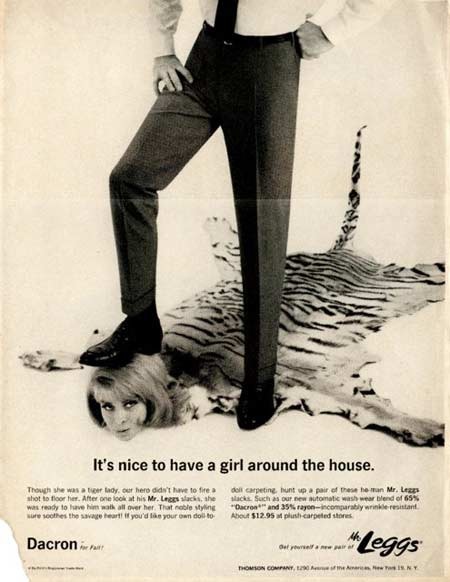
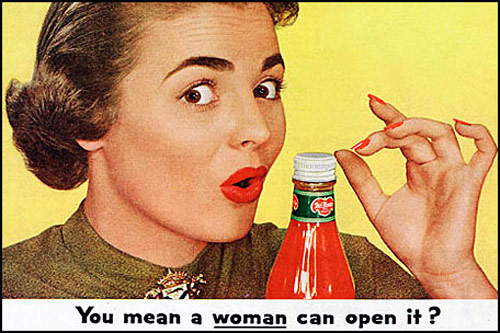
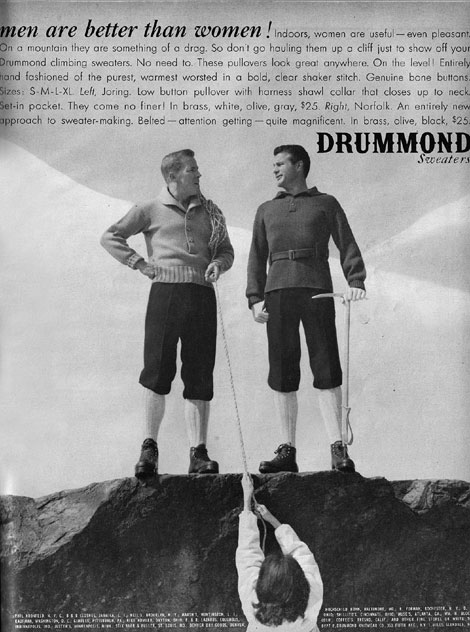
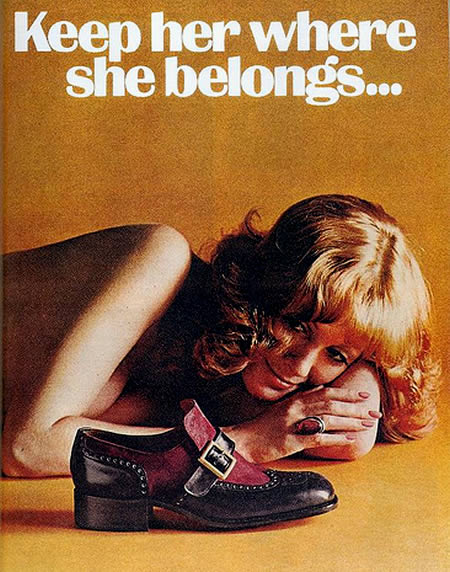
So Retronaut has a page of “Vintage Ad Sexism” – hilariously sexist ads, many of them aimed at men’s pride (“brand new man-talking, power packed patterns that tell her it’s a man’s world”) or women’s insecurities (“Would YOUR husband marry you again?”). There are some gems in there, like these:

source: retronaut.co

I'm just gonna let these speak for themselves.

source: retronaut.co

source: retronaut.co

Read some of this one for the full effect

source: retronaut.co

And this one might be my favorite…source: retronaut.co

Aren’t some of them kind of frighteningly recent-looking?

So yeah, we remember sexism, 1919 and women’s suffrage and bra-burning and all that. Being shocked that women couldn’t vote, etc. But seeing advertisements make it more harrowing. Serious political oppression at least treats women with enough dignity to be oppressed – advertisements make light of women as entities. I am less concerned with the essential sexism in these than I am the reduction.

Violence and political oppression are horrid, yes, but reduction is more insidious because it tends to keep hanging around long after voting rights have been own and salaries have been evened out.

The advertisements here, of course, appear ludicrous to us. “Is a wife to blame if she doesn’t know [to use a douche]? Yes! She’s decidedly to blame.” The one with the rug with a woman’s head, the man standing with one foot on her head Captain-Morgan-style. Some of them are just ridiculous.

But it is good to remember that as insane as they may seem, these are real, and they are recent. People who saw these ads and accepted them as a relevant way to advertise a product – people who made the ads, laughed at them, nodded in agreement – still make up a large part of our society today. Even after that generation dies, the fact is that American culture (it’s what I’m talking about here; can’t speak to other places) has been steeped in the reduction of women – and this is not an influence easily shed.

Now, establishing a double standard to “make up” for lost time is not the answer. Ensuring that all males are instilled with a sense of guilt about the past will not help society. Only by awareness of our ideological roots, and the flaws and violence therein, can we stay – or at least slow – regression.