Author Archives: Kat

“Sorry” Means Nothing Unless It Comes With Real Change: On Truth and Reconciliation in Canada and Beyond

Last semester, I took a course called “the Dark Side of Sorry”, which examined the Sorry Movement in Australia and the Truth and Reconciliation Commissions in South Africa and Canada. Since it was a literature course we spent part of the semester reading books that dealt with the effects of colonization in those three countries.

The novels we read explored the effects of apartheid in South Africa, the Stolen Generation in Australia, and residential schools in Canada on the lives of specific characters. In contrast, our critical readings examined the way each of those countries dealt with those events after they were nationally, and internationally, condemned. I want to touch on a few of the criticisms that were raised through our critical readings and discuss why those arguments are particularly relevant today.

South Africa

“Suffice it to say that none of these unconventional projects was intended to lead to any gross violation of human rights […] It can, however, be argued that they did create an atmosphere conducive to abuses.”

– from the apology that F.W. de Klerk, the last South African leader of the apartheid era, gave to the Truth and Reconciliation Commission.While de Klerk apologized for apartheid before the Truth and Reconciliation Commission, he later “withdrew from the commission, saying he had no need to apply for amnesty as he hadn’t committed any crime.” In an interview in 2012, Klerk pointed out that he had not apologized for “the original concept of seeking to bring justice to all South Africans through the concept of nation states”. He also stated that, not all aspects of apartheid were “morally repugnant”.

After apartheid was finally overthrown South Africa attempted to bring healing to a divided nation through their Truth and Reconciliation Commission. This commission, led by Archbishop Desmond Tutu, was meant to be an act of restorative justice, rather than retribution.

In many ways the TRC was a success. For example, it unearthed the truth about many missing persons, allowing families to finally discover what happened to their loved ones. However, there were also many criticisms against the South African TRC, some of which I’ve outlined below.

1) The TRC didn’t differentiate between violence committed by “an illegal state” and “the combatants of a just war”.

“… from the moment the Commission chose to define violation of human rights in terms of individual acts, it ceased – politically and historically – to be viable: ‘There is,’ write Kader and Louise Asmal and Ronald Suresh Roberts… ‘simply no proportionality between the two sides of the struggle, a fact that is lost on the commission’s decision to individualize it’s definition of a gross human rights abuse'” (171).

– from”Apathy and Accountability” by Jacqueline Rose

2) Racial wealth equality was never really on the table.

“Let one’s fantasy roam a little – what really would be preposterous or ethically inadmissible in imposing a general levy on South Africa’s white population? … such an offer could originate from the beneficiaries of Apartheid themselves, in a voluntary gesture of atonement – it need not be a project of the state. Is such a genesis – from within the indicted group itself – really beyond conception?”

– from “Reparations, Truth and Reconciliation” by Wole Soyinka

3) The TRC remained so focused on the horrific crimes that were being confessed during the hearings that it overlooked the general state of apathy that allowed apartheid to exist for so long. The crimes presented at the TRC trials stood out as “outrageous” acts, and they drew “the nation’s attention away from the more commonplace violations” (162).

“Spread accountability too wide by flattening out the differences between the state and its opponents, then oddly, symmetrically, it will also start to shrink, as the crimes of apartheid becomes more and more the acts of individuals, [and] less and less the machinery of the unjust, and illegal apartheid state” (168).

– from”Apathy and Accountability” by Jacqueline Rose

Australia

“We reflect in particular on the mistreatment of those who were Stolen Generations – this blemished chapter in our nation’s history.”

– from the official apology given by Australian Prime Minister Kevin Rudd in February 2008.

I knew the least about Australia’s history, out of the three countries we studied. From what I understand, race relations in Australia were fairly similar to here in Canada, where indigenous peoples were restricted from public areas, treated like scientific specimens, and removed from their families “for their own benefit”.

In May 1997, the Bringing Them Home investigation shocked the Australian settler community by publicizing these historical injustices. It also prompted the Sorry Movement and Sorry Day, which has been held on May 26th since 1998. Below are a few observations critics have made about settler Australians’ “Sorry” response.

1) The Sorry movement is entirely settler-centred.

“These revelations brought about a form of ‘bad conscience’ in the settler Australians… [and] present[ed] them with a vision of a nation improperly formed. They experience the unsettledness of losing their sense of innocent national selfhood. For settlers so afflicted, the postcolonial apology becomes a lifeline to the restitution of a legitimate sense of belonging” (243)

– from “Apology in Postcolonizing Australia” by Haydie Gooder and Jane M. Jacobs.

2) The Sorry movement backfired politically for indigenous Australians.

“The era of reconciliation has coincided with a post-native title backlash in which many sectors of Australian society, not least the powerful mining lobby, have responded negatively and often hysterically to the overturning of the doctrine terra nullis (land belonging to no one) and the common law recognition of native title… Federal Government policy, attentive to the electoral and economic implications of such a backlash, has responded by cutting funds to key indigenous organizations and eroding the gains secured through the Native Title Act and subsequent native title adjudications.”  (234)

– from “Apology in Postcolonizing Australia” by Haydie Gooder and Jane M. Jacobs.

Canada

“The treatment of children in Indian Residential Schools is a sad chapter in our history.”

– from the official apology given by Canadian Prime Minister Stephen Harper in June 2008.

I don’t think I’ve ever met a Canadian who isn’t familiar with the trauma residential schools inflicted on Indigenous communities across the country, but for those of you who are not Canadian I’ve included a short video below that sums up some of that history.

In 2008, Canada instituted our own Truth and Reconciliation Commission, which allowed survivors of the residential school experience to speak out publicly. Unfortunately, there were several elements of the TRC that many indigenous spokespersons found problematic.

1) The term “reconciliation” misrepresents our history.

“Re-conciliation refers to the repair of a previously harmonious relationship. The word choice imposes a fiction that equanimity is the states quo between Aboriginal people and Canada.” (35)

– from “Imaginary Spaces of Conciliation and Reconciliation” by David Garneau

2) The majority of the damage had been done by Christian organizations, yet the reconciliation movement rests upon Christian theology and terminology.

“Whether the choice of this world [reconciliation] … is an accidental inheritance, it is ironic, if not sinister, that survivors of religious residential schools … are asked to participate in a ritual that so closely resembles that which abused them” (35)

– from “Imaginary Spaces of Conciliation and Reconciliation” by David Garneau

3) The Western understanding of apology allows us to move on, without necessarily doing anything to rectify our mistakes.

“Cree artist, poet and oral historian and theorist, Neal McLeod explains that there is no equivalent in the Cree language for the Western notion of an apology. The closest equivalent to ‘I am sorry’ is nimihta tân, which means ‘I regret something’.  McLeod explains that the word used in reference to the residential school experience is ê-kiskakwêyehk, which means ‘we wear it.’ This is a profound difference. It is visual and visceral rather than abstract. It describes a recognition and acceptance that cannot be washed or wished away.” (36)

 – from “Imaginary Spaces of Conciliation and Reconciliation” by David Garneau

4) The government continues to protect perpetrators.

“While many truth commissions are granted judicial powers to subpoena witnesses and the ability to ‘name names’ of perpetrators, the Canadian TRC has neither of these powers.”

– from “Truth, Reconciliation and “Success” in the International Context” by Dr. Rosemary Nagy

5) Activists are worried that nothing will actually be done about the commissions recommendations.

The Canadian Truth and Reconciliation Commission came to a close in June of this year, making many of the critiques we explored in this class particularly relevant. The TRC commission concluded that residential schools were an act of “cultural genocide” and put forward 94 recommendations for the Canadian government. Several weeks have passed and Canadians are now asking, is our government going to act on any of them?

https://twitter.com/bonneau_l/status/613349362630942721

https://twitter.com/shahaviator/status/611742882366660608

In Conclusion

It’s hardly surprising that the one thing in common with the national apologies offered by political leaders in each of these countries is their attempt to distance themselves from the atrocities that took place. The Canadian and Australian prime ministers attempted to do so metaphorically, by referring to the events as a chapter which could be left in the past. In contrast, de Klerk’s non-apology seems to reflect a more blatant refusal to fully accept responsibility.

However, these apologies are certainly better than nothing at all. In fact, many indigenous peoples in South Africa, Australia and Canada have celebrated their country’s national apology as a hard-won victory. But shouldn’t we strive for something more than “better than nothing”? Especially when a a public apology eases settlers’ consciouses and allows us to overlook the systemic problems that led to these injustices in the first place?

“How can we overlook the fact that those admitting to guilt and professing regret continue to occupy, and to speak from, a position of dominance, so that to read abjection or loss of power in their situation would be to misread not merely power relations but the nature of the political apology itself?”

– from “Righting Wrongs and Rewriting History” by Rajeswaru Sunder Rajan

5 Classic Films I’m Going to Force My Kids to Watch

Okay, I realize I don’t have kids yet, but I probably will eventually, so bear with me. I’ve been thinking a lot lately about the way watching movies have changed. When I was a kid everything was on VHS. You owned a few (or a lot) of movies and you watched those over and over until you could pretty much recite them by heart. If you were lucky, on nights when a friend came for a sleepover, you might get to go to the video store, where you would get to spend hours perusing the shelves for the most interesting-looking VHS. Unfortunately, my kids probably won’t have that experience.

I’m basically being the millennial version of this right now.

Even if there are a few video stores kept alive purely on nostalgia (like the one in Victoria, B.C.), John and I aren’t the kind of people who would bother buying a VHS or DVD player when we could just hook up our computer to a TV. So my kids will probably never have to watch the same show twice (unless they want to or I make them). Between Netflix and YouTube, there is an endless world of movies available. However, rather than let them just watch the newest flashiest shows around, I’ve officially decided I’m going to make them watch the classics with me. Here are a few movies that will be at the top of my list (for this particular list, I’ve decided to leave out cartoons to focus on the live-action films that have stayed with me through the years).

The Princess Bride

When I was a kid I LOVED The Princess Bride. The only thing was, I did not pick up on any of the sarcasm. In my little kid brain it was just this magical tale full of adventure, passion, and rodents of unusual size.

As an adult, I get to go back and laugh at the dry humour peppered throughout.

Yet somehow, even though I now know it’s a comedy, and I can laugh almost the whole way through the movie, the ending still gets me. In fact, I think it’s still one of the most poignant revenge plots I’ve seen.

You all should know how this line ends.

Continue reading

Rachel Brown on Food, Religious Identity, and the Appeal of Muslim Extremists

A few months ago, I had the opportunity to hear PhD candidate Rachel Brown speak about her research on food and religious identity in French and Quebecois Muslim immigrant communities. I found Brown’s talk fascinating and contacted her soon afterwards; I wanted to find out if her work was publicly available so I could write about it here on the blog. While Brown has written a chapter on her work for an academic publication it hasn’t been published quite yet. Lucky for me, Brown was willing to share a draft with me. Throughout this interview I will be referring to, and occasionally quoting, that draft in order to give you context for the questions I ask Brown.

According to Brown, her “primary research interest lies in the study of immigrant religious experience and how members of immigrant communities negotiate their religious identities through food and food practices in their host countries.” In order to write on this topic, Brown conducted fieldwork and semi-structured interviews in both Paris, France and Montreal, Quebec.

This was the most French gif I could find.

Kat: Hi Rachel, thanks again for being willing to share your research with me and our readers. Before I dive into the questions I have from reading your draft, can I ask, what drew you to this area of study?

Brown: I came to the project out of a love of all things food and all things France. On one of my many visits, I noticed that how and what the Muslim community in France ate was a point of interest for media, politics, and everyday conversation on the street between friends and neighbours. There was clearly a subject to be addressed. I figured if I was going to be in the field for a year I might as well be somewhere I love and studying something I am passionate about, and so I set out to study the topic of food and religion. As I got further and further into the topic I realized just how essential food practice is to identity, especially religious identity and my research has grown exponentially ever since. The importance of food in religious identity negotiation for immigrants can be seen across a variety of locations and traditions.

Kat: I’m also curious about the technical side of things. Did you intentionally limit your case studies to individuals from the Maghreb? If yes, then why? Also, how did you go about arranging these interviews, or even making these connections in the first place?

Brown: I definitely limited my study to individuals from the Maghreb. I did this because the largest Muslim community in both France and Quebec comes from the countries of the Maghreb. This is not only because of proximity, of the Maghreb to France, but also because of a colonial history between France and the countries of the Maghreb. When one thinks of Muslims in France, this is most often the community that comes to mind.

In terms of arranging the interviews, this was a tough process. I started by going to the Grand Mosque of Paris and just getting to know people there. I had to build up trust, and spent many hours just helping out at the mosque in order to show that I was not a journalist (a profession folks are very hesitant of in France) and that I meant well with my research. After people got to know me, some started to agree to do personal interviews with me. Once I conducted the first interviews the people I interviewed then put me in contact with friends or family members to interview. So I followed a snowball methodology. It was not easy to get people to talk to me, but because my topic is such an approachable one (who doesn’t want to talk about food?), it made it a little bit easier to get people to agree to interviews. Having the personal connection, and a validation from friends or family members that had already done the interview was also key. Continue reading

Mad Max has a Feminist Hero for (Almost) Everyone

I know. Pretty well every woman with a computer has written about how great Mad Max: Fury Road was. I actually meant to write about it last week, but then I decided that I needed to address the news about the Duggars instead.

Not only am I late to the Mad Max conversation, but when I went to write about this post I came across the video I’ve included below, which succinctly summarizes many of the points I was hoping to make.

Even though Rowan Ellis beat me to the punch with several of her points, I loved this movie too much not to add my two cents. I also wanted to dig deeper into some of the feminist identities offered in the film and how they impacted me as a female viewer. Spoilers, obviously.

Furiosa: The Tough, Capable Woman

Furiosa is, of course, the first person anyone is going to think of when I say “strong female character”. She is a brave, intelligent, and capable character. I also love that she isn’t sexualized by the camera angles, and that we aren’t forced to view her through the male gaze.

As much as I absolutely love Furiosa, she doesn’t really bring anything new to the table. We’ve already had hardcore, confident female leaders like Sarah Connor and Ellen Ripley since the 80’s. And as much as I want to be like Furiosa, I don’t always feel myself reflected in these kind of figures. Sometimes that’s okay, sometimes all I want is to escape into the kind of fantasy where I can imagine myself kicking ass and taking names. However, it can be discouraging when movies only have one type of “strong female character”  to offer. While I absolutely love female heroes like Furiosa, I really loved having less capable heroines in Mad Max as well. Heroines who were well-rounded and brave in spite of their weaknesses and fears. Continue reading

Two Things Forgiveness Should Never Mean (i.e. Learning from the Duggars)

On May 19th In Touch Weekly published an article alleging that when Josh Duggar was a teenager, he molested five underage girls, including several of his sisters.

I didn’t want to write about the Duggars, but I felt compelled to. I wanted to write about this case because I am a Christian, so I understand a lot of the rhetoric of forgiveness that the Duggars and their supporters have used to explain their stance towards the eldest son. However, I am also a feminist, and I have seen the effects of sexual violence on the lives of people I love. So for this post, I want to explain why the Duggar’s act of forgiveness doesn’t make me angry, instead, it is the decisions they made along with that gift of forgiveness that have left me in disbelief.

We Need Forgiveness More Than We Realize

Those of you who know me in person have probably chatted with me about Christianity. I’ve struggled with it a lot over the last few years, and considered throwing the label out the window altogether. However, there are a few things that keep pulling me back to the faith I grew up in. One of these things is the tenant of forgiveness.

You have probably all heard some kind of variation of the quote I included above. While most of these sayings have essentially become cliches, I honestly believe the act of forgiveness can help wounded individuals in their journey of healing. In my own life, I’ve had experiences that could have easily led me to foster an intense bitterness towards certain individuals. The theology I grew up with helped me to understand those individuals as damaged people, which made it much easier to move on from those events.

The tenant of forgiveness extends far beyond the Christian faith. Forgiveness is a valued aspect of most world religions, and is even recognized by doctors and psychologists as a key part of healing. However, there are certain aspects about the Duggar case that undermine their appeal to forgiveness. Continue reading

3 Questions We Need to Ask about FHRITP and Internet Justice

You may have seen the following video circulating on the internet. For those of you who haven’t seen it, I should warn you that it contains coarse language.

I absolutely love how CityNews reporter Shauna Hunt manages to professionally undermine this popular joke. She is bang on in identifying the blatant sexism of the comment, and the way it exudes disrespect for all female news anchors. This phrase, and the trend of harassing female reporters, is particularly frustrating because it falls into “legal no man’s land” and would be very difficult to prosecute. However, shortly after this video aired, one of the men who defends the FHRITP trend was fired from his high-paying engineering job for violating their code of conduct.

While I am frankly quite ecstatic that we no longer live in the era of “boys will be boys”, there are certain aspects of this case that have also raised up questions for me. I’ve shared those questions with you below.

At what point does internet justice become cyber-bullying?

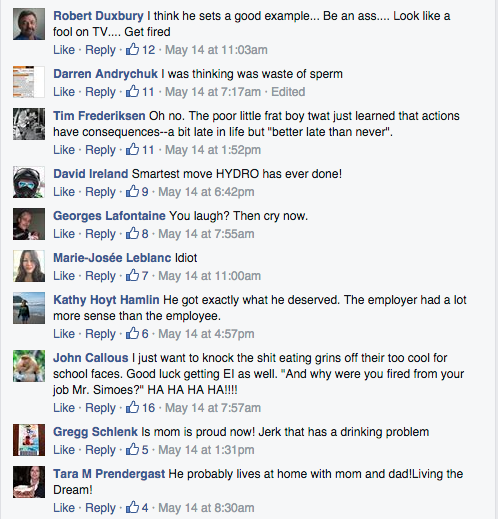
The internet has been a major catalyst for feminist activism. For example, a wide variety of feminist issues that are not usually discussed by mainstream media have been able to gain traction on social media. As a woman, I’m so thankful for that. I’m also a big believer in creating stigma around certain behaviours, since it often seems far more effective than banning them altogether. However, I have noticed some instances where public shaming has become an unnecessary contest between shamers. Evan has touched on this in the past, but I also found some prime examples of this on the “Help Shawn Simoes get his Job Back” Facebook page. It seems that instead of liking it in order to actually support the FHRITP scapegoat, people have been liking it so that they can one up each other with their witty comments.

Screen Shot 2015-05-19 at 9.59.41 PM Continue reading