Author Archives: Evan

Coping with Cartoon Death

Cartoons are a complicated thing. For example, children’s cartoon characters are required, in general, to always be wearing a seatbelt when in a vehicle. British TV character Peppa Pig was forced to wear one in all future episodes once parents raised concern about safety [the first few episodes would also be reanimated to reflect the change].
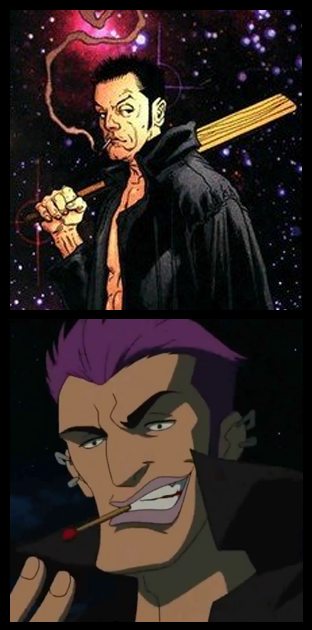
The presence of tobacco is yet another issue. In the upcoming DC animated movie “Superman vs. The Elite” British antihero Manchester Black is portrayed without his customary cigarette hanging from his lips. As you can see by the images to the right, it has been replaced by a matchstick.

What I’m slowly trying to get to is death in cartoons, and how it’s handled. The reason that this post didn’t go up yesterday was that I was powering through an entire season of “The Avengers: Earth’s Mightiest Heroes.” While I was watching the show, however, the same thought kept running through my mind: so many people just died.

Large fight scenes abound in the show as the Avengers battle to save New York City and the world, and collateral damage abounds. Skyscrapers fall and cars are thrown around, often with the implication that there are indeed people inside. A movie can be rated PG-13 for “sci-fi destruction and violence,” and I wonder how the show would stand up to the MPAA’s standards.

Similarly, in Pixar’s “The Incredibles” it is very strongly implied [though never outright seen/stated] that people, specifically Syndrome’s henchmen, die. There is a scene where Dash fights one of these goons and causes him to crash his vehicle into a cliffside. The result is a fiery explosion. From what I could tell the first few times I saw the movie, the man had definitely perished in the blast. Out of curiosity, however, I watched it again yesterday at half the speed.
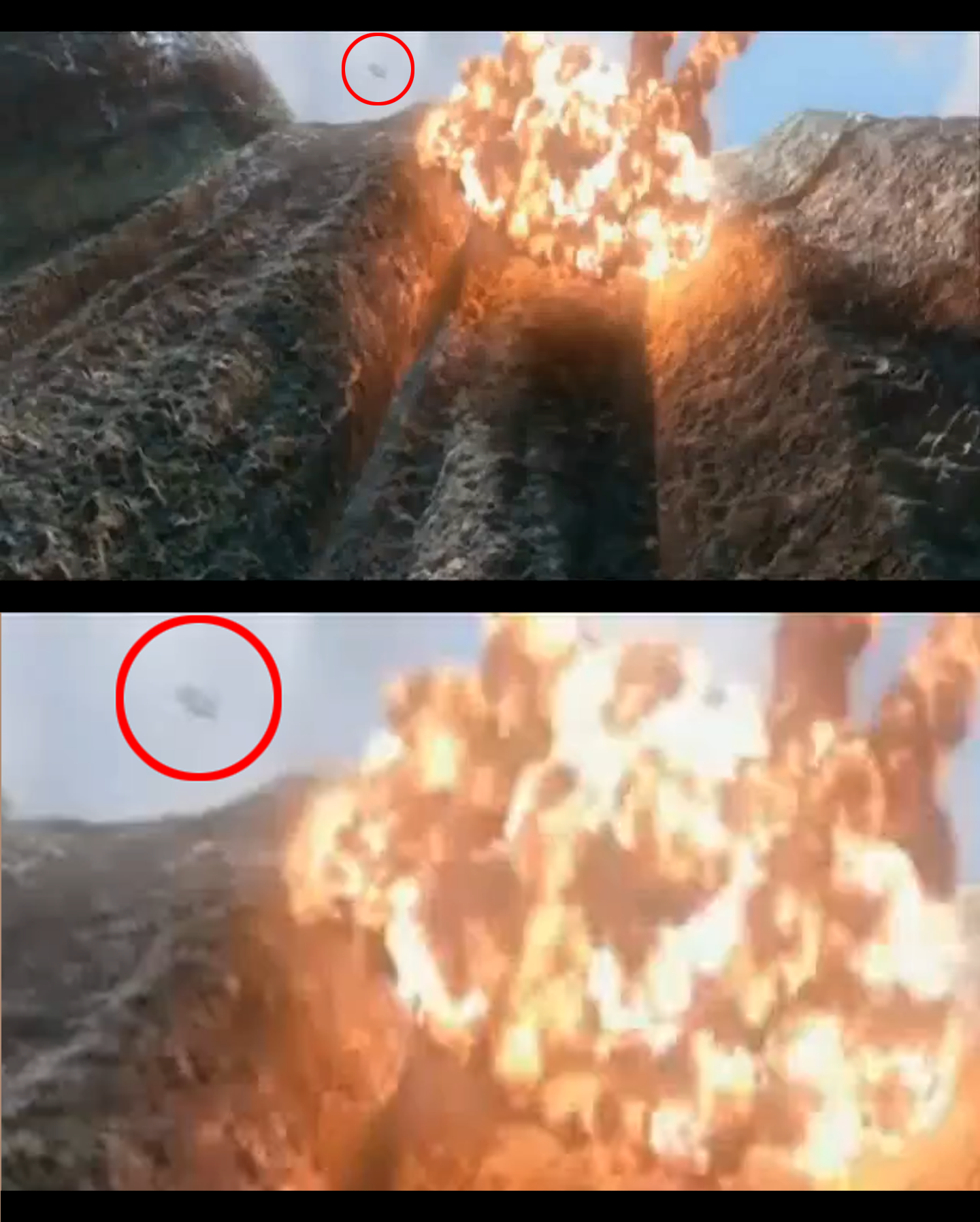
As you can see, there is a brief second where a piece of debris can be glimpsed that could maybe be interpreted as some sort of escape pod. I sincerely doubt it, though. And this causes me to wonder how Pixar managed to get away with it, and how exactly the rules can be bent. In the scene pictured above a ten-year-old boy is the cause of a man’s death. Is that something worth considering, would children even notice or be bothered by it?
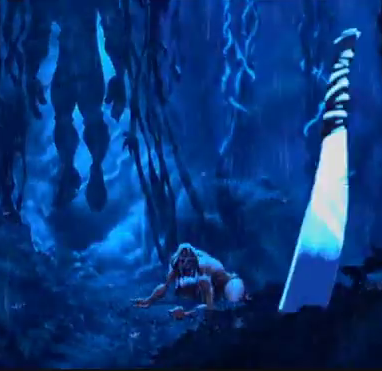
Death in cartoons has always been a very important event. Primary antagonists are normally relegated to some sort of dramatic end, and Disney movies are a fine example of this. Gaston [Beauty and the Beast] plummets to his death in a gorge, Clayton [Tarzan] ends up hanging himself from vines, and Commander Rourke [Atlantis: The Lost Empire] is turned into crystal and ends up shattering after hitting the fan of a hot air balloon. Their henchmen are, by and large, simply knocked out, oftentimes in a comical manner.

The question I’m trying to ask is whether or not we should continue to uphold the concept of death as this sacred thing in cartoons. Does a henchman’s demise deserve any kind of gravitas, or should he die in the first place? How much credit do we give children to understand what is happening when a character dies on screen? I can’t say that I have the answers, but becoming a parent will probably force me to find out.

Is Rich Michelson As Good As Anybody?

This past weekend I was privileged to attend the Festival of Faith & Writing at Calvin College. I went to a lot of the sessions and was practically drowned in ideas and information; there’s a lot to process, and I’m only just beginning to look over the notes I took. With that in mind, I’d like to discuss a talk I attended entitled “Extolling or Exploiting?”

10864659-large

Richard (Rich) Michelson is Northampton’s poet laureate. He’s also the author of over a dozen children’s books, many of which have won awards including Amazon.com’s 12 Best Children’s Books of the Decade. His presence was humble, friendly, and unassuming, broken only when he began talking about a topic very sensitive to him, the question and stipulations of who is allowed to write what.

To provide some background, Michelson is White and Jewish. Many of his books explore the lives of Jewish children. Quite a few of his books also feature African-American characters.

In 2008 his book As Good As Anybody: Martin Luther King and Abraham Joshua Heschel’s Amazing March Towards Freedom was published. It tracks the paths of both men, respected spiritual leaders, and the journey that drew them to march together in the 1965 civil rights march from Selma to Montgomery. The book features an introduction by  Martin Luther King’s wife, Coretta Scott King, and was the book to receive the aforementioned award from Amazon.com.

The Coretta Scott King Award is awarded for books about “the African American experience, that are written for a youth audience (high school or below).” In spite of appearing to fit the description of the award perfectly, Michelson’s book was not even considered. There were two reasons for this. The first was that Michelson was not African American. The illustrator, being Latino, was also ineligible.

As he recounted this series of events a slight tension arose in his voice. As Good As Anybody was and is, well, as good as any of these other books. It documents the life of a prominent African American individual and the great deeds he undertook in his life. The issue here lies in the ethnicity of the author.

So he asked us, does intent matter? The Education of Little Tree is a novel that recounts the fictional memoirs of a Cherokee boy. The author, Forrest Carter, was revealed to be Asa Carter, a former member of the Ku Klux Klan. Prior to that being revealed, however, many praised the work, Oprah Winfrey going so far as to promote it on her show in 1994.

Rich Michelson is a White Jewish man, and he wants to tell stories about African American history. By doing so, is he robbing African American authors of that niche market? Are editors maybe more comfortable dealing with him than they  might be with Black authors?

I don’t have the answers, and from what I can tell Michelson doesn’t claim to either. He believes that we can all write what we want, but it’s up to society to determine whether or not they deem your writing “appropriate.”

[Very] Brief Thoughts On Entertainment

A bitter, angry old man once said:

There’s been a growing dissatisfaction and distrust with the conventional publishing industry, in that you tend to have a lot of formerly reputable imprints now owned by big conglomerates. As a result, there’s a growing number of professional writers now going to small presses, self-publishing, or trying other kinds of [distribution] strategies. The same is true of music and cinema. It seems that every movie is a remake of something that was better when it was first released in a foreign language, as a 1960s TV show, or even as a comic book. Now you’ve got theme park rides as the source material of movies. The only things left are breakfast cereal mascots. In our lifetime, we will see Johnny Depp playing Captain Crunch.

That same man wrote The League of Extraordinary GentlemenV for Vendetta, and one of Time Magazine’s All-Time 100 Novels, Watchmen. Alan Moore certainly has the writing credentials, but is he accurate in his assessment of the future of entertainment?

The truth is, as you’re probably well-aware, that the publishing industry is an ever-changing thing. ComicsAlliance writer Chris Sims has called for the “big two” [Marvel and DC Comics] to get serious about webcomics. In other words, for the two publishers to release content for free to compete in an age where people just aren’t buying print anymore. It would work as a way to increase and maintain interest in their product, and would even help sales; people who like reading something online will typically buy it if they like it enough.

As for creativity, I wrote in a post earlier this month [Mashin’ It Up] about people who are seemingly just reaching into a bucket of tropes and smashing them together at high speeds. Cowboys and Aliens was a movie that came out last year, and it wasn’t even original; it was an adaptation of a [honestly, not very good] webcomic. Not only that, but by next year Gore Verbinski will have directed Lone Ranger, with Johnny Depp as Tonto. That could be considered one step closer to Captain Crunch, I suppose.

At the same time adaptations are being made of novels. They may not be original screenplays, but the original work is nothing like a TV show from the 80s, it’s not built on nostalgia. Audrey Niffenegger’s The Time Traveler’s Wife was adapted for the big screen, and although it didn’t do great with the critics it still stands as evidence that books will do well; and they’ll do well enough to warrant films. This could lead into the conversation about how some books receive film opportunities before they’re even published, but that’s for another time.

The “conventional publishing industry” will continue to change; it has and it will continue to. Alan Moore is a cynical miser of a man [subjective], but he has a point that shouldn’t be ignored. We’re not doing great in regards to creativity, and it’s an area we should expect more from. Cynicism may appear to be the logical place to turn to, but looking for media worthy of attention is the more worthy activity.

The Avengers and New Footage Fatigue

Mild spoilers, if you’re not constantly watching for comic book movie news [like I do].
                                                                                                                                                                      

Don’t get me wrong, I’m still going to see The Avengers this summer. The thing is, I may as well be watching it for the second time.

Joss Whedon’s biggest directorial experience to date will hit in a little under three weeks with a running time of 155 minutes. After all of the trailers, previews, and TV spots I’ve seen I think that only leaves me about half an hour of footage to experience in the theatre for the first time.

Seriously, though, today I found out that Maria Hill and Nick Fury will have an argument of some sort. I don’t know exactly what it’s going to be about, but I know that it will happen because of an interview Cobie Smulders [playing Hill] did with David Letterman. I also know that Captain America will tell the Gamma-Powered Goliath to smash something. At some point in the film I know that Black Widow will soundly thrash a general and his cronies, because a 43-second clip was released by Marvel.

I don’t mind that Marvel has been advertising this film with everything from Dr. Pepper to Wyndham Hotels. Pixar’s Cars made something like $462 million in the box office, which isn’t bad. What’s even better, though, is the $5 billion they made in merchandise. Movie tie-ins that include toys and such are not at all what worry me. What worries me is knowing too much about the movie before I see it on the big screen.

StarCraft II: Wings of Liberty was what the summer of 2010 held for me, and while waiting for in the ’09-10 academic year I spent a great deal of my free time trying to find out more about the game. In the process I became privy to information on seven or eight missions. That’s about a third of the game. Not only that, but I also perused a site that had posted unit models, robbing myself of experiencing them in the game first-hand.

We live in a world where information is at our fingertips, and leaks and spoilers of any kind can be found within seconds. At this point in time I have no idea what the image on the right is of, only that they are part of Loki’s army and the primary antagonists in The Avengers. I don’t want to know what they are until I see the movie, and it’s getting harder and harder to when I daily visit sites such as ComicBookMovie.com, ComicsAlliance, and io9 [the latter even has a daily feature called Early Morning Spoilers].

From this point on I refuse to watch another TV spot for The Avengers. There’s only so many seconds of new footage they can cram in there before I’ve seen more of the movie than I wanted to. I’m going to see if I can hold out until May 4, and I hope that when I finally see it in theatres I’ll be able to enjoy every second of those 155 minutes like I’m watching them for the first time.

Mashin’ It Up

Outrage doesn’t even begin to describe what fans of Teenage Mutant Ninja
Turtles felt when Michael Bay, producer of the franchise’s next live-action film,  announced that the quartet would be aliens. This was coupled with the news that Leonardo, Raphael, Michaelangelo, and Donatello would not only lose their alien status, but would not be teenagers either.

Ninja Turtles aside [that’s the working film title, folks], why should this matter to non-fans? From an objective perspective, this is simply taking two modifiers, “mutant” and “ninja,” and replacing them with another, “alien.” The original thing idea was already a conglomeration of extremely dissimilar parts. The seemingly mindless melding of genres.

Take the past decade in film for example. Jon Favreau’s Cowboys and Aliens hit theatres in 2011, and Abraham Lincoln, Vampire Hunter, premiering this summer, causes us to branch out further still. The film is based on a book by Seth Grahame-Smith, the same person who authored Pride and Prejudice and Zombies. Taking zombies into account, they’ve terrorized everyone and everything from strippers to ninjas to plants to the entire Marvel universe.

So where does it stop, and should it? Grant Morrison will be writing Dinosaurs Vs. Aliens, both a graphic novel and a feature film that will pit highly evolved dinosaurs against extraterrestrial invaders. This sounds utterly ridiculous, but if anyone can do it, it’s Morrison. His miniseries We3 features three mech-clad house pets and their escape from a government facility, and he finds a way to embody these animals and their experiences with more depth than you would think possible.

So clearly this can be done well. 2009’s Sherlock Holmes mixed detective work, martial arts, and some steampunk elements. Joss Whedon’s short-lived series Firely was a space western, meaning that it melded both the futuristic and the American Western. Genre mashups can and have worked.

At this point in time I think that we’ve oversaturated media with these films, books, shows, et cetera. In light of the fact that this summer’s The Avengers is essentially a gigantic hodgepodge of genres I’m postponing my embargo on such works for the time of being. Until then, please, for the sake of good entertainment, enough with the zombies.

Missing: Non-White Actors

This past weekend I asked my friends over lunch who the new generation of actors are. Who are this decade’s Julia Roberts and Tom Hanks? Who are the actors who will be representative of these years?

We came to a few conclusions. Nostalgia is a powerful force, and that’s why our Bruce Willis is still Bruce Willis. Leonardo DiCaprio has been acting since Romeo + Juliet in the mid-90s and has continued to go strong with 2010’s Shutter Island and Inception. Newer stars such as Michael Fassbender and Sam Worthington have only really begun gaining recognition in the past five or so years. Name recognition is what matters, and they’re still earning theirs.

Having answered that question, I posed yet another one: Where are all the new non-white actors?

There are actors [using the gender-neutral version of the word] making a reputation for themselves, but they’re men and women like Emma Stone and Andrew Garfield [yes, the leads of this summer’s The Amazing Spider-Man, I think in comic book movies, okay?]. But where are their non-white counterparts? The following are short lists I’ve made categorized by ethnicity-

AFRICAN-AMERICAN/BLACK
Donald Glover tops the list. NBC’s Community has done a lot to get him out there, and he’s beginning to become a household name. Idris Elba will be in this year’s sci-fi epic Prometheus and in Guillermo del Toro giant mech vs. alien action flick Pacific Rim. Anthony Mackie took a backseat to Matt Damon and Emily Blunt in The Adjustment Bureau, but will be starring in a number of films both this year and the next.

HISPANIC
Édgar Ramirez starred in 2008’s Ché, and will be in this summer’s Wrath of the Titans as the Greek god of war Ares. Javier Bardem has been in show business for quite a while, but will be the primary antagonist [okay, villain] of the next Bond film, Skyfall. Gael García Bernal starred opposite Will Ferrel in Casa de Mi Padre, and will be appearing alongside acting greats Pacino and Daniel Day Lewis in the upcoming years.

EAST INDIAN
Similar to Donald Glover television is where Aziz Ansarfi thrives and he’s gained the most recognition for his role on Parks and Recreation.  Russell Peters was in last year’s star-studded New Year’s Eve, and primarily works as a stand-up comedian. Kal Penn [Kumar, of Harold and Kumar fame] will be in the yet to-be-announced Bhopal: Prayer for Rain.

CHINESE, KOREAN, JAPANESE
Ken Jeong has been running around screaming ever since The Hangover; he’s going to keep finding work. John Cho  will be in the Star Trek sequel reprising his role as Hikaru Sulu. Daniel Dae Kim continues to be ridiculously good-looking on CBS’ Hawaii Five-0. Really, all of these actors are Korean.

As far as Asian actors go martial-arts movies are not as popular as they once were. In fact, the two most recent listed on Wikipedia are MMA [mixed martial arts] films, starring White leads. Actors of Asian descent must find work elsewhere, and normally this means in comedy movies.

In general non-white actors find themselves relegated to supporting roles, most lacking the clout in the industry that heavyweights like Will Smith have. There’s an immense multiethnic audience out there but few studios willing to cast actors of different ethnicities in roles where names mean everything.

Actors like Morgan Freeman, Denzel Washington, Chow Yun-fat, and Jackie Chan aren’t getting any younger. These are all names that once were, and still are, recognizable by most. One day, however, they will inevitably retire, and once that happens who will be there to take their place?