Category Archives: comics

The Lizard’s New Look

Film franchise reboots are certainly nothing new, and next summer’s The Amazing Spider-Man is sure to bring with it a certain amount of new flair to a familiar super-hero. More than just showing us a different kid in red and blue tights, this film is also an opportunity for us to see yet another (less well-known) Spidey villain: The Lizard.

Way back in July of this year io9 reported on a surprise viewing of the first Lizard clip, describing the character they saw:

…a giant beast, green with oversized arms, and a proportionally smaller head and enormous yellow eyes. He doesn’t have a crocodile head — more of a cross between a lizard and a human’s, with a flat nose, but a grotesque curled mouth.

This instantly drew criticism, and created the unanimous viewpoint that this sounded much more like a Goomba from the 1993 film Super Mario Bros. Yet another observation was that the design was much more reminiscent of the Batman villain Killer Croc.
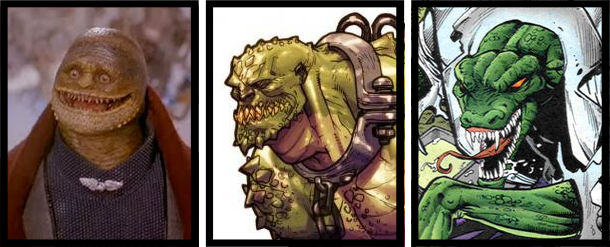
As you can see in the image above, The Lizard has always had a more pointed snout, and looked generally more like, well, a lizard. The torn lab coat is also a trademark for the character, as well as purple pants [apparently he and The Hulk buy their clothes at the same place].

Yesterday the website spiderman.ru released concept art of the film’s Lizard, creating an uproar in internet comic circles. This is not at all what fans were expecting (even after the aforementioned description of the clip), and debates were sparked between Lizard apologists and Lizard die-hards.

I began sifting through the comments sections of blogs, as I am wont to do, and found an interesting disputation between two commenters on this article, with one commenter, Kitradu, stressing that actors wearing masks “should be able to act THROUGH their limitations, physical or mental.” He referenced Willem Defoe’s performance as the Green Goblin in the first Spider-Man movie as being captivating in spite of the helmet he wore which fully obscured his face.

His opponent, storymark, began the debate with the comment:

One of the big complaints about the Raimi movies, the first in particular, was that all the masks prevented any emoting. And very few actors would be interested in a role where their actual performance is obscured.

Personally, I think an expressionless face is boring as hell.

As far as evidence goes, I tend to side with Kitradu. He references V from V for Vendetta as well as Darth Vader in the original Star Wars films as characters that held our attention without us ever seeing their faces (save for that one scene in Return of the Jedi). Emotion is more easily portrayed through a humanoid face, but what does the design change mean as far as the abilities of the actor and our viewing abilities as an audience?

To be fair to storymark, The Lizard is a very different character from either of the examples he provided. He’s far more bestial, and, from what I remember, not particularly articulate. The motion capture that Rhys Ifans is doing may not allow him the freedom Hugo Weaving had behind the Guy Fawkes mask. Though, to refute my own point, this is something Andy Serkis had no problem doing in King Kong, or Rise of the Planet of the Apes. To counter that point, both Kong and Caesar have faces more similar to humans than reptiles.

All debate aside, it should be noted, as a potential last point for this post, that the character design for The Lizard is extremely similar to his original design by Steve Ditko. But maybe there’s a reason his look has changed in the comics we read today.

Christopher Bird: Should Be Writing For Comics

Part of this post hinges on you having read the last one I did, Aaron Diaz: Has a Lot of Opinions About DC. In it I wrote about webcomicker Diaz, his redesigns of DC characters [and his reasons for doing so] in particular. Where that post and this one overlap is that Diaz wrote new origin stories for his reboots, and these have been the subjects of replete praise.

Christopher Bird, creator [and namesake] of the blog Mightygodking, is another man with ideas that involve the intellectual property of others. A man who knows [and loves] comics, he’s written his fair share of posts about them, and demonstrates an impressive knowledge of the work of both Marvel and DC. We would expect someone in his position to have strong opinions about the direction both companies are going with their comics, maybe even implying that either company would do well to hire him to write for one of their properties.

MGK should write Marvel’s Doctor Strange. And he has reasons.

Eight days ago MGK released the 42nd of his “I Should Write Dr. Strange” posts. That’s 42 reasons why Marvel certainly wouldn’t suffer by putting him in charge of writing about the Sorcerer Supreme himself.

The reasons, however, are never directed at his own qualifications. From the very first post, in which he creates a scenario where the colour blue has been magically leached from our existence, he presents stories. There’s little to no explanation whatsoever before he starts it off with the sentence, “One day, you wake up, and blue is gone.” From then on it’s a description of an eerie, uncomfortable scene right up until the last two paragraphs. The last one is but a single sentence, “And that’s why this is a job for Dr. Strange.”

I read through all 42 of his reasons this week, and was thoroughly engrossed and enchanted by every one. As someone who loves comics but isn’t terribly familiar with Dr. Stephen Vincent Strange, I found myself garnering an appreciation for the character and wishing that these stories, all hypothetical, were a reality.

Where MGK really excels in his knowledge of the lore behind it all. Whereas Diaz took and remade characters, creating an entirely new universe for them, MGK makes his narratives fit in Marvel continuity and acknowledges the world he’s writing in even though he has no obligation to do so. When he writes about Dracula he mentions Blade, and when writing about the death of Cytorrak [picture shown above] he makes sure to hint that there’s a chance not all is well with the Juggernaut. He even justifies his entire act of writing these reasons by explaining how it all continues to work even when Doctor Strange was no longer Sorcerer Supreme.

When it comes to writing about comics, especially Marvel and DC, it’s easy to criticize. While Diaz provided an alternative of sorts there’s a sense, in his redesigns, that he rejects a great deal of the characters’ original origins and histories. I enjoyed a few of his takes on a few heroes, but ultimately wasn’t convinced that this was an entire world worth creating.

MGK, Christopher Bird, on the other hand has won me over with his tremendous tales of superheroism and magic. He tips his hat at every turn to the ones who came before him, even though he technically does not come after them. He doesn’t disparage current writers [which isn’t to say that he’s never criticized any aspect of the industry], but instead provides stories, dozens of them, to prove that he knows the character and what he’s doing.

And, if after all of that, he hasn’t proved that he should write Doctor Strange, maybe he can convince you that he should write The Legion.

Aaron Diaz: Has a Lot of Opinions About DC

If you peruse the website ComicsAlliance daily, like I do, then you’ve stumbled upon the increasingly controversial work of webcomic artist Aaron Diaz.

Starting in early October, with his post on tumblr Rebooting the Justice League!, Diaz has gone from being the creator of webcomic Dresden Codak to becoming the supposed saviour of the comic book industry. Featuring his own personal take on DC’s super hero team, he redesigned everything from costumes to origins.

This spawned a few other posts, such as Rebooting DC’s Villains!, in which he recreates the Legion of Doom as the “Secret Society,” and Rebooting Batman!, where the Caped Crusader is recreated to fit his new alternative DC canon [his earlier incarnation of the Dark Knight can be seen here]. Beginning with his take on the Justice League, each post has been featured on Comics Alliance, much to the delight/irritation of its readers.

Diaz states clearly that his reboots were spawned by DC’s own “New 52” [which I discussed, in part, here]. Their new designs for Starfire and Harley Quinn, in particular, were targeted in their elevation of sex appeal over utility. Diaz gets downright aggressive in his post DC Comics Reboots Dresden Codak!, where he imagines what it would be like if the company redesigned his own webcomic.

As you can see above, the female characters are overly curvaceous and barely dressed, while the men are very obviously the same male body type with different costumes and hair colour. While a point is being made satirically, he single-handedly slams the work of an entire publishing company instead of the individual artists or writers responsible for the designs he dislikes.

As one would expect, the comments on his tumblr consist almost entirely of praise for his work. One particular question asks “Can you just, like, take over DC and make this happen for reals? These redesigns actually look like superheroes I WANT to read about.” On his Justice League reboot Stephanie Charette admits that “I have never before commented on anyone’s Tumblr, but I must. This is what the comic’s industry needs to do. THIS. THIS. THIS.”

Leaving his tumblr for more balanced opinions, the comments on his features on ComicsAlliance provide a happy medium between blind adoration and outright disdain. Paying no heed to the ones about the rate he updates his comic [which is neither here nor there], there are comments which were written calmly and logically.

On one of ComicsAlliance’s latest features, Aaron Diaz’s ‘Tales of the Uncomfortable’ Takes a Halloween Look at Harley Quinn, a commenter states that “The message of DC has been beaten like a dead horse (particularly on this site) and I really don’t know what else to say anymore.” Thankfully someone else does, and they bring up a post on the tumblr of webcomic artist Amanda Lafrenais. The commenter even pulls a direct quote:

And I REALLY enjoyed, save for minor nitpicks, Aaron Diaz’s redesigns, criticisms and praise of costumes. However his newest post on the subject about cleavage and crimefighting kind of made me wanna talk about it. A friend pointed out that, yes baring your breasts is very impractical in fighting. But so are capes. And spandex. And having no padding or armor.

In her post Lafrenais goes on to push the idea that costumes aren’t really intended to be realistic [their utility further broken down by Edna Mode]. While she admires what Diaz has done, she implores artists not to “take the fun away,” and that there is a point where “practicality ends and fantasy begins.” Even though her post doesn’t address part of what Diaz is railing against, the overt sexualization of women, she does attempt to soften the extreme logic from which many of his designs were birthed.

On a personal note, I liked many of his redesigns, particularly his take on Batman and Robin. Conversely, I strongly disliked  some of his ideas, primarily taking Gorilla Grodd and making him more “Planet of the Apes” than “Mighty Joe Young.” The man has some great ideas [their originality contested by many commenters on ComicsAlliance], and he aims for a creative revitalization of the industry, which I can agree with.

My issue would be with the apparent bitterness his work gives off. His reboots were all well and good, but his portrayal of DC rebooting his own characters was unnecessary and extreme. I can understand in part why he’s doing what he’s doing, but he could cut down on the vitriol.

Lastly, I was very confused with a particular question I read on his tumblr. When a reader asked if he would be willing to redesign the entire DC universe, similar to what Marvel did with Brian Michael Bendis and their Ultimate line, Diaz responded with “I’d do it, and only if they paid me five times whatever Marvel pays Bendis.” I’m unsure as to whether he meant it sardonically, or if he actually believes he deserves five times the money Bendis does. Either way, I found it difficult to take.

Tune in next Thursday, when I write on Christopher Bird, aka “Mightygodking” [or “MGK” for short]. His titular blog is one of my all-time favourites, and his opinions on comics [and one character in particular] are deserving of some exploration. Particularly when viewed opposite of those of Aaron Diaz.

[follow-up post can be read here]

Attitudes Towards Feminism in the Past Week 2

My first post ever on this blog was the first “Attitudes Towards Feminism in the Past Week.” It’s been quite a few months since then, but I guess it’s just that time again. To be more accurate, though, these are observations I’ve made in the past two to three weeks.

Most everyone knows about DC’s “New 52.” Well, people who know comics know about it. To summarize it quickly, the people at DC comics have decided to relaunch [reboot] 52 new titles this year. Most have since come out.

Since I am wont to read a comic book every now and then, I perused a few of the bigger titles. I specifically went out of my way to read Catwoman and Red Hood and the Outlaws, two releases that  appeared to have been garnering more than their fair share of attention. They weren’t.

Comics Alliance and io9 put it into much better words than I do, and I strongly, strongly suggest you read at least one of their articles. If I were to personally point out the problems with both comics, they would go as follows:

In Catwoman her first on-panel appearance involves her changing into her suit; red lingerie and butt/boob-shots abound. The issue ends [SPOILER] with her and Batman having sex. It ends with a whole page of them just- going at it.

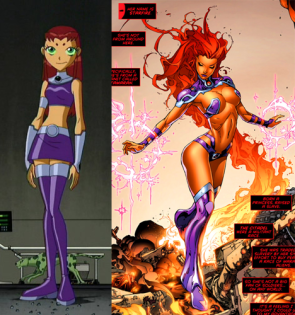
Red Hood and the Outlaws is a comic which features Starfire, a character who also showed up in the immensely popular cartoon Teen Titans. My problem here isn’t so much with her costume design [on the right]; it’s what you expect from most female heroes nowadays. My problem is that she spends most of her time out of that costume and in a barely-there bikini. She also wants to basically have sex with everyone.
DC’s responded to fans’ reactions about Starfire on Twitter. Essentially, we’re not supposed to be letting our kids read these comics.

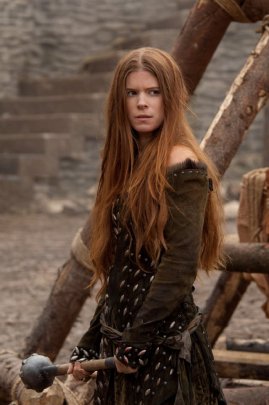
This past Sunday I watched Ironclad, a period piece which features Paul Giamatti as an irate Prince John trying to take over in spite of the Magna Carta he just signed. Baron William de Albany, played by Brian Cox1, must defend a castle alongside templar Thomas Marshal [James Purefoy]. Kate Mara plays Lady Isabel, who occupies the keep they guard.

Lady Isabel serves two purposes.

1) To be a strong female character in a heavily male-dominated film/era.

2) To incessantly try to seduce Marshal, haranguing him about how his vows keep him from love and that he should listen to his emotions.

I hated Lady Isabel.

Mara’s character strives to be both fierce and independent [she hits a man in the face with a mace]2, yet her single goal seems to be trying to get into a templar’s pants [tights?]. As a role model she teaches that the ultimate victory is not over the iron grip of royalty, but instead the taking of a holy warrior’s virginity.

In two comic issues and one film [all released in 2011] we’re given a picture of what strong female characters should be. Attractive, certainly, but also sexually aggressive. Sexual freedom and independence seems to be what helps define a woman as strong and in control. This has caused me to come to the conclusion that the last thing I want my daughter becoming is a “strong female character.”

This has been  attitudes towards feminism in the past week. Two.

1. Who I must point out was also Colonel William Stryker in X2. It’s the only thing I can think when I see him.

2. Though when you take into account the fact that one man is cleaved in twain and another is beat in the face with a disembodied arm, it’s not that big an accomplishment.

Everyone’s Talking About Miles Morales

It doesn’t matter if comics are something you keep up with or not, you’ve probably heard the news: Spider-Man is black. Yes, you’re reading it here for possibly the third or fourth time, but it’s true. Our resident wall-crawler is now a person of colour, and people are not happy.

In case you haven’t heard anything at all about this change, allow me to restate what’s been said a thousand times already. In the Ultimate Marvel universe Peter Parker has died, and replacing him is a half black, half Latino teenager by the name of Miles Morales.

Ever since this news was announced by USA Today five days ago the internet has erupted in outrage. Many see Marvel’s decision as the purest example of forced diversity, that in the politically correct culture we live in this is just one more addition to a long line of changes made to make us more accepting.

What’s really riling people up, though, is the media. Erik Hayden’s article for The Atlantic Wire entitled “The Backlash to the Backlash of a Multiracial Spider-Man” informs us that the way the news is being portrayed is strongly affecting how we react, whether it be Glen Beck tying this change to something Michelle Obama said or Scott Mendelson of the Huffington Post pointing out that “[. . .] Parker Had To Die To Make It Happen.” As media consumers people are taking on opinions and making them their own.

The most upsetting article so far was one I found on The Daily Mail website entitled “Marvel Comics reveals the new Spider Man is black – and he could be gay in the future.” My problem with the article was not that they misspelled his name and omitted the dash, it was the gross assumption implied by the title, and the fact that said title would both pull in and incite readers.

The title is based on a quote [found in the article] by Sara Pichelli, an artist who created the new Spider-Man’s look. It goes as follows: “Maybe sooner or later a black or gay – or both – hero will be considered something absolutely normal.” Nowhere does she mention that Miles Morales might be gay. Nowhere in that statement does she even hint at it. All Pichelli did was muse that perhaps one day our comic book heroes will have a little more diversity.

My ire at faulty journalism aside, allow me to lay down a few facts that may be able to extinguish any flames of frustration over this change in character. Miles Morales is the new Spider-Man in the Ultimate universe. Peter Parker died in the Ultimate universe. It’s not regular Marvel continuity and as far as anyone is concerned in the regular comics Pete’s still donning those red and blue webbed tights and trash-talking the petty thugs of New York City.

If you can’t cope with the very fact that Marvel had the audacity to kill Peter Parker in the first place check out the Wikipedia page on Ultimatum. People die in the Ultimate universe all the time, and it’s almost always permanent. If key members of the X-Men can bite the bullet then really anyone’s fair game.

On the off chance that you’re still upset tune in to MGK [Mightygodking] and what he has to say about the topic. He’s got a point.

The Batgirl of San Diego: Diversity in the DC Universe

Yesterday I was blessed with the opportunity to interview “The Batgirl of San Diego,” a woman who was at this year’s SDCC [San Diego Comic-Con] dressed as Stephanie Brown’s alter-ego. While she was there she appeared at every DC panel and asked questions which were met with responses ranging from indifference to open hostility. Gotham’s Batgirl may have rid the city streets of crime, but San Diego’s fights to ask why there aren’t more women in comics.

She responded with more thoroughness and thoughtfulness than even I expected, so I asked as many questions as I could before our time was up.

Evan: You made quite a scene at this year’s Comic-Con. Could you explain to us in a few short sentences what exactly went down?

SDB [San Diego Batgirl]: I don’t know that I would say that I ‘made a scene.’ I attended several of the DC Comics panels and asked questions about what I saw as a lack of female presence, both in comic books and on the panels. The audience, while receptive initially, eventually seemed to grow angry that I was asking these questions.  The main questions were simple: “Where are the women?” in response to the fact that there was not a single solo title cover featuring a woman in the entire Justice League line-up (though I believe Wonder Woman is supposed to be included), “Are you committed to hiring more women?” in response to the fact that the panels I attended were entirely male with only two exceptions, and one addressed to the room asking whether people there would buy and read a comic written about a strong, intelligent female protagonist.

Evan: Do you believe that DC has a large number of strong female characters?

SDB: The female characters DC has are definitely strong.  But let me give you some statistics presented by another women at one of the panels. She went through and counted, and out of 98 prominent figures on the covers, 27 were women.  Out of 28 single character titles, six were women.  As you can see, about a quarter of the DC universe lead characters are female – which means that the other 75% are male.  On the other hand, there are many existing female characters that aren’t being used or are being underused.  If DC were to bring these existing characters more prominently into the spotlight, it would be easy to make this ratio a little less extreme. Continue reading