Category Archives: feminism

Evan and Gordon Talk: The Bechdel Test


EVAN:
So I came across a little something called the “Bechdel Test” through an article on racebending.com. It’s a test that’s supposed to rate how well a film does in terms of portraying women. That’s a rough description, anyway.

GORDON: I’ve heard of it in film criticism. It essentially asserts that for a film to have “real” female characters, it must have a scene in which (1) two women (2) talk to each other (3) about something other than a man. Sounds simple enough, but you’d be blown away by how many movies fail it…

EVAN: And the thing is, some of these movies happen to have perfectly good “strong female characters.” The site bechdeltest.com lists films that do or don’t make the cut, and in the comments section many a person states “but this female character was such and such…”

GORDON: Example?

EVAN: User “lili” disagreed with the rating given Wrath of the Titans, saying:

Although conversation between the two named women was minimal, the character of the main woman was well developed with no sexual stereotyping or weaknesses. I think it passes the Bechdel test in spirit, if not in actual letter.

GORDON: See man, as much as I’d consider myself a feminist, I really don’t like the Bechdel Test and some of the assumptions it seems to make. A lot of it just really doesn’t pan out- I’m looking at the list they’ve got here, and it’s seriously twisted.

Check it out- Sex and the City 2- easily some of the most misogynistic and racist crap out there gets a free pass, and movies like The Rum Diary or Rise of the Planet of the Apes– which have way better portrayals of women- are failed…

EVAN: I mean, it’s easy to see why their criteria was picked- having the women named is extremely important, as it’s a pretty solid way of ensuring that they’re actual character and not just waitresses or other extras. Also having them talk about something other than a man. That’s pretty important stuff, I think, in maintaining that they’re not just female verbal support for the male lead.

Where it really falls apart is the second part of the test: the need for the female character to have to talk to each other-

GORDON: I don’t think you’re being quite hard enough here, dude- this is a bad test. Look at it this way-

The first criteria is that there be two women, which is dumb because it assumes that a woman’s identity is based on how she relates/matches up with/differs/etc. with other women. Totally disregards her qualities (or failings) as an individual, y’know? The second criteria is, like you say, that they have to interact which each other, which again doesn’t make much sense (see previous point). And the third point, while decent, also kinda falls apart- if two men talk to each other about nothing but women, are they not real male characters? Kinda throws relationship movies out of the window.

…Point is, the test sorta shows you when a movie drops the ball on female characters, but a “passing grade” doesn’t really mean much of anything.

EVAN: I agree with you completely. Part of the reason I’m a little less harsh is thinking about how to construct/write a single test which judges a film on something as deceptively simple as the “active presence of female character,” as Feminist Frequency would put it.

GORDON: Well, what makes a female character a female character?

EVAN: Well, I took Human Sexuality my senior year of college, so I can think of a few key specifics-

Continue reading

Fascists, Skinheads, and Nazis (Oh My!)

As you all doubtlessly know, two days ago, a gunman entered a Sikh temple in the little town of Oak Creek, Wisconsin, killing six and injuring four more before being shot dead by police. The killer, one Wade Michael Page, was connected to a number of vicious white-supremacist groups, most notably the “Hammerskins”, a white-supremacist group that focuses on dispersing racist messages and propaganda through music- Page being the founder of one band and a member in another.

Why is this even being brought up here? As strange as it may seem, there’s an argument to be made for the Oak Creek massacre having its origins in culture. Now many of you might be thinking of the Aurora massacre, and no, this isn’t some discussion about our attitudes towards guns, violence in media, or anything of the kind. There’s certainly a good discussion to be had on that subject as well, but it’s not what I’ll be addressing here.

No, what I’m going to be talking about is this:

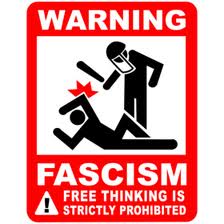
Fascism.

It’s coming back.

See, the idea that the culture, traditions, and history of specific people group are superior to those of all others and should be promoted and maintained through brute force didn’t die when Hitler blew his bigoted brains all over an underground bunker in Berlin, or when Communist freedom fighters gunned down Mussolini in a picturesque Italian village. It’s been dormant for a long time, but in recent years, it has again shown its ugly face.
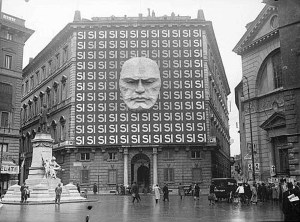
Nope- uglier than that…

While there have been plenty of racially motivated murders over the years since Nazism fell (to say nothing of countless lesser hate crimes), what we’re seeing now is a resurgence in full-fledged Fascist ideology- but before we get into that, just a side note.

For many of you, the term “Fascism” probably conjures up images of generic authoritarianism. Obama’s a Fascist. Rush Limbaugh’s a Fascist. That one really strict teacher is a Fascist.

I’ve struggled for a while to come up with a good, succinct definition for what Fascism is all really about, so I’m going to offer this illustration. To a Fascist, his people (often, race) are inherently great and good, and they are inherently great and good because of their traditions, values, and culture, which are all also inherent to them. The greatness of the nation is lost when evil, conniving undesirables start pushing their own cultures, values, and traditions, which are subversive and degenerative to the nation. Therefore, these degenerates who threaten the nation must be stomped out (often quite literally), and the “original” culture/traditions/values must be restored, enforced, and maintained through an all-powerful government, police force, military, etc.

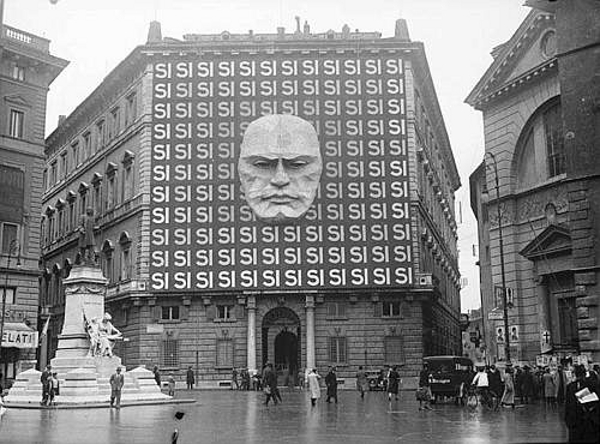
There’s more to it, of course. I could talk about the concepts of autocracy, corporatism, use of ancient Roman symbolism, and the like, but for now, let this all above be the definition we work with.

Now why do I say it’s coming back? Certainly if we disregard the recent massacre and the occasional race-related attack, there doesn’t seem to be any major Fascist threat in the US. The KKK isn’t roaming with impudence in the South. Gangs of Nazis aren’t attacking Jewish stores and businesses. Self-proclaimed defenders of the nation aren’t roaming the boarders trying to-

Oh yeah…

Ok, but it’s not like there’s been any major attack on people for having different skin or heritage or religio-

Ok, fine, but it’s not like any of this bigotry has been legislated or-
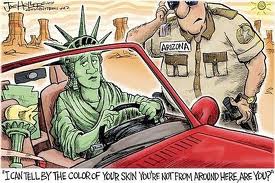
…Yeah…

See, that’s how it works. It’s subtle, discreet. The great Sinclair Lewis perhaps said it best:

And this is just America. In Europe, Fascism is even more prevalent and less shameless, simply take a look at France, where the government has instituted laws banning certain forms of Muslim garb, or forcibly expelling the Roma Gypsies.
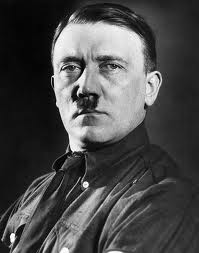
I recall another guy who took actions to get rid of gypsies…

Over in Germany, Chancellor Angela Merkel declared that “Multiculturalism has failed”

Kinda forgetting about the last time a German chancellor declared the failure of multiculturalism…

…And in Britain, holocaust-denier Nick Griffin, leader of the white-supremacist British Nationalist Party (BNP) was elected to the European Parliament. That’s about the equivalent of the Grand Wizard of the KKK getting elected to congress.

I’d show you an actual picture of Nick Griffin but **** that guy…

And this is to say nothing of the escalating attacks on immigrants across Europe. Why? Because many Europeans and Americans are buying into the idea that the values, traditions, culture, and beliefs of other people are a direct threat to them. I recall in college on particularly nasty student who asserted that “All immigrants should go home”. Interesting, considering he had an Italian last name. Does he mean that he too will leave America? Of course not. Does he mean the Canadians who attended that school? Not at all. “Immigrants” was simply code for those “undesirable brown people”. But don’t take the words of one bigoted student as evidence of this ugly trend- just look at Congressman Steve King’s attempt to make English the “Official Language” of the US!

Now why on earth would you try to make English the official language of the US? It’s not like the vast majority doesn’t already speak it. And what if we did speak Spanish? How would it make a difference to anyone what we speak… unless English was somehow viewed as “inherent” to America!
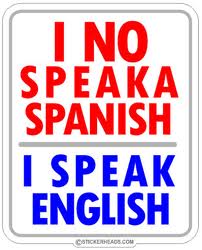
There’s really part of the problem. It’s a perspective on society. Back in College, I had a conservative friend whose opposition to gay marriage was that “the traditional family is the building block of society, and changing the family weakens society”. I’m not saying he’s a fascist- not at all, but this view of society as a solid, unchanging thing is what really serves to create so much of the general bigotry and outright fascism that we see today. When society’s well-being is linked to culture, to maintain society is to maintain culture, and while there’s a certain logic there, all too often it’s taken to mean that every aspect of culture, right down to traditional gender roles, religion, and racial demographics, must be controlled. It’s the reason why you see Muslims, immigrants, homosexuals, or as the past couple days have shown us, Sikhs, targeted. And don’t for a minute imagine that it’s just Aryans who take up this line of thought. I recently had an encounter with an Asian immigrant who cited that his country was once upon a time a “Christian country”, and that he was concerned at Hindus, Buddhists, and the like building places of worship in his community.
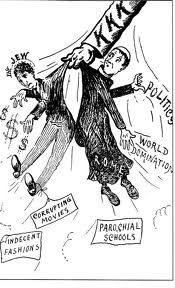
Only where does it end? Suppose you argue that non-Christians should be excluded from a country because their cultures threaten the stability of the nation- what the minority groups? I always want to bring this up when I hear someone make the argument that America is a “Christian Country”- does that include the Mormons and Jehovah’s witnesses? What about Unitarians? Episcopalians? Catholics? Mennonites?

That’s the crux of the matter. The Fascists- both the self-declared and the self-deluded- would have us believe that we’re all hopelessly divided. That we cannot respectfully disagree with each other. That you can’t speak Mandarin and I can’t speak Arabic and the two of us get along. That multiculturalism is a fantasy. That we can’t have our own practices and perspectives while all agreeing, to some degree, on how to live together. We’re meant to live in constant fear that if we tolerate anyone who doesn’t fit in, there goes our way of life.

So let it go.

This will be harder for some than others…

The title of this blog is the Culture War Reporters, and perhaps what needs to be understood is that the culture war isn’t something that can (or should) be won. There’s always going to be divergence in opinion and in behavior. There’s always going to be new things coming in, and old things struggling to stay on. There’s always going to be good stuff and bad, so at the end of the day, why worry? Don’t buy the idea that culture can be maintained, or that one group has found all the answers. For all the dark content about murders, genocide, and the like, strange a line from Disney’s Ratatouille should fit so appropriately. Defending his lifestyle against the accusation that it’s “against nature”, Remy the rat declares that “Change is nature”.

Is “Art of Manliness” Sexist?

Imagine my surprise to log on to Culture War Reporters to jot down my Tuesday post, only to find Elisa having already written something. I can only imagine that her cutting in on my territory means that she’s looking to start a fight so vicious, bloody, and prison-lunch-line-shanking-ly brutal it will make the combined carnage of the fall of Masada and the genocide at Wounded Knee look like a slap-fight between a couple of elderly Mennonites.

But I’m not here to talk about that. I’m here to make good on my promise last week- to investigate and determine whether or not Art of Manliness is sexist.


Of course, before we begin we have to define what “sexism” is. The obvious answer would be discrimination/prejudice against women, but it has got to be more than that. The stereotyping of women (regardless of whether its positive or negative) has also got to be a part of sexism, just as much as it would be a part of racism or any other form of bigotry.

Now at first glance, Art of Manliness really doesn’t touch on the subject of gender relations all that much. For every one of their articles on subjects such as “What to Wear on a First Date“, there are ten articles on how to shine your shoes, shuffle a deck of cards, hitchhike around the US, make maple syrup, and even a world history of shaving. On the whole, the blog is far more invested in trying to break from what it sees as a culture totally lacking in strength, competence, and independence.

But of course, you really can’t devote an entire blog to what makes a man a man without every once in a while stumbling across the subject of women.

For example, take a look at “Women and Children First? Down with the Ship?” or “Womanly Things We Wish Women Still Did“. In both cases, the author simply brings up the subject, allowing the readers to duke it out in the comments section on whether or not the old cry of “Women and children first!” is still right or fair (or if it ever was to begin with).

On the whole, Brett McKay (the principal author) understands that the subject of feminism and feminist issues are still quite controversial, and only more volatile in the venue of his Art of Manliness blog. For the most part, he either allows his readers to debate such questions as “should men hold doors open for women?”, or refers the issue to his wife (and co-author) Kate. Indeed, from everything I’ve read on the blog, it would appear that the single most “edgy” post on gender roles (“What Can Manly Men Expect of Women?”) really doesn’t do anything more than point out (what the author sees) as a double-standard in what men and women can ask of each other. In fact, I’ll stick my neck out there and say that the author makes some solid points on women’s issues and feminism.


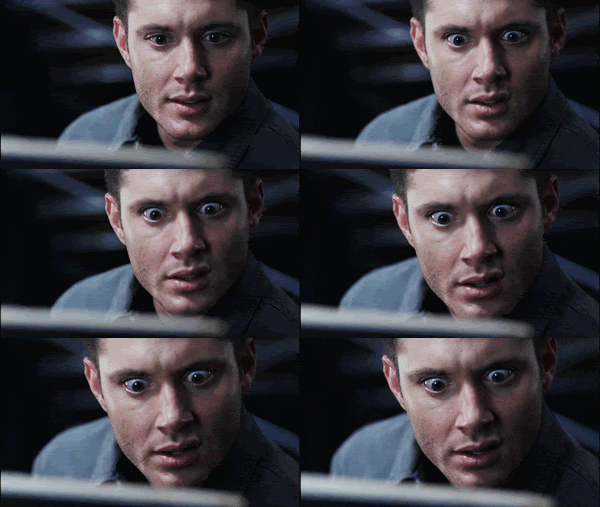
When I was in college, my house was once visited by a collection of female students bearing cookies that they had baked for the men of the campus. The self-titled “Domestic Divas” claimed their mission was to call for a return to “Biblical” roles for men and women, and a rejection of “feminism”. My reaction, and the reaction of every sane man and woman on that campus, went sort of like this:


As many pointed out, this well-meaning but idiotic group had ignored the fact that their ability to be at college (or to speak to men without us having spoken to them first) was a direct result of feminism. And while perhaps not as extreme as in the case I just cited, this basic problem seems rather prevalent in our culture- many women seem to take the struggles and hardships of their predecessors for granted. The (few) benefits of 1950s society are looked back on fondly, but the abuse, neglect, and degradation is completely forgotten. I don’t think Brett McKay is sexist for decrying equality in gender roles combined with inequality in social expectations. McKay isn’t stating that its a woman’s place to dress up for a date, but simply that its as an appreciated gesture as flowers or getting the door.

No, I think Art of Manliness is sexist for completely different reasons.

And in the defense of the authors of the blog, I don’t think it’s anything intentional.

My main issue comes down to this. Art of Manliness is a good site. Heck, it’s a great site. The information is useful, the writing is concise and simple. The subject matter is instructive and edifying. Only it’s directed solely at men.

Don’t get me wrong, I’m not saying that I don’t think both myself and the males of my generation could stand to toughen up a bit…

I just don’t think that the characteristics or skills in the blog are in any way unique to men. Starting fires, shooting guns, shuffling a deck of cards, picking out a good scotch, backing up a trailer, breaking down a door, wrestling alligators (yeah, that’s an article)- these are all things just as useful to women as they are to men. There’s even an article titled “How To Parallel Park… Like a Man!“.


See, I’d imagine that we’d just call that “Parallel Parking”, since driving isn’t exactly exclusive to men or something men are just better at. And I don’t want to hear the whole “Men are evolutionary predisposed to having better spatial judgment” schpeel. First, if it’s correct, it just means men are more likely to have better spatial abilities- it’s not universally true. Second, just because I’m six feet tall doesn’t mean I stand a chance against a five foot NBA star in a basketball match- training trumps negligible physique every time. I’m a man and a relatively new driver- I’d bet that every woman driver in the city I live in can parallel park faster and better than I can.

Case in point…

The real problem with Art of Manliness isn’t so much the content but that the content is labeled as being “for men”. Even the abstract qualities brought up in the blog are good for men and women alike. The post on the virtue of justice uses an illustration in which justice is depicted as a woman, for ****’s sake. Bravery, intelligence, perseverance, leadership, heroism- can you really tell me that these aren’t just as admirable in women as they are in men?

(Just as a final note, I want to thank and recommend Reaction Gifs, from where I frequently borrow my illustrations- it’s a neat site, check it out).

Sexism, Reductionism, and Stepping on Women’s Heads

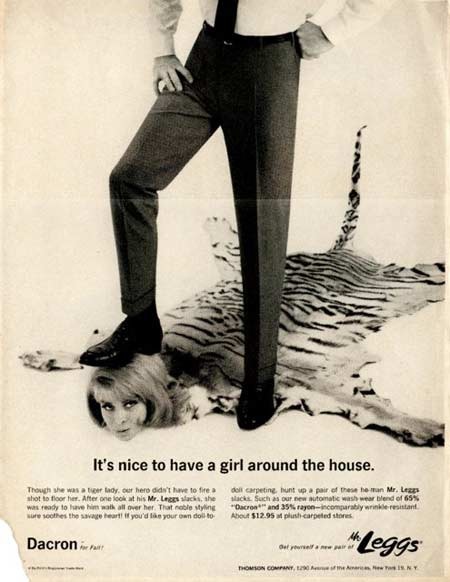
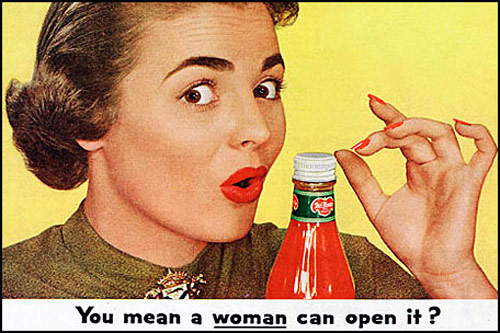
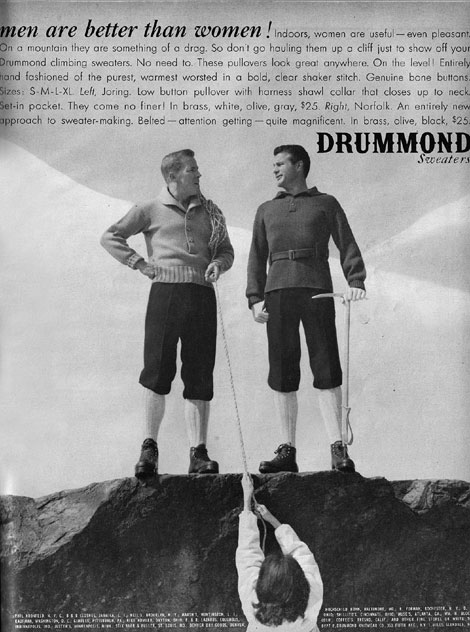
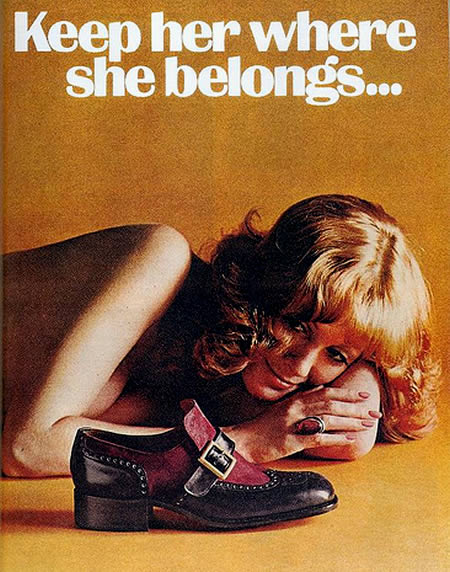
So Retronaut has a page of “Vintage Ad Sexism” – hilariously sexist ads, many of them aimed at men’s pride (“brand new man-talking, power packed patterns that tell her it’s a man’s world”) or women’s insecurities (“Would YOUR husband marry you again?”). There are some gems in there, like these:

source: retronaut.co

I'm just gonna let these speak for themselves.

source: retronaut.co

source: retronaut.co

Read some of this one for the full effect

source: retronaut.co

And this one might be my favorite…source: retronaut.co

Aren’t some of them kind of frighteningly recent-looking?

So yeah, we remember sexism, 1919 and women’s suffrage and bra-burning and all that. Being shocked that women couldn’t vote, etc. But seeing advertisements make it more harrowing. Serious political oppression at least treats women with enough dignity to be oppressed – advertisements make light of women as entities. I am less concerned with the essential sexism in these than I am the reduction.

Violence and political oppression are horrid, yes, but reduction is more insidious because it tends to keep hanging around long after voting rights have been own and salaries have been evened out.

The advertisements here, of course, appear ludicrous to us. “Is a wife to blame if she doesn’t know [to use a douche]? Yes! She’s decidedly to blame.” The one with the rug with a woman’s head, the man standing with one foot on her head Captain-Morgan-style. Some of them are just ridiculous.

But it is good to remember that as insane as they may seem, these are real, and they are recent. People who saw these ads and accepted them as a relevant way to advertise a product – people who made the ads, laughed at them, nodded in agreement – still make up a large part of our society today. Even after that generation dies, the fact is that American culture (it’s what I’m talking about here; can’t speak to other places) has been steeped in the reduction of women – and this is not an influence easily shed.

Now, establishing a double standard to “make up” for lost time is not the answer. Ensuring that all males are instilled with a sense of guilt about the past will not help society. Only by awareness of our ideological roots, and the flaws and violence therein, can we stay – or at least slow – regression.

Hitler, Ray Comfort, and the Dismal State of Discussion

I did something bad for my health that I do not recommend. I watched “180”, a half-hour documentary made by Ray Comfort.

It is a bastardization of discourse from all sides. In an interview with Steve, a neo-Nazi punk type of young man, Steve says that he’s certain of his opinions about the falsehood of the Holocaust and other offensive things. To combat this, Comfort asks Steve to spell shop (Steve does) and then asks: “what do you do at a green light?” The question is a trick to get the mind to quickly respond “stop”, which is semi-associated with green lights and rhymes with “shop”, and the person answering looks silly. Sure enough, Steve responded “Stop” and looked silly. And then – well, then Comfort treated that like an actual argument for something.

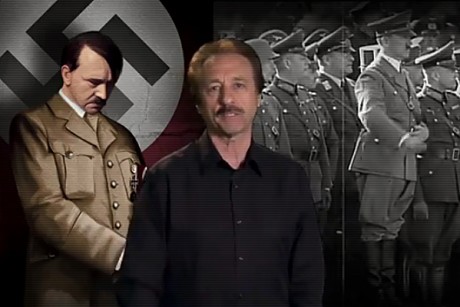
The documentary was dipped in dramatic music, photos of piles of dead bodies, and use of gratuitously violent photographs. What is most interesting to me, however, is the use of what seems to be the universal argument-ender: comparisons of things to Hitler.

Hitler, the Nazis, and Lazy Discussion
Hitler and the Holocaust have become mythic elements of American culture, I think, and to the detriment of the truth of the actual historical events. I was recently visiting a small church where the members, after the service, started (sort of randomly) to wax poetic about the horrors of Hitler and the Nazis. They weren’t saying anything new – everyone was just affirming that Hitler was inhuman and the Nazis were too. It was the fervent insistence that “real humans could never do that sort of thing” that struck me – I thought of all of the other genocides and massacres of the past century alone, of the killing of civilians in wars by troops of every nationality, of atomic bombs. But even in light of all of these things, current conversation about Hitler seems to serve contrast to our new, very human, very un-barbaric society. We talk about Hitler basically like Satan – an ultimate evil; a rhetorical catch-all.

Ray Comfort and 180: Unethical Discourse

Steve, in the movie "180" by Ray Comfort

Comfort’s specific use of the Hitler argument is reductive and tired. It is, if anything, an exploration of how charged and empty rhetoric in the realm of politics is being mirrored in general culture. His interviewees are inconsistent, and seem to know very little about philosophy, theology, or basic logic. Comfort’s questions are also always precisely and pseudo-cleverly leading, and it doesn’t seem that he wants to engage with the interviewees at all: “Does this mean you’ve changed your mind about abortion?”, he asks. “Are you going to vote differently in the future?” It is not a conversation, is the point: it is a poorly executed set of rhetorical acrobatics. Is this the way to foster discourse and an informed public? Probably not. Arguments depending on rhetorical cleverness are insulting to both parties.

Comfort’s series of interviews are not only annoyingly inconsistent and poorly constructed, however: the movie is also a manipulative presentation of complex issues and events, presented crassly and with a smugly triumphant attitude. One of the less graceful moments was when Comfort asked a woman if she’d had an abortion; she said that she had. He then immediately asked: “Do you feel guilty about it?”

As the big finish, Comfort sets up a game-show setup of moral responsibility and the afterlife, and awkwards them into admissions of fright and death anxiety:

  • Comfort asks people if they have lied/stolen/been lustful: most of them say that they have.
  • Comfort then gets them to admit that this makes them liars/thieves/adulterers.
  • Comfort gets them to admit that liars/thieves/adulterers go to hell.
  • Comfort elicits from the interviewees an understandable anxiety about the prospect of hell.
  • Comfort asks them if they are going to go read their Bibles.
  • Some of them say yes.

Alesia, from Ray Comfort's movie "180"

Theologically, morally, rhetorically, and logically, this is one of the most horrible things ever. Comfort’s quick-talking way of “tricking” people into professing a fright of punishment does very little for the moral health of humanity or the search for truth within rhetoric and theology. The triumphant music and photos of bloody sheets are no help for the legitimacy of the movie.

There are also 40 thousand comments. I do not recommend those either. They are not a happy picture of humanity.

It makes sense to protest the legalization of abortion and to be horrified at the amount of deaths occurring if one believes that life begins before birth. Comfort’s smugness and “gotcha” questions, however, lack earnestness, humility. The whole thing turns a serious situation into an awkward and unproductive onslaught of unhelpful rhetorical inconsistencies, devoid of integrity and, therefore, real efficacy.

In sum, the movie is a disjointed account of unproductive discussions with unproductive people with vague and uninformed opinions. It’s a disheartening representation of the state of discourse on American sidewalks.

Attitudes Towards Feminism in the Past Week 3

If you are a person who gets their video game news from the Penny Arcade Report, this won’t be new to you. If you’re a person who doesn’t read video game news much at all, this is not a post that will enhance your views of the subculture.

The article is here, and I strongly recommend you read it. I’m going to be summarizing the issue pretty succinctly, so it’s definitely worth a read.

Cross Assault, a Capcom-sponsored event is “the world’s first fighting game reality show.” It features ten contestants, with half being experts of the Street Fighter games and other half being highly proficient at Tekken. Since the show is streamed live online, there’s evidence on the web of all of the reprehensible behaviour that was featured on it.

The primary individual I’m going to be writing about is Aris Bakhtanians, the coach of the Tekken team. To sum up his stance on women and fighting games, he’s quoted as saying that sexual harassment and the fighting game community are “one and the same thing.”

The victim of the harassment in this case is Miranda “Super Yan” Pakozdi, a member of his team. She forfeited a match due to mistreatment by her coach. Below is a video of the first day of the show. Below that are quotes pulled from the clip, in case you didn’t want to hear/watch all of that.

Miranda vs. Sheri mud wrestling cage match, what do you think, Miranda? [. . .] That’s the theme, mud wrestling. And then I get the winner?

How does Miranda smell?

Miranda, I want to know your bra size.

I want to hang a Mona Lisa in the ladies room with the eyes cut out.

That’s all from the first four or so minutes of the video. I’m not certain of whether or not all of the quotes can be attributed to Bakhtanians.

The Tekken coach did email Patrick Klepek at GiantBomb.com with a full apology. To sum up where he’s coming from, he cites the origins of the fighting game scene in arcades as a large part of the subculture. People trash-talked a lot back then and he is, in part, afraid that bringing this world into the public eye will censor a lot of what created it in the first place.

This was a combination of the people taking things out of context and my own inability in the heat of the moment to defend myself and the community I have loved for over 15 years.

In other news, yesterday podcaster/writer Mur Lafferty posted on her website a response to a New York Times article from last year titled “‘Tough, Cold, Terse, Taciturn and Prone to Not Saying Goodbye When They Hang Up the Phone.’” In the article Carina Chocano derided the “strong female characters” that appear in pop culture are defined primarily by being the “strong, silent type.” She also complains that the aforementioned women also show little to no traditionally feminine traits.

Lafferty’s post, “Strong Female Characters, My Own Definition” argues that these characters do exist, and that that they’re “[women] who can take action, who [aren’t] passive.” The following quote was also the one featured on i09’s article [where I discovered the articles]. It’s a good one.

Strength is taking charge of your own destiny and not waiting on others to do so. You don’t have to swear and drink and beat people up and slay monsters. You’re allowed to cry and take care of children and cook and get your heart broken and dress up and date and get pregnant. But when decisions have to be made, a strong character makes them and doesn’t wait for someone else. When a monster is chewing on your true love, you hit it with a stick (or pick up the sword that’s RIGHT THERE.)

I also highly recommend reading both articles, as Lafferty’s fuller, more complete definition manages to soundly trump Chocano’s.

milehighTo end this all off with my favourite subject, comics, Kate Beaton, Carly Monardo, and Meredith Gran created Strong Female Characters last summer, a clear parody of how they saw women portrayed in the media. With names like Georgia O’Queefe, Queen Elizatits, and Susan B. Assthony, these are three ladies who know how to pose while showing off as much of their assets as [in]humanly possible. They featured in a decent number of strips, all hilarious, which can be read at Kate Beaton’s site here.

This has been  attitudes towards feminism in the past week. Three.