Category Archives: film

World War Z Minus the History

In 2006 Max Brooks’ novel World War Z: An Oral History of the Zombie War hit bookshelves across North America. As a sequel to his previous book, The Zombie Survival Guide, it was guaranteed to acquire cult status, with zombie-lovers all over the world treating its predecessor as a bible for the imminent undead apocalypse. Fans were thrilled when it was announced just the following year that the rights to the film adaptation had been bought by Plan B Entertainment, Brad Pitt’s film production company.¹

Although the film struggled early on financially2, filming finally went underway this summer. It wasn’t until just three days ago, however, that Paramount released their official synopsis for the film, which goes as follows:3

“The story revolves around United Nations employee Gerry Lane (Pitt), who traverses the world in a race against time to stop the Zombie pandemic that is toppling armies and governments and threatening to decimate humanity itself.  Enos plays Gerry’s wife Karen Lane; Kertesz is his comrade in arms, Segen.”

Cue instant uproar from the entire internet.

To be fair, film adaptations of books have often changed substantial plot points to the benefit of the film’s reception, et cetera. Stuart Little was a hit with children because it didn’t feature what is essentially a mouse who acts like a little man who was born of a human womb. Teenagers enjoyed A Walk to Remember because it was set in the 90s and not in the mid-1950s.World War Z, however, is not a novel that required such significant changes.

In reference to the latter part of the title, An Oral History of the Zombie War, the novel consists of a number of interviews conducted just ten years after the last country was officially deemed victorious over the undead hordes. What makes the scope of the novel so grand is who is being interviewed.

Beginning with Chinese doctor Kwang Jingshu and the minor outbreak in New Dachang and reaching as far as Xolelwa Azania of South Africa, reading through World War Z is a global experience. Tying the novel together are several interviews with Todd Wainio, a former U.S. Army infantryman who had taken part in the greatest military defeat of the Zombie Wars.

Pitt’s adaptation with himself as a modern-day Cassandrais not the story that needs to be told. By omitting the latter part of the title the film will ultimately fail to capture what made the novel stand out among the rest: an almost uncomfortable sense of peace after a decade at war and one man questioning why exactly it all happened.

The film will be watched by many because even those who haven’t read the book have heard the title World War Z. They were probably raved to about the novel and how it captured the horrors of a zombie pandemic in a way that was both realistic and emotional. It’s too bad that they won’t realize the film is just another fast-paced action thriller with a bit of zombie thrown in until they’re sitting in their seats.

1. Plan B Entertainment was originally founded by Brad Pitt, Jennifer Aniston, and some other dude. Which had to have been awkward, especially for the other guy.

2. It’s hard to believe the amount of fun these newswriters must be having coming up with these titles. Source: http://nymag.com/daily/entertainment/2011/03/world_war_z_brad_pitt.html

3. From the reliably titled site, Movies.com: http://www.movies.com/movie-news/world-war-z-movie/3869

4. As well as significant deviations from the plot as well as Shane West as a rebellious badboy, etc etc.

5. King Priam’s daughter, soothsayer of Troy. Warned her countrymen the danger that was the Trojan Horse, to no avail. Just in case you were wondering.
Liam Neeson to costar in Battleship

So, back in 2008 Universal Studios and Hasbro announced a movie deal that would center around Hasbro games like Battleship, Ouija, Clue (wait, don’t we already have a Clue movie? How can anything without Tim Curry be any better?), Candy Land, and Magic the Gathering. Most normal people promptly forgot this fact because our attention spans don’t last the length of a movie production with no news. But on August 3rd we found out that Universal was dropping Clue (though Gore Verbinski will still be making it), Monopoly, and Magic, leaving them with Battleship, Candy Land (CANDY LAND??), Ouija, and Stretch Armstrong. Personally, the potential of 7 board game movies being released in the next decade makes me want to buy stock in foreign companies.

And so Battleship is going to be the first lovechild of this unholy coupling of basically plotless board games and film; the trailer was released in late July:

It stands to reason that battleships might be the worst things with which to fight aliens – aliens that, bizarrely, don’t seem to want to attack a city or government or mine for Unobtanium or whatever, but just want to trap some Earth ships, which are defending nothing, in a semisphere of their intense technology, instead of just flying over them or dropping some huge alien bomb on them, which one assumes they could do.

Rihanna will appear in Battleship, inexplicably, dressed in something suprisingly unsexy; requisite hot-daughter-of-authority-figure-and-romantic-interest-of-authority-challenging-protagonist1 is played by generically-hot Brooklyn Decker (the trailer opens with a “There will be sexiness as well as battleships!” shot of her in denim shorts and a white bikini straddling the authority-challenging-protagonist on the beach).

Liam Neeson, Oscar and Golden Globe nominee, known best for his iconic role in Schindler’s List (and less fondly for his hideous hair in Star Wars I), will be delivering lines like “I don’t know what my daughter sees in you.”2

The only connection to the actual game of Battleship seems to be that there are ships and, presumably, a battle – but I guess that’s really all they had to go on anyways, short of making the ships have giant pegs on the bottoms of them.

And yes, everyone thought Pirates of the Caribbean was going to be terrible, and yes, Pirates of the Caribbean was awesome, but the justification of similar hopes for Battleship becomes extremely weak when the last, super-duper-intense-and-awesome lines of the trailer are:

Liam Neeson: Prepare to fire.
Man In Charge of Firing: Sir, which weapons?
Liam Neeson: All of them.

I mean, seriously, I know this isn’t where art films come from, but is this all our big movie businesses can do? Slam out as many potential fad-ish movies as fast as they can and hope something has that Pirates magic? A sad day for the movie industry, I think, but what makes this sadder than the release of Spy Kids XVII is that they’ve sucked real actors into it this time.

1is that a trope? I feel like it is. This is basically like half of all leading females ever (Elizabeth Swann in Pirates, Neytiri in Avatar, Lucilla in Gladiator, Jasmine in Aladdin….

2Okay, okay, or “What my daughter sees in you is a mystery to me”; they didn’t fool me by using crappy verbs and putting it in passive tense. [Also, did you know that “Liam” was short for “William”? His name just got a lot less cool and foreign, sadly (sad for him and also a sad indication of what my standards are for coolness). This is like when I found out that “Topher” wasn’t some cool nonWASP name but in fact just an abbreviation of one of the WASPiest names out there. Sigh.]

The Autobots Wage Their Battle To…

There will be spoilers. Please be wary.
                                                                                                                                                                      

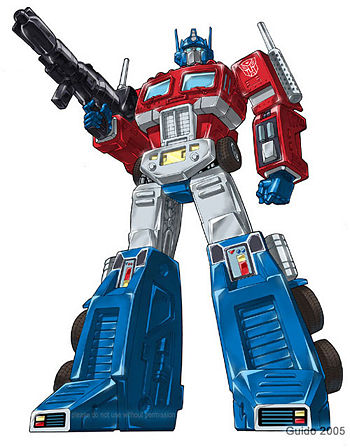
Cartoons from the 80s permeated much of my childhood, largely because a lotSource: http://tfwiki.net/wiki/Optimus_Prime_(G1) of older shows were aired in the Philippines, like the Captain America segment of The Marvel Super Heroes.1 Most people who grew up in the 90s have been exposed to Transformers, however, and know exactly what I’m writing about when I say that at one point Megatron didn’t transform into a tank or a jet, but a gun.2

Beginning in 2007, director Michael Bay began creating films based on the franchise, the content of said films fitting more in line with current cultural norms. In other words, the level of violence was ramped up to much higher levels.3 I never saw a transformer go down when watching the cartoon, but in the first two films we are witness to Optimus Prime, the leader of the Autobots: ramming his Energon Sword through Devastator’s head/neck region4, cutting off Starscream’s arm and clubbing him in the face with it5, and ultimately killing Grindor by pulling his head apart with hooks6.

As the antagonists in these films, the deaths of the Decepticons are seen as victories and not tragedies. Their design, especially when it comes to their sharp teeth and red eyes, helps to depict them as more beast-like than human. The Autobots being seen as people, however, is a point that’s pushed pretty hard in Transformers: Dark of the Moon, the third and final instalment in the series. Wheeljack, the elderly inventor of the Autobots, is captured by the Decepticons and, as he begs for mercy, brutally shot twice. Ironhide is betrayed by Sentinel Prime and shot in the back, and as he asks why the Prime “dismisses” him and deals a finishing blow. Sam [Shia LaBeouf] and Bumblebee have a relationship going back to the first film, and whenever the Chevrolet Camaro-transforming robot is endangered the audience feels as Sam does, taking emotional cues from his panicked yells.

Since the first film we’ve seen Optimus Prime lay down the law and watched him and the Autobots wage their righteous war against the Decepticons. In spite of them clearly being in the right [no one wants humans to become slaves to the Decepticons] some of the actions that they perform in the third film seem . . . excessive. One battle is concluded by Ironhide pulling a spear out of his shoulder and impaling it into Crankcase’s (a Decepticon) face, slamming him into a car, and then kicking the wreckage into an auto shop.7 More disturbing by far, though, is what happens when a Decepticon aircraft is brought down. As the pilot struggles to get out he is surrounded by Autobots and dismembered. His head, arms, and legs are all yanked from his body, with his torso being further pulled apart by one of the Wreckers. Optimus Prime ends the carnage (and the film) by finishing off Sentinel Prime in a fashion eerily similar to how Wheeljack and Ironhide were, by executing him with Megatron’s fusion shotgun as he begs for mercy.

As exhaustive as this post seems to be, there are many instances of robot carnage which I have neglected to include. I suppose that the ones mentioned could show us that extreme violence can be justified when it is the forces of good against the forces of evil (and when they are robots). What it doesn’t explain is how, exactly, to understand this. If the Autobots are to be seen as people then why aren’t the Decepticons? Their fight is a civil war, and with this in mind would we be so cavalier to promote the murder of brother by brother? Are there any real-life parallels that these levels of brutality can be placed on?

The well-known Transformers theme song has the line “The Transformers! More than meets the eye!” The lesser known lyrics immediately proceeding that are: “Autobots wage their battle to destroy the evil forces of the Decepticons!” Knowing this, I suppose we always knew as children that Optimus and his forces were destined to more than defeat Megatron and his cohorts. A dozen or more years later, what I don’t think we could have known is how brutally this would happen.


1. First syndicated on US television in 1966: [http://en.wikipedia.org/wiki/The_Marvel_Super_Heroes]

2. Specifically a Walther P-38, a World War II era handgun. Source: [http://en.wikipedia.org/wiki/Megatron_(Transformers)#Dreamwave_Productions]

3. Levels that  can only really be described as Bay-esque. [citation needed]

4. For your viewing pleasure: [http://tfwiki.net/w2/images2/thumb/5/52/Movie_Bonecrusher_dies.jpg/800px-Movie_Bonecrusher_dies.jpg]

5. Source: [http://www.youtube.com/watch?v=-T-ehTYfE-0#t=00m38s]

6. Source: [http://www.youtube.com/watch?v=-T-ehTYfE-0#t=00m46s]

7. Which then promptly explodes. Courtesy of Michael Bay.

Wristcutters: A [Self-Defeating] Love Story

The title of Wristcutters: A Love Story made me cringe, but the movie was pretty great. I’m going to say that anything with Tom Waits in it was great, though, so that’s not really an objective opinion.

The one thing that was less than fabulous about it was the “: A Love Story” part, because it starred the exact same uninspiring Indie Couple that Quirky Romances can’t seem to get away from. If you’re not familiar with it, Indie Couple is comprised of: Indie Girl – who pretends to be the opposite of your typical white-bread Hot Girl but is actually really just a white-bread Hot Girl with short hair and about a tablespoon of quirk, and Indie Boy, who is usually a dorkyish looking, socially inept 20something guy who lives a) with his parents, b) with his idiot friends or c) in a sad apartment alone, possibly after breaking up with his previous girlfriend, who was Hot but, we find out, way too Stereotypical and possibly Shallow for him.  Indie Girl is at first much more put together and take-charge than Indie Boy, but she is slowly revealed to be the Hot Damsel in Distress, and Indie Boy finds himself at some point and, like, erupts from his social awkwardness to save her, as the awesome person that the audience knew he was.

Once you start looking for Indie Couple, you find them everywhere: Zack and Miri Make a Porno (and its sister film of the fun-loving-Seth-Rogen-gets-hot-source: http://amandacw.tumblr.comblonde genre, Knocked Up);  Zach Braff with his dorky motorthing and Natalie Portman as Sam in Garden State, for whom IMDB actually uses the phrase “A blast of color, hope and quirks”; semi-sociopathic-but-only-in-cute-ways Amélie in Amélie and source: http://worldfilm.about.comthat shy photobooth guy she ends up with; Michael Cera and emotionally hair-dyeing Ramona Flowers in Scott Pilgrim Vs. the World (also just Michael Cera in everything), to name a few. Wristcutters: A Love Story is one of the worst offenders, starring tired and burnt out looking Patrick Fugit and improbably-perfect-looking-for-a-stable-person-much-less-a-dead-drug-addict Shannyn Sossamon as thumb-sucking Mikal.

And yeah, fine, romance in art in general tends to get pretty archetypal.  The basic plot of the romance hasn’t really changed…ever. Maybe there are only so many combinations of people who will fall in love the way we want to see it happen.  But it’s not just that all indie romances seem to be eerily similar – it’s that indie movies just do it so dang self consciously, like they’re trying to prove that they are somehow extremely different from every romance ever written.  “We’re not like other romances!” they’re yelling, “See how our actors are slightly less attractive than typical movie stars? See how our actresses have an offbeat fashion sense? See what we did there?”

Which is why the chemistry in Wristcutters and Scott Pilgrim and the like seems flat – self-consciousness just doesn’t work with romances, but it seems to be one of the main things that contemporary pop culture has inherited, and it’s proving a hard habit to break.  So we get all these loves stories that nervously try to brush away the archetypes of romance, and that ignore the tradition of love stories in art since basically forever. And a romance that’s self-conscious about its romanticness isn’t going to do much else but collapse in on itself.