Category Archives: film

Les Miserables Movie 2012 (?): Mostly Exciting

LES MIS – it’s one of those things about which people who are familiar with it are very excited, and the rest of the world has no idea what it is or what is going on.

Info has been trickling into the internet for the past few months, and with any movie like this, people almost immediately get pretty rabid about the casting, so let’s muse over that for a while.

Hugh Jackman and Russel Crowe are to play Jean Valjean and Javert, respectively. This is so perfect that I have no snarky comment to make about it. I am so excited it makes me feel ill.

Geoffrey Rush will play Thenardier in the new Les Mis movie. Bizarrely, both of these pictures are of him.

Another illness-level-of-excitement-inducing thing: Geoffrey Rush will play Thenardier and will be terrifyingly perfect for the role. Rush was actually already in the crappily adapted 1998 movie(the one with Liam Neeson and Uma Thurman) as Javert, and he did a fine job (as he is a fine actor), but will be more impressive in a borderline caricature role like Thenardier, I think.

Mme. Thenardier will be played by Helena Bonham Carter. All right. Obviously. There is the risk that her in the role will be too similar to her Mrs. Lovett in Sweeney Todd.

Helena Bonham Carter: beautiful enough for Hollywood, strange-looking enough for caricatures.

It already seems like all her as Mrs. Lovett would need to become Mme. Thenardier is a little less goth and worse teeth. She will be terrifying and beautiful, to be sure, but I don’t know if that’ll be super interesting at this point, weirdly. Helena Bonham Carter in The King’s Speech interests me more than another Helena Bonham Carter with eyeshadow sinking her cheekbones.
 
Anne Hathaway will be Fantine. This will make some people mad – especially considering the unexcited response to Alice in Wonderland. Amy Adams was purportedly also considered for the role, and it’s sort of surprising that she didn’t get it – she seems to be the new Anne Hathaway-type character, with more popular movies (to the younger crowd) lately. This could be good for Hathaway. It could also be bad for the movie. Maybe that’s just because I still define Anne Hathaway by The Princess Diaries.
 
A shortlist for the role of Eponine has been released, which includes Scarlett Johansson, Taylor Swift, Evan Rachel Wood, and Lea Michele. This is mildly worrisome – some of my reasons might be petty but still, worrisome. Eponine is about 15; Scarlett Johansson is 27 – and wouldn’t easily or believably look much younger (she’s usually made to look older than she is) (look at the woman’s body, for goodness’ sake). At the thought of Taylor Swift, a blonde country singer, being cast as the neglected and not-as-pretty-as-Cosette Eponine, rabid teenage musical theater buffs will gnash their teeth. Lea Michele reportedly “knocked it out of the park” at her audition – but I can’t see how Lea Michele could escape her role as the obnoxious and talented belting alto from Glee. Eponine being such a classic role does nothing to help that – it’s a role that Rachel from Glee would play. I do prefer Lea Michele in terms of her capability for annoyingness over the other 3; Eponine’s role is supposed to be tragic and self-pitying, not demure and victimized.
 

Eddie Redmayne in The Pillars of the Earth miniseries

Eddie Redmayne (Jack in the Pillars of the Earth Series) will be Marius; he will be appropriately annoyingly earnest and attractive.


They’re actually holding an open casting call for the role of Cosette in NYC. In the context of the rest of the cast, this obviously indicates the young, ingenue quality that the casting directors are looking for – an unknown talent (a la Robin Wright in The Princess Bride) in between Russell Crowe and Geoffrey Rush. It’s a pretty common take on Cosette – it might idealize the character a little too much, but that’s a large part of the novel itself.

Theater geeks are on the prowl as information comes out. There are rumors that the movie might be released in 2013, not 2012, as filming is expected to last through the summer.

What I’m nerdily looking forward to is seeing what they’re going to do with the accents – even though the film is set in France, the theater community is kind of used to hearing everything in cockney (as they all have the original London cast CD) – will they speak with an American accent? With a French accent (like the Russians speaking English with a Russian accent in K-19)? Or will they just throw some British accents in there to make it more foreign-seeming (like in the 1998 Les Miserables, The Prince of Persia, all of the Star Wars movies, Gladiator…)? So we’ll see what choice they make with that. One just hopes the singing will be good.
The Lizard’s New Look

Film franchise reboots are certainly nothing new, and next summer’s The Amazing Spider-Man is sure to bring with it a certain amount of new flair to a familiar super-hero. More than just showing us a different kid in red and blue tights, this film is also an opportunity for us to see yet another (less well-known) Spidey villain: The Lizard.

Way back in July of this year io9 reported on a surprise viewing of the first Lizard clip, describing the character they saw:

…a giant beast, green with oversized arms, and a proportionally smaller head and enormous yellow eyes. He doesn’t have a crocodile head — more of a cross between a lizard and a human’s, with a flat nose, but a grotesque curled mouth.

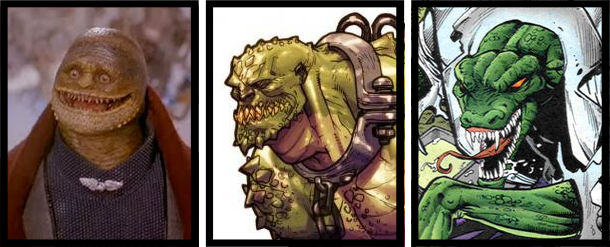
This instantly drew criticism, and created the unanimous viewpoint that this sounded much more like a Goomba from the 1993 film Super Mario Bros. Yet another observation was that the design was much more reminiscent of the Batman villain Killer Croc.

As you can see in the image above, The Lizard has always had a more pointed snout, and looked generally more like, well, a lizard. The torn lab coat is also a trademark for the character, as well as purple pants [apparently he and The Hulk buy their clothes at the same place].

Yesterday the website spiderman.ru released concept art of the film’s Lizard, creating an uproar in internet comic circles. This is not at all what fans were expecting (even after the aforementioned description of the clip), and debates were sparked between Lizard apologists and Lizard die-hards.

I began sifting through the comments sections of blogs, as I am wont to do, and found an interesting disputation between two commenters on this article, with one commenter, Kitradu, stressing that actors wearing masks “should be able to act THROUGH their limitations, physical or mental.” He referenced Willem Defoe’s performance as the Green Goblin in the first Spider-Man movie as being captivating in spite of the helmet he wore which fully obscured his face.

His opponent, storymark, began the debate with the comment:

One of the big complaints about the Raimi movies, the first in particular, was that all the masks prevented any emoting. And very few actors would be interested in a role where their actual performance is obscured.

Personally, I think an expressionless face is boring as hell.

As far as evidence goes, I tend to side with Kitradu. He references V from V for Vendetta as well as Darth Vader in the original Star Wars films as characters that held our attention without us ever seeing their faces (save for that one scene in Return of the Jedi). Emotion is more easily portrayed through a humanoid face, but what does the design change mean as far as the abilities of the actor and our viewing abilities as an audience?

To be fair to storymark, The Lizard is a very different character from either of the examples he provided. He’s far more bestial, and, from what I remember, not particularly articulate. The motion capture that Rhys Ifans is doing may not allow him the freedom Hugo Weaving had behind the Guy Fawkes mask. Though, to refute my own point, this is something Andy Serkis had no problem doing in King Kong, or Rise of the Planet of the Apes. To counter that point, both Kong and Caesar have faces more similar to humans than reptiles.

All debate aside, it should be noted, as a potential last point for this post, that the character design for The Lizard is extremely similar to his original design by Steve Ditko. But maybe there’s a reason his look has changed in the comics we read today.

Hugo: Scorsese Tells a Story and is Awesome at it

source: alualuna.wordpress.comHugo was another demonstration that a large part of Scorsese is dedicated to documentary. His movie plots rarely rely only on a simple story structure, but draw at truth about some world or society or person – in The Aviator, it was the telling of the life of Howard Hughes; in Kundun it was the exile of Dalai Lama Tenzin Gyatzo from India; In Shutter Island it was the mechanics of early 20th century mental health treatment. Scorsese has also made a fair share of documentaries, on topics like Italian cinema, The Rolling Stones, and Bob Dylan.

source: typofile.com

The film tells the story of early and revolutionary filmmaker Georges Melies

In Hugo, Scorsese tells the story of Georges Méliès and the beginning of filmmaking in general. At points the movie goes very far into documentary-land, like in the flashback/exposition which serves as the emotional denoument of the story, which rather adorably self-consciously begins with a full-on direct shot of Ben Kingsley’s face, and involves long clips of Méliès’ original film.

Scorsese uses archetype expertly well, wielding it like a tool and using structure as a support, not a creative hindrance. The plot devices are intentional, elegant, and familiar enough to be pleasant but done well enough to avoid the negative aspects of cliche: the plucky, adorable girl, the awkward side love story, the child-who-is-the-exception-to-the-rule, and the ultimately relatable and flawed authority figure whose villiany is centered on the fact that he does not notice that the child is the exception-to-the-rule [complete with semi-frightening animal companion, physical deformity, past pain, awkward love interest…].

source: hollywoodreporter.com

Hugo and his father, who is briefly and attractively played by Jude Law

The aesthetic themes of the film, too, are constructed elegantly. Hugo is a boy who only sees the world through cracks and holes – through the numbers in the station clocks, through the holes in the vent windows, and through the metal grid of the automaton’s chest. He ultimately enters the world through these cracks, too, when he slips out of the vents or climbs out of the clock face to hang outside. Hugo’s relation to cracks and holes and small spaces mirrors Méliès’ relationship with the camera lens: he sees the world through a lens and ultimately enters it through the lens as well.

The film uses as sort of wheel spokes Hugo’s various relationships with the people surrounding him. The most obvious one is his father, and the automaton which connects them. There’s also, however, the fact that in a fit of frustration he flings himself into his degenerate uncle’s armchair; there’s the moment when the previously hostile bookseller (given gravitas by being played by Saruman) lends Hugo Robin Hood, and there’s Hugo’s emotional infiltration to Georges via Isabelle and Georges’ wife.

The film is ultimately a demonstration of developed connections and necessary maintenances, without which the characters would remain inoperable, like the broken automaton. The relationship aspect of Hugo includes Scorsese’s relationship with the film itself, and the thing reads like a love letter to filmmaking in general.

Worth noting:

source: aceshowbiz.com

Sacha Baron Cohen in Hugo

Sacha Baron Cohen is absolutely brilliant in his complex portrayal of a character which could very easily be buffooned.His stuttering speech is not quite ridiculous enough for us to laugh at, and it complements the familiar crippling self-consciousness that sort of oozes out of his character’s dialogue. He is a fool, but in a relatable sense. He is terribly awkward, but we cringe instead of laugh at his misfortunes. His air of self-confidence is quite transparent and allows us to see the very real human being underneath. Sacha Baron Cohen does excellently.

It seems kind of moot to point out that Ben Kingsley also does a tremendous job. The part spans a huge amount of time and character development, demanding that Kingsley not just play the secretive, intelligent, and broken older Méliès, but also the pre-war inspired artist, delivering platitudes to young boys while wearing a lobster costume. In Hugo, Ben Kingsley is everything that his part should be.

The aesthetics are another solid part of the film. Hugo is (and it does this wonderfully) a war-era film glazed in steam punk. The aesthetic is wrapped in gears, trains, skeleton keys, and old video cameras, and topped with flower sellers in berets and a reassuring sense of the fantastic – lovers of flim noir, steam punk, cyber punk and any aesthetically-intentional style may drool a little. I am unsure about how I feel about 3D – I am too poor and not interested enough to see the more expensive version of the movie – but the fact that directors like Scorsese and Jackson are using it is making me consider itmore carefully. I can at least see how the aesthetic would work well with the round, polished dimension that 3D movies have.
Hugo is a story and, if you Wikipedia Georges Méliès, a true one at that. Its comments on the changing public reception to fantasy and story telling are especially pertinent: the generation that grew up on ultra-ironic media like Shrek, The Office, and SNL are more often receiving stories told unapologetically, like Hugo and Avatar and Harry Potter, and it is interesting to see how we’ll react.

Attitudes Towards Feminism in the Past Week 2

My first post ever on this blog was the first “Attitudes Towards Feminism in the Past Week.” It’s been quite a few months since then, but I guess it’s just that time again. To be more accurate, though, these are observations I’ve made in the past two to three weeks.

Most everyone knows about DC’s “New 52.” Well, people who know comics know about it. To summarize it quickly, the people at DC comics have decided to relaunch [reboot] 52 new titles this year. Most have since come out.

Since I am wont to read a comic book every now and then, I perused a few of the bigger titles. I specifically went out of my way to read Catwoman and Red Hood and the Outlaws, two releases that  appeared to have been garnering more than their fair share of attention. They weren’t.

Comics Alliance and io9 put it into much better words than I do, and I strongly, strongly suggest you read at least one of their articles. If I were to personally point out the problems with both comics, they would go as follows:

In Catwoman her first on-panel appearance involves her changing into her suit; red lingerie and butt/boob-shots abound. The issue ends [SPOILER] with her and Batman having sex. It ends with a whole page of them just- going at it.

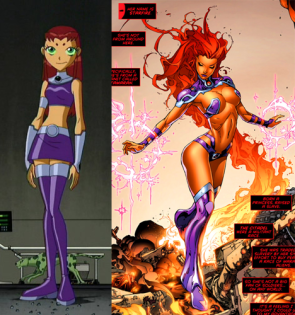
Red Hood and the Outlaws is a comic which features Starfire, a character who also showed up in the immensely popular cartoon Teen Titans. My problem here isn’t so much with her costume design [on the right]; it’s what you expect from most female heroes nowadays. My problem is that she spends most of her time out of that costume and in a barely-there bikini. She also wants to basically have sex with everyone.

DC’s responded to fans’ reactions about Starfire on Twitter. Essentially, we’re not supposed to be letting our kids read these comics.

This past Sunday I watched Ironclad, a period piece which features Paul Giamatti as an irate Prince John trying to take over in spite of the Magna Carta he just signed. Baron William de Albany, played by Brian Cox1, must defend a castle alongside templar Thomas Marshal [James Purefoy]. Kate Mara plays Lady Isabel, who occupies the keep they guard.

Lady Isabel serves two purposes.

1) To be a strong female character in a heavily male-dominated film/era.

2) To incessantly try to seduce Marshal, haranguing him about how his vows keep him from love and that he should listen to his emotions.

I hated Lady Isabel.

Mara’s character strives to be both fierce and independent [she hits a man in the face with a mace]2, yet her single goal seems to be trying to get into a templar’s pants [tights?]. As a role model she teaches that the ultimate victory is not over the iron grip of royalty, but instead the taking of a holy warrior’s virginity.

In two comic issues and one film [all released in 2011] we’re given a picture of what strong female characters should be. Attractive, certainly, but also sexually aggressive. Sexual freedom and independence seems to be what helps define a woman as strong and in control. This has caused me to come to the conclusion that the last thing I want my daughter becoming is a “strong female character.”

This has been  attitudes towards feminism in the past week. Two.

1. Who I must point out was also Colonel William Stryker in X2. It’s the only thing I can think when I see him.

2. Though when you take into account the fact that one man is cleaved in twain and another is beat in the face with a disembodied arm, it’s not that big an accomplishment.

From Puppetry to Pod Races

I love alliteration. It’s short, it’s snappy, and it has a lot of mental sticking power. I’ve used it in the title of my interview with the Batgirl of San Diego, and when I named my self-indulgent essay comparing StarCraft and Barbara Kingsolver’s literature. This time around, I find it appropriate to utilize this literary technique in bringing attention to Star Wars.

It’s not news to the movie fan or the Star Wars fanatic that there have been quite a few changes made in the rereleases of the classic films, old content packaged in a new format. A few of the alterations seem pretty logical [the Rebels’ computers are looking pretty dated when compared to the holograms of the prequel trilogy], while others are downright upsetting [replacing Sebastian Shaw with Hayden Christensen in the Jedi ghost scene]. With Blu-ray being the new format on the block, a new change has been announced for the rerelease of The Phantom Menace.

Episode I can be remembered as the last of the Star Wars films to feature the diminutive Master Yoda using puppetry. There are no backflips or lightsabre fights with bearded Sith lords that nobody likes, just a short green alien with a penchant for reversing the order of his sentences, sitting down. After The Phantom Menace CGI was used to render the Jedi Grand Master.

On the left, Yoda as he appeared in 2009. On the right, Yoda on Blu-ray.

While this alteration causes the first of the prequels to fit in with the following two films, what it loses is a bit of its connection with the original trilogy. Yoda was voiced by Frank Oz, but he was also controlled by the man, who acted as a puppeteer for the first four films. While he’s certainly more expressive, he lacks a lot of the signature movements that once characterized him.

But what does this say about film? Green screens are being used more than ever before, forcing actors to show fear, confusion, and even awe while standing in front of immense emerald sheets. While technology has been moving ever forward in delivering realistic CGI, it’s apparent that it still has a way to go.

Consider the animatronic dinosaurs in Spielberg’s Jurassic Park. Created in the early 90s,  it featured creatures that looked real because they were. They had actual size and weight and texture and you could have touched them if you were there. Compare Neytiri from James Cameron’s Avatar with Ron Perlman as Hellboy from the eponymous film. The difference from the left to the right is that of computer generated imagery to simple prosthetics and makeup.

In an age when CGI seems to be taking over it’s always a pleasant surprise to see the more traditional techniques, be they puppetry or prosthetics, to help suspend the audience’s disbelief. When Hollywood’s pumping out real-world-meets-animated-characters films like The Smurfs, we can all thank God for Jason Segel.

Decemberists, Infinite Jest, and Michael Schur Unite (and there was much rejoicing)

The Decemberist’s latest music video (for Calamity Song, from their most recent album The King is Dead) portrayed a scene from David Foster Wallace’s mammoth novel Infinite Jest, and the probability that somewhere within 100 yards of you a humanities major is freaking out increased by about 600%.

And this is awesome not only because 1) The Decemberists are awesome and 2) Infinite Jest is awesome, both of which reasons would be plenty justification for awesomeness, but it’s awesome because Infinite Jest is so huge and complicated and a-linear and full of bizarre details that it seems only slightly short of a miracle than anyone would even be able to succesfully portray in film just one scene from the novel, and yet Michael Schur (known for writing for SNL, The Office, and Parks and Recreation) managed to have the scene play out almost exactly as I imagined it – which I understand is a hideously biased judgement but I really only have my own imagination to go by, and perhaps the fact that film adaptations of writing almost never do that for me bolster the impressiveness of my statement.

The scene fromt the book, by the way, was brilliantly and kind of impressively chosen too – it shows the students at a tennis academy playing Eschaton, which is a ludicrously complicated game involving a mentally-projected map of the world on a tennis court, socks and tshirts representing different strategic targets, tennis balls (lobbed by each country) representing nuclear bombs, and insane algorithms (that David Foster Wallace all but teaches you in the book) to determine the damage and population loss of each hit. Colin Meloy sitting in the place of Michael Pemulis, one of the main characters of the book, with his characteristic sailor’s hat, is weirdly perfect. Schur’s attention to details from the novel made the video, I think, bringing yelps of excitement from readers of the book seeing a scene from possibly the most bizarre and un-movie-able piece of fiction they’ve read portrayed (almost) perfectly on film, but also allowing people who haven’t read the book to still understand what’s going on.

So, in summary, props to The Decemberists for being awesome, postmortem props to David Foster Wallace for being brilliant, and mad props to Michael Schur for creating a visual reality out of a piece of something as abstract and wonderful as Infinite Jest.