Category Archives: media

Attitudes Towards Feminism in the Past Week 3

If you are a person who gets their video game news from the Penny Arcade Report, this won’t be new to you. If you’re a person who doesn’t read video game news much at all, this is not a post that will enhance your views of the subculture.

The article is here, and I strongly recommend you read it. I’m going to be summarizing the issue pretty succinctly, so it’s definitely worth a read.

Cross Assault, a Capcom-sponsored event is “the world’s first fighting game reality show.” It features ten contestants, with half being experts of the Street Fighter games and other half being highly proficient at Tekken. Since the show is streamed live online, there’s evidence on the web of all of the reprehensible behaviour that was featured on it.

The primary individual I’m going to be writing about is Aris Bakhtanians, the coach of the Tekken team. To sum up his stance on women and fighting games, he’s quoted as saying that sexual harassment and the fighting game community are “one and the same thing.”

The victim of the harassment in this case is Miranda “Super Yan” Pakozdi, a member of his team. She forfeited a match due to mistreatment by her coach. Below is a video of the first day of the show. Below that are quotes pulled from the clip, in case you didn’t want to hear/watch all of that.

Miranda vs. Sheri mud wrestling cage match, what do you think, Miranda? [. . .] That’s the theme, mud wrestling. And then I get the winner?

How does Miranda smell?

Miranda, I want to know your bra size.

I want to hang a Mona Lisa in the ladies room with the eyes cut out.

That’s all from the first four or so minutes of the video. I’m not certain of whether or not all of the quotes can be attributed to Bakhtanians.

The Tekken coach did email Patrick Klepek at GiantBomb.com with a full apology. To sum up where he’s coming from, he cites the origins of the fighting game scene in arcades as a large part of the subculture. People trash-talked a lot back then and he is, in part, afraid that bringing this world into the public eye will censor a lot of what created it in the first place.

This was a combination of the people taking things out of context and my own inability in the heat of the moment to defend myself and the community I have loved for over 15 years.

In other news, yesterday podcaster/writer Mur Lafferty posted on her website a response to a New York Times article from last year titled “‘Tough, Cold, Terse, Taciturn and Prone to Not Saying Goodbye When They Hang Up the Phone.’” In the article Carina Chocano derided the “strong female characters” that appear in pop culture are defined primarily by being the “strong, silent type.” She also complains that the aforementioned women also show little to no traditionally feminine traits.

Lafferty’s post, “Strong Female Characters, My Own Definition” argues that these characters do exist, and that that they’re “[women] who can take action, who [aren’t] passive.” The following quote was also the one featured on i09’s article [where I discovered the articles]. It’s a good one.

Strength is taking charge of your own destiny and not waiting on others to do so. You don’t have to swear and drink and beat people up and slay monsters. You’re allowed to cry and take care of children and cook and get your heart broken and dress up and date and get pregnant. But when decisions have to be made, a strong character makes them and doesn’t wait for someone else. When a monster is chewing on your true love, you hit it with a stick (or pick up the sword that’s RIGHT THERE.)

I also highly recommend reading both articles, as Lafferty’s fuller, more complete definition manages to soundly trump Chocano’s.

milehighTo end this all off with my favourite subject, comics, Kate Beaton, Carly Monardo, and Meredith Gran created Strong Female Characters last summer, a clear parody of how they saw women portrayed in the media. With names like Georgia O’Queefe, Queen Elizatits, and Susan B. Assthony, these are three ladies who know how to pose while showing off as much of their assets as [in]humanly possible. They featured in a decent number of strips, all hilarious, which can be read at Kate Beaton’s site here.

This has been  attitudes towards feminism in the past week. Three.
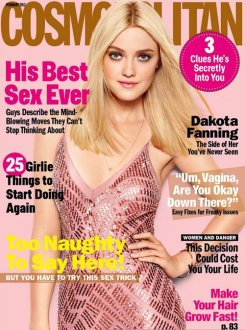
Dakota Fanning Being Sexy on Magazine Covers

Dakota Fanning will be posing for Playboy Magazine.

Now that I’ve got your attention, let me be the first to say that this definitely isn’t true. The article I found it on, DAKOTA FANNING POSES FOR PLAYBOY was hosted by Weekly World News, a “news” site that features categories like “ALIENS” and “MUTANTS.” It’s unfortunate that at least one person out there failed to question its validity, but that’s just the internet for you.

While I was initially taken aback by the news, a perfunctory Google search revealed it for what it was, while also calling attention to something that actually happened. 17-year-old Dakota Fanning appeared in this month’s issue of Cosmopolitan, and people got fairly upset about it.

A bit of context: Fanning turns 18 on the 23rd of this month. That being said, many were outraged that a minor would appear on a cover with such headlines as “His Best Sex Ever” and “Too Naughty To Say Here!” According to The Daily Mail twitter users were particularly vocal, with one user tweeting: “Dakota Fanning is 17 years old and on the cover of Cosmo. Am I the only one who sees a problem with this?”

On the other side of things we have self-described former editor-in-chief of Cosmopolitan and mother of a 21-year-old daughter, Bonnie Fuller. She takes the stance that since the media [primarily shows like Gossip GirlKeeping Up With The Kardashians, etc] has, and continues to depict sex “pretty explicitly,” this is nothing to get upset about. Add to that the fact that Fanning has already taken on many “very adult” roles and what we’re looking at was more to be expected than anything else.

There’s a certain legitimacy in both viewpoints. On one hand, there’s something that should be at least mildly disturbing about a teenager surrounded by sex headlines. On the other, culture as a whole is doing little to hide the fact that teenagers have sex and we know and are okay with it. Where Fuller gets a little shaky is leaving the specific context of Dakota Fanning on the cover of Cosmo. Would her viewpoints change if it were a different 17-year-old? How young an actress does one have to be to raise her hackles? She cites both Miley Cyrus’ scandalous photo shoot and Kendall Jenner as crossing the line, so clearly she’s bothered by some cases.

In general, Cosmopolitan is a magazine that has not shied away from its sexual content, using catchy headlines like “YOUR ORGASM GUARANTEED.” As “the lifestylist for millions of fun fearless females who want to be the best they can in every area of their lives” the publication is a force that affects women and the way they view themselves and each other. How exactly they choose to do this remains entirely up to them.

You Should Care About Super PACs

The new potentially-sort-of-boring-topic-about-which-we-should-educate-ourselves (this is the first election I’m paying attention to and I’m finding a lot of these things) is the issue of Super PACs and their effect on the current election.

To summarize, Political Action Committees (PACs) have been around for a while. They are organizations that raise money to use toward elections, usually television commercials — they are limited to collecting small amounts of money from individuals, political parties, and other PACs — and the stipulation was that they could only accept $5000 per person per year, which meant that (at least in theory) candidates’ support would be semi-related to the amount of supporters donating to them.

In 2010, however, it became legal for some organizations to receive unlimited donations from corporations and unions: organizations which accept these unlimited donations are called “super PACs.” They are like PACs, but much more evil. While PACs forced candidates to build a large support base to earn a substantial amount of money, a few millionaire individuals or corporations can fund a candidate’s entire ad campaign.

Super PACs are devastating to the essence of democracy: Why should congressional and presidential candidates care more about the votes of single constituents than the needs of unions and corporations when campaigns can be made or broken by union and corporate funding?

Super PACs allow campaigns to distance themselves from negative ad campaigns while reaping the benefits from commercials slandering political opponents — Mitt Romney’s PAC (the idiotically named “Restoring Our Future” — okay, one might restore hope for the future, but not the future itself) spent $3 million running negative campaigns against Newt Gingrich, effectively killing his campaign.

(evil?)Super PACs allow corporations and unions to spend huge amounts of money on elections — billions, in the 2010 midterm election — and that directly translates into influence on government decisions. If you’re imagining large men in suits grinning evilly while photographing themselves with dollar bills coming out of their ears, keep imagining it: there’s a picture of Mitt Romney that looks exactly like that.

Super PACs are a key factor in the commercialization of the political process. Since the late 90s, the money involved in elections (adjusted for inflation) has increased at an alarming rate. The amount of money that went into the 2008 election ($1 billion, 86 million) was more than twice that of the 1996 election (599 million dollars, adjusted for inflation) — Barack Obama’s 2008 campaign alone spent more than was spent in 1996 ($799 million).

Super PACs do not have to report the amount of money they receive, or how they spend it. A candidate’s super PAC can fund ridiculous amounts of illogical and negative commercials without having to pin the candidate’s name on the commercials at all. A candidate’s super PAC can also donate money to other PACs, effectively buying the good will of other politicians. Recent Supreme Court decisions deem this legal.

You should buy one of these tshirts on Colbert's website. And protect democracy.

The Colbert Report flaunted the troubling legalities of Super PACs in last Thursday’s episode, when Stephen Colbert’s Super PAC (Americans for a Better Tomorrow, Tomorrow) was transferred from Colbert to Jon Stewart as Colbert announced his fake intention to run for president. Colbert is not supposed to coordinate with the super PAC, his lawyer said on the show, but he could remain business partners with Stewart and the staff of his PAC didn’t have to change, even though they clearly knew everything about his election strategy.

Super PACs are the final step in making political campaigns entirely about money and slander. The political scene becomes a game of who-can-find-the-most-loopholes, with politicians focusing their energies on how to betray the spirit of the law without breaking the letter of it, which seems quite bad indeed.

Product Placement, and/or Wouldn’t an Ice Cold Pepsi Really Hit The Spot Right Now?

After a long day, I plan on sitting back and finally watching the last episode of CBC’s Being Erica, a show I began last summer and have yet to finish. While skimming its Wikipedia page I was reminded of Season 4 Episode 8, and the product placement that the video below accurately describes  as “egregious.”


It’s difficult to be immersed in a show that shoves advertising down your throat, and I definitely remember being disturbed by it. A car that can park itself is impressive, but watching two characters you’ve grown familiar with ooh and aah as a car salesman lists its features is not. As I watch the clip again and hear the back and forth of “No way” and “Way” it’s hard not to feel a little sick inside.

As was to be expected, the Canadian press was far from thrilled by this. An article on the National Post titled “How Being Erica took product integration too far” cites this episode as the one that caused the author to “break up with Erica.” She also referenced a the following point I had already been planning on making:

Is there anything 30 Rock can’t get away with? The clip above features product placement that is far more in-your-face than what was found in Being Erica, yet manages to pull it off. It’s both meta and very funny, and as a result as viewers we can laugh it off and even respect what the show is doing.

How much, then, can we put up with? I fully recognize that Dr. Pepper plays a fairly prominent role in the first three Spider-man films, and the ridiculous amount of BMWs in Mission Impossible: Ghost Protocol was impossible to ignore. Phones, more than ever have gotten a good amount of screen time in music videos, with so many examples out there I’m not even going to link to one.

Product placement [or integration, which definitely has more positive connotations] has, and will continue to be around, but is this something that we should take for granted and accept? That particular episode of Being Erica sparked an uproar of sorts, with audience members feeling offended that the network would think so little of them. The message behind their complaints seems to be: You can advertise to us, but be subtle about it.

The economy’s not in great shape, and TV shows and movies and music videos can only be made if there’s money to fund them. Since we’re going to keep getting logos flashed in our faces, what should we do? Can we do anything about it? As consumers of the media we should all have standards we expect to be met, but the question now is when do we draw the line?

World War Z and other Incidences of the Undead

I read World War Z by Max Brooks over break – I tend to stay away from zombie media,1 but the book was interesting enough to win over my zombie-avoiding tendencies and now I can’t stop noticing the huge and recent (I’d say – recent as in like, the last decade) zombie focus almost everywhere in culture.

Did everyone else but me know about this? Did you know how many zombie poetry websites there are? You can even buy a zombie-themed magnetic poetry set. You know, so you can compose some verses about decaying flesh-eating people on the fridge while waiting for your ramen to heat up.

This guy published his work online in 2005 – excerpt:

Making
love with
zombies can
never be
without consequence.

There’s Aim for the Head, an anthology of 50 poets.

There’s Z-Composition, which is a recent start-up with sections slated for poetry, recipes, and flash fiction, and grand ideas of “a bi-monthly literary e-zine with a yearly print anthology slated to launch in 2012”.

The Zombie Nation (the tagline of which is “Begin the Zombpocalypse”) also has zombie poetry posts.

The Zombie Hunter: A Survivalist’s Journal [“A family man’s guide to surviving the zombie apocalypse”] isn’t poetry but is impressive: it’s been going pretty steadily since 2010, complete with pictures, coconuts, and a thorough knowledge of firearms.

Why are zombies so freaking popular? (or: Elisa thinks too much)
The prevalence of a smaller genre like poetry dedicated to the zombie wave is just a piece of the fascinating trend. The prevailing attraction of zombie/zombie-fighting culture, I think, is the focus on vivacity and resourcefulness amidst the breakdown of society. You have to rob the grocery store to eat and you have to destroy the staircase of a building to secure it from zombies, but the stealing and destruction are by themselves also pretty exciting. And in this generation, one of the first to grow up in such a (generally) stable and structured society, craves some sense of rule-breaking and the ability to use their imagined Crusoe/Macguyver-esque survival skills.

Zombies are also about death, but not because they’re dead. Zombies as a villain are extremely basic (I’m talking about slow-moving zombies, here, generally): in World War Z Brooks pointed out that you have no hope of discouraging zombies; there is no leader to go after and you cannot, like humans, make them uncomfortable or fearful. We fear zombies not because they’ll go after us quickly and suprisingly, but because they’re slow and, as much as we ignore or outrun them, we know that they’re still coming. A scenario in which we lose to zombies wouldn’t be large and violent and exciting – it would be, simply, slow and inevitable.

Our fear of zombies precisely mimics our fear of death, which I think is a sort of manifestation of a denial of death in contemporary culture for the past century.

The Movies Always Come Back, the Actors Don’t

Sequels are popular. I know I shouldn’t have to spell that out for anyone, but really, they are. The top 7 movies of 2011 were sequels. The ninth film on that list was too, if that helps prove my point at all.

What also isn’t new are sequels [or prequels] to feature  different actors for the same characters. The earliest example that comes to mind is Christopher Showerman, who played the titular character in George of the Jungle 2, and who also broke the 4th wall by telling the audience that the studio is “too cheap to pay Brendan Fraser.” Another example is a franchise that nobody cares about, with The Scorpion King 3: Battle for Redemption featuring the third actor thus far to portray Mathayus.

A more up-to-date illustration is Rachel Dawes in Christopher Nolan’s first two
Batman films. Katie Holmes was initially to reprise the role in The Dark Knight, but turned it down to be in Mad Money. Maggie Gyllenhaal took over, a choice that did not affect audiences’ enjoyment of the film [it’s currently the tenth highest-grossing film of all time].

In even more recent news, E! Online reported this morning that a Bridesmaids sequel could happen with or without star and writer Kristin Wiig. Co-star Melissa McCarthy is quoted as saying “I think it’s a terrible idea,” coupled with the assertions that she wouldn’t want to be a part of a film without Wiig.

A sequel that has actually been given the green light is The Bourne Legacy, which will not be featuring Matt Damon as Jason Bourne. The film will instead star Jeremy Renner as Aaron Cross, with the narrative acting as a “sidequel” to the original trilogy. The current director has not completely ruled out the chance of Damon returning for future films.

What do these choices say about the audiences viewing these films? Is a franchise, a movie title, all that’s needed to draw us back to theatres? If sequels are going to continue to dominate the big screen then we will watch them, but what are our standards for them? How important is continuity to the average media consumer?

TV Tropes has a term “Chuck Cunningham Syndrome,” which refers to characters who simply disappear into thin air. The following trailer for G.I. Joe: Retaliation appears to have all of the cast from the original film die, which I think is definitely one way to justify an entirely new cast.