Category Archives: Christianity

Apocalypse Wow

There is, if sources are to be believed, going to be a rebooted Left Behind movie coming out sometime next year.

Your reaction should be as follows:

If it isn’t, then you probably aren’t familiar with the series (and should count yourself truly fortunate), so for you blissfully innocent, here’s the basic run-down.

The Left Behind series is based on the book of Revelation in the Bible, as well as certain (delectably) apocalyptic verses in Old Testament books. I say “based on”, but that’s more to demonstrate the authors’ intentions. Left Behind is “based on” the book of Revelation in the same way that Teenage Mutant Ninja Turtles is based on Vasari’s biographies of Italian Renaissance artists.

In the sixteen-novel series, all true (cough, Protestant, cough) Christians have been “raptured” (removed from the world and taken directly to the after life), leaving behind the unsaved protagonists of the story who find themselves contending with the oncoming “tribulations” (the host of hardships and catastrophes marking the end times) and the rise of the antichrist, who walks the earth in the form of a Romanian politician who takes control of the UN (because, you know, there’s no one more powerful than the UN).

Things more powerful than the UN:
The Student Government of MLK Jr. Middle School,
A Junior Sales Rep from Prescott Pharmaceuticals,
Paris Hilton’s Chihuahua

Needless to say, I don’t think very highly of the series. But hey, if we’re looking for badly written fan-fiction, why not haul Twilight to the guillotine?

It’s because of the fan part. That’s what really gets me. We’re not talking about someone fawning over the idea of stalker-veggie-sparkle-vampires, we’re talking about someone fawning over the idea of millions- billions– of human beings undergoing agonizing deaths. Think I’m reading into things? Take a look at this passage from the series:

The riders not thrown leaped from their horses and tried to control them with the reins, but even as they struggled, their own flesh dissolved, their eyes melted, and their tongues disintegrated. As Rayford watched, the soldiers stood briefly as skeletons in now-baggy uniforms, then dropped in heaps of bones as the blinded horses continued to fume and rant and rave.

Seconds later the same plague afflicted the horses, their flesh and eyes and tongues melting away, leaving grotesque skeletons standing, before they too rattled to the pavement.

You might say “Sure, that’s violent, but that isn’t exactly glorifying it, is it?”. Let me continue on.

…Jesus nudged His magnificent white charger and descended to the top of the Mount of Olives.

As He dismounted, Carpathia shrieked out his final command, “Attack!” The hundred thousand troops followed orders, horsemen at full gallop firing, foot soldiers running and firing, rolling stock rolling and firing.

And Jesus said, in that voice like a trumpet and the sound of rushing waters, “I AM WHO I AM.”

At that instant the Mount of Olives split in two from east to west, the place Jesus stood moving to the north and the place where the Unity Army stood moving to the south, leaving a large valley.

All the firing and the running and the galloping and the rolling stopped. The soldiers screamed and fell, their bodies bursting open from head to toe…

So much for turning the other cheek, eh?

And here’s what gets me about the series. It’s not the generally bad writing or the twisted theology- it’s just how freakishly popular the series is. Popular enough not to spawn just one movie attempt, but two. It’s hard enough for good stories to get a second chance at something like that, let alone this junk. And it’s the implication of that popularity which gnaws at me. There are people out there- a lot of people- who genuinely look forward to this supposed apocalyptic scenario, or an apocalyptic scenario, anyhow. People who fully expect the end of the world to be a plague and hellfire ridden Armageddon, complete with WWIII and genocide of unheard of proportions. People who look forward to this- and not in a “in the sweet by and by” way, I’m talking about a “I love the smell of napalm in the morning” kind of way.

You can’t deny that this blood-thirsty anticipation does exist. If you’re even only vaguely familiar with the Christian (American-Christian, more on that in a second) subculture, you’ll almost have certainly run into this. There’s plenty of other lousy Armageddon fantasies out there.

And what makes it all the worse is just how utterly undeserved all this hidden vitriol is. This vengeful glee isn’t coming from people who have been mercilessly persecuted for their faith. This isn’t coming from the families of martyrs or the congregations of assassinated priests and pastors in the third world. The churches of Africa, Asia, and South America have enough problems combating war, poverty, and disease to be drooling over prophesied war, poverty, and disease. No, this is the bitter vindictiveness that only comfort and safety can breed. All this body-bursting leering isn’t a result of imprisonment (not that it would be justified there either), it’s a result of being snubbed by Bill Maher or portrayed as yokels on some sitcom.

That’s just messed up.

Now this isn’t Shame Day, but that doesn’t mean we can’t all gather ’round and ruthlessly mock something that so richly deserves it, and if this drivel doesn’t deserve it, I don’t know what does.

Does Billy Graham Think Mormonism Is A Cult?

Yesterday a friend of mine posted a link to an article on the TIME website titillatingly titled “Billy Graham No Longer Thinks Mormonism Is a Cult.”

For those of you who don’t know, Billy Graham’s name has long been synonymous with “famous Christian guy.” To put that into more quantitative terms, he has been spiritual adviser to US presidents Eisenhower and Nixon, and  as of 2008 has had an estimated lifetime audience of 2.2 billion. Christians the world over  look to him to be a powerful representative of their faith.

Roughly two weeks ago US presidential candidate, and Mormon, Mitt Romney visited Graham at his home. At some point during their time together, the 93-year-old Evangelist told him, “I will do all I can to help you.

Shortly after this the Billy Graham Evangelistic Association [BGEA] took down a reference to Mormonism as a cult on its website.

This has, as most any action in the political sphere, provoked all sorts of public outcry, some of it mild, some of it extreme to the point that Graham’s whole ministry has been dubbed “a sham.” Basically your typical response to an event that combines two of the conversation topics you’re not allowed to bring up at the dinner table.

The viewpoint of Mormonism by mainstream Christianity aside, what’s truly important is what the man himself believes. While on the BGEA website I found an actual answer by Billy Graham, undated, to the question “What is your definition of a cult, and how do cults differ from Christianity?” His answer is as follows:

Cults differ widely from each other, of course, but they often have several characteristics in common. (Your local Christian bookstore can suggest some books that describe cults in more detail.)

One characteristic is that cults reject the basic beliefs of the Christian faith—beliefs that Christians have held in common for almost 2,000 years. Instead, they say they alone have a full understanding of the truth about God, and the only way to know the truth is to be part of their group. Many cults have their own writings also, which they either substitute for the Bible or add to the Bible.

Cults also often have a strong leader—one who demands total obedience, and actually claims to speak for God. This is very dangerous, of course, because he or she may lead others into disaster. Remember: Only Christ is worthy of our allegiance, for only He is God’s Son. The Bible says, “Through him you believe in God … so your faith and hope are in God” (1 Peter 1:21).

Pray for your brother and ask God to help you share Christ’s love with him. Cult members are often very resistant to outsiders, but pray that in time he will see this group’s false claims. Most of all, may his experience challenge you and your family to a deeper commitment to Christ.

Let’s break down his definition in regards to the Mormon faith.

———

  • Cults reject the basic beliefs of the Christian faith.

When it comes down to the bare basics, and concentrating on the personhood and divinity of Jesus Christ, they’re pretty spot on. “Jesus Christ is the Savior of the world and the Son of God. He is our Redeemer.” Judging by this singular belief I suppose Mormonism would not be considered a cult.

  • Many cults have their own writings also, which they either substitute for the Bible or add to the Bible.

The Book of Mormon. People know about this because it is also the name of a popular Broadway musical. From their website it is apparently viewed as an addition, not a substitution, to the Bible. It is also a book which “contains the history and God’s dealings with the people who lived in the Americas between approximately 600 BC and 400 AD.”

  • Cults also often have a strong leader—one who demands total obedience, and actually claims to speak for God.

The head of the Church of Latter-Day Saints is known as the President of the Church. According to their Doctrine and Covenants, this man is the only one empowered to receive revelation for the entire church and clarify doctrine. Presidents can also correct or change any previous teachings.

———

Judging by the qualities of cults that Billy Graham lists, Mormonism hits two out of three. Why is it then that his organization took down the reference to the Church of Latter-Day Saints as a cult?

Ken Barun, the organization’s chief of staff, is quoted as as saying: “We removed the information from the website because we do not wish to participate in a theological debate about something that has become politicized during this campaign.”

Have politics, then, trumped religion in this case? A debate on faith is avoided in order to bypass a possible issue of contention with a presidential candidate, one that Graham directly endorses. Cults are described as groups that espouse “false claims,” but apparently that can be ignored in light of Romney’s campaign.

While it is unfair to cite the holy life Billy Graham has lived as invalid in light of his recent actions, his decision should nonetheless be viewed for what it is: a sign of weakness in prioritizing the politics of this world over a commitment to spiritual truth.

Shame Day: Concerned Women for America

“Concerned Women for America.”

It sounds almost like a cartoonish satire of the kind of people who storm into PTA meetings demanding to know why their children have been
“exposed to filth” after discovering a copy of Catcher in the Rye, Slaughterhouse Five, or Harry Potter in their kids’ assigned reading list. The kind of people who warn about the corrosive and unwholesome messages hidden in rock songs, or who sit horrified in front of the TV as some sensationalist dead-inside “journalist” warns about the latest secret teenager trend that’s sure to kill them/get them pregnant.

And as much as it sounds like something that’s ripped out of Footloose, Concerned Women for America is very real.

And that is an absolute shame.

Let’s take a look at some of the bilge that these guys are producing.

What caught my eye was a recent article of theirs on Malala Yousafzai, a heroic Pakistani girl and women’s rights and peace activist. In this post, the authors launch a vicious attack on Islam as being an inherently barbarous and misogynistic religion with a murderous agenda for any who dare oppose it. As the article states

“Malala questioned the station of women under Islam’s oppressive thumb, and the Taliban tried to put her six feet under the ground.”

This, quite simply, is a lie.

Yes the Taliban tried to kill Malala, and yes, Malala questioned the station of women-but what the authors of the article neglect to mention is that Malala Yousafzai is a Muslim herself.

Apparently it’s not enough that this fifteen year old girl (and she is fifteen, not fourteen, as the CWA article wrongly states) has to deal with the threat of violence and murder- she now has to endure her activism being hijacked by the “Concerned Women for America” bent on turning her sacrifice into a smear campaign against her own religion, which they claim is both “false” and “hate-filled.”

But why stop there?

The “Concerned Women for America” are also turning their ignorant ire against the “Slut Walks,” which for those of you who may be unaware, are parades of women wearing clothes of different degrees of modesty or exposure to make the point that it doesn’t matter how you’re dressed- one’s wardrobe is never an “invitation to rape” as some sex-offenders have tried claiming.

Being the moral, upstanding people that they are, CWA has sent up a howl of protest against these walks, declaring:

“The latest desperate bid for attention by the publicity-starved feminists is to sponsor SlutWalks — events where scantily clad women take to the streets en masse to claim their “right” to dress and behave however they want or to go anywhere at any time without the risk of being sexually assaulted or deemed streetwalkers.”

“They propose somehow to make the point that even if what they wear, their drunken state, or their presence alone in a very vulnerable place might indicate their willingness to participate in a sexual free-for-all, women should not be subject to lewd propositions or be at risk of being raped.”

Now I could leave it right there- those two statements alone are enough to demonstrate without a shred of doubt just what vile, reprehensible misogynistic scum the CWA is made of, but just to hammer in a few more nails for safe measure, here are some of there other quotes.

Here’s a lovely little comment regarding the Russian punk-rock protest group “Pussy Riot,” recently sentenced to two years in prison for singing an anti-government song in a cathedral.

Their formal statements about the incident reveal their utter lack of morality, embrace of a “blame-everyone-but-us” ideology, and disdain for capitalism and individual responsibility. Like their U.S. counterparts, they want “human rights, civil and political freedoms” for themselves but not for Christian believers or anyone else with different beliefs… Christians around the world are facing intolerance of their beliefs and sometimes violence as well. In spite of the Constitution, religious liberty is under attack in the United States, with the federal government telling religious institutions that they must violate their beliefs and support homosexual “marriage,” homosexual adoptions, contraception, and abortion or face penalties.

Really? A handful of women sing a song in a church decrying the increasingly totalitarian state, get the ridiculous sentence of two years prison for doing so (the same action in the US would merit a fine, if that) and it’s you who are the persecuted ones.

Here’s another good one- outrage that a Macy’s employee was fired for confronting a transgender person for using the women’s dressing room.

Transgender?  Give me a break!  First of all, there is no such thing; it is a choice of behavior.  And hope as we might, our desire to behave in a certain way does not legitimize a chosen behavior.  It certainly does not entitle them to circumvent the rights of society and our moral tenets in order for them to “have their way.”  Natalie Johnson, the employee in question, was quoted in an ABC interview, “I refuse to comply with this policy,” and “There are no transgenders in the world.  A guy can dress up as a woman all he wants.  That’s still not going to make you a woman.”

An easy call? Certainly not, but this self-righteous outrage is just plain stupid. What if the person in question had been born a hermaphrodite? How would he or she be treated then? Would that kind of ambiguity have justified the guy/gal being denied service? If that’s our logic, why not deny service to people in wheelchairs for not conforming to the societal norm? That logic just doesn’t hold up.

End of the day, “Concerned Women for America” is what cancer would look like if it were an social movement. Shame on this vile organization.

Fascists, Skinheads, and Nazis (Oh My!)

As you all doubtlessly know, two days ago, a gunman entered a Sikh temple in the little town of Oak Creek, Wisconsin, killing six and injuring four more before being shot dead by police. The killer, one Wade Michael Page, was connected to a number of vicious white-supremacist groups, most notably the “Hammerskins”, a white-supremacist group that focuses on dispersing racist messages and propaganda through music- Page being the founder of one band and a member in another.

Why is this even being brought up here? As strange as it may seem, there’s an argument to be made for the Oak Creek massacre having its origins in culture. Now many of you might be thinking of the Aurora massacre, and no, this isn’t some discussion about our attitudes towards guns, violence in media, or anything of the kind. There’s certainly a good discussion to be had on that subject as well, but it’s not what I’ll be addressing here.

No, what I’m going to be talking about is this:

Fascism.

It’s coming back.

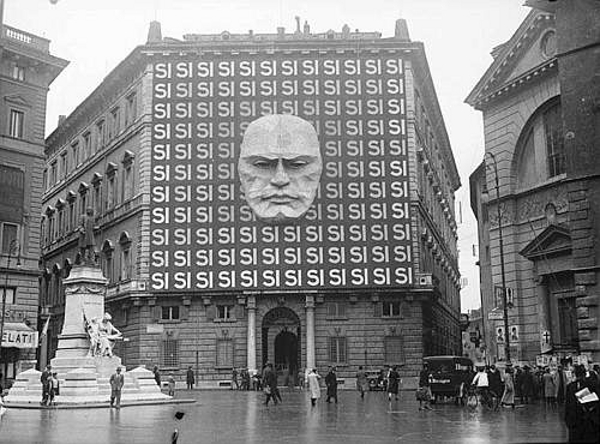
See, the idea that the culture, traditions, and history of specific people group are superior to those of all others and should be promoted and maintained through brute force didn’t die when Hitler blew his bigoted brains all over an underground bunker in Berlin, or when Communist freedom fighters gunned down Mussolini in a picturesque Italian village. It’s been dormant for a long time, but in recent years, it has again shown its ugly face.

Nope- uglier than that…

While there have been plenty of racially motivated murders over the years since Nazism fell (to say nothing of countless lesser hate crimes), what we’re seeing now is a resurgence in full-fledged Fascist ideology- but before we get into that, just a side note.

For many of you, the term “Fascism” probably conjures up images of generic authoritarianism. Obama’s a Fascist. Rush Limbaugh’s a Fascist. That one really strict teacher is a Fascist.

I’ve struggled for a while to come up with a good, succinct definition for what Fascism is all really about, so I’m going to offer this illustration. To a Fascist, his people (often, race) are inherently great and good, and they are inherently great and good because of their traditions, values, and culture, which are all also inherent to them. The greatness of the nation is lost when evil, conniving undesirables start pushing their own cultures, values, and traditions, which are subversive and degenerative to the nation. Therefore, these degenerates who threaten the nation must be stomped out (often quite literally), and the “original” culture/traditions/values must be restored, enforced, and maintained through an all-powerful government, police force, military, etc.

There’s more to it, of course. I could talk about the concepts of autocracy, corporatism, use of ancient Roman symbolism, and the like, but for now, let this all above be the definition we work with.

Now why do I say it’s coming back? Certainly if we disregard the recent massacre and the occasional race-related attack, there doesn’t seem to be any major Fascist threat in the US. The KKK isn’t roaming with impudence in the South. Gangs of Nazis aren’t attacking Jewish stores and businesses. Self-proclaimed defenders of the nation aren’t roaming the boarders trying to-

Oh yeah…

Ok, but it’s not like there’s been any major attack on people for having different skin or heritage or religio-

Ok, fine, but it’s not like any of this bigotry has been legislated or-

…Yeah…

See, that’s how it works. It’s subtle, discreet. The great Sinclair Lewis perhaps said it best:

And this is just America. In Europe, Fascism is even more prevalent and less shameless, simply take a look at France, where the government has instituted laws banning certain forms of Muslim garb, or forcibly expelling the Roma Gypsies.

I recall another guy who took actions to get rid of gypsies…

Over in Germany, Chancellor Angela Merkel declared that “Multiculturalism has failed”

Kinda forgetting about the last time a German chancellor declared the failure of multiculturalism…

…And in Britain, holocaust-denier Nick Griffin, leader of the white-supremacist British Nationalist Party (BNP) was elected to the European Parliament. That’s about the equivalent of the Grand Wizard of the KKK getting elected to congress.

I’d show you an actual picture of Nick Griffin but **** that guy…

And this is to say nothing of the escalating attacks on immigrants across Europe. Why? Because many Europeans and Americans are buying into the idea that the values, traditions, culture, and beliefs of other people are a direct threat to them. I recall in college on particularly nasty student who asserted that “All immigrants should go home”. Interesting, considering he had an Italian last name. Does he mean that he too will leave America? Of course not. Does he mean the Canadians who attended that school? Not at all. “Immigrants” was simply code for those “undesirable brown people”. But don’t take the words of one bigoted student as evidence of this ugly trend- just look at Congressman Steve King’s attempt to make English the “Official Language” of the US!

Now why on earth would you try to make English the official language of the US? It’s not like the vast majority doesn’t already speak it. And what if we did speak Spanish? How would it make a difference to anyone what we speak… unless English was somehow viewed as “inherent” to America!

There’s really part of the problem. It’s a perspective on society. Back in College, I had a conservative friend whose opposition to gay marriage was that “the traditional family is the building block of society, and changing the family weakens society”. I’m not saying he’s a fascist- not at all, but this view of society as a solid, unchanging thing is what really serves to create so much of the general bigotry and outright fascism that we see today. When society’s well-being is linked to culture, to maintain society is to maintain culture, and while there’s a certain logic there, all too often it’s taken to mean that every aspect of culture, right down to traditional gender roles, religion, and racial demographics, must be controlled. It’s the reason why you see Muslims, immigrants, homosexuals, or as the past couple days have shown us, Sikhs, targeted. And don’t for a minute imagine that it’s just Aryans who take up this line of thought. I recently had an encounter with an Asian immigrant who cited that his country was once upon a time a “Christian country”, and that he was concerned at Hindus, Buddhists, and the like building places of worship in his community.

Only where does it end? Suppose you argue that non-Christians should be excluded from a country because their cultures threaten the stability of the nation- what the minority groups? I always want to bring this up when I hear someone make the argument that America is a “Christian Country”- does that include the Mormons and Jehovah’s witnesses? What about Unitarians? Episcopalians? Catholics? Mennonites?

That’s the crux of the matter. The Fascists- both the self-declared and the self-deluded- would have us believe that we’re all hopelessly divided. That we cannot respectfully disagree with each other. That you can’t speak Mandarin and I can’t speak Arabic and the two of us get along. That multiculturalism is a fantasy. That we can’t have our own practices and perspectives while all agreeing, to some degree, on how to live together. We’re meant to live in constant fear that if we tolerate anyone who doesn’t fit in, there goes our way of life.

So let it go.

This will be harder for some than others…

The title of this blog is the Culture War Reporters, and perhaps what needs to be understood is that the culture war isn’t something that can (or should) be won. There’s always going to be divergence in opinion and in behavior. There’s always going to be new things coming in, and old things struggling to stay on. There’s always going to be good stuff and bad, so at the end of the day, why worry? Don’t buy the idea that culture can be maintained, or that one group has found all the answers. For all the dark content about murders, genocide, and the like, strange a line from Disney’s Ratatouille should fit so appropriately. Defending his lifestyle against the accusation that it’s “against nature”, Remy the rat declares that “Change is nature”.

Porn Is Not Poltergeists

So last Friday I came across the following trailer for a movie called Harmless. Here it is:

In the spring semester of last year I took a writing class called Literary Nonfiction. One of the required reading pieces was Culture Making: Recovering Our Creative Calling, by Andy Crouch. The general gist of the book was that as Christians we have the ability to create our own culture. We live in the world, but we don’t need to be of it. If we can’t find anything out there that we can agree to be part of than we can make our own.

That being said, I’m not sure that I can necessarily support this film. I understand why they did it, though. I’ve seen Paranormal Activity; I understand the way fear is exacerbated by the intimacy of the  mockumentary format. I get that if you want to talk to people about your faith movies are a great way to do it, and the horror genre is an extremely popular one. The problem is that it’s ridiculous.

I won’t lie and say that pornography is all well and good. I do believe that it is degrading to women and can be extremely harmful to relationships and families. I will even go so far as to say that there is a dangerous spiritual component involved, but this is not the time or place to discuss that. I can also tell you what porn is not, though. Porn is not poltergeists.

I can’t agree with a film that could potentially be more ridiculous than the 2006 film Facing the Giants. Trailer seen here:

This was a film that just dripped with cheese.  It’s difficult for me to put into words how awful it was. The messages were certainly positive, but weren’t delivered in a way that was well-written or even believable. If Christian media wants to be taken seriously by those outside of its target audience it has to at least be a decent example of its art form.

I’m all for Christian media, or at least media with a Christian message of sorts. Ted Dekker’s novels Blink and Thr3e are well-written and actually very good. What I wish is that this would spread to the film industry, that as Christians we could do better at making and affecting culture around us, instead of creating something laughable.


Evangelical Christianity and Destructive Views of Heaven

ImageAbout two years ago I started attending an Anglican church regularly. It was the first time I had ever attended multiple liturgical services — one of the most surprising things to me, after I got over the water the priest was flicking at us, was that Communion happened every Sunday (in any other church I had been to it was only once a month). What was more was the reverence with which Communion was taken. My previous churches weren’t irreverent, but Communion wasn’t really a big deal at all. This was one of the first discrepancies I noticed between the liturgical service and my own non-denominational upbringing.

My confusion at the Anglican church was due to the fact that I had always learned throughout my childhood that Communion didn’t really count — it was just a nice thing to do together to commemorate something. I strongly internalized the idea that there was nothing particularly important about the act of communion.

This seems like a small idea but it suggests something very significant about the more general physical world — that it doesn’t matter either. More, it’s evil — bodies are the source of temptations and failings, and about as far from divinity as one can get.

This might sound borderline gnostic and/or heretical to some of you, but I think that at least some students might have also been surrounded by similar theologies at some point in their lives. The tone of the churches I attended — mostly Baptist, Bible, and non-denominational — and the Christian influences (radio networks, authors, etc.) inculcated in me the sense that we weren’t so much as “in the world but not of it” but that we were “sort of in the world but definitely not of it nor part of it in any way.”

ImageBodies were inconveniences, to be ignored or, ultimately, despised. I absorbed suggestions that at the rapture our purified souls would leave behind dead corpses. Theological issues and Biblical references like the Kingdom of God on Earth and the resurrection of the body — things having to do with the physical world — were ignored.

Even the Bible’s physical existence was ignored. The first I ever heard of arguments about the canon, Athanasius’ 367 letter, and all those people mad about James and Hebrews was at college. Before then, I think I just assumed that a copy of the KJV fell out of the sky a few hours after the Ascension. How could the Bible be put together by mere non-disciple humans, over a long period of time? I kept the book nicely separate and away from actual human history. This also suited my willful ignorance of the traditions of the Eucharist and other things that I filed under “weird things that Catholics do.”

So I was marinated in this idea that the present world is an unholy place, and therefore not worth participating in, via a solemn practice of communion or crossing one’s self or kneeling during services or repeating a liturgy or anything else.

In my religious surroundings, the logical conclusion to the world’s ungodliness was a huge focus on the afterlife and Heaven. Perhaps I’m being unjust to a necessarily simplified message aimed at young children, but when I was young, church seemed to be mostly about accepting Jesus to get to Heaven.

The prevailing Christian teachings in my life rarely addressed issues of the tensions of existence, and this lack of struggle or mystery was convenient for my young mind. Morality teachings warned against a displeased God, not dysfunctional relationships. Evangelism was never nuanced and existence was never complicated.

Everything seemed to point away from the present and toward the future — toward Heaven, which I was assured I would get to if I said the right prayer. I repeated the inviting-Jesus-into-my-heart prayer once every few months when I was very young, because I was nervous that the first time didn’t take (never had Jesus been so thoroughly invited, I was pretty sure).

The problem that I found was that all of this — the whole prevailing culture — pointed me toward a profound disconnect from the world.

If the only thing that matters is my ticket to Heaven, I began to ask myself, then what am I here for? If nothing of the present right now is holy in any way, I might as well try to expedite my exit, right? Or at least ignore everything until I get to leave?

These considerations troubled me, and still do. I am not at all 100% gung-ho about either tran- or consubstantiation, nor do I cross myself consistently or demand that I only attend high liturgical masses involving incense burning and silk vestments. I really, as far as theology goes, have very little idea of what is going on.

But I do think that we, as evangelicals and Protestants, need to focus less on prepaid train tickets to Heaven and concern ourselves with trying to find a way to live a holy, engaging existence.

I don’t want to argue against points of widely accepted Christian theology, or thoughtful readings of the Bible. I’m arguing against the notion that the only reason to live is for what we believe we get after death — this is, I think, imbued in the current culture; in the unthinking things we say about other doctrines and the assumptions we make about our own. And I think that it is ultimately destructive.

The ticket-to-Heaven idea is by no means ascribable to all of Christian theology, but it is prevalent, especially in Christian culture during the past century. Devaluing physical existence is, I think, an illogical and ultimately damaging thing, and before we talk about how silly Catholics are to believe in transubstantiation we might do well to consider the implications of our own philosophy.