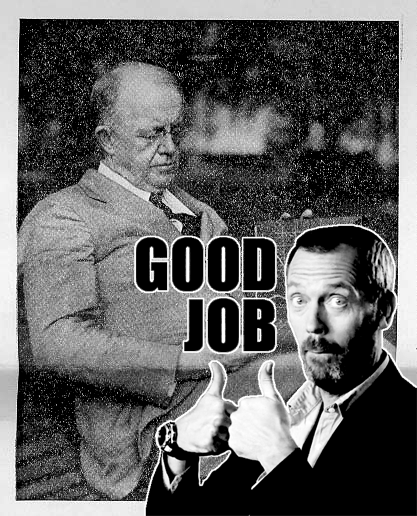
Last week I wrote about George Romero, a film-maker who has had perhaps one of the most profound influences on modern culture. Continuing in that vein, today I’d like to stir up some applause for Frank Bunker Gilbreth, Sr., or as you might better know him, the dad the Cheaper By The Dozen movies.
Now if you’ve seen any of the films, you’ll see the father of the twelve kids hopelessly overwhelmed until the family finally remembers that they need a happy ending to appeal to the widest possible audience causing them to get back together in the last ten or so minutes of movie. Truth is, the actual Frank Gilbreth was an excellent parent who took care of his twelve kids as best as could possibly be expected. How did he manage that? Well, it turns out Gilbreth was an expert in the study and application of efficiency, and applied his unique brand of training to his own family, as well as the workplace. Gilbreth was obsessed with reducing the steps every action took (which he named “therbligs,” reversing his own last name). For example, eliminating the “therblig” of having to search for your razor by having the razor painted bright red, making it easily noticeable. Things such as more efficient guns, pedal-operated trashcans, and arguable the entire study of ergonomics all owe a great debt to this man. But that’s not the big thing.
You ever see a nurse handing a surgeon his tools while in the middle of an operation?
Frank Gilbreth Sr. came up with that.
You ever see a soldier or spy blindfolded, reassembling his gun?
Frank Gilbreth Sr. came up with that too.
Think about that. How many lives have been saved and ended because of this guy? The guy died in 1924- think about all the expansion that’s happened in medicine and warfare since then. Think about all the people who have died or been saved since then. Heck, there’s a decent possibility neither you or I would exist without this guy’s work.
And his legacy is a terrible Steve Martin popcorn movie?
Ladies and gentlemen, if you will, a moment of applause for the real Frank Gilbreth.
DISCLAIMER: This week we kind of dropped the ball, so our discussion on the topic is short and then turns to how WE can write this feature a little better. Our apologies.
And now back to the subject of the night: Is there artistic merit in Adventure Time?
EVAN: Whoa. You’re gonna shameless-plug your friend and then let me discuss the topic? Say something about it, haha.
GORDON: Is there artistic merit in beloved Cartoon Network show Adventure Time? Well, let’s break down what we mean by “artistic merit.” Evan?
EVAN: Is it worthy or deserving of being called art? Alternatively, does the show have the admirable qualities or attribute that art has? I guess a question to answer your question is: What is art?
GORDON: Well, let’s not try defining “art”. We’ve been trying to do that ever since we first started scratching pictures of fat ponies onto cave walls, and I doubt we’re gonna solve it in the next half hour or so. Let’s instead focus on the “merit”- what is it that makes ANY show good?
EVAN: Here’s a factor that relates directly to Adventure Time: Accessibility. How accessible does a show have to be to be good? Does it have to be accessible to be good?
GORDON: Are we talking about mass appeal here?
EVAN: Eh, sure, why not.
GORDON: Well, we gotta address that then. I mean, Twilight and the work of Michael Bay are popular, but they aren’t good. At the same time, you can’t just have a show that only you find funny, and then still call it good, right?
EVAN: You’re right. So is there a magic number of people we have to reach when it comes to a show being good? I shudder to remember Tim and Eric Awesome Show, Great Job! and how much our one friend used to love it.
GORDON: What’s worse is that my dad is into that show for some unfathomable reason. But the point is, a good thing ought to be popular to some degree, but popularity can’t be the sole element.
EVAN: Okay, so how about execution? How well the show pulls off whatever it’s supposed to be doing. Adventure Time is a show about a boy and his magical dog that is also his brother adventuring in a colourful post-apocalyptic fantasy world, but it works. They pull it off. I personally think this has a little something to do with its easy-to-digest ten minute segments.
GORDON: And there’s really no way of arguing with that- the story-telling is spot-on, but there’s gotta be more than that. The same can be said (and this is gonna give Evan an aneurysm), to some degree, of the copy-paste work of Seth McFarlane.
GORDON: What I’m saying is that McFarlane’s shows are both popular and (for what they are) well-executed, and yet we can both agree that his shows aren’t really “good,” at least, not anymore than a bag of chips is “good” food.
Therefore, there’s got to be another element at play, right?
EVAN: Ugh. I can’t even look at the chat window I’m so offended you would say something like that. I wish he would be “well-executed.” Share your other element if you must.
GORDON: Uniqueness. The show has to be unique. It’s not enough to go through the motions (as McFarlane’s shows do), you have to actually be able to make your show something that can’t be seen anywhere else.
EVAN: Something to make your stuff stand out of the crowd, okay, that’s fair. So I guess we can see how Adventure Time stands up to the criteria we’ve come up with.
Accessible? Eh, I’d say so, for its demographic and older.
Popular? Yeah, again for who I’ve stated.
You want to let these nice people know if it’s unique?
GORDON: Soooo Unique. If you can find anything remotely similar to it made in the past decade, I will slap Evan on the ears and vote for taxing the homeless.
EVAN: I mean, like I said: Boy. Magical Dog. Colourful fantasy world that is also post-apocalyptic.
EVAN: What more could you want?
GORDON: Vampire rocker girls?
EVAN: I would not mind.
GORDON: Oh wait, we’ve got that too.
You want D&D references spliced in with Science Fiction and elements of Gothic Horror?
EVAN: I think we could go for some.
GORDON: WELL WE’VE GOT IT!
EVAN: I think it’s clear that we think Adventure Time is a good show, but one thing that’s been painfully clear with this entry of E> is how much trouble it’s been doing this. Might I suggest a little something?
GORDON: Go for it.
EVAN: Let’s just choose our own topics for a little while, just to really get back into the swing of things. Keep things casual, going back and forth, avoid the heavy questions. And then we can ease our way back into all this.
GORDON: I am inclined to agree with you on this one.
EVAN: Yeah? Awesome. Anything in particular you wanted to casually discourse about next time?
GORDON: Well, I don’t think my suggestion about the Disney takeover of the Star Wars franchise was all that bad, even if Adventure Time did win by a landslide…
EVAN: I kinda wanted to talk about Deadliest Warrior.
GORDON: That would be likewise awesome. Let’s do that.
EVAN: Yes. Awesome. I’m going to post this because we are men true to our word and we promise an E> every Wednesday. We shall discuss Deadliest Warrior in a week. Or this weekend, maybe, just to get ahead. I mean, whatever.
GORDON: Good night, everyone.
EVAN: Yep, sorry this wasn’t as awesome or decent as usual. But we will be back! With a vengeance. And remember:
Today is Election Day for the United States of America, so I suppose this is just as good a time to write about this as any. While the embedded video below “stars” Mitt Romney, he is in no part the focal point of this post.
Mitt Romney has some things to say about ways to help those affected by Hurricane Sandy.
A man yells at around 00:22, and says “What about climate? What about climate, that’s what caused this monster storm!”
He holds up a sign that says “End Climate Silence.”
This is almost instantly met with boos.
The boos turn into a rousing cheer of “USA! USA!”
At around 36 seconds in his sign is violently yanked down.
Seemingly unperturbed, the man tries in vain to yell above the crowd; he does not succeed.
00:54 has the camera zoom in nice and close on Romney’s awkward grinning face.
Thirty seconds after the man’s outburst, Romney continues his speech where he left off as if nothing happened.
Even watching that video for a third and fourth time to write this I’m still both shocked and angry. This man was raising a legitimate point about the source of the storm, and he was shouted down. What’s more, he was shouted down by dozens of people yelling the name of their country over and over and over.
Why did this happen? Sure, the guy may have been interrupting what was ultimately supposed to be a way for Gov. Romney to raise support, but is that a reason to boo him? Is it a reason to yank his sign down? You can see the man struggle to keep it up and then decide it’s not worth the trouble.
As a presidential candidate, can you stop Americans from crying “USA! USA! USA!”? Yes. You can. When what is typically a patriotic cheer is used to instead bully someone and invalidate their opinion. It is disgusting what happened, and anyone involved should feel disgraced by their behaviour.
A reply to Beaton’s tweet put it well when he said:
Now that’s a lousy title, so let me kick things off by immediately clarifying what I’m talking about. This isn’t academia, or the world of contending theories and thirty-page papers on the finer points of psychopharmacolgy in relation to the mating habits of the Atlantic bluefin tuna. While this kind of world certainly does exist, it’s not what we’re talking about here. This is the culture not so much of scientists, as it is of science fans: those who are becoming increasingly invested in the idea that advancements in our knowledge is not only inherently awesome, but the solution to many, if not most or all, of the world’s problems.
“But Gordon, you striking portrait of wisdom and nobility,” you may be asking, “don’t we all fit that category?”
And to some extent, yes, we do. Even the most hardcore Luddite or primitivist will applaud the polio vaccine or HIV medication, but even so, there is a growing number of people who take things to the next level entirely. Check out this trailer:
Kind of a crazy premise- guy transfers his consciousness into a machine body. But still not too far off from the way many people believe we’ll eventually be living. “Transhumanism”, they call it, which, to grossly simplify it, is the general idea that the best (or even inevitable) course of human existence is to “evolve” beyond the confines of our biology. That with the progression of science and technology we’ll stop the effects of aging and be capable of improving upon our own minds and bodies. If you wanted to find a decent illustration of this kind of issue, try watching Battlestar Galactica (the new ones), or better still, Caprica. Now this is an extreme element of this culture, but a contributing element nonetheless. Major advances in prosthetics over the years, as well as films such as Surrogates, Gamer, Avatar, The Matrix, I, Robot (heck, any film or media dealing with the whole “what makes a person a person?” question) have all been instrumental in introducing transhumanist ideas. But of course, it’s more than just that.
It also has a lot to do with these guys:
These guys right here are arguably responsible for popularizing this entire culture, breaking down even dry subjects and making them compelling and (relatively) easy to grasp, even if only on the most basic level. You probably won’t go off to revolutionize the world of astrophysics after a few episodes of Cosmos, but chances are you’ll come away amazed. Would the recent Mars landing have had the same widespread popularity as it did without these guys? Would the cutting of manned space-missions have been met with the same outrage? Almost certainly not.
To some extent, the decline of religious adherence in the West may also be a factor in this culture. A growing number of individuals in the US are simply reporting themselves as being “without religion,” and the “science culture’s” emphasis on altruistic humanism (more on that in a minute) and skepticism offer a sympathetic atmosphere. The fact that many leaders (or at least, poster boys) for the culture are atheist (Mythbusters’ Savage and Hyneman, for example) or agnostic (Neil Degrasse Tyson) is also certainly a factor.
And perhaps the most fundamental element of all in this culture is the concept of “post-scarcity.” Quite simply, it’s the idea that we have progressed to a point where we no longer have scarcity of resources. E-books are typically used as an example, with adherents of the idea pointing out that with almost everything ever written in human history accessible in digital form, we could potentially give access to everything ever written to every man, woman, and child who will ever live without ever cutting down a single tree. The same logic is applied to film and music as well.
All of this combined creates and fuels a culture based ultimately on values of human welfare. In many respects, it’s the polar opposite of the “manly” culture discussed last week, emphasizing interdependence rather than independence, cooperation rather than competition, and progressive and postmodern social norms rather than traditional ones.
So what are the pros and cons of the culture?
Positives:
The fundamentally altruistic and humanistic elements of the culture are certainly something to be admired.
Money goes into scientific research, and cures and advancements come out; you can explain that.
Quite simply, the idea that we, as individuals and societies “aren’t done yet” creates a great atmosphere for experimentation, advancement, and general optimism about our conditions.
Negatives:
We could talk about playing God and paternalistic big-government and all that, but ultimately, the issue of the “science culture” is a fundamental misunderstanding of the way things actually are in the world. While it’s certainly true that there’s enough to go around, we simply aren’t a “post-scarcity” world. The vast majority of the planet is desperately poor, and their needs have to be met. The culture’s basic tenets also have the issue of seeming to assume that science is the answer to everything- that we can maintain our (general) levels of consumption and simply have our decadence off-set by the latest, greatest advance in clean energy. Now even if you assert that our problems can be solved by a use of technology to give us a surplus of everything we could ever possibly need, the same fact of the matter is that those technologies do not yet exist. The entire outlook is, quite simply, utopian, and while optimism should be applauded, it desperately needs to be tempered with realism.
And that’s it for today- be sure to check out Tuesday’s “Shame Day” post, and check in next time for our look at “internet/free information culture.”
There’s a stark difference between what’s on children’s programming now and what there was when I was younger. I’m not here to critique the quality of the shows, because stuff like The Regular Show and The Amazing World of Gumball are really good; I’m here to comment on the content.
Cartoons used to be about kids. At the youngest end of the scale you had Rugrats, which was literally about babies. Moving up you went through Hey Arnold!, The Weekenders, all the way up to the aptly named 6teen. These were kids who went to school, who had sleepovers, who hung out with their friends. They were relatable.
The following is the opening theme from The Weekenders [1999-2004]:
This is the opening theme from Sidekick [2010-present]:
Both of these shows are, at their core, about the same thing. The difference is the gimmick present in the latter. Sidekick is about kids, sure, but it’s about kids who are training at the Academy for Aspiring Sidekicks. To contrast, The Weekenders is about kids who enjoy hanging out with each other on weekends.
That’s not to say genre-mixing in kids’ shows hasn’t been around for ages, and that I don’t enjoy them. Programs about kids who are also spies have been around since Kim Possible and Totally Spies. One of my all-time favourite shows, Fillmore!, is a shameless parody of hard-boiled police dramas, with its characters often acting more like tiny adults than children.
The fact is, I miss shows without gimmicks. When all you have to deal with is a football-headed kid and his pals, that forces you as a writer to be creative, to make the ordinary extraordinary but still relatable. Stuff can get weird, like the barbarically tribal kindergarteners in Recess, but for the most part you’re sticking to real life stuff. Honestly, being a kid is a bizarre enough experience as it is.
I love Adventure Time and its protagonist, Finn the Human. He’s a fourteen-year-old kid, and his escapades are all kinds of awesome. The thing is, I’m never going to be best friends/brothers with a magical talking dog, or date a girl who is literally on fire. I get escapism, I know why it’s important, but I also can’t feel the same way about Adventure Time as I do The Weekenders. I could have been Tino or Carver, but there’s no way I can ever be Finn.
Who invented Rock-and-Roll? Who should be credited as the inventor of the video game? Who’s responsible for the Zoidberg meme? Who is responsible for the way we celebrate Halloween?
Simple truth of the matter is, we can trace plenty of elements of culture to the general time period or people group where they originated, but never just who first came up with the idea of shoelaces, or “push it somewhere else Patrick.”
There’s plenty of our culture that we just accept without being able to credit the inventor, however, this Fame Day we’ll be shining the spotlight on someone we can.
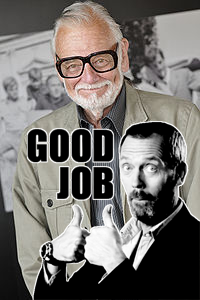
The one and only George Romero, whose influence on our culture arguable is on par with Rock-and-Roll.
Romero, for those few of you who might not recognize the name, is the creator of such films as Night of the Living Dead, Dawn of the Dead, and Day of the Dead, and according to many the father of all zombies.
Now while that affectionate title has been attached to him, the fact of the matter is, Romero did not invent the concept of the living dead. What he did do, however, was bring the concept out of obscurity, and do it so well that his work has become the basis for all subsequent zombie-horror. Zombieland, The Walking Dead, Shaun of the Dead, Resident Evil, Left for Dead, World War Z, Plants Vs. Zombies, Stephen King’s Cell, “Thriller,” I am Legend, you name it. There’s hardly an aspect of our culture that hasn’t had some zombie influence or spin-off (even before our recent craze), and there’s hardly an aspect of the zombie mythos that hasn’t been cemented and popularized by Romero. The man has simply hit it out of the park.
Now I’m not saying you have to like zombies- you don’t. I’m not saying that you have to like the films of George Romero- I don’t. But you have got to respect a man who has had such a profound influence on not only American, but world culture over the past half century (that’s right, half-century).
So, George Romero, in this last minute before midnight on Halloween 2012, we here at Culture War Reporters are tipping our hats to you.

 Last week I wrote about George Romero, a film-maker who has had perhaps one of the most profound influences on modern culture. Continuing in that vein, today I’d like to stir up some applause for Frank Bunker Gilbreth, Sr., or as you might better know him, the dad the Cheaper By The Dozen movies.


 DISCLAIMER: This week we kind of dropped the ball, so our discussion on the topic is short and then turns to how WE can write this feature a little better. Our apologies.




 Culture War Reporters