Tag Archives: internet

Free Information Culture

The last of my installments (for now) in looking at these rising alternative cultures is “Free Information Culture,”  which shares the same problem with “science” culture in that there’s really no good name for it yet. I’ve referred to it before as “internet culture,” only the problem with that is that, like “science culture,” it isn’t so much the culture of the thing itself as the culture of the fanbase. In simpler terms, it’s the difference between Hollywood culture and movie-lover culture- it’s the end product that’s valued.
So what’s the internet’s “end product”?

Besides porn and stuff like this…

Free Information.

Whether it’s the news, or Wikipedia, or TED Talks, or Imgur, or anything else imaginable, it’s on the internet for free and public use. It’s something of a great equalizer. No matter where you’re from, what language you speak, what class you hail from- you can create or say anything and then get called gay in the comment section.

And while that last bit is sort of a joke, it does play a role in developing the “free information culture.” Granted, general anonymity can make us vicious and vile people, but it also (to some extent) strips us of our egos. When you make something online, you really don’t get much, if any, credit, but that’s alright since it isn’t the point. It’s just about creating, nothing more or less. Who drew the first rage face? Who started up Bad Luck Brian? Who edited and sourced that one Wikipedia page you used to stitch your last minute term-paper together? Who puts together those monthly fail compilation videos? I don’t know and will probably never know, but I do know that they’ll keep coming because of the simple joy of creating them. I and every other person with a half-decent internet connection.

And all of this simply isn’t understood by some people.

Recall the massive outcry against the SOPA and PIPA bills? What prompted the creation of  these acts was that some people- certain corporations in particular- couldn’t quite wrap their heads around the idea of free and unlimited access. Now maybe you agree with them, and maintain that posting copyrighted material of any kind is piracy and immoral, however, what needs to be understood is that this was viewed as an act on the very nature of the internet and everything it had come to represent.

Again excluding porn and stuff like this…

Now more and more companies are catching on to the idea that it’s wiser to try to work with the faceless and vengeful cat-worshippers of the internet than against them- just look at video game companies that are starting to work in tandem with modders. The game Minecraft in particular is a good example of this, as many of the new aspects of each update to the game coming from the fan-forums themselves. Nevertheless, there are still plenty of people out there (I’m looking at you, Music Industry) who continue to struggle (vainly) against the dissemination of what they view to be the “information wants to be free” crowd.

Again, it all boils down the core of the culture that the internet has produced, gravitating around the concepts of freedom and egalitarianism. Look at Wikileaks founder, Julian Assange.

If he did his work back in the early 90s, we can be pretty sure he’d be viewed overwhelmingly as a candidate for a James Bond villain. But today we (for the most part) view him as being a heroic (or at least positive) figure in a world that’s become increasingly secretive and unequal. Why this dramatic shift in perception? Again, it’s the internet and it’s affect on us. In a time of economic crisis we might not be able to go to the movies, or eat out, or drive for miles to see a friend, but we can watch something online, or browse recipes, or video-chat with the same buddies that you’d otherwise not be able to see. Any threat to your full and unrestricted access to the internet is, by proxy, a threat to some of the last pleasures you have left.

Hence the formation of a culture obsessed with the values of free speech, free access to information, and freedom from censorship. And with every development of the internet or our access to it serving as another leap in the evolution of the culture, it’s safe to say that the howl of anger that the governments of the world met when trying to create such bills as ACTA is only going to intensify.

“Science” Culture

Now that’s a lousy title, so let me kick things off by immediately clarifying what I’m talking about. This isn’t academia, or the world of contending theories and thirty-page papers on the finer points of psychopharmacolgy in relation to the mating habits of the Atlantic bluefin tuna. While this kind of world certainly does exist, it’s not what we’re talking about here. This is the culture not so much of scientists, as it is of science fans: those who are becoming increasingly invested in the idea that advancements in our knowledge is not only inherently awesome, but the solution to many, if not most or all, of the world’s problems.
“But Gordon, you striking portrait of wisdom and nobility,” you may be asking, “don’t we all fit that category?”

And to some extent, yes, we do. Even the most hardcore Luddite or primitivist will applaud the polio vaccine or HIV medication, but even so, there is a growing number of people who take things to the next level entirely. Check out this trailer:


Kind of a crazy premise- guy transfers his consciousness into a machine body. But still not too far off from the way many people believe we’ll eventually be living. “Transhumanism”, they call it, which, to grossly simplify it, is the general idea that the best (or even inevitable) course of human existence is to “evolve” beyond the confines of our biology. That with the progression of science and technology we’ll stop the effects of aging and be capable of improving upon our own minds and bodies. If you wanted to find a decent illustration of this kind of issue, try watching Battlestar Galactica (the new ones), or better still, Caprica. Now this is an extreme element of this culture, but a contributing element nonetheless. Major advances in prosthetics over the years, as well as films such as Surrogates, GamerAvatar, The Matrix, I, Robot (heck, any film or media dealing with the whole “what makes a person a person?” question) have all been instrumental in introducing transhumanist ideas. But of course, it’s more than just that.

It also has a lot to do with these guys:

These guys right here are arguably responsible for popularizing this entire culture, breaking down even dry subjects and making them compelling and (relatively) easy to grasp, even if only on the most basic level. You probably won’t go off to revolutionize the world of astrophysics after a few episodes of Cosmos, but chances are you’ll come away amazed. Would the recent Mars landing have had the same widespread popularity as it did without these guys? Would the cutting of manned space-missions have been met with the same outrage? Almost certainly not.

To some extent, the decline of religious adherence in the West may also be a factor in this culture. A growing number of individuals in the US are simply reporting themselves as being “without religion,” and the “science culture’s” emphasis on altruistic humanism (more on that in a minute) and skepticism offer a sympathetic atmosphere. The fact that many leaders (or at least, poster boys) for the culture are atheist (Mythbusters’ Savage and Hyneman, for example) or agnostic (Neil Degrasse Tyson) is also certainly a factor.

And perhaps the most fundamental element of all in this culture is the concept of “post-scarcity.” Quite simply, it’s the idea that we have progressed to a point where we no longer have scarcity of resources. E-books are typically used as an example, with adherents of the idea pointing out that with almost everything ever written in human history accessible in digital form, we could potentially give access to everything ever written to every man, woman, and child who will ever live without ever cutting down a single tree. The same logic is applied to film and music as well.

All of this combined creates and fuels a culture based ultimately on values of human welfare. In many respects, it’s the polar opposite of the “manly” culture discussed last week, emphasizing interdependence rather than independence, cooperation rather than competition, and progressive and postmodern social norms rather than traditional ones.

So what are the pros and cons of the culture?

Positives:

  • The fundamentally altruistic and humanistic elements of the culture are certainly something to be admired.
  • Money goes into scientific research, and cures and advancements come out; you can explain that.
  • Quite simply, the idea that we, as individuals and societies “aren’t done yet” creates a great atmosphere for experimentation, advancement, and general optimism about our conditions.

Negatives:

  • We could talk about playing God and paternalistic big-government and all that, but ultimately, the issue of the “science culture” is a fundamental misunderstanding of the way things actually are in the world. While it’s certainly true that there’s enough to go around, we simply aren’t a “post-scarcity” world. The vast majority of the planet is desperately poor, and their needs have to be met. The culture’s basic tenets also have the issue of seeming to assume that science is the answer to everything- that we can maintain our (general) levels of consumption and simply have our decadence off-set by the latest, greatest advance in clean energy. Now even if you assert that our problems can be solved by a use of technology to give us a surplus of everything we could ever possibly need, the same fact of the matter is that those technologies do not yet exist. The entire outlook is, quite simply, utopian, and while optimism should be applauded, it desperately needs to be tempered with realism.

And that’s it for today- be sure to check out Tuesday’s “Shame Day” post, and check in next time for our look at “internet/free information culture.”

Looking Back at a History of Booze and Bacon

It’s been pretty evident for a while now that a lot of you have gotten here due to a post I wrote almost exactly a year ago, “Epic Meal Time: Leaving Grease Stains on Pop Culture.” In it I extol the internet show and its evolution into something that ultimately rewards long-time viewers, as well as its impact on pop culture.

Coinciding with the anniversary of my original EMT post is the show’s second birthday, and a loving tribute to their first episode ever, the Fast Food Pizza. Video below:

While two whole years of epic meals is impressive enough, what got me even more excited is what the crew uploaded yesterday.

The new feature, going by the name “Flashback Friday” is a director’s commentary of sorts, presumably all done by creator and star of EMT, Harley Morenstein. Essentially the entirety of their Fast Food Pizza episode, the main difference takes the form of pop-ups that are very reminiscent of Xbox Live Achievements, or [probably more accurately] VH1’s Pop-Up Video

Additional changes include a bacon strip censor bar for Muscles Glasses’ eyes, as well as vocal distortion. From this point on they moved forward with turning him into a silent, powerful destroyer of fast food and liquor.

What I probably appreciate more than the fact that they made this video is that they haven’t removed the first. There’s a trend on the internet to simply remove or take down earlier work, or whatever you’re not proud of. Both Harley and Epic Meal Time are sticking to their roots in remembering the first video that got them where they are today. And that means not removing this video with Alex Perrault [as you’d call him sans aviators, I suppose], or another where they, believe it or not, actually use vegetables.

EMT announced on its twitter account that if fans liked the video then they’d continue to do more. While not all of the feedback was positive, I for one hope that the likes, and views, continue to multiply. Watching the behind the scenes of almost anything is interesting, even more so learning about the history behind two years of booze and bacon.

EDIT: After their fourth episode on YouTube the EMT guys have decided to move the show over to their own site. You can watch every one of the episodes here, where they continue to be put up every Thursday.

Thoughts About The Internet

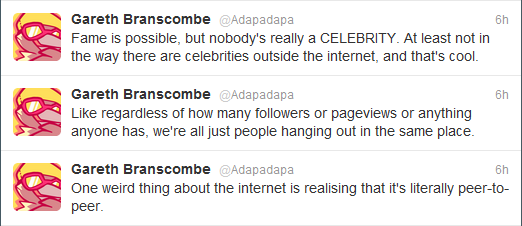
So a friend of mine tweeted in the early hours of the morning, musing about the internet. The tweets are as follows [to be read from bottom to top]:

Before I can really begin addressing this, I think it’d be good for me to have a good definition of the word “celebrity.” Dictionary.com tells me that as far as people go, a celebrity is a “famous or well-known person.”

So are there capital letters CELEBRITIES, or are there just people, again, referencing the tweets, with fame? And, if they’re one and the same, do they equate with people outside the internet?

The 21st century is a place where being “outside the internet” is a basic impossibility. That being said, there is a distinction between being general fame and internet fame. Brad Pitt is a well-known movie star. wheezywaiter is a popular YouTuber with 382,628 subscribers. If both walked around the streets of any major city in America they’d be recognized, but only one would create a stampede of screaming fans leaving several dead.

On the other hand, some celebrities have supplemented their fame with their internet presence. Ashton Kutcher was the first twitter user to reach a million followers, and currently has almost ten times that. Comparing that to his work in film and television, it actually dwarfs his presence “outside the internet.”

The thing with being internet famous is how quickly it spills into the offline
world. High school pole vaulter Allison Stokke had her picture submitted to With Leather, a sports blog, where it appeared in this post [as far as I can tell, the images connected to the specific post have since been removed]. These images quickly spread around the internet, however, and Stokke became the target of a large amount of unwanted attention, a lot of it very sexual. It got to the point where her high school began receiving requests for photo shoots of the athlete. The Washington Post has more to say about it here.

To be fair, that wasn’t Stokke garnering internet fame for herself, but was instead unwittingly swept into it by a blogger named Matt Ufford. She’s not the only one who runs the very real risk of being recognized in public. Webcomic artist Jeph Jacques bumped into fans while vacationing in New Zealand, less of a surprise when you take into account the fact that his strip has thousands and thousands of viewers.

The internet is a “peer-to-peer” place where anyone can post anything and have an audience of anywhere from one to millions. I have 71 followers on twitter [with only a few spambots], meaning that anything I tweet [which I rarely do anymore] is instantaneously communicated to a several dozen people all over the world. That’s an amazing thing. Audience does matter, though.

If you have a blog, and there are millions, what are the chances that anyone is going to read it? You could tag it with words like “Dakota Fanning” and “Playboy,” and that might help, but your readers won’t be consistent and probably won’t be coming back. We may all be in the same place, but we write or draw or play instruments because we hope that others might be audience to our work, and when that audience gets large enough it will inevitably change our lives outside the internet.

Here Be Unwise Internet Purchases

Sometime last week I was on the lookout for books on webcomics, searching for covers to inspire a Graphic Design project. Somehow, through liberal use of the keywords “webcomic,” “history,” and “book,” I was led to a book entitled “Webcomics By Year, including: Penny Arcade (webcomic), Jerry Holkins, Mike Krahulik, Child’s Play (charity), Penny Arcade Expo, Penny Arcade Adventures: On The Rain-slick Precipice Of Darkness, Robert Khoo, Poker Night At The Inventory, User Friendly,” the cover of which you can see below.

The first thing you may notice from the cover, after the ridiculous length of the title, is that the book can’t be attributed to any specific author. Instead, the only evidence of there being an origin for the book are the words “Hephaestus Books,” centred and in small print at the bottom of the cover.

Fully intrigued at that point, I checked to see what else Barnes and Noble had to say about this publishing company, and was aghast at my findings. There were tens of thousands of books attributed to Hephaestus Books,  each featuring a title just as [if not more] lengthy and list-like as the first I found. They covered topics ranging from Judy Blume novels to the 1950s in British television. It seemed that Barnes and Noble could show me more, but not explain, and so began my investigation.

A social reading site of sorts, Goodreads ‘ page on Hephaestus Books featured a description about the “author” that goes as follows:

“Hephaestus Books represents a new publishing paradigm, allowing disparate content sources to be curated into cohesive, relevant, and informative books. To date, this content has been curated from Wikipedia articles and images under Creative Commons licensing, although as Hephaestus Books continues to increase in scope and dimension, more licensed and public domain content is being added. We believe books such as this represent a new and exciting lexicon in the sharing of human knowledge.”

In other words it publishes print-on-demand compilations of Wikipedia articles not original works. Caveat Emptor

Author Robin Hobb wrote about the series of books on her website early this month, stating that the concept of Hephaestus Books is one that “offends [her] mightily.” Science fiction writer Jerry Pournelle wrote on his own site that he was concerned in that he had “never authorized ANYONE to make a compilation of a lot of [his] books and sell them in a single volume.” His confusion is well-founded, but in reality what appears to be a single book containing multiple novels is nothing more than, as mentioned above, Wikipedia articles.

Hephaestus isn’t even the only malefactor out there. Fonte Wikipedia and Book LLC are both “publishing companies” that do the exact same thing. A blog post I found entitled Beware the Wikipedia Scrapers exposed both of those examples, and also has a helpful list on how to “avoid this junk.”

I’m not altogether surprised by this scam; it’s one I stumbled upon years ago but have only recently found again. It sadden me, however, that it’s ongoing, and that there have been people who have fallen for it, as evidenced by the used books on sale on these sites.

As writers have said before me, watch out. Caveat emptor. Let the buyer beware. Be on your guard. Please mind the gap. This is a swindle that has befallen others, and as much as a book titled “Novels By R. A. Salvatore, including: Vector Prime, The Dark Elf Trilogy, Legacy Of The Drow, The Woods Out Back, The Icewind Dale Trilogy, The Hunter’s Blades Trilogy, Paths Of Darkness, The Cleric Quintet, The Dragon’s Dagger, Dragonslayer’s Return” might catch your eye, it might be better to stop and think about what you’re doing.