Tag Archives: zombies

Evan and Gordon Talk: Zombies

GORDON: Brrrrrrrrrrrrrrrrraaaaaaaaaaaaaaaaaaaaaaaaaaaaaaaiiiiiiiiiiiiinnsss. I mean: Welcome to this week’s installment of Gordon and Evan Talk. Our subject for today: Zombies, have we had enough already?

EVAN: Answer: yes.

GORDON: Have we though? The media keeps on pumping out zombie show/game/story/you-name-it, and we keep gobbling them down like, well, zombies.

Continue reading

Tupac and the Digitally Embalmed

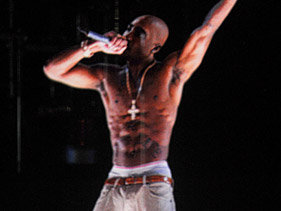
So if you haven’t heard [I hadn’t until yesterday], there was a hologram of Tupac that performed at Coachella.

ImageAnd yeah, yeah, we know it wasn’t actually a hologram now, that it was some mirror-projection-onto-glass-thing-that-the-Wall-Street-Journal-explains-better-than-I-could. And we know that there are rumors of a tour of this faux-Tupac, and people are alternately asking when Kurt Cobain will show up and decrying the monstrous zombie-raising performance.

The thing is, you could argue that the hologram/projection isn’t much different from showing videos and voice recordings of the dead. When that technology was new, I imagine people thought it pretty eerie that they could see their loved ones move and breathe and speak on a screen.

Interesting thing: They needed to project the image onto a mirror below the stage, which created a lot of light, which is why I think they made the animation look like it was lit from the bottom - it looked like the glow from the projection apparatus was part of the lighting system.

But the thing about the performance that makes it different from just a new way of looking at recordings of dead people is the new content. The animation of Tupac, at the beginning of his act, shouted “What’s the f*** up, Coachella?”. The choreography of his performance wasn’t just a recording – the people who animated him studied the way he moved, but they controlled his body and created something new. In a sense, Tupac was performing new material.

The Illusion of Interaction
And this is the real issue – not just the commemoration of the dead. We’ve been recalling the dead, through art and technology, as accurately as we can for as long as humans have been dying. But the faux-Tupac isn’t just a 21st century version of an Egyptian sarcophagus mask. What they wanted to create with the Tupac animation – which is why the fact that it was in front of a live audience was such a big deal – was the sense that Tupac was interacting with Snoop Dogg and the audience, just as a real live performer would.

This is about creating an illusion of interaction, and while a scripted interaction with an animation might be actually quite close to the way concerts can be formalized and scripted (like pro wrestling), it’s still just an illusion.

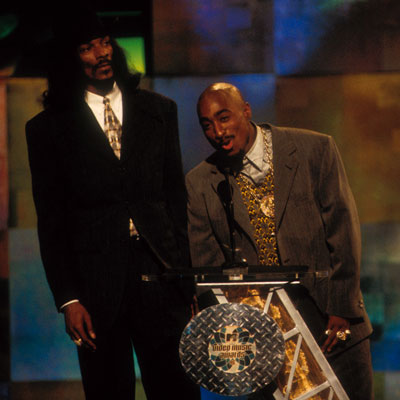
Snoop Dogg and Tupac, both about 25, in 1996

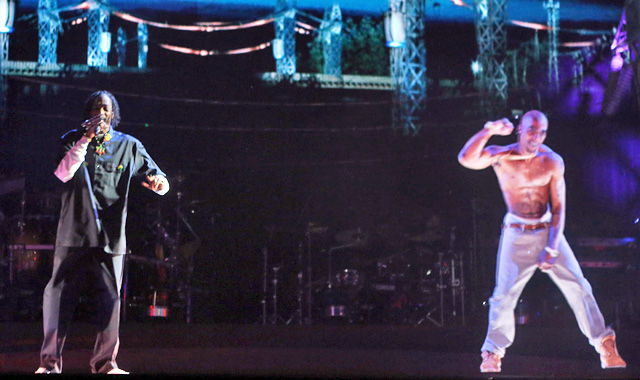
One of the weirder things though, for me,  was the age discrepancy between Snoop Dogg and Animated Tupac. Snoop Dogg is 40, and has grey hair. When Tupac died in 1996, Snoop Dogg was like 25. Tupac, who was shown as a young, shirtless 20-something, would be turning 41 this year if he were still alive, and might not look as good as his hologram did in white sweatpants.

Snoop Dogg, 40, and the Tupac Illusion, still 25

The juxtaposition of digitally-embalmed washboard-ab Tupac and 40-year-old greying Snoop Dogg was probably the most eerie element of the whole performance.

If this trend continues, I think the problem is the illusion of interaction. The essence of human existence is interaction – it’s why we still feel a little weird hearing about guys dating digital AIs, and why the most popular games are the ones that allow you to play on the internet with others. Interaction with humans, illogical and annoying as we are, can’t quite be simulated. And judging from Snoop Dogg’s awkward performance with faux-Tupac, our interactions with the digitally animated dead will always fall a little short of the real thing.

Mashin’ It Up

Outrage doesn’t even begin to describe what fans of Teenage Mutant Ninja
Turtles felt when Michael Bay, producer of the franchise’s next live-action film,  announced that the quartet would be aliens. This was coupled with the news that Leonardo, Raphael, Michaelangelo, and Donatello would not only lose their alien status, but would not be teenagers either.

Ninja Turtles aside [that’s the working film title, folks], why should this matter to non-fans? From an objective perspective, this is simply taking two modifiers, “mutant” and “ninja,” and replacing them with another, “alien.” The original thing idea was already a conglomeration of extremely dissimilar parts. The seemingly mindless melding of genres.

Take the past decade in film for example. Jon Favreau’s Cowboys and Aliens hit theatres in 2011, and Abraham Lincoln, Vampire Hunter, premiering this summer, causes us to branch out further still. The film is based on a book by Seth Grahame-Smith, the same person who authored Pride and Prejudice and Zombies. Taking zombies into account, they’ve terrorized everyone and everything from strippers to ninjas to plants to the entire Marvel universe.

So where does it stop, and should it? Grant Morrison will be writing Dinosaurs Vs. Aliens, both a graphic novel and a feature film that will pit highly evolved dinosaurs against extraterrestrial invaders. This sounds utterly ridiculous, but if anyone can do it, it’s Morrison. His miniseries We3 features three mech-clad house pets and their escape from a government facility, and he finds a way to embody these animals and their experiences with more depth than you would think possible.

So clearly this can be done well. 2009’s Sherlock Holmes mixed detective work, martial arts, and some steampunk elements. Joss Whedon’s short-lived series Firely was a space western, meaning that it melded both the futuristic and the American Western. Genre mashups can and have worked.

At this point in time I think that we’ve oversaturated media with these films, books, shows, et cetera. In light of the fact that this summer’s The Avengers is essentially a gigantic hodgepodge of genres I’m postponing my embargo on such works for the time of being. Until then, please, for the sake of good entertainment, enough with the zombies.

A Look at The Walking Dead‘s Theodore Douglas

Season 2 of AMC’s The Walking Dead wrapped up this past Sunday, kind of a big deal when you take into consideration the fact that the show was pulling in roughly 10 million viewers every time it aired. There are blogs all over the place discussing the big reveal, so feel free to head over there if you’re wondering what all the fuss is about. This post is meant to take a good hard look at character Theodore “T-Dog” Douglas.

AMC’s The Walking Dead is based on an immensely well-received comic book series of the same name written by Robert Kirkman. While it has, for the most part, stuck with the comics’ general plot progression, there have been a large amount of changes made. The addition of T-Dog as a member of the group in the first season was one of them.

As this season has progressed the internet has taken a lot of interest in T-Dog, for the most part discussing how little a role he actually has to play in the show. The following are his biggest moments listed in chronological order:

S1E1, Guts: T-Dog is one of the group members. He is savagely beaten by a racist among them and is almost killed.  The character who beat him is handcuffed to a roof as punishment. Later, when sent to free him, T-Dog drops the keys down a drain.

S2E1, What Lies Ahead: The survivors are scavenging an abandoned
highway for supplies. T-Dog doesn’t hear Rick, their leader, tell everyone to hide under cars due to zombies. He cuts his arm open on a car door. His life is saved when another survivor covers him with a dead zombie.

S2E2, Bloodletting: T-Dog is upset because the group is leaving him behind with an old man. He thinks it is because he is black. It turns out that he has blood poisoning and is weak and might die.

S2E4, Cherokee Rose: T-Dog almost drinks water from a well that had a big fat zombie in it.

S2E6, Secrets: They’re at a farm, and one of the farmer’s kids turns his pistol sideways during shooting practice. T-Dog tells him not to “give [him] any of that gangster sh-t.”

S2E12, Better Angels: T-dog sees that a prisoner has escaped and exclaims “Aw hell no!”

S2E13, Beside the Dying Fire: Zombies attack the farm and everyone scatters. T-Dog is driving himself and two others to the coast. One of them, Rick’s wife, tells him to turn around or she’ll jump out of the truck. He does so, performing a particularly ugly U-turn.

As the second season progressed, the conversation about T-Dog and what he has to do with anything grew immensely. In the last few episodes many were wondering if he was ever going to get past more than one or two lines per episode. Some have theorized [and by some I mean me] that he shares the same affliction as Eddie Murphy’s character in the universally panned A Thousand Words.

Thankfully, an interview with showrunner Glen Mazzara hopes to answer all of your questions about this enigma of a man. Entertainment Weekly asked if we would be seeing more of T-Dog next season, and the answer was as follows:

There is a plan for T-Dog. Given all of the things that I had to focus on to develop the show in a way that I felt was best, I will say that T-Dog got short shrift. We took care of business, and now we can delve into [SPOILERS] and T-Dog and all these other characters. T-Dog fans will be happy. We’re no longer interested in having a character in the background only saying one line per episode. We’re done with that. But again, we only had so much real estate, and it was very important for me to tell Rick’s story.

Which is great, really, except that I don’t see him having much more to offer the show. As far as what his role is it’s difficult to look any further than token black character. Glenn, a Korean-American character, was present in the comics and as a result has a pretty well-defined personality and storyline. In other words, Glenn has a foundation that extends beyond diversity for diversity’s sake. At this point in the series, T-Dog is actually the only character [save for a girl whose name was changed] not found in the original comics, and this really stands out.

It’s great that Mazzara was able to address, in a straightforward manner, that they did have a character who was “only saying one line per episode.” What remains to be seen is whether or not the writers for The Walking Dead can add any sort of complexity to T-Dog in this upcoming season. It’s been amusing watching and waiting to see if he does, well, anything, but while that may be enjoyable it doesn’t make it good television.


World War Z and other Incidences of the Undead

I read World War Z by Max Brooks over break – I tend to stay away from zombie media,1 but the book was interesting enough to win over my zombie-avoiding tendencies and now I can’t stop noticing the huge and recent (I’d say – recent as in like, the last decade) zombie focus almost everywhere in culture.

Did everyone else but me know about this? Did you know how many zombie poetry websites there are? You can even buy a zombie-themed magnetic poetry set. You know, so you can compose some verses about decaying flesh-eating people on the fridge while waiting for your ramen to heat up.

This guy published his work online in 2005 – excerpt:

Making
love with
zombies can
never be
without consequence.

There’s Aim for the Head, an anthology of 50 poets.

There’s Z-Composition, which is a recent start-up with sections slated for poetry, recipes, and flash fiction, and grand ideas of “a bi-monthly literary e-zine with a yearly print anthology slated to launch in 2012”.

The Zombie Nation (the tagline of which is “Begin the Zombpocalypse”) also has zombie poetry posts.

The Zombie Hunter: A Survivalist’s Journal [“A family man’s guide to surviving the zombie apocalypse”] isn’t poetry but is impressive: it’s been going pretty steadily since 2010, complete with pictures, coconuts, and a thorough knowledge of firearms.

Why are zombies so freaking popular? (or: Elisa thinks too much)
The prevalence of a smaller genre like poetry dedicated to the zombie wave is just a piece of the fascinating trend. The prevailing attraction of zombie/zombie-fighting culture, I think, is the focus on vivacity and resourcefulness amidst the breakdown of society. You have to rob the grocery store to eat and you have to destroy the staircase of a building to secure it from zombies, but the stealing and destruction are by themselves also pretty exciting. And in this generation, one of the first to grow up in such a (generally) stable and structured society, craves some sense of rule-breaking and the ability to use their imagined Crusoe/Macguyver-esque survival skills.

Zombies are also about death, but not because they’re dead. Zombies as a villain are extremely basic (I’m talking about slow-moving zombies, here, generally): in World War Z Brooks pointed out that you have no hope of discouraging zombies; there is no leader to go after and you cannot, like humans, make them uncomfortable or fearful. We fear zombies not because they’ll go after us quickly and suprisingly, but because they’re slow and, as much as we ignore or outrun them, we know that they’re still coming. A scenario in which we lose to zombies wouldn’t be large and violent and exciting – it would be, simply, slow and inevitable.

Our fear of zombies precisely mimics our fear of death, which I think is a sort of manifestation of a denial of death in contemporary culture for the past century.

World War Z Minus the History

In 2006 Max Brooks’ novel World War Z: An Oral History of the Zombie War hit bookshelves across North America. As a sequel to his previous book, The Zombie Survival Guide, it was guaranteed to acquire cult status, with zombie-lovers all over the world treating its predecessor as a bible for the imminent undead apocalypse. Fans were thrilled when it was announced just the following year that the rights to the film adaptation had been bought by Plan B Entertainment, Brad Pitt’s film production company.¹

Although the film struggled early on financially2, filming finally went underway this summer. It wasn’t until just three days ago, however, that Paramount released their official synopsis for the film, which goes as follows:3

“The story revolves around United Nations employee Gerry Lane (Pitt), who traverses the world in a race against time to stop the Zombie pandemic that is toppling armies and governments and threatening to decimate humanity itself.  Enos plays Gerry’s wife Karen Lane; Kertesz is his comrade in arms, Segen.”

Cue instant uproar from the entire internet.

To be fair, film adaptations of books have often changed substantial plot points to the benefit of the film’s reception, et cetera. Stuart Little was a hit with children because it didn’t feature what is essentially a mouse who acts like a little man who was born of a human womb. Teenagers enjoyed A Walk to Remember because it was set in the 90s and not in the mid-1950s.World War Z, however, is not a novel that required such significant changes.

In reference to the latter part of the title, An Oral History of the Zombie War, the novel consists of a number of interviews conducted just ten years after the last country was officially deemed victorious over the undead hordes. What makes the scope of the novel so grand is who is being interviewed.

Beginning with Chinese doctor Kwang Jingshu and the minor outbreak in New Dachang and reaching as far as Xolelwa Azania of South Africa, reading through World War Z is a global experience. Tying the novel together are several interviews with Todd Wainio, a former U.S. Army infantryman who had taken part in the greatest military defeat of the Zombie Wars.

Pitt’s adaptation with himself as a modern-day Cassandrais not the story that needs to be told. By omitting the latter part of the title the film will ultimately fail to capture what made the novel stand out among the rest: an almost uncomfortable sense of peace after a decade at war and one man questioning why exactly it all happened.

The film will be watched by many because even those who haven’t read the book have heard the title World War Z. They were probably raved to about the novel and how it captured the horrors of a zombie pandemic in a way that was both realistic and emotional. It’s too bad that they won’t realize the film is just another fast-paced action thriller with a bit of zombie thrown in until they’re sitting in their seats.

1. Plan B Entertainment was originally founded by Brad Pitt, Jennifer Aniston, and some other dude. Which had to have been awkward, especially for the other guy.

2. It’s hard to believe the amount of fun these newswriters must be having coming up with these titles. Source: http://nymag.com/daily/entertainment/2011/03/world_war_z_brad_pitt.html

3. From the reliably titled site, Movies.com: http://www.movies.com/movie-news/world-war-z-movie/3869

4. As well as significant deviations from the plot as well as Shane West as a rebellious badboy, etc etc.

5. King Priam’s daughter, soothsayer of Troy. Warned her countrymen the danger that was the Trojan Horse, to no avail. Just in case you were wondering.